CONTENTS

MESSAGE OF THE GITA
MAIN TOPICS
SUNDRY TOPICS
MODES OF MATERIALNATURE
WORD REFERENCE
QUALITIES
SUMMARY VERSES
COMPILED BY MAITREYA DASAIN THE SERVICE OF
HIS DIVINE GRACE SRILA SATSVARUPA DASA GOSWAMI MAHARAJA
The Message of the Bhagavad Gita
Content MAIN TOPICS

1 ACCEPTANCE
1 ACTION
1 ADVANCEMENT
1 ANALOGIES
2 ANGER
2 ARJUNA
4 ATTACHMENT
4 AUSPICIOUS / INAUSPICIOUS
4 AUSTERITY / PENANCE
5 BACK TO GODHEAD
6 BEWILDERMENT
6 BIRTH / DEATH
7 BRAHMAN
7 CAUSES
8 CHANTING
8 CHARACTERISTICS OF TRANSCENDENCE
9 CLEANLINESS
9 CONDITIONED LIFE
9 CONSCIOUSNESS
10 CONTROL
11 CONTROLLERS
11 DEFEAT
12 DEMIGODS
12 DEMONS
12 DESIRE
13 DETACHMENT
13 DETERMINATION
13 DEVOTEES
14 DEVOTIONAL SERVICE / DEVOTION
16 DISCIPLIC SUCCESSION
16 DOUBT
17 DUALITY
17 ENDEAVOR
17 ENVY
18 EQUALITY
18 ETERNAL
18 FAITH
19 FALLIBLE / INFALLIBLE
19 FALSE EGO
19 FAME / INFAMY
19 FEAR
19 FIXED / STEADY
20 FOOLISHNESS
21 FREEDOM
26 FRIENDSHIP
27 GREED
27 HAPPINESS / ENJOYMENT / PLEASURE
28 HAPPINESS / DISTRESS
29 HATE
29 HEARING
29 HONOR / DISHONOR
29 IGNORANCE
30 ILLUSION / DELUSION
30 INDEPENDENCE
32 KNOWLEDGE
37 LAMENTATION
37 LIBERATION
38 LOVE
38 MANIFEST / UNMANIFEST
38 MATERIAL BODY
39 MEDITATION
39 MIND
40 MODES OF MATERIAL NATURE
41 NATURE
42 PEACE / TRANQUILITY
42 PERFECTION / SUCCESS
43 POWER
44 PRACTICE
44 PRIDE
44 PROPRIETORSHIP
45 PURIFICATION / PURITY
45 QUALITIES
46 REGULATIVE LIFE
47 RELIGION
47 REMEMBRANCE
47 RENUNCIATION
48 RESPECT
48 SACRIFICE
49 SANKHYA
49 SANSKRIT WORDS
51 SATISFACTION
51 SCRIPTURAL INJUNCTIONS REGULATIONS
52 SEEING THE LORD
52 SELF
53 SELF-REALIZATION
54 SENSES
55 SHELTER / REFUGE
55 SIMILAR VERSES
56 SOUL
56 SPIRITUAL MASTER
56 SUPERSOUL
57 SUPREME LORD
61 SURRENDER
61 TEMPORARY / IMPERMANENT
61 THINKING
62 TIME
63 TOLERANCE
63 TRANSMIGRATION
64 TRUTH
64 UNDEVIATED
64 VEDAS
65 WORK / DUTY
67 WORSHIP
67 YOGA
68 YOGIS / MYSTICS
69 YOURS FAITHFULLY
MAIN TOPICS
ACCEPTANCE
OF THE LORD Five, 15: Nor does the Supreme Lord assume anyone’s sinful or pious activities. Embodied beings, however, are bewildered because of the ignorance which covers their real knowledge.
na– never; adatte—accepts
Nine, 26: If one offers Me with love and devotion a leaf, a flower, fruit or water, I will accept it.
- THE BODY Two, 22: As a person puts on new garments, giving up old ones, the soul similarly accepts new material bodies, giving up the old and useless ones.
Five, 8-9: …receiving…knows he does nothing…in divine consciousness…
grhnan—accepting
BENEFICIAL
Four, 28: Having accepted strict vows, some become enlightened by sacrificing their possessions, and others by performing severe austerities, by practicing the yoga of eightfold mysticism, or by studying the Vedas to advance in transcendental knowledge.
Eight, 28: …accepts the path of devotional service…is not bereft of the results derived from studying the Vedas etc…
Ten, 14: O Krsna, I totally accept as truth all that You have told me. Neither the demigods nor the demons, O Lord, can understand Your personality.
Thirteen, 8-12: …accepting the importance of self-realization… I declare to be knowledge…
Eighteen, 51-53: …free from…acceptance of material things… elevated to the position of self-realization…
UNBENEFICIAL
Seven, 15: Those miscreants who are grossly foolish, who are lowest among mankind, whose knowledge is stolen by illusion, and who partake of the atheistic nature of demons do not surrender unto Me.
asuram– demonic; bhavam– nature; asritah—accepting
Sixteen, 9: Following such conclusions, the demoniac, who are lost to themselves and who have no intelligence, engage in unbeneficial, horrible works meant to destroy the world.
etam– this; drstim– vision; avastabhya—accepting
Eighteen, 47: It is better to engage in one’s own occupation, even though one may perform it imperfectly, than to accept another’s occupation and perform it perfectly. Duties prescribed according to one’s nature are never affected by sinful reactions.
ACTION
FORCED TO
Three, 5: Everyone is forced to act helplessly according to the qualities he has acquired from the modes of material nature; therefore no one can refrain from doing something, not even for a moment.
Three, 27: The spirit soul bewildered by the influence of false ego thinks himself the doer of activities that are in actuality carried out by the three modes of material nature.
Three, 33: Even a man of knowledge acts according to his own nature, for everyone follows the nature he has acquired from the three modes. What can repression accomplish?
Five, 14: The embodied spirit, master of the city of his body, does not create activities, nor does he induce people to act, nor does he create the fruits of action. All this is enacted by the modes of material nature.
Thirteen, 20: Material nature and the living entities should be understood to be beginningless. Their transformations and the modes of matter are products of material nature.
Thirteen, 21: Nature is said to be the cause of all material causes and effects, whereas the living entity is the cause of the various sufferings and enjoyments in this world.
Thirteen, 22: The living entity in material nature thus follows the ways of life, enjoying the three modes of nature. This is due to his association with that material nature. Thus he meets with good and evil among various species.
Fourteen, 5: Material nature consists of three modes–goodness, passion and ignorance. When the eternal living entity comes in contact with nature, O mighty-armed Arjuna, he becomes conditioned by these modes.
Eighteen, 11: It is indeed impossible for an embodied being to give up all activities. But he who renounces the fruits of action is called one who has truly renounced.
Eighteen, 40: There is no being existing, either here or among the demigods in the higher planetary systems, which is freed from these three modes born of material nature.
Eighteen, 59: If you do not act according to My direction and do not fight, then you will be falsely directed. By your nature, you will have to be engaged in warfare.
Eighteen, 60: Under illusion you are now declining to act according to My direction. But, compelled by the work born of your own nature, you will act all the same, O son of Kunti.
Eighteen, 61: The Supreme Lord is situated in everyone’s heart, O Arjuna, and is directing the wanderings of all living entities, who are seated as on a machine, made of the material energy.
See also SOUL, AS WITNESS ONLY.
FRUITIVE
Arjuna’s Question Three, 1: Arjuna said: O Janardana, O Kesava, why do You want to engage me in this ghastly warfare, if You think that intelligence is better than fruitive work?
The Lord’s Answer See Chapter Three, KARMA YOGA
DEFINED
Arjuna’s Question Eight, 1: Arjuna inquired: O my Lord, O Supreme Person, what is Brahman? What is the self? What are fruitive activities? What is this material manifestation? And what are the demigods? Please explain this to me.
The Lord’s Answer Eight, 3: The Supreme Personality of Godhead said: The indestructible, transcendental living entity is called Brahman, and his eternal nature is called adhyatma, the self. Action pertaining to the development of the material bodies of the living entities is called karma, or fruitive activities.
See also FREEDOM, FROM FRUITIVE ACTION
See also SACRIFICE, SACRIFICE CHARITY AND PENANCE
UNDER THE MODES
Eighteen, 19: According to the three different modes of material nature, there are three kinds of knowledge, action, and performer of action. Now hear of them from Me.
BINDING EFFECTS, 14.7,9 ACTION, 14.16, 18.23,24,25 | |
SYMPTOMS, 14.12 | PERFORMERS OF ACTION, 18.26,27,28 |
See also INDEPENDENCE, TO ACT
See also KNOWLEDGE, AND ACTION
ADVANCEMENT
Two, 40: In this endeavor there is no loss or diminution, and a little advancement on this path can protect one from the most dangerous type of fear.
Four, 28: Having accepted strict vows, some become enlightened by sacrificing their possessions, and others by performing severe austerities, by practicing the yoga of eightfold mysticism, or by studying the Vedas to advance in transcendental knowledge.
Four, 30: All these performers who know the meaning of sacrifice become cleansed of sinful reactions, and, having tasted the nectar of the results of sacrifices, they advance toward the supreme eternal atmosphere.
Six, 9: A person is considered still further advanced when he regards honest well-wishers, affectionate benefactors, the neutral, mediators, the envious, friends and enemies, the pious and the sinners all with an equal mind.
Twelve, 5: For those whose minds are attached to the unmanifested, impersonal feature of the Supreme, advancement is very troublesome. To make progress in that discipline is always difficult for those who are embodied.
ANALOGIES
banyan tree/entanglement of material world, 15.1-4
banyan tree leaves / Vedic hymns, 15.1
banyan tree twigs/objects of the senses, 15.2
boat – wind/intelligence – roaming sense, 2.67
city of nine gates/body, 5.13
rivers – ocean/desire – not disturbed by, 2.70
fire – smoke/endeavor – fault, 18.48
fire – ashes / knowledge – reactions to material activities, 4.37
fire – smoke — mirror – dust — embryo – womb / living entity – lust, 3.38
fire/lust never satisfied, 3.39
changing seasons/happiness and distress, 2.14
lamp – windless place / transcendentalist – meditation on self, 6.19
lamp – darkness/knowledge – ignorance, 10.11
air – aromas/living entity – conceptions, 15.8
lotus leaf – water/duty without attachment – sinful action, 5.10
machine/body, 18.61
new garments/soul – material bodies, 2.22
rivers – ocean/warriors – mouths, 11.28
sky – never mixes / soul – body, 13.33
sun – lights up everything / knowledge – reveals everything, 5.16
sun illuminates universe / living entity – body – consciousness, 13.34
tortoise limbs within shell/senses from sense objects, 2.58
pearls – thread/truth – Me, 7.7
well – great reservoir / Vedas – knowing purpose of, 2.46
wind – sky / created beings – in Me, 9.6
ANGER
CAUSES OF
Two, 62: While contemplating the objects of the senses, a person develops attachment for them, and from such attachment lust develops, and from lust anger arises.
Three, 37: The Supreme Personality of Godhead said: It is lust only, Arjuna, which is born of contact with the material mode of passion and later transformed into wrath, and which is the all-devouring sinful enemy of this world.
RESULTS OF
Two, 63: From anger, complete delusion arises, and from delusion bewilderment of memory. When memory is bewildered, intelligence is lost, and when intelligence is lost one falls down again into the material pool.
Sixteen, 21: There are three gates leading to this hell— lust, anger and greed. Every sane man should give these up, for they lead to the degradation of the soul.
See also FREEDOM, FROM ANGER
See also QUALITIES, DEMONIAC, 16.4,11-12,18
ARJUNA
FIGHT
ARJUNA’S ARGUMENTS
One, 31: I do not see how any good can come from killing my own kinsmen in this battle, nor can I, my dear Krsna, desire any subsequent victory, kingdom, or happiness.
One, 36: Sin will overcome us if we slay such aggressors. Therefore it is not proper for us to kill the sons of Dhrtarastra and our friends. What should we gain, O Krsna, husband of the goddess of fortune, and how could we be happy by killing our own kinsmen?
One, 37-38: O Janardana, although these men, their hearts overtaken by greed, see no fault in killing one’s family or quarreling with friends, why should we, who can see the crime in destroying a family, engage in these acts of sin?
One, 39: With the destruction of dynasty, the eternal family tradition is vanquished, and thus the rest of the family becomes involved in irreligion.
One, 40: When irreligion is prominent in the family, O Krsna, the women of the family become polluted, and from the degradation of womanhood, O descendant of Vrsni, comes unwanted progeny.
One, 41: An increase of unwanted population certainly causes hellish life both for the family and for those who destroy the family tradition. The ancestors of such corrupt families fall down, because the performances for offering them food and water are entirely stopped.
One, 42: By the evil deeds of those who destroy the family tradition and thus give rise to unwanted children, all kinds of community projects and family welfare activities are devastated.
One, 43: O Krsna, maintainer of the people, I have heard by disciplic succession that those who destroy family traditions dwell always in hell.
One, 44: Alas, how strange it is that we are preparing to commit greatly sinful acts. Driven by the desire to enjoy royal happiness, we are intent on killing our own kinsmen.
One, 45: Better for me if the sons of Dhrtarastra, weapons in hand, were to kill me unarmed and unresisting on the battlefield.
One, 46: Sanjaya said: Arjuna, having thus spoken on the battlefield, cast aside his bow and arrows and sat down on the chariot, his mind overwhelmed with grief.
Two, 4: Arjuna said: O killer of enemies, O killer of Madhu, how can I counterattack with arrows in battle men like Bhisma and Drona, who are worthy of my worship?
Two, 5: It would be better to live in this world by begging than to live at the cost of the lives of great souls who are my teachers. Even though desiring worldly gain, they are superiors. If they are killed, everything we enjoy will be tainted with blood.
Two, 6: Nor do we know which is better–conquering them or being conquered by them. If we killed the sons of Dhrtarastra, we should not care to live. Yet they are now standing before us on the battlefield.
DISCOMFORT
One, 28: Arjuna said: My dear Krsna, seeing my friends and relatives present before me in such a fighting spirit, I feel the limbs of my body quivering and my mouth drying up.
One, 29: My whole body is trembling, my hair is standing on end, my bow Gandiva is slipping from my hand, and my skin is burning.
One, 30: I am now unable to stand here any longer. I am forgetting myself, and my mind is reeling. I see only causes of misfortune, O Krsna, killer of the Kesi demon.
Two, 7: Now I am confused about my duty and have lost all composure because of miserly weakness. In this condition I am asking You to tell me for certain what is best for me. Now I am Your disciple, and a soul surrendered unto You. Please instruct me.
Two, 8: I can find no means to drive away this grief which is drying up my senses. I will not be able to dispel it even if I win a prosperous, unrivaled kingdom on earth with sovereignty like the demigods in heaven.
REFUSALS
One, 32-35: …I am not prepared to fight…
Two, 9: Sanjaya said: Having spoken thus, Arjuna, chastiser of enemies, told Krsna, “Govinda, I shall not fight,” and fell silent.
REQUESTS
One, 21-22: Arjuna said: O infallible one, please draw my chariot between the two armies so that I may see those present here, who desire to fight, and with whom I must contend in this great trial of arms.
One, 23: Let me see those who have come here to fight, wishing to please the evil-minded son of Dhrtarastra.
THE LORD’S ARGUMENTS
Two, 18: The material body of the indestructible, immeasurable and eternal living entity is sure to come to an end; therefore, fight, O descendant of Bharata.
Two, 31: Considering your specific duty as a ksatriya, you should know that there is no better engagement for you than fighting on religious principles; and so there is no need for hesitation.
Two, 32: O Partha, happy are the ksatriyas to whom such fighting opportunities come unsought, opening for them the doors of the heavenly planets.
Two, 33: If, however, you do not perform your religious duty of fighting, then you will certainly incur sins for neglecting your duties and thus lose your reputation as a fighter.
Two, 34: People will always speak of your infamy, and for a respectable person, dishonor is worse than death.
Two, 35: The great generals who have highly esteemed your name and fame will think that you have left the battlefield out of fear only, and thus they will consider you insignificant.
Two, 36: Your enemies will describe you in many unkind words and scorn your ability. What could be more painful for you?
Two, 37: O son of Kunti, either you will be killed on the battlefield and attain the heavenly planets, or you will conquer and enjoy the earthly kingdom. Therefore, get up with determination and fight.
Two, 38: Do thou fight for the sake of fighting, without considering happiness or distress, loss or gain, victory or defeat–and by so doing you shall never incur sin.
Three, 30: Therefore, O Arjuna, surrendering all your works unto Me, with full knowledge of Me, without desires for profit, with no claims to proprietorship, and free from lethargy, fight.
Four, 15: All the liberated souls in ancient times acted with this understanding of My transcendental nature. Therefore you should perform your duty, following in their footsteps.
Four, 42: Therefore the doubts which have arisen in your heart out of ignorance should be slashed by the weapon of knowledge. Armed with yoga, O Bharata, stand and fight.
Eight, 7: Therefore, Arjuna, you should always think of Me in the form of Krsna and at the same time carry out your prescribed duty of fighting. With your activities dedicated to Me and your mind and intelligence fixed on Me, you will attain Me without doubt.
Eleven, 33: Therefore get up. Prepare to fight and win glory. Conquer your enemies and enjoy a flourishing kingdom. They are already put to death by My arrangement, and you, O Savyasaci, can be but an instrument in the fight.
Eleven, 34: Drona, Bhisma, Jayadratha, Karna and the other great warriors have already been destroyed by Me. Therefore, kill them and do not be disturbed. Simply fight, and you will vanquish your enemies in battle.
Eighteen, 59: If you do not act according to My direction and do not fight, then you will be falsely directed. By your nature, you will have to be engaged in warfare.
But Do As You Like Eighteen, 63: Thus I have explained to you knowledge still more confidential. Deliberate on this fully, and then do what you wish to do.
QUESTIONS AND PROGRESS
blows his conch, 1.15
takes up his bow and arrows, 1.20
requests the chariot be drawn between the two armies, 1.21-22
sees his friends and relatives in both armies, 1.26-27
describes the symptoms of his distress, 1.27-30
gives his arguments against fighting, 1.31-45
casts aside his bow and arrows and sits down, 1.46
gives further arguments against fighting, 2.4-6
is confused about his duty and surrenders for instruction, 2.7
is unable to drive away his grief, 2.8
refuses to fight, 2.9
2.54, QUESTION: Arjuna said: O Krsna, what are the symptoms of one whose consciousness is thus merged in transcendence? How does he speak, and what is his language? How does he sit, and how does he walk?
3.1, QUESTION: Arjuna said: O Janardana, O Kesava, why do You want to engage me in this ghastly warfare, if You think that intelligence is better than fruitive work?
His intelligence is bewildered by the Lord’s equivocal instructions, and he requests to be told what is most beneficial for him, 3.2
3.36, QUESTION: Arjuna said: O descendant of Vrsni, by what is one impelled to sinful acts, even unwillingly, as if engaged by force?
4.4, QUESTION: Arjuna said: The sun-god Vivasvan is senior by birth to You. How am I to understand that in the beginning You instructed this science to him?
5.1, QUESTION: Arjuna said: O Krsna, first of all You ask me to renounce work, and then again You recommend work with devotion. Now will You kindly tell me definitely which of the two is more beneficial?
rejects the system of yoga because of the difficulty in controlling the mind, 6.33-34
6.37, QUESTION: Arjuna said: O Krsna, what is the destination of the unsuccessful transcendentalist, who in the beginning takes to the process of self-realization with faith but who later desists due to worldly-mindedness and thus does not attain perfection in mysticism?
6.38, QUESTION: O mighty-armed Krsna, does not such a man, who is bewildered from the path of transcendence, fall away from both spiritual and material success and perish like a riven cloud, with no position in any sphere?
asks the Lord to dispel his doubt as only He can, 6.39
8.1, QUESTION: Arjuna inquired: O my Lord, O Supreme Person, what is Brahman? What is the self? What are fruitive activities? What is this material manifestation? And what are the demigods? Please explain this to me.
8.2, QUESTION: Who is the Lord of sacrifice, and how does He live in the body, O Madhusudana? And how can those engaged in devotional service know You at the time of death?
Accepts Krsna as the Supreme Personality of Godhead and all that He has said as truth, 10.12-15
asks about the Lord’s divine opulences, 10.16
10.17, QUESTION: O Krsna, O supreme mystic, how shall I constantly think of You, and how shall I know You? In what various forms are You to be remembered, O Supreme Personality of Godhead?
asks again about the Lord’s opulences, 10.18
his illusion is dispelled by the lord’s instructions, 11.1
he realizes the Lord’s inexhaustible glories, 11.2
wishes to see the Lord’s universal form – gets divine eyes – is bewildered – offers obeisances and prayers – tell me who you are – asks to see the Lord’s four-handed form – regains composure on seeing the Lord’s two-handed form, 11.3-52
12.1, QUESTION: Arjuna inquired: Which are considered to be more perfect, those who are always properly engaged in Your devotional service or those who worship the impersonal Brahman, the unmanifested?
13.1, QUESTION: Arjuna said: O my dear Krsna, I wish to know about prakrti [nature], purusa [the enjoyer], and the field and the knower of the field, and of knowledge and the object of knowledge.
14.21, QUESTION: Arjuna inquired: O my dear Lord, by which symptoms is one known who is transcendental to these three modes? What is his behavior? And how does he transcend the modes of nature?
17.1, QUESTION: Arjuna inquired: O Krsna, what is the situation of those who do not follow the principles of scripture but worship according to their own imagination? Are they in goodness, in passion, or in ignorance?
18.1, QUESTION: Arjuna said: O mighty-armed one, I wish to understand the purpose of renunciation [tyaga] and of the renounced order of life [sannyasa], O killer of the Kesi demon, master of the senses.
His illusion has gone – memory regained – firm and free from doubt – prepared to act according to the Lord’s instruction, 18.73
TERMS OF ADDRESS
ANAGHA
O sinless one, 3.3, 14.6, 15.20
BHARATA RSABHA
O lord of the Bharatas, 7.11
O chief amongst the descendants of Bharata, 3.41, 14.12
O great one amongst the descendants of Bharata, 7.16
O son (scion) of Bharata, 7.27
O best of the Bharatas, 8.23, 18.36
O chief of the Bharatas, 13.27
BHARATA SAT TAMA
O best of the Bharatas, 18.4
BHARATA SRESTHA
O chief of the Bharatas, 17.12
BHARATA
O descendant of the Bharata dynasty, 2.14
O descendant of Bharata, 1.24, 2.18,28,30, 3.25, 4.7,42
O best of the Bharatas, 11.6
O son (scion) of Bharata, 13.3,34, 14.3,8,9,10, 15.19,20, 16.1-3, 17.3, 18.62
DHANANJAYA
O Arjuna, the winner of wealth, 1.15, 2.48, 12.9, 11.14, 18.29
O conqueror of wealth, 2.49, 7.7, 18.72
O conqueror of riches, 4.41, 9.9
DHANUH-DHARAH
the carrier of the bow and arrow, 18.78
GUDAKESA
O Arjuna, ( one who has conquered the darkness of sleep) 10.20, 11.7
gudakesah–Arjuna, the master of curbing ignorance, 1.24, 2.9
gudakesena–by Arjuna ( one who conquers sleep & ignorance ), 1.24
KAUNTEYA
O son of Kunti, 2.14,37,60, 3.9,39, 5.22, 6.35, 7.8, 8.6,16, 9.7,10,23,27,31, 13.1-2,32, 14.4,7, 16.20,22, 18.48,50,60
kaunteyah–the son of Kunti, 1.27
KIRITI
Arjuna, 11.35
KURU-NANDANA
O beloved child of the Kurus, 2.41
O son of Kuru, 6.43, 14.13
KURU-PRAVIRA
O best among the Kuru warriors, 11.48
KURU-SAT-TAMA
O best amongst the Kurus, 4.31
KURU-SRESTHA
O best of the Kurus, 10.19
MAHA-BAHO
O mighty-armed one, 2.26,68, 3.28,43, 5.3,6, 6.35, 7.5, 10.1, 11.54, 14.5, 18.1,13
PANDAVA
O son of Pandu, 4.35, 6.2, 11.55, 14.22-25, 16.5
pandavah–the son of Pandu (Arjuna), 1.20, 11.13
PARAM-TAPA / PARANTAPA
O chastiser of the enemies, 2.3
O subduer of the enemies, 4.2,5, 18.41
O chastiser of the enemy, 4.33
O conqueror of the enemies, 7.27, 10.40
O killer of the enemies, 9.3
O mighty armed one, 11.54
parantapah–the chastiser of the enemies, 2.9
PARTHA
O son of Prtha, 1.25, 2.21,32,39,55, 3.16,22, 4.11,33, 6.40, 7.1,10, .8,14,27, 9.13,32, 11.5, 12.6-7, 16.4,6, 17.26-27, 18.6,30,31,32,33,34,35,72
parthah–the son of Prtha, 18.78
PURUSA-RSABHA
O best among men, 2.15
PURUSA-VYAGHRA
O tiger among human beings, 18.4
SAVYA-SACIN
O Savyasaci ( one who can shoot arrows very expertly in the field ), 11.33.
VARA
O best of the embodied beings, 8.4
See also
BEWILDERMENT CAUSES DESIRE DETERMINATION DOUBT FAME AND INFAMY FOOLISHNESS FRIENDSHIP GREED | HONOR AND DISHONOR ILLUSION AND DELUSION LAMENTATION LOVE MIND PURIFICATION AND PURITY RELIGION SENSES SUPREME LORD |
ATTACHMENT
CAUSES OF
Two, 62: While contemplating the objects of the senses, a person develops attachment for them, and from such attachment lust develops, and from lust anger arises.
Three, 29: Bewildered by the modes of material nature, the ignorant fully engage themselves in material activities and become attached. But the wise should not unsettle them, although these duties are inferior due to the performers’ lack of knowledge.
Fourteen, 12: O chief of the Bharatas, when there is an increase in the mode of passion, the symptoms of great attachment, fruitive activity, intense endeavor, and uncontrollable desire and hankering develop.
Sixteen, 16: Thus perplexed by various anxieties and bound by a network of illusions, they become too strongly attached to sense enjoyment and fall down into hell.
TO KNOWLEDGE
Four, 39: A faithful man who is dedicated to transcendental knowledge and who subdues his senses is eligible to achieve such knowledge, and having achieved it, he quickly attains the supreme spiritual peace.
tat-parah– very much attached to it
TO SENSE ENJOYMENT
Two, 42-43: Men of small knowledge are very much attached to the flowery words of the Vedas, which recommend various fruitive activities for elevation to heavenly planets, resultant good birth, power, and so forth. Being desirous of sense gratification and opulent life, they say that there is nothing more than this.
Two, 44: In the minds of those who are too attached to sense enjoyment and material opulence, and who are bewildered by such things, the resolute determination for devotional service to the Supreme Lord does not take place.
Seventeen, 5-6: …impelled by lust and attachment…known as demons.
TO THE LORD
Seven, 1: The Supreme Personality of Godhead said: Now hear, O son of Prtha, how by practicing yoga in full consciousness of Me, with mind attached to Me, you can know Me in full, free from doubt.
Eleven, 36: Arjuna said: O master of the senses, the world becomes joyful upon hearing Your name, and thus everyone becomes attached to You. Although the perfected beings offer You their respectful homage, the demons are afraid, and they flee here and there. All this is rightly done.
Twelve, 5: For those whose minds are attached to the unmanifested, impersonal feature of the Supreme, advancement is very troublesome. To make progress in that discipline is always difficult for those who are embodied.
Twelve, 6-7: …being devoted to Me…for them I am the swift deliverer from the ocean of birth and death.
mat-parah– being attached to Me
UNDER THE MODES
RENUNCIATION, 18.9,10 | WORKERS, 18.27 |
KNOWLEDGE, 18.22 | DETERMINATION, 18.34 |
ACTION, 18.23 |
|
See also FREEDOM, FROM ATTACHMENT.
See also DETACHMENT
AUSPICIOUS AND INAUSPICIOUS
Eight, 24: Those who know the Supreme Brahman attain that Supreme by passing away from the world during the influence of the fiery god, in the light, at an auspicious moment of the day, during the fortnight of the waxing moon, or during the six months when the sun travels in the north.
Twelve, 17: …renounces both auspicious and inauspicious things…is very dear to Me…
Sixteen, 19: Those who are envious and mischievous, who are the lowest among men, I perpetually cast into the ocean of material existence, into various demoniac species of life.
asubhan– inauspicious; asurisu– demoniac
Eighteen, 71: And one who listens with faith and without envy becomes free from sinful reactions and attains to the auspicious planets where the pious dwell.
WORK, AND ITS RESULTS
Six, 40: The Supreme Personality of Godhead said: Son of Prtha, a transcendentalist engaged in auspicious activities does not meet with destruction either in this world or in the spiritual world; one who does good, My friend, is never overcome by evil.
Nine, 28: In this way you will be freed from bondage to work and its auspicious and inauspicious results. With your mind fixed on Me in this principle of renunciation, you will be liberated and come to Me.
Eighteen, 10: The intelligent renouncer situated in the mode of goodness, neither hateful of inauspicious work nor attached to auspicious work, has no doubts about work.
AUSTERITY & PENANCE
GODLY V. DEMONIAC
Four, 28: Having accepted strict vows, some become enlightened by sacrificing their possessions, and others by performing severe austerities, by practicing the yoga of eightfold mysticism, or by studying the Vedas to advance in transcendental knowledge.
Sixteen, 1-3: …austerity…as a godly quality…
Seventeen, 5-6: …undergo severe austerities and penances not recommended in the scriptures…known as demons.
Eighteen, 42: Peacefulness, self-control, austerity, purity, tolerance, honesty, knowledge, wisdom and religiousness–these are the natural qualities by which the brahmanas work.
LORD BENEFICIARY OF
Five, 29: A person in full consciousness of Me, knowing Me to be the ultimate beneficiary of all sacrifices and austerities, the Supreme Lord of all planets and demigods, and the benefactor and well-wisher of all living entities, attains peace from the pangs of material miseries.
Nine, 27: Whatever you do, whatever you eat, whatever you offer or give away, and whatever austerities you perform–do that, O son of Kunti, as an offering to Me.
RESULTS OF
Eight, 28: …performing austere sacrifices…by performing devotional service, he attains all these…
SOURCE OF
Seven, 9: (“I” and I am”)…the penances of all ascetics…
Ten, 4-5: …austerity…created by Me alone…
See also SACRIFICE, SACRIFICE, CHARITY AND PENANCE
See also KNOWLEDGE, AND AUSTERITY
BACK TO GODHEAD
Two, 51: By thus engaging in devotional service to the Lord, great sages or devotees free themselves from the results of work in the material world. In this way they become free from the cycle of birth and death and attain the state beyond all miseries [by going back to Godhead].
ATTAINING LOVE
Four, 10: Being freed from attachment, fear and anger, being fully absorbed in Me and taking refuge in Me, many, many persons in the past became purified by knowledge of Me–and thus they all attained transcendental love for Me.
Six, 28: Thus the self-controlled yogi, constantly engaged in yoga practice, becomes free from all material contamination and achieves the highest stage of perfect happiness in transcendental loving service to the Lord.
ATTAINING THE LORD’S NATURE
Eight, 5: And whoever, at the end of his life, quits his body, remembering Me alone, at once attains My nature. Of this there is no doubt.
Thirteen, 19: Thus the field of activities [the body], knowledge and the knowable have been summarily described by Me. Only My devotees can understand this thoroughly and thus attain to My nature.
Fourteen, 2: By becoming fixed in this knowledge, one can attain to the transcendental nature like My own. Thus established, one is not born at the time of creation or disturbed at the time of dissolution.
Fourteen, 19: When one properly sees that in all activities no other performer is at work than these modes of nature and he knows the Supreme Lord, who is transcendental to all these modes, he attains My spiritual nature.
ATTAINING THE SPIRITUAL KINGDOM / ABODE
Two, 72: That is the way of the spiritual and godly life, after attaining which a man is not bewildered. If one is thus situated even at the hour of death, one can enter into the kingdom of God.
Four, 9: One who knows the transcendental nature of My appearance and activities does not, upon leaving the body, take his birth again in this material world, but attains My eternal abode, O Arjuna.
Four, 24: A person who is fully absorbed in Krsna consciousness is sure to attain the spiritual kingdom because of his full contribution to spiritual activities, in which the consummation is absolute and that which is offered is of the same spiritual nature.
Four, 30: All these performers who know the meaning of sacrifice become cleansed of sinful reactions, and, having tasted the nectar of the results of sacrifices, they advance toward the supreme eternal atmosphere.
Six, 15: Thus practicing constant control of the body, mind and activities, the mystic transcendentalist, his mind regulated, attains to the kingdom of God [or the abode of Krsna] by cessation of material existence.
Eight, 28: A person who accepts the path of devotional service…at the end he reaches the supreme eternal abode…
Fifteen, 5: …attain to that eternal kingdom…(the surrendering process)…
Eighteen, 55: One can understand Me as I am, as the Supreme Personality of Godhead, only by devotional service. And when one is in full consciousness of Me by such devotion, he can enter into the kingdom of God.
Eighteen, 56: Though engaged in all kinds of activities, My pure devotee, under My protection, reaches the eternal and imperishable abode by My grace.
Eighteen, 62: O scion of Bharata, surrender unto Him utterly. By His grace you will attain transcendental peace and the supreme and eternal abode.
THE LORD AS Ten, 12-13: …You are…the ultimate abode…
ATTAINING THE SUPREME DESTINATION / GOAL
Six, 45: And when the yogi engages himself with sincere endeavor in making further progress, being washed of all contaminations, then ultimately, achieving perfection after many, many births of practice, he attains the supreme goal.
Eight, 13: After being situated in this yoga practice and vibrating the sacred syllable om, the supreme combination of letters, if one thinks of the Supreme Personality of Godhead and quits his body, he will certainly reach the spiritual planets.
Eight, 21: That which the Vedantists describe as unmanifest and infallible, that which is known as the supreme destination, that place from which, having attained it, one never returns–that is My supreme abode.
Nine, 32: O son of Prtha, those who take shelter in Me, though they be of lower birth–women, vaisyas [merchants] and sudras [workers]–can attain the supreme destination.
Thirteen, 29: One who sees the Supersoul equally present everywhere, in every living being, does not degrade himself by his mind. Thus he approaches the transcendental destination.
Thirteen, 35: Those who see with eyes of knowledge the difference between the body and the knower of the body, and can also understand the process of liberation from bondage in material nature, attain to the supreme goal.
Sixteen, 22: The man who has escaped these three gates of hell, O son of Kunti, performs acts conducive to self-realization and thus gradually attains the supreme destination.
THE LORD AS
Six, 13-14: One should hold one’s body, neck and head erect in a straight line and stare steadily at the tip of the nose. Thus, with an unagitated, subdued mind, devoid of fear, completely free from sex life, one should meditate upon Me within the heart and make Me the ultimate goal of life.
Seven, 18: All these devotees are undoubtedly magnanimous souls, but he who is situated in knowledge of Me I consider to be just like My own self. Being engaged in My transcendental service, he is sure to attain Me, the highest and most perfect goal.
Nine, 18: (“I” and“I am”)…the goal…the abode…
Eleven, 55: My dear Arjuna, he who engages in My pure devotional service, free from the contaminations of fruitive activities and mental speculation, he who works for Me, who makes Me the supreme goal of his life, and who is friendly to every living being–he certainly comes to Me.
Twelve, 20: ..making Me the supreme goal..are very dear to Me.
Thirteen, 18: He is the source of light in all luminous objects. He is beyond the darkness of matter and is unmanifested. He is knowledge, He is the object of knowledge, and He is the goal of knowledge. He is situated in everyone’s heart.
ATTAINING THE SUPREME LORD
Three, 19: Therefore, without being attached to the fruits of activities, one should act as a matter of duty, for by working without attachment one attains the Supreme.
Five, 6: Merely renouncing all activities yet not engaging in the devotional service of the Lord cannot make one happy. But a thoughtful person engaged in devotional service can achieve the Supreme without delay.
Seven, 18: … attain Me, the highest and most perfect goal… See above
Eight, 7: Therefore, Arjuna, you should always think of Me in the form of Krsna and at the same time carry out your prescribed duty of fighting. With your activities dedicated to Me and your mind and intelligence fixed on Me, you will attain Me without doubt.
Eight, 8: He who meditates on Me as the Supreme Personality of Godhead, his mind constantly engaged in remembering Me, undeviated from the path, he, O Partha, is sure to reach Me.
Eight, 10: One who, at the time of death, fixes his life air between the eyebrows and, by the strength of yoga, with an undeviating mind, engages himself in remembering the Supreme Lord in full devotion, will certainly attain to the Supreme Personality of Godhead.
Eight, 14: For one who always remembers Me without deviation, I am easy to obtain, O son of Prtha, because of his constant engagement in devotional service.
Eight, 22: The Supreme Personality of Godhead, who is greater than all, is attainable by unalloyed devotion. Although He is present in His abode, He is all-pervading, and everything is situated within Him.
Twelve, 3-4: … at last achieve Me…(worship of impersonal Brahman).
Twelve, 9: My dear Arjuna, O winner of wealth, if you cannot fix your mind upon Me without deviation, then follow the regulative principles of bhakti-yoga. In this way develop a desire to attain Me.
COME TO ME
Nine, 28: In this way you will be freed from bondage to work and its auspicious and inauspicious results. With your mind fixed on Me in this principle of renunciation, you will be liberated and come to Me.
Nine, 34: Engage your mind always in thinking of Me, become My devotee, offer obeisances to Me and worship Me. Being completely absorbed in Me, surely you will come to Me.
Ten, 10: To those who are constantly devoted to serving Me with love, I give the understanding by which they can come to Me.
Eleven, 55: …comes to Me. See above
Eighteen, 65: Always think of Me, become My devotee, worship Me and offer your homage unto Me. Thus you will come to Me without fail. I promise you this because you are My very dear friend.
Eighteen, 68: For one who explains this supreme secret to the devotees, pure devotional service is guaranteed, and at the end he will come back to Me.
IN ME
Four, 10: …taking refuge in Me…attained transcendental love… See above
Six, 31: Such a yogi, who engages in the worshipful service of the Supersoul, knowing that I and the Supersoul are one, remains always in Me in all circumstances.
Six, 47: And of all yogis, the one with great faith who always abides in Me, thinks of Me within himself, and renders transcendental loving service to Me–he is the most intimately united with Me in yoga and is the highest of all. That is My opinion.
Seven, 18: .. sure to attain Me, the highest and most perfect goal…See above
mam– in Me
Nine, 29: I envy no one, nor am I partial to anyone. I am equal to all. But whoever renders service unto Me in devotion is a friend, is in Me, and I am also a friend to him.
Ten, 9: The thoughts of My pure devotees dwell in Me, their lives are fully devoted to My service, and they derive great satisfaction and bliss from always enlightening one another and conversing about Me.
Twelve, 8: Just fix your mind upon Me, the Supreme Personality of Godhead, and engage all your intelligence in Me. Thus you will live in Me always, without a doubt.
THEY NEVER RETURN
Four, 9: One who knows the transcendental nature of My appearance and activities does not, upon leaving the body, take his birth again in this material world, but attains My eternal abode, O Arjuna.
Eight, 15: After attaining Me, the great souls, who are yogis in devotion, never return to this temporary world, which is full of miseries, because they have attained the highest perfection.
Eight, 16: From the highest planet in the material world down to the lowest, all are places of misery wherein repeated birth and death take place. But one who attains to My abode, O son of Kunti, never takes birth again.
Eight, 21: …the supreme destination…one never returns..See above
Thirteen, 24: One who understands this philosophy concerning material nature, the living entity and the interaction of the modes of nature is sure to attain liberation. He will not take birth here again, regardless of his present position.
Fifteen, 3-4: …seek that place…one never returns…(the banyan tree)…
Fifteen, 6: That supreme abode of Mine is not illumined by the sun or moon, nor by fire or electricity. Those who reach it never return to this material world.
See also YOGIS AND MYSTICS, PASSING FROM THIS WORLD.
WHO CANNOT GO
Nine, 3: Those who are not faithful in this devotional service cannot attain Me, O conqueror of enemies. Therefore they return to the path of birth and death in this material world.
Sixteen, 20: Attaining repeated birth amongst the species of demoniac life, O son of Kunti, such persons (the envious and mischievous) can never approach Me. Gradually they sink down to the most abominable type of existence.
Sixteen, 23: He who discards scriptural injunctions and acts according to his own whims attains neither perfection, nor happiness, nor the supreme destination.
See also BIRTH AND DEATH, ENTANGLEMENT IN
See also LIBERATION
See also FREEDOM, FROM BIRTH AND DEATH
BEWILDERMENT
ARJUNA’S
Two, 7: Now I am confused about my duty and have lost all composure because of miserly weakness. In this condition I am asking You to tell me for certain what is best for me. Now I am Your disciple, and a soul surrendered unto You. Please instruct me.
sammudha– bewildered; cetah– in heart
Three, 2: My intelligence is bewildered by Your equivocal instructions. Therefore, please tell me decisively which will be most beneficial for me.
- THE UNIVERSAL FORM: Eleven, 14,25,49
Question: Six, 38: O mighty-armed Krsna, does not such a man, who is bewildered from the path of transcendence, fall away from both spiritual and material success and perish like a riven cloud, with no position in any sphere?
See YOGIS AND MYSTICS, UNSUCCESSFUL
CAUSES AND CONSEQUENCES OF
Two, 44: In the minds of those who are too attached to sense enjoyment and material opulence, and who are bewildered by such things, the resolute determination for devotional service to the Supreme Lord does not take place.
Two, 63: From anger, complete delusion arises, and from delusion bewilderment of memory. When memory is bewildered, intelligence is lost, and when intelligence is lost one falls down again into the material pool.
Three, 27: The spirit soul, bewildered by the influence of false ego, thinks himself the doer of activities that are in actuality carried out by the three modes of material nature.
Three, 29: Bewildered by the modes of material nature, the ignorant fully engage themselves in material activities and become attached. But the wise should not unsettle them, although these duties are inferior due to the performers’ lack of knowledge.
Three, 40: The senses, the mind and the intelligence are the sitting places of this lust. Through them lust covers the real knowledge of the living entity and bewilders him.
Four, 16: Even the intelligent are bewildered in determining what is action and what is inaction. Now I shall explain to you what action is, knowing which you shall be liberated from all misfortune.
Five, 15: Nor does the Supreme Lord assume anyone’s sinful or pious activities. Embodied beings, however, are bewildered because of the ignorance which covers their real knowledge.
Nine, 12: Those who are thus bewildered are attracted by demonic and atheistic views. In that deluded condition, their hopes for liberation, their fruitive activities, and their culture of knowledge are all defeated.
Sixteen, 18: Bewildered by false ego, strength, pride, lust and anger, the demons become envious of the Supreme Personality of Godhead, who is situated in their own bodies and in the bodies of others, and blaspheme against the real religion.
See also FREEDOM, FROM BEWILDERMENT
BIRTH & DEATH
CERTAIN AND UNAVOIDABLE
Two, 27: One who has taken his birth is sure to die, and after death one is sure to take birth again. Therefore, in the unavoidable discharge of your duty, you should not lament.
Eight, 16: From the highest planet in the material world down to the lowest, all are places of misery wherein repeated birth and death take place. But one who attains to My abode, O son of Kunti, never takes birth again.
ENTANGLEMENT IN
Nine, 3: Those who are not faithful in this devotional service cannot attain Me, O conqueror of enemies. Therefore they return to the path of birth and death in this material world.
Nine, 21: When they have thus enjoyed vast heavenly sense pleasure, and the results of their pious activities are exhausted, they return to this mortal planet again. Thus those who seek sense enjoyment by adhering to the principles of the three Vedas achieve only repeated birth and death.
Sixteen, 19: Those who are envious and mischievous, who are the lowest among men, I perpetually cast into the ocean of material existence, into various demoniac species of life.
Sixteen, 20: Attaining repeated birth amongst the species of demoniac life, O son of Kunti, such persons can never approach Me. Gradually they sink down to the most abominable type of existence.
Eighteen, 12: For one who is not renounced, the threefold fruits of action–desirable, undesirable and mixed–accrue after death. But those who are in the renounced order of life have no such result to suffer or enjoy.
See also BACK TO GODHEAD, WHO CANNOT GO
FAULT OF
Seven, 27: O scion of Bharata, O conqueror of the foe, all living entities are born into delusion, bewildered by dualities arisen from desire and hate.
Thirteen, 8-12: …the perception of the evil of birth, death, old age and disease…I declare to be knowledge…
SOURCE OF
Seven, 6: All created beings have their source in these two natures. Of all that is material and all that is spiritual in this world, know for certain that I am both the origin and the dissolution.
Ten, 4-5: …birth, death…created by Me…
Fourteen, 3: The total material substance, called Brahman, is the source of birth, and it is that Brahman that I impregnate, making possible the births of all living beings, O son of Bharata.
Fourteen, 4: It should be understood that all species of life, O son of Kunti, are made possible by birth in this material nature, and that I am the seed-giving father.
THE LORD AS DEATH
Nine, 19: (“I” and “I am”) …death personified…
Ten, 34: (“I” and “I am”) …all-devouring death…
See also: FREEDOM, FROM BIRTH AND DEATH
See also: REMEMBRANCE, AT DEATH
See also: KNOWING THE LORD, AT DEATH
BRAHMAN
THE KNOWER OF Two, 46: All purposes served by a small well can at once be served by a great reservoir of water. Similarly, all the purposes of the Vedas can be served to one who knows the purpose behind them.
brahmanasya– of the man who knows the Supreme Brahman
THE MATERIAL ENERGY AS Fourteen, 3: The total material substance, called Brahman, is the source of birth, and it is that Brahman that I impregnate, making possible the births of all living beings, O son of Bharata.
ACHIEVING AND SYMPTOMS
Four, 25: Some yogis perfectly worship the demigods by offering different sacrifices to them, and some of them offer sacrifices in the fire of the Supreme Brahman.
Five, 19: Those whose minds are established in sameness and equanimity have already conquered the conditions of birth and death. They are flawless like Brahman, and thus they are already situated in Brahman.
Five, 21: Such a liberated person is not attracted to material sense pleasure but is always in trance, enjoying the pleasure within. In this way the self-realized person enjoys unlimited happiness, for he concentrates on the Supreme.
brahma-yoga– by concentration in Brahman
Seven, 29: Intelligent persons who are endeavoring for liberation from old age and death take refuge in Me in devotional service. They are actually Brahman because they entirely know everything about transcendental activities.
Eight, 11: Persons who are learned in the Vedas, who utter omkara and who are great sages in the renounced order enter into Brahman. Desiring such perfection, one practices celibacy. I shall now briefly explain to you this process by which one may attain salvation.
Eight, 24: Those who know the Supreme Brahman attain that Supreme by passing away from the world during the influence of the fiery god, in the light, at an auspicious moment of the day, during the fortnight of the waxing moon, or during the six months when the sun travels in the north.
Thirteen, 13: I shall now explain the knowable, knowing which you will taste the eternal. Brahman, the spirit, beginningless and subordinate to Me, lies beyond the cause and effect of this material world.
Thirteen, 31: When a sensible man ceases to see different identities due to different material bodies, and he sees how beings are expanded everywhere, he attains to the Brahman conception.
Thirteen, 33: The sky, due to its subtle nature, does not mix with anything, although it is all-pervading. Similarly, the soul situated in Brahman vision does not mix with the body, though situated in that body.
Fourteen, 26: One who engages in full devotional service, unfailing in all circumstances, at once transcends the modes of material nature and thus comes to the level of Brahman.
Eighteen, 50: O son of Kunti, learn from Me how one who has achieved this perfection can attain to the supreme perfectional stage, Brahman, the stage of highest knowledge, by acting in the way I shall now summarize.
Eighteen, 51-53: …such a person is certainly elevated to the position of self-realization.
Eighteen, 54: One who is thus transcendentally situated at once realizes the Supreme Brahman and becomes fully joyful. He never laments or desires to have anything. He is equally disposed toward every living entity. In that state he attains pure devotional service unto Me.
THE LIVING ENTITIES AS
Arjuna’s Question Eight, 1: Arjuna inquired: O my Lord, O Supreme Person, what is Brahman? What is the self? What are fruitive activities? What is this material manifestation? And what are the demigods? Please explain this to me.
The Lord’s Answer Eight, 3: The Supreme Personality of Godhead said: The indestructible, transcendental living entity is called Brahman, and his eternal nature is called adhyatma, the self. Action pertaining to the development of the material bodies of the living entities is called karma, or fruitive activities.
THE LORD AS
Three, 15: Regulated activities are prescribed in the Vedas, and the Vedas are directly manifested from the Supreme Personality of Godhead. Consequently, the all-pervading Transcendence is eternally situated in acts of sacrifice.
aksara– from the Supreme Brahman (Personality of Godhead); samudbhavam– directly manifested
Ten, 12-13: …You are the Supreme Personality of Godhead…
param– supreme; brahma—truth
Fourteen, 27: And I am the basis of the impersonal Brahman, which is immortal, imperishable and eternal and is the constitutional position of ultimate happiness.
See also: WORSHIP, THE MOST PERFECT
CAUSES
Two, 2: Arjuna’s impurities…the cause of infamy.
Two, 21: How can a person who knows the soul cause anyone to kill.
Two, 47: Never consider yourself the cause of the results of your activities.
Three, 9: Work for Visnu has to be performed; otherwise, work causes bondage in this material world.
Three, 24: If I did not perform prescribed duties…I would be the cause of creating unwanted population.
Three, 26: A learned man should not cause disruption of the intelligence of ignorant men.
Five, 13: When the embodied living being controls his nature etc., he is happy, neither working nor causing work to be done.
Ten, 28: Of causes for procreation I am Kandarpa.
Eleven, 33: They are already put to death by My arrangement…just become the cause.
Thirteen, 22: Association with the modes causes the living entity to meet with good and evil amongst various species.
Sixteen, 8: The demoniac say that this world has no cause other than lust.
Seventeen, 9: Foods in the mode of passion cause distress, misery, and disease.
Seventeen, 19: Penance performed for the sake of causing annihilation to others is in ignorance.
Eighteen, 13: There are five causes for the accomplishment of all action.
Eighteen, 15: Whatever action a man performs is caused by these five factors.
Eighteen, 22: Being attached to one kind of work without cause is knowledge in darkness.
Eighteen, 25: Action performed without concern for future bondage or for violence or distress caused to others, is in ignorance.
Eighteen, 61: The Lord situated in the heart causes the wanderings of all living entities.
ARJUNA’S CONSIDERATIONS
One, 30: He sees only causes of misfortune.
One, 41: An increase of unwanted population certainly causes hellish life.
One, 42: The destruction of family tradition causes unwanted children.
CAUSE AND EFFECT
Eleven, 37: …You are…the cause of all causes…
sat-asat– to cause and effect; tat param– transcendental
Thirteen, 5: That knowledge of the field of activities and of the knower of activities is described by various sages in various Vedic writings. It is especially presented in Vedanta-sutra with all reasoning as to cause and effect.
Thirteen, 13: I shall now explain the knowable, knowing which you will taste the eternal. Brahman, the spirit, beginningless and subordinate to Me, lies beyond the cause and effect of this material world.
Thirteen, 21: Nature is said to be the cause of all material causes and effects, whereas the living entity is the cause of the various sufferings and enjoyments in this world.
CAUSE OF ALL CAUSES
Seven, 19: After many births and deaths, he who is actually in knowledge surrenders unto Me, knowing Me to be the cause of all causes and all that is. Such a great soul is very rare.
Eleven, 37: …You are…the cause of all causes…
CAUSELESS MERCY
Two, 65: For one thus satisfied [in Krsna consciousness], the threefold miseries of material existence exist no longer; in such satisfied consciousness, one’s intelligence is soon well established.
prasade– on achievement of the causeless mercy of the Lord
See also:
ANGER ATTACHMENT AUSTERITY AND PENANCE BEWILDERMENT BIRTH AND DEATH DEMIGODS DESIRE DUALITY FOOLISHNESS HAPPINESS AND DISTRESS | ILLUSION AND DELUSION INTELLIGENCE MATERIAL BODY POWER REMEMBRANCE SACRIFICE SENSES TRANSMIGRATION WORK AND DUTY |
CHANTING
Nine, 14: Always chanting My glories, endeavoring with great determination, bowing down before Me, these great souls perpetually worship Me with devotion.
Nine, 16: (“I” and I am”)…the transcendental chant…
Ten, 25: (“I” and I am”)…of vibrations I am the transcendental om. Of sacrifices I am the chanting of the holy names [japa]…
Seventeen, 13: Any sacrifice performed without regard for the directions of scripture, without distribution of prasadam [spiritual food], without chanting of Vedic hymns and remunerations to the priests, and without faith is considered to be in the mode of ignorance.
Seventeen, 23: From the beginning of creation, the three words om tat sat were used to indicate the Supreme Absolute Truth. These three symbolic representations were used by brahmanas while chanting the hymns of the Vedas and during sacrifices for the satisfaction of the Supreme.
CHARACTERISTICS OF TRANSCENDENCE
OF ELEVATION IN YOGA Six, 4: A person is said to be elevated in yoga when, having renounced all material desires, he neither acts for sense gratification nor engages in fruitive activities.
Six, 20-23: In the stage of perfection called trance, or samadhi…
See also: CHAPTER 6, DHYANA YOGA
OF FULL KNOWLEDGE
Four, 19: One is understood to be in full knowledge whose every endeavor is devoid of desire for sense gratification. He is said by sages to be a worker for whom the reactions of work have been burned up by the fire of perfect knowledge.
Four, 20: Abandoning all attachment to the results of his activities, ever satisfied and independent, he performs no fruitive action, although engaged in all kinds of undertakings.
Four, 21: Such a man of understanding acts with mind and intelligence perfectly controlled, gives up all sense of proprietorship over his possessions, and acts only for the bare necessities of life. Thus working, he is not affected by sinful reactions.
Four, 22: He who is satisfied with gain which comes of its own accord, who is free from duality and does not envy, who is steady in both success and failure, is never entangled, although performing actions.
OF TRANSCENDENCE
Four, 18: One who sees inaction in action, and action in inaction, is intelligent among men, and he is in the transcendental position, although engaged in all sorts of activities.
Five, 8-9: A person in the divine consciousness…
Five, 20: A person who neither rejoices upon achieving something pleasant nor laments upon obtaining something unpleasant, who is self-intelligent, who is unbewildered, and who knows the science of God, is already situated in transcendence.
Six, 19: As a lamp in a windless place does not waver, so the transcendentalist, whose mind is controlled, remains always steady in his meditation on the transcendent self.
Thirteen, 32: Those with the vision of eternity can see that the imperishable soul is transcendental, eternal, and beyond the modes of nature. Despite contact with the material body, O Arjuna, the soul neither does anything nor is entangled.
Eighteen, 54: One who is thus transcendentally situated at once realizes the Supreme Brahman and becomes fully joyful. He never laments or desires to have anything. He is equally disposed toward every living entity. In that state he attains pure devotional service unto Me.
Arjuna’s Question
Two, 54: Arjuna said: O Krsna, what are the symptoms of one whose consciousness is thus merged in transcendence? How does he speak, and what is his language? How does he sit, and how does he walk?
The Lord’s Answer
Two, 55: The Supreme Personality of Godhead said: O Partha, when a man gives up all varieties of desire for sense gratification, which arise from mental concoction, and when his mind, thus purified, finds satisfaction in the self alone, then he is said to be in pure transcendental consciousness.
Two, 56: One who is not disturbed in mind even amidst the threefold miseries or elated when there is happiness, and who is free from attachment, fear and anger, is called a sage of steady mind.
Two, 57: In the material world, one who is unaffected by whatever good or evil he may obtain, neither praising it nor despising it, is firmly fixed in perfect knowledge.
Two, 58: One who is able to withdraw his senses from sense objects, as the tortoise draws its limbs within the shell, is firmly fixed in perfect consciousness.
Two, 61: One who restrains his senses, keeping them under full control, and fixes his consciousness upon Me, is known as a man of steady intelligence.
Two, 68: Therefore, O mighty-armed, one whose senses are restrained from their objects is certainly of steady intelligence.
Two, 71: A person who has given up all desires for sense gratification, who lives free from desires, who has given up all sense of proprietorship and is devoid of false ego–he alone can attain real peace.
Two, 72: That is the way of the spiritual and godly life, after attaining which a man is not bewildered. If one is thus situated even at the hour of death, one can enter into the kingdom of God.
OF TRANSCENDING THE MODES
Four, 23: The work of a man who is unattached to the modes of material nature and who is fully situated in transcendental knowledge merges entirely into transcendence.
Arjuna’s Question Fourteen, 21: Arjuna inquired: O my dear Lord, by which symptoms is one known who is transcendental to these three modes? What is his behavior? And how does he transcend the modes of nature?
The Lord’s Answer Fourteen, 22-25: …such a person is said to have transcended the modes of nature.
See also BACK TO GODHEAD
See also BRAHMAN, ACHIEVING AND SYMPTOMS
See also DEVOTEES, CHARACTERISTICS OF
See also INTELLIGENCE, CHARACTERISTICS OF
See also LIBERATION, SYMPTOMS OF
See also MIND, EQUANIMITY OF
See also SELF-REALIZATION, SYMPTOMS OF
See also TRANSCENDENTAL, TRANSCENDENTALIST
See also YOGIS / MYSTICS, HIGHEST MOST PERFECT ETC.
CLEANLINESS
Thirteen, 8-12: …cleanliness… I declare to be knowledge…
Sixteen, 1-3: …cleanliness…as a godly quality…
UNDER THE MODES
AUSTERITY AND PENANCE, 17.14 WORKERS, 18.27
See also QUALITIES, DEMONIAC, 16.7,10,16
CONDITIONED LIFE
STRUGGLE FOR EXISTENCE Fifteen, 7: The living entities in this conditioned world are My eternal fragmental parts. Due to conditioned life, they are struggling very hard with the six senses, which include the mind.
TWO CLASSES Sixteen, 6: O son of Prtha, in this world there are two kinds of created beings. One is called the divine and the other demoniac. I have already explained to you at length the divine qualities. Now hear from Me of the demoniac.
THE PROCESS OF ENTANGLEMENT
Two, 62: While contemplating the objects of the senses, a person develops attachment for them, and from such attachment lust develops, and from lust anger arises.
Two, 63: From anger, complete delusion arises, and from delusion bewilderment of memory. When memory is bewildered, intelligence is lost, and when intelligence is lost one falls down again into the material pool.
Seven, 27: O scion of Bharata, O conqueror of the foe, all living entities are born into delusion, bewildered by dualities arisen from desire and hate.
Ten, 6: The seven great sages and before them the four other great sages and the Manus [progenitors of mankind] come from Me, born from My mind, and all the living beings populating the various planets descend from them.
Fifteen, 1,2,3-4: …the banyan tree…
Arjuna’s Question
Three, 36: Arjuna said: O descendant of Vrsni, by what is one impelled to sinful acts, even unwillingly, as if engaged by force?
The Lord’s Answer
Three, 37: The Supreme Personality of Godhead said: It is lust only, Arjuna, which is born of contact with the material mode of passion and later transformed into wrath, and which is the all-devouring sinful enemy of this world.
Three, 38: As fire is covered by smoke, as a mirror is covered by dust, or as the embryo is covered by the womb, the living entity is similarly covered by different degrees of this lust.
Three, 39: Thus the wise living entity’s pure consciousness becomes covered by his eternal enemy in the form of lust, which is never satisfied and which burns like fire.
Three, 40: The senses, the mind and the intelligence are the sitting places of this lust. Through them lust covers the real knowledge of the living entity and bewilders him.
See also ACTION, FORCED TO
See also FREEDOM, FROM MATERIAL CONDITIONS
See also MODES OF MATERIAL NATURE, CONDITION
THE LIVING ENTITY
CONSCIOUSNESS
ARJUNA’S Eleven, 51: When Arjuna thus saw Krsna in His original form, he said: O Janardana, seeing this humanlike form, so very beautiful, I am now composed in mind, and I am restored to my original nature.
sa-cetah– in my consciousness
EXPLAINED Ten, 22: (“I” and “I am”)…in living beings I am the living force [consciousness].
Thirteen, 34: O son of Bharata, as the sun alone illuminates all this universe, so does the living entity, one within the body, illuminate the entire body by consciousness.
DIVINE
Two, 53: See below
Five, 8-9: …A person in the divine consciousness…
Of the Fallen Yogi See YOGIS AND MYSTICS, UNSUCCESSFUL
KRSNA CONSCIOUSNESS
Two, 41: Those who are on this path are resolute in purpose, and their aim is one. O beloved child of the Kurus, the intelligence of those who are irresolute is many-branched.
vyavasaya-atmika– resolute in Krsna consciousness
Two, 49: O Dhananjaya, keep all abominable activities far distant by devotional service, and in that consciousness surrender unto the Lord. Those who want to enjoy the fruits of their work are misers.
buddhi-yogat– on the strength of Krsna consciousness
Two, 50: A man engaged in devotional service rids himself of both good and bad actions even in this life. Therefore strive for yoga, which is the art of all work.
yogah– Krsna consciousness; karmasu– in all activities; kausalam—art
Two, 53: When your mind is no longer disturbed by the flowery language of the Vedas, and when it remains fixed in the trance of self-realization, then you will have attained the divine consciousness.
samadhau– in transcendental consciousness, or Krsna consciousness
Two, 65: For one thus satisfied [in Krsna consciousness], the threefold miseries of material existence exist no longer; in such satisfied consciousness, one’s intelligence is soon well established.
Five, 16: When, however, one is enlightened with the knowledge by which nescience is destroyed, then his knowledge reveals everything, as the sun lights up everything in the daytime.
prakasayati– discloses; tat param– Krsna consciousness
Six, 29: A true yogi observes Me in all beings and also sees every being in Me. Indeed, the self-realized person sees Me, the same Supreme Lord, everywhere.
yukta-atma– one who is dovetailed in Krsna consciousness
Eight, 27: Although the devotees know these two paths, O Arjuna, they are never bewildered. Therefore be always fixed in devotion.
yoga-yuktah– engaged in Krsna consciousness
See also FIXED AND STEADY, IN CONSCIOUSNESS
LACK OF
Two, 66: One who is not connected with the Supreme [in Krsna consciousness] can have neither transcendental intelligence nor a steady mind, without which there is no possibility of peace. And how can there be any happiness without peace?
Three, 32: But those who, out of envy, disregard these teachings and do not follow them are to be considered bereft of all knowledge, befooled, and ruined in their endeavors for perfection.
acetasah– without Krsna consciousness
Five, 12: The steadily devoted soul attains unadulterated peace because he offers the result of all activities to Me; whereas a person who is not in union with the Divine, who is greedy for the fruits of his labor, becomes entangled.
ayuktah– one who is not in Krsna consciousness
ACTIVITIES IN
Three, 7: On the other hand, if a sincere person tries to control the active senses by the mind and begins karma-yoga [in Krsna consciousness] without attachment, he is by far superior.
Three, 26: So as not to disrupt the minds of ignorant men attached to the fruitive results of prescribed duties, a learned person should not induce them to stop work. Rather, by working in the spirit of devotion, he should engage them in all sorts of activities [for the gradual development of Krsna consciousness].
Three, 43: …by deliberate spiritual intelligence [Krsna consciousness]…conquer lust.
Four, 24: A person who is fully absorbed in Krsna consciousness is sure to attain the spiritual kingdom because of his full contribution to spiritual activities, in which the consummation is absolute and that which is offered is of the same spiritual nature.
Five, 11: The yogis, abandoning attachment, act with body, mind, intelligence and even with the senses, only for the purpose of purification.
yoginah– Krsna conscious persons
Six, 10: A transcendentalist should always engage his body, mind and self in relationship with the Supreme; he should live alone in a secluded place and should always carefully control his mind. He should be free from desires and feelings of possessiveness.
yunjita– must concentrate in Krsna consciousness
OF THE LORD
Two, 61: One who restrains his senses, keeping them under full control, and fixes his consciousness upon Me, is known as a man of steady intelligence.
Three, 30: Therefore, O Arjuna, surrendering all your works unto Me, with full knowledge of Me, without desires for profit, with no claims to proprietorship, and free from lethargy, fight.
cetasa– by consciousness
Four, 40: But ignorant and faithless persons who doubt the revealed scriptures do not attain God consciousness; they fall down. For the doubting soul there is happiness neither in this world nor in the next.
Five, 29: A person in full consciousness of Me, knowing Me to be the ultimate beneficiary of all sacrifices and austerities, the Supreme Lord of all planets and demigods, and the benefactor and well-wisher of all living entities, attains peace from the pangs of material miseries.
Seven, 1: The Supreme Personality of Godhead said: Now hear, O son of Prtha, how by practicing yoga in full consciousness of Me, with mind attached to Me, you can know Me in full, free from doubt.
Seven, 30: …Those in full consciousness of Me…can know Me at the time of death.
Twelve, 11: If, however, you are unable to work in this consciousness of Me, then try to act, giving up all results of your work, and try to be self-situated.
Eighteen, 55: One can understand Me as I am, as the Supreme Personality of Godhead, only by devotional service. And when one is in full consciousness of Me by such devotion, he can enter into the kingdom of God.
Eighteen, 57: In all activities just depend upon Me and work always under My protection. In such devotional service, be fully conscious of Me.
Eighteen, 58: If you become conscious of Me, you will pass over all the obstacles of conditioned life by My grace. If, however, you do not work in such consciousness but act through false ego, not hearing Me, you will be lost.
PURE
Two, 55: …is said to be in pure transcendental consciousness…
Three, 39: Thus the wise living entity’s pure consciousness becomes covered by his eternal enemy in the form of lust, which is never satisfied and which burns like fire.
Nine, 26: If one offers Me with love and devotion a leaf, a flower, fruit or water, I will accept it.
prayata-atmanah– from one in pure consciousness
CONTROL
OF INTELLIGENCE See below: 2.67, 3.43, 4.21, 5.27-28
OF ONE’S NATURE
Five, 13: When the embodied living being controls his nature and mentally renounces all actions, he resides happily in the city of nine gates [the material body], neither working nor causing work to be done.
Seven, 20: Those whose intelligence has been stolen by material desires surrender unto demigods and follow the particular rules and regulations of worship according to their own natures.
prakrtya– by nature; niyatah– controlled; svaya– by their own
OF THE MIND
Three, 26: So as not to disrupt the minds of ignorant men attached to the fruitive results of prescribed duties, a learned person should not induce them to stop work. Rather, by working in the spirit of devotion, he should engage them in all sorts of activities [for the gradual development of Krsna consciousness].
Four, 21: Such a man of understanding acts with mind and intelligence perfectly controlled, gives up all sense of proprietorship over his possessions, and acts only for the bare necessities of life. Thus working, he is not affected by sinful reactions.
Five, 26: Those who are free from anger and all material desires, who are self-realized, self-disciplined and constantly endeavoring for perfection, are assured of liberation in the Supreme in the very near future.
yata-cetasam– who have full control over the mind
Six, 6: For him who has conquered the mind, the mind is the best of friends; but for one who has failed to do so, his mind will remain the greatest enemy.
Six, 7: For one who has conquered the mind, the Supersoul is already reached, for he has attained tranquillity. To such a man happiness and distress, heat and cold, honor and dishonor are all the same.
Six, 19: As a lamp in a windless place does not waver, so the transcendentalist, whose mind is controlled, remains always steady in his meditation on the transcendent self.
BY RENUNCIATION
Twelve, 12: If you cannot take to this practice, then engage yourself in the cultivation of knowledge. Better than knowledge, however, is meditation, and better than meditation is renunciation of the fruits of action, for by such renunciation one can attain peace of mind.
Eighteen, 49: One who is self-controlled and unattached and who disregards all material enjoyments can obtain, by practice of renunciation, the highest perfect stage of freedom from reaction.
jita-atma– having control of the mind
FAILURE IN
Two, 44: In the minds of those who are too attached to sense enjoyment and material opulence, and who are bewildered by such things, the resolute determination for devotional service to the Supreme Lord does not take place.
Two, 60: The senses are so strong and impetuous, O Arjuna, that they forcibly carry away the mind even of a man of discrimination who is endeavoring to control them.
Two, 66: One who is not connected with the Supreme [in Krsna consciousness] can have neither transcendental intelligence nor a steady mind, without which there is no possibility of peace. And how can there be any happiness without peace?
Two, 67: As a boat on the water is swept away by a strong wind, even one of the roaming senses on which the mind focuses can carry away a man’s intelligence.
Three, 6: One who restrains the senses of action but whose mind dwells on sense objects certainly deludes himself and is called a pretender.
Three, 40: The senses, the mind and the intelligence are the sitting places of this lust. Through them lust covers the real knowledge of the living entity and bewilders him.
Fifteen, 11: The endeavoring transcendentalists, who are situated in self-realization, can see all this clearly. But those whose minds are not developed and who are not situated in self-realization cannot see what is taking place, though they may try to.
Arjuna’s Statements
Six, 33: Arjuna said: O Madhusudana, the system of yoga which You have summarized appears impractical and unendurable to me, for the mind is restless and unsteady.
Six, 34: For the mind is restless, turbulent, obstinate and very strong, O Krsna, and to subdue it, I think, is more difficult than controlling the wind.
The Lord’s Reply
Six, 35: Lord Sri Krsna said: O mighty-armed son of Kunti, it is undoubtedly very difficult to curb the restless mind, but it is possible by suitable practice and by detachment.
Six, 36: For one whose mind is unbridled, self-realization is difficult work. But he whose mind is controlled and who strives by appropriate means is assured of success. That is My opinion.
See also FIXED AND STEADY, IN MIND
See also FIXED AND STEADY, IN MIND AND INTELLIGENCE
See also YOGIS AND MYSTICS, UNSUCCESSFUL
OF THE SENSES
Two, 61: One who restrains his senses, keeping them under full control, and fixes his consciousness upon Me, is known as a man of steady intelligence.
Two, 64: But a person free from all attachment and aversion and able to control his senses through regulative principles of freedom can obtain the complete mercy of the Lord.
Three, 41: Therefore, O Arjuna, best of the Bharatas, in the very beginning curb this great symbol of sin [lust] by regulating the senses, and slay this destroyer of knowledge and self-realization.
Four, 39: A faithful man who is dedicated to transcendental knowledge and who subdues his senses is eligible to achieve such knowledge, and having achieved it, he quickly attains the supreme spiritual peace.
Five, 23: Before giving up this present body, if one is able to tolerate the urges of the material senses and check the force of desire and anger, he is well situated and is happy in this world.
Six, 8: …established in self-realization…
vijita-indriyah– sensually controlled
Twelve, 3-4: …those who fully worship the unmanifested…by controlling the various senses…
OF THE MIND AND SENSES
Three, 7: On the other hand, if a sincere person tries to control the active senses by the mind and begins karma-yoga [in Krsna consciousness] without attachment, he is by far superior.
Three, 43: Thus knowing oneself to be transcendental to the material senses, mind and intelligence, O mighty-armed Arjuna, one should steady the mind by deliberate spiritual intelligence [Krsna consciousness] and thus– by spiritual strength– conquer this insatiable enemy known as lust.
Four, 26: Some [the unadulterated brahmacaris] sacrifice the hearing process, and the senses in the fire of mental control, and others [the regulated householders] sacrifice the objects of the senses in the fire of the senses.
Four, 27: Others, who are interested in achieving self-realization through control of the mind and senses, offer the functions of all the senses, and of the life breath, as oblations into the fire of the controlled mind.
Five, 7: One who works in devotion, who is a pure soul, and who controls his mind and senses is dear to everyone, and everyone is dear to him. Though always working, such a man is never entangled.
Eighteen, 33: O son of Prtha, that determination which is unbreakable, which is sustained with steadfastness by yoga practice, and which thus controls the activities of the mind, life and senses is determination in the mode of goodness.
Eighteen, 51-53: …controlling the mind…controls his body, mind and power of speech…elevated to the position of self-realization.
See also SACRIFICE, FORMS OF
CREATED BY THE LORD
Ten, 4-5: …control of the senses, control of the mind…created by Me alone.
FAILURE IN
Two, 60: The senses are so strong and impetuous, O Arjuna, that they forcibly carry away the mind even of a man of discrimination who is endeavoring to control them.
Two, 67: As a boat on the water is swept away by a strong wind, even one of the roaming senses on which the mind focuses can carry away a man’s intelligence.
Three, 40: The senses, the mind and the intelligence are the sitting places of this lust. Through them lust covers the real knowledge of the living entity and bewilders him.
Fifteen, 7: The living entities in this conditioned world are My eternal fragmental parts. Due to conditioned life, they are struggling very hard with the six senses, which include the mind.
IN YOGA
Four, 29: …breath restraint…curtailing the eating process…
Five, 27-28: …controlling the mind, senses and intelligence…
Six, 10: …always carefully control his mind…
Six, 11-12: … purify the heart by controlling his mind, senses and activities…
Six, 13-14: …with an unagitated, subdued mind…
Six, 15: …constant control of the body, mind and activities…
Six, 18: …disciplines his mental activities…
Six, 20-23: …mind is completely restrained from material mental activities…samadhi
Six, 24: …control all the senses on all sides by the mind…
Eight, 12: …Closing all the doors of the senses and fixing the mind on the heart…
See also SELF, SELF-CONTROL / CONTROLLED
CONTROLLERS
THE DEMIGODS Three, 12: In charge of the various necessities of life, the demigods, being satisfied by the performance of yajna [sacrifice], will supply all necessities to you. But he who enjoys such gifts without offering them to the demigods in return is certainly a thief.
Ten, 29: (“I”and“I am”) …among the dispensers of law I am Yama, the lord of death.
THE DEMONS Sixteen, 8: They say that this world is unreal, with no foundation, no God in control. They say it is produced of sex desire and has no cause other than lust.
Sixteen, 13-15: The demoniac person thinks…I am the lord of everything…none so powerful and happy as I…
THE KSATRIYAS Eighteen, 43: Heroism, power, determination, resourcefulness, courage in battle, generosity and leadership are the natural qualities of work for the ksatriyas.
THE LORD
Four, 6: Although I am unborn and My transcendental body never deteriorates, and although I am the Lord of all living entities, I still appear in every millennium in My original transcendental form.
isvarah– the Supreme Lord
Four, 11: As all surrender unto Me, I reward them accordingly. Everyone follows My path in all respects, O son of Prtha.
Five, 29: A person in full consciousness of Me, knowing Me to be the ultimate beneficiary of all sacrifices and austerities, the Supreme Lord of all planets and demigods, and the benefactor and well-wisher of all living entities, attains peace from the pangs of material miseries.
Seven, 30: Those in full consciousness of Me, who know Me, the Supreme Lord, to be the governing principle of the material manifestation, of the demigods, and of all methods of sacrifice, can understand and know Me, the Supreme Personality of Godhead, even at the time of death.
Eight, 9: One should meditate upon the Supreme Person…who is the controller…
Nine, 10: This material nature, which is one of My energies, is working under My direction, O son of Kunti, producing all moving and nonmoving beings. Under its rule this manifestation is created and annihilated again and again.
Ten, 15: Indeed, You alone know Yourself by Your own internal potency, O Supreme Person, origin of all, Lord of all beings, God of gods, Lord of the universe!
bhuta-isa– O Lord of everything; deva-deva– O Lord of all demigods
Eleven, 39: You are…the supreme controller…
Eighteen, 61: The Supreme Lord is situated in everyone’s heart, O Arjuna, and is directing the wanderings of all living entities, who are seated as on a machine, made of the material energy.
See also MODES OF MATERIAL NATURE, LORD AS SOURCE AND CONTROLLER OF
See also NATURE, MATERIAL, LORD AS CREATION AND ANNIHILATION
See also SUPREME LORD, AS SOURCE, ORIGIN AND CREATOR
See also SOUL, AS ISVARA
DEFEAT
Three, 16: My dear Arjuna, one who does not follow in human life the cycle of sacrifice thus established by the Vedas certainly leads a life full of sin. Living only for the satisfaction of the senses, such a person lives in vain.
Three, 32: But those who, out of envy, disregard these teachings and do not follow them are to be considered bereft of all knowledge, befooled, and ruined in their endeavors for perfection.
Four, 40: But ignorant and faithless persons who doubt the revealed scriptures do not attain God consciousness; they fall down. For the doubting soul there is happiness neither in this world nor in the next.
Seven, 15: Those miscreants who are grossly foolish, who are lowest among mankind, whose knowledge is stolen by illusion, and who partake of the atheistic nature of demons do not surrender unto Me.
Nine, 3: Those who are not faithful in this devotional service cannot attain Me, O conqueror of enemies. Therefore they return to the path of birth and death in this material world.
Nine, 12: Those who are thus bewildered are attracted by demonic and atheistic views. In that deluded condition, their hopes for liberation, their fruitive activities, and their culture of knowledge are all defeated.
Nine, 21: When they have thus enjoyed vast heavenly sense pleasure, and the results of their pious activities are exhausted, they return to this mortal planet again. Thus those who seek sense enjoyment by adhering to the principles of the three Vedas achieve only repeated birth and death.
Nine, 24: I am the only enjoyer and master of all sacrifices. Therefore, those who do not recognize My true transcendental nature fall down.
Sixteen, 19: Those who are envious and mischievous, who are the lowest among men, I perpetually cast into the ocean of material existence, into various demoniac species of life.
Sixteen, 20: Attaining repeated birth amongst the species of demoniac life, O son of Kunti, such persons can never approach Me. Gradually they sink down to the most abominable type of existence.
Sixteen, 23: He who discards scriptural injunctions and acts according to his own whims attains neither perfection, nor happiness, nor the supreme destination.
Eighteen, 58: If you become conscious of Me, you will pass over all the obstacles of conditioned life by My grace. If, however, you do not work in such consciousness but act through false ego, not hearing Me, you will be lost.
Eighteen, 59: If you do not act according to My direction and do not fight, then you will be falsely directed. By your nature, you will have to be engaged in warfare.
See also BACK TO GODHEAD, WHO CANNOT GO
See also BIRTH AND DEATH, ENTANGLEMENT IN
See also CONTROL, OF THE MIND, FAILURE IN
See also CONTROL, OF THE MIND AND SENSES, FAILURE IN
See also FOOLISHNESS, RESULTS OF
See also HAPPINESS, WHO DOES NOT ACHIEVE
See also PEACE AND TRANQUILLITY, ATTAINING, WHO CANNOT
See also PERFECTION AND SUCCESS, FAILURE TO ACHIEVE
DEMIGODS
Arjuna’s Question Eight, 1: Arjuna inquired: O my Lord, O Supreme Person, what is Brahman? What is the self? What are fruitive activities? What is this material manifestation? And what are the demigods? Please explain this to me.
The Lord’s Answer Eight, 4: …The universal form of the Lord, which includes all the demigods, like those of the sun and moon, is called adhidaiva…
AS CONDITIONED KINGS OF HEAVEN
Two, 8: I can find no means to drive away this grief which is drying up my senses. I will not be able to dispel it even if I win a prosperous, unrivaled kingdom on earth with sovereignty like the demigods in heaven.
Eighteen, 40: There is no being existing, either here or among the demigods in the higher planetary systems, which is freed from these three modes born of material nature.
AS SUBORDINATE TO THE LORD
Five, 29: A person in full consciousness of Me, knowing Me to be the ultimate beneficiary of all sacrifices and austerities, the Supreme Lord of all planets and demigods, and the benefactor and well-wisher of all living entities, attains peace from the pangs of material miseries.
Seven, 30: Those in full consciousness of Me, who know Me, the Supreme Lord, to be the governing principle of the material manifestation, of the demigods, and of all methods of sacrifice, can understand and know Me, the Supreme Personality of Godhead, even at the time of death.
Ten, 15: Indeed, You alone know Yourself by Your own internal potency, O Supreme Person, origin of all, Lord of all beings, God of gods, Lord of the universe!
deva-deva– O Lord of all demigods
SACRIFICES FOR
Three, 11: The demigods, being pleased by sacrifices, will also please you, and thus, by cooperation between men and demigods, prosperity will reign for all.
Three, 12: In charge of the various necessities of life, the demigods, being satisfied by the performance of yajna [sacrifice], will supply all necessities to you. But he who enjoys such gifts without offering them to the demigods in return is certainly a thief.
SOURCE OF
Three, 10: In the beginning of creation, the Lord of all creatures sent forth generations of men and demigods…
Ten, 2: Neither the hosts of demigods nor the great sages know My origin or opulences, for, in every respect, I am the source of the demigods and sages.
Ten, 6: The seven great sages and before them the four other great sages and the Manus [progenitors of mankind] come from Me, born from My mind, and all the living beings populating the various planets descend from them.
THE LORD AS
Ten, 22: (“I” and“I am”)…of the demigods I am Indra, the king of heaven…
Ten, 23: (“I” and“I am”) …Of all the Rudras I am Lord Siva, of the Yaksas and Raksasas I am the Lord of wealth [Kuvera], of the Vasus I am fire [Agni]…
Ten, 26: (“I” and“I am”) …of the Gandharvas I am Citraratha…
Ten, 29: (“I” and“I am”) …among the aquatics I am the demigod Varuna. Of departed ancestors I am Aryama, and among the dispensers of law I am Yama, the lord of death.
See also KNOWING THE LORD, WHO DOES NOT, 10.2,14
See also WORSHIP, OF THE DEMIGODS
DEMONS
AND THE LORD
Seven, 15: Those miscreants who are grossly foolish, who are lowest among mankind, whose knowledge is stolen by illusion, and who partake of the atheistic nature of demons do not surrender unto Me.
Ten, 14: O Krsna, I totally accept as truth all that You have told me. Neither the demigods nor the demons, O Lord, can understand Your personality.
Ten, 30: (“I” and“I am”) …Among the Daitya demons I am the devoted Prahlada…
ADDRESSED AS THE KILLER OF One, 30,32-35, 6.33, 18.1
AS SEEN IN THE UNIVERSAL FORM Eleven, 22,36
WORSHIP OF
Seventeen, 4: Men in the mode of goodness worship the demigods; those in the mode of passion worship the demons; and those in the mode of ignorance worship ghosts and spirits.
See also CHAPTER SIXTEEN, THE DIVINE AND DEMONIAC
NATURES
See also QUALITIES, DEMONIAC
DESIRE
AND FREE WILL Eighteen, 63: Thus I have explained to you knowledge still more confidential. Deliberate on this fully, and then do what you wish to do.
ARJUNA’S CONSIDERATIONS One, 32-35: O Govinda, of what avail to us are a kingdom, happiness or even life itself when all those for whom we may desire them are now arrayed on this battlefield…why should I wish to kill them, even though they might otherwise kill me…
One, 44: …Driven by the desire to enjoy royal happiness, we are intent on killing our own kinsmen.
Two, 5: …Even though desiring worldly gain, they are superiors…
IN DEVOTIONAL SERVICE Seven, 16: O best among the Bharatas, four kinds of pious men begin to render devotional service unto Me–the distressed, the desirer of wealth, the inquisitive, and he who is searching for knowledge of the Absolute.
THE CAUSE OF A BATTLE One, 1: Dhrtarastra said: O Sanjaya, after my sons and the sons of Pandu assembled in the place of pilgrimage at Kuruksetra, desiring to fight, what did they do?
CAUSES OF
Two, 62: While contemplating the objects of the senses, a person develops attachment for them, and from such attachment lust develops, and from lust anger arises.
Three, 37: The Supreme Personality of Godhead said: It is lust only, Arjuna, which is born of contact with the material mode of passion and later transformed into wrath, and which is the all-devouring sinful enemy of this world.
EXISTENTIAL FACTS Seven, 27: O scion of Bharata, O conqueror of the foe, all living entities are born into delusion, bewildered by dualities arisen from desire and hate.
Thirteen, 6-7: …desire…the field of activities and its interactions.
See also CONDITIONED LIFE, THE PROCESS OF ENTANGLEMENT
CONQUERING
Three, 41: Therefore, O Arjuna, best of the Bharatas, in the very beginning curb this great symbol of sin [lust] by regulating the senses, and slay this destroyer of knowledge and self-realization.
Three, 43: Thus knowing oneself to be transcendental to the material senses, mind and intelligence, O mighty-armed Arjuna, one should steady the mind by deliberate spiritual intelligence [Krsna consciousness] and thus–by spiritual strength–conquer this insatiable enemy known as lust.
FOR FRUITIVE RESULTS
Two, 49: O Dhananjaya, keep all abominable activities far distant by devotional service, and in that consciousness surrender unto the Lord. Those who want to enjoy the fruits of their work are misers.
phala-hetavah– those desiring fruitive results
Three, 30: Therefore, O Arjuna, surrendering all your works unto Me, with full knowledge of Me, without desires for profit, with no claims to proprietorship, and free from lethargy, fight.
Four, 21: Such a man of understanding acts with mind and intelligence perfectly controlled, gives up all sense of proprietorship over his possessions, and acts only for the bare necessities of life. Thus working, he is not affected by sinful reactions.
nirasih– without desire for the result
Five, 3: One who neither hates nor desires the fruits of his activities is known to be always renounced. Such a person, free from all dualities, easily overcomes material bondage and is completely liberated, O mighty-armed Arjuna.
Seventeen, 25: Without desiring fruitive results, one should perform various kinds of sacrifice, penance and charity with the word tat. The purpose of such transcendental activities is to get free from material entanglement.
FULFILLMENT OF
Three, 10: …“Be thou happy by this yajna [sacrifice] because its performance will bestow upon you everything desirable for living happily and achieving liberation.”…
Four, 11: As all surrender unto Me, I reward them accordingly. Everyone follows My path in all respects, O son of Prtha.
PURE Twelve, 9: My dear Arjuna, O winner of wealth, if you cannot fix your mind upon Me without deviation, then follow the regulative principles of bhakti-yoga. In this way develop a desire to attain Me.
See also WORSHIP, OF THE DEMIGODS
UNDER THE MODES
BINDING EFFECTS, 14.7 | CHARITY, 17.21 |
SYMPTOMS, 14.12 | ACTION, 18.23,24 |
SACRIFICE, 17.11 | WORKERS, 18.27 |
AUSTERITY AND PENANCE, 17.17 | DETERMINATION, 18.34 |
See also FREEDOM, FROM DESIRE
See also QUALITIES, DEMONIAC
DETACHMENT
AS KNOWLEDGE Thirteen, 8-12: …detachment…detachment from the general mass of people…I declare to be knowledge…
OF THE LORD
Nine, 9: O Dhananjaya, all this work cannot bind Me. I am ever detached from all these material activities, seated as though neutral.
Thirteen, 15: The Supersoul is the original source of all senses, yet He is without senses. He is unattached, although He is the maintainer of all living beings. He transcends the modes of nature, and at the same time He is the master of all the modes of material nature.
THE PRACTICE OF
Six, 35: Lord Sri Krsna said: O mighty-armed son of Kunti, it is undoubtedly very difficult to curb the restless mind, but it is possible by suitable practice and by detachment.
Eight, 12: The yogic situation is that of detachment from all sensual engagements. Closing all the doors of the senses and fixing the mind on the heart and the life air at the top of the head, one establishes himself in yoga.
Fifteen, 3-4: …one must cut down this strongly rooted tree with the weapon of detachment…(description of the banyan tree).
See also ATTACHMENT
See also FREEDOM, FROM ATTACHMENT
DETERMINATION
Ten, 34: (“I” and“I am”) …Among women…steadfastness…
Thirteen, 6-7: …convictions…the field of activities and its interactions…
Fifteen, 3-4: …with determination one must cut down this strongly rooted tree…(the banyan tree).
Sixteen, 1-3: ..determination..fortitude…(as a godly quality).
Eighteen, 43: Heroism, power, determination, resourcefulness, courage in battle, generosity and leadership are the natural qualities of work for the ksatriyas.
AND DESIRE Four, 19: One is understood to be in full knowledge whose every endeavor is devoid of desire for sense gratification. He is said by sages to be a worker for whom the reactions of work have been burned up by the fire of perfect knowledge.
sankalpa– determination
AND THE MIND Eighteen, 51-53: …controlling the mind with determination… elevated to the position of self-realization.
ARJUNA’S
Two, 37: O son of Kunti, either you will be killed on the battlefield and attain the heavenly planets, or you will conquer and enjoy the earthly kingdom. Therefore, get up with determination and fight.
Eleven, 24: O all-pervading Visnu, seeing You with Your many radiant colors touching the sky, Your gaping mouths, and Your great glowing eyes, my mind is perturbed by fear. I can no longer maintain my steadiness or equilibrium of mind.
Eighteen, 59: If you do not act according to My direction and do not fight, then you will be falsely directed. By your nature, you will have to be engaged in warfare.
esah– this is all false; vyavasayah– determination
IN YOGA Six, 24: One should engage oneself in the practice of yoga with determination…
Six, 25: …intelligence sustained by full conviction…
AND DEVOTIONAL SERVICE
Two, 44: In the minds of those who are too attached to sense enjoyment and material opulence, and who are bewildered by such things, the resolute determination for devotional service to the Supreme Lord does not take place.
Seven, 28: Persons who have acted piously in previous lives and in this life and whose sinful actions are completely eradicated are freed from the dualities of delusion, and they engage themselves in My service with determination.
Nine, 14: Always chanting My glories, endeavoring with great determination, bowing down before Me, these great souls perpetually worship Me with devotion.
Nine, 30: Even if one commits the most abominable action, if he is engaged in devotional service, he is to be considered saintly because he is properly situated in his determination.
Twelve, 13-14: …engaged in devotional service with determination…is very dear to Me.
Twelve, 18-19: …fixed in knowledge…is very dear to Me.
sthira– fixed; matih– determination
UNDER THE MODES
DETERMINATION, 18.29 (three kinds), 33,34,35
WORKERS, 18.26
DEVOTEES
Ten, 30: (“I” and “I am”) …Among the Daitya demons I am the devoted Prahlada…
BECOME MY DEVOTEE
Eight, 27: Although the devotees know these two paths (of passing from this world), O Arjuna, they are never bewildered. Therefore be always fixed in devotion.
Nine, 34: Engage your mind always in thinking of Me, become My devotee, offer obeisances to Me and worship Me. Being completely absorbed in Me, surely you will come to Me.
Eighteen, 65: Always think of Me, become My devotee, worship Me and offer your homage unto Me. Thus you will come to Me without fail. I promise you this because you are My very dear friend.
CHARACTERISTICS OF
Nine, 14: Always chanting My glories, endeavoring with great determination, bowing down before Me, these great souls perpetually worship Me with devotion.
Ten, 9: The thoughts of My pure devotees dwell in Me, their lives are fully devoted to My service, and they derive great satisfaction and bliss from always enlightening one another and conversing about Me.
See also DEVOTEES WHO ARE VERY DEAR TO
THELORD.
OF THE DEMIGODS
See WORSHIP, OF THE DEMIGODS
See also ENDEAVOR, OF DEVOTEES
See also KNOWLEDGE, QUALIFICATIONS FOR ECEIVING QUALIFICATIONS FOR UNDERSTANDING
See also PURIFICATION AND PURITY, PURE DEVOTEES
See also SATISFACTION, TRANSCENDENTAL, OF THE DEVOTEES
See also SUPREME LORD, MERCY OF, PROTECTION / RECIPROCATION
See also YOGIS AND MYSTICS, THE HIGHEST
DEVOTIONAL SERVICE AND DEVOTION
GIVES ALL RESULTS Eight, 28: A person who accepts the path of devotional service is not bereft of the results derived from studying the Vedas, performing austere sacrifices, giving charity or pursuing philosophical and fruitive activities. Simply by performing devotional service, he attains all these, and at the end he reaches the supreme eternal abode.
AS KARMA YOGA
Three, 3: The Supreme Personality of Godhead said: O sinless Arjuna, I have already explained that there are two classes of men who try to realize the self. Some are inclined to understand it by empirical, philosophical speculation, and others by devotional service.
karma-yogena– by the linking process of devotion
Three, 7: On the other hand, if a sincere person tries to control the active senses by the mind and begins karma-yoga [in Krsna consciousness] without attachment, he is by far superior.
karma-yogam– devotion; asaktah– without attachment
Four, 41: One who acts in devotional service, renouncing the fruits of his actions, and whose doubts have been destroyed by transcendental knowledge, is situated factually in the self. Thus he is not bound by the reactions of work, O conqueror of riches.
yoga–by devotional service in karma-yoga
EASY AND UNIVERSAL
Nine, 26: If one offers Me with love and devotion a leaf, a flower, fruit or water, I will accept it.
Nine, 32: O son of Prtha, those who take shelter in Me, though they be of lower birth–women, vaisyas [merchants] and sudras [workers]–can attain the supreme destination.
Nine, 33: How much more this is so of the righteous brahmanas, the devotees and the saintly kings. Therefore, having come to this temporary, miserable world, engage in loving service unto Me.
ENGAGEMENT IN
Three, 26: So as not to disrupt the minds of ignorant men attached to the fruitive results of prescribed duties, a learned person should not induce them to stop work. Rather, by working in the spirit of devotion, he should engage them in all sorts of activities [for the gradual development of Krsna consciousness].
Six, 28: Thus the self-controlled yogi, constantly engaged in yoga practice, becomes free from all material contamination and achieves the highest stage of perfect happiness in transcendental loving service to the Lord.
Seven, 29: Intelligent persons who are endeavoring for liberation from old age and death take refuge in Me in devotional service. They are actually Brahman because they entirely know everything about transcendental activities.
BY KNOWING THE LORD
Three, 28: One who is in knowledge of the Absolute Truth, O mighty-armed, does not engage himself in the senses and sense gratification, knowing well the differences between work in devotion and work for fruitive results.
Seven, 17: Of these, the one who is in full knowledge and who is always engaged in pure devotional service is the best. For I am very dear to him, and he is dear to Me.
Seven, 19: After many births and deaths, he who is actually in knowledge surrenders unto Me, knowing Me to be the cause of all causes and all that is. Such a great soul is very rare.
Nine, 13: O son of Prtha, those who are not deluded, the great souls, are under the protection of the divine nature. They are fully engaged in devotional service because they know Me as the Supreme Personality of Godhead, original and inexhaustible.
Ten, 7: One who is factually convinced of this opulence and mystic power of Mine engages in unalloyed devotional service; of this there is no doubt.
Ten, 8: I am the source of all spiritual and material worlds. Everything emanates from Me. The wise who perfectly know this engage in My devotional service and worship Me with all their hearts.
Fifteen, 19: Whoever knows Me as the Supreme Personality of Godhead, without doubting, is the knower of everything. He therefore engages himself in full devotional service to Me, O son of Bharata.
BY PIETY
Seven, 16: O best among the Bharatas, four kinds of pious men begin to render devotional service unto Me–the distressed, the desirer of wealth, the inquisitive, and he who is searching for knowledge of the Absolute.
Seven, 28: Persons who have acted piously in previous lives and in this life and whose sinful actions are completely eradicated are freed from the dualities of delusion, and they engage themselves in My service with determination.
TO BE DEAR TO THE LORD
Twelve, 13-14: …engaged in devotional service with determination… is very dear to Me.
Twelve, 18-19: …engaged in devotional service…is very dear to Me.
Twelve, 20: Those who follow this imperishable path of devotional service…are very, very dear to Me.
See also RENUNCIATION, OF WORK
See also SURRENDER, TO THE LORD
IS ALWAYS A SUCCESS
Two, 40: In this endeavor there is no loss or diminution, and a little advancement on this path can protect one from the most dangerous type of fear.
Nine, 30: Even if one commits the most abominable action, if he is engaged in devotional service he is to be considered saintly because he is properly situated in his determination.
Nine, 31: He quickly becomes righteous and attains lasting peace. O son of Kunti, declare it boldly that My devotee never perishes.
OBSTACLES IN ACHIEVING
Two, 44: In the minds of those who are too attached to sense enjoyment and material opulence, and who are bewildered by such things, the resolute determination for devotional service to the Supreme Lord does not take place.
Nine, 3: Those who are not faithful in this devotional service cannot attain Me, O conqueror of enemies. Therefore they return to the path of birth and death in this material world.
Eighteen, 67: This confidential knowledge may never be explained to those who are not austere, or devoted, or engaged in devotional service, nor to one who is envious of Me.
PURE
Seven, 17: See above
Nine, 26: If one offers Me with love and devotion a leaf, a flower, fruit or water, I will accept it.
Eleven, 55: My dear Arjuna, he who engages in My pure devotional service, free from the contaminations of fruitive activities and mental speculation, he who works for Me, who makes Me the supreme goal of his life, and who is friendly to every living being–he certainly comes to Me.
Eighteen, 54: One who is thus transcendentally situated at once realizes the Supreme Brahman and becomes fully joyful. He never laments or desires to have anything. He is equally disposed toward every living entity. In that state he attains pure devotional service unto Me.
Eighteen, 55: One can understand Me as I am, as the Supreme Personality of Godhead, only by devotional service. And when one is in full consciousness of Me by such devotion, he can enter into the kingdom of God.
bhaktya– by pure devotional service
Eighteen, 68: For one who explains this supreme secret to the devotees, pure devotional service is guaranteed, and at the end he will come back to Me.
TO ATTAIN THE SUPREME
Seventeen, 26-27: The Absolute Truth is the objective of devotional sacrifice, and it is indicated by the word sat. The performer of such sacrifice is also called sat, as are all works of sacrifice, penance and charity which, true to the absolute nature, are performed to please the Supreme Person, O son of Prtha.
See also BACK TO GODHEAD: 2.51
ATTAINING LOVE, 6.28
ATTAINING THE SPIRITUAL KINGDOM, 8.28, 11.55, 18.55
ATTAINING THE SUPREME LORD, 5.6, 7.18, 8.10,14,22, 12.9
COME TO ME, 10.10, 18.68
See also above PURE DEVOTIONAL SERVICE
UNDEVIDED
Ten, 7: One who is factually convinced of this opulence and mystic power of Mine engages in unalloyed devotional service; of this there is no doubt.
avikalpena– without division; yogena– in devotional service; yujyate– is engaged
Eleven, 54: My dear Arjuna, only by undivided devotional service can I be understood as I am, standing before you, and can thus be seen directly. Only in this way can you enter into the mysteries of My understanding.
ananyaya– without being mixed with fruitive activities or speculative knowledge
SUMMARY ANALYSIS
CHARACTERISTICS AND REQUIREMENTS
Two, 39: …working without fruitive results…act in such knowledge…
Two, 44: …resolute determination…
Two, 48: …perform your duty equipoised…abandoning all attachment to success or failure…equanimity…
Two, 49: …keep all abominable activities far distant…surrender unto the Lord.
Two, 50: …the art of all work.
Two, 53: …mind-remains fixed in the trance of self-realization…
Three, 7: …sincere person…tries to control the active senses by the mind…without attachment…
Four, 1: …I instructed this imperishable science of yoga to the sun-god…Vivasvan instructed it to Manu…Manu in turn instructed it to Iksvaku.
Four, 2: This supreme science was thus received through the chain of disciplic succession…the saintly kings understood it in that way.
Four, 3: …very ancient science of the relationship with the Supreme…
Four, 41: …renouncing the fruits of his actions…
Four, 42: …doubts-should be slashed by the weapon of knowledge.
Five, 2: …work in devotion…
Five, 4: …actually learned…applies himself well…
Five, 6: …thoughtful person…
Five, 7: …works in devotion…is a pure soul… controls his mind and senses…
Five, 12: …steadily devoted…offers the result of all activities to Me…
Five, 21: …not attracted to material sense pleasure…always in trance, enjoying the pleasure within…enjoys unlimited happiness…concentrates on the Supreme.
Seven, 1: …practicing yoga in full consciousness of Me… mind attached to Me…
Seven, 18: …magnanimous souls…situated in knowledge of Me…engaged in My transcendental service…
Seven, 28: …with determination.
Seven, 29: Intelligent persons…endeavoring for liberation from old age and death…take refuge in Me in devotional service.
Eight, 8: …meditates on Me as the Supreme Personality of Godhead…mind constantly engaged in remembering Me, undeviated from the path…
Eight, 14: …always remembers Me without deviation…constant engagement in devotional service.
Eight, 27: …the devotees know these two paths (of passing from this world)…never bewildered…be always fixed in devotion.
Nine, 13: …not deluded…are under the protection of the divine nature.
Nine, 14: Always chanting My glories…endeavoring with great determination…bowing down before Me…perpetually worship Me with devotion.
Nine, 22: …always worship Me with exclusive devotion…meditating on My transcendental form…
Nine, 26: …offers Me with love and devotion a leaf, a flower, fruit or water…
Nine, 28: …mind fixed on Me in this principle of renunciation…
Nine, 29: …service unto Me in devotion…
Nine, 30: …properly situated in his determination.
Nine, 32: …take shelter in Me…
Nine, 33: …engage in loving service unto Me.
Ten, 8: …worship Me with all their hearts.
Ten, 10: …constantly devoted to serving Me with love…
Eleven, 54: …undivided devotional service…
Twelve, 2: …fix their minds on My personal form…always engaged in worshiping Me with great and transcendental faith…
Twelve, 6-7: … worship Me, giving up all their activities unto Me and being devoted to Me without deviation…always meditating upon Me, having fixed their minds upon Me…
Twelve, 8: … fix your mind upon Me…engage all your intelligence in Me.
Twelve, 9: … fix your mind upon Me without deviation…follow the regulative principles…develop a desire to attain Me.
Twelve, 10: … practice the regulations…
Sixteen, 1-3: …cultivation of spiritual knowledge…
Eighteen, 33: …determination which is unbreakable-sustained with steadfastness…controls the activities of the mind, life and senses…
Eighteen, 57: In all activities just depend upon Me…work always under My protection…be fully conscious of Me.
FAVORABLE CONDITIONS FOR
Four, 3: …because you are My devotee as well as My friend and can therefore understand the transcendental mystery of this science.
Five, 2: …renunciation of work…
Five, 5: …analytical study…
Seven, 16: …four kinds of pious men begin to render devotional service…the distressed, the desirer of wealth, the inquisitive, and he who is searching for knowledge of the Absolute.
Seven, 28: …acted piously in previous lives and in this life — engage themselves in My service…
Nine, 13: …because they know Me as the Supreme Personality of Godhead, original and inexhaustible.
Ten, 7: …factually convinced of this opulence and mystic power of Mine…
Ten, 8: …The wise who perfectly know this (everything emanates from Me etc.) engage in My devotional service…
Twelve, 10: …work for Me…
Twelve, 11: …act giving up all results of your work…be self-situated.
Twelve, 12: …the cultivation of knowledge …meditation…renunciation of the fruits of action…
Thirteen, 25: …meditation…cultivation of knowledge…working without fruitive desires.
Fifteen, 19: Whoever knows Me as the Supreme Personality of Godhead, without doubting — engages himself in full devotional service…
Eighteen, 33: …the mode of goodness.
Eighteen, 68: …explains this supreme secret to the devotees…
Eighteen, 78: Wherever there is Krsna, the master of all mystics, and wherever there is Arjuna, the supreme archer…
GOALS AND RESULTS OF
Two, 39: …free yourself from the bondage of works.
Two, 40: In this endeavor there is no loss or diminution…a little advancement on this path can protect one from the most dangerous type of fear.
Two, 50: …rids himself of both good and bad actions even in this life.
Two, 51: …free themselves from the results of work in the material world…become free from the cycle of birth and death…attain the state beyond all miseries [by going back to Godhead].
Two, 53: …attained the divine consciousness.
Three, 3: …realize the self.
Four, 38: …knowledge is the mature fruit…enjoys this knowledge within himself in due course of time.
Four, 41: …doubts have been destroyed by transcendental knowledge…is situated factually in the self…not bound by the reactions of work…
Five, 2: …good for liberation.
Five, 4: …achieves the results of both (karma-yoga and Sankhya).
Five, 5: …sees things as they are.
Five, 6: …can achieve the Supreme without delay.
Five, 7: …is dear to everyone, and everyone is dear to him…is never entangled.
Five, 12: …attains unadulterated peace…
Five, 21: …liberated person…self-realized…
Seven, 1: …you can know Me in full, free from doubt.
Seven, 18: …he who is situated in knowledge of Me I consider to be just like My own self…sure to attain Me, the highest and most perfect goal.
Seven, 28: …sinful actions are completely eradicated…freed from the dualities of delusion…
Seven, 29: They are actually Brahman…they entirely know everything about transcendental activities.
Eight, 8: …is sure to reach Me.
Eight, 14: …I am easy to obtain…
Eight, 22: …unalloyed devotion.
Eight, 28: …not bereft of the results derived from studying the Vedas, performing austere sacrifices, giving charity or pursuing philosophical and fruitive activities…reaches the supreme eternal abode.
Nine, 13: …fully engaged in devotional service…
Nine, 22: …I carry what they lack, and I preserve what they have.
Nine, 26: If one offers Me with love and devotion a leaf, a flower, fruit or water, I will accept it.
Nine, 26: …I will accept it (whatever is offered with love).
Nine, 28: …freed from bondage to work and its auspicious and inauspicious results…you will be liberated and come to Me.
Nine, 29: ..is a friend, is in Me, and I am also a friend to him.
Nine, 30: …considered saintly…
Nine, 31: …quickly becomes righteous…attains lasting peace…never perishes.
Nine, 32: …can attain the supreme destination.
Ten, 10: …I give the understanding by which they can come to Me.
Ten, 18: …never satiated in hearing about You.
Eleven, 54: …can I be understood as I am…be seen directly…enter into the mysteries of My understanding.
Twelve, 6-7: …I am the swift deliverer from the ocean of birth and death.
Twelve, 8: …you will live in Me always…
Fourteen, 26: …full devotional service, unfailing in all circumstances…
transcends the modes of material nature…comes to the level of Brahman.
Fifteen, 19: …is the knower of everything.
Eighteen, 54: …transcendentally situated…realizes the Supreme Brahman…becomes fully joyful…never laments or desires to have anything…equally disposed toward every living entity…attains pure devotional service unto Me.
Eighteen, 55: …can understand Me as I am, as the Supreme Personality of Godhead…full consciousness of Me…can enter into the kingdom of God.
Eighteen, 68: …pure devotional service is guaranteed…will come back to Me.
Eighteen, 78: …opulence, victory, extraordinary power, and morality.
See also DETERMINATION, IN D.S.
See also FREEDOM, FROM FRUITIVE ACTION, BY D.S.
See also FREEDOM, FROM REACTIONS OF WORK, BY D.S.
See also FREEDOM, FROM REACTIONS AND RESULTS OF
WORK, BY D.S.
See also KNOWING THE LORD, BY D.S.
See also KNOWLEDGE, SOURCE OF, IN D.S.
See also LIBERATION, BY D.S.
See also LOVE, LOVING SERVICE
See also NATURE, SPIRITUAL, ACTIVITIES OF
See also PRACTICE, OF D.S., AND IT’S ALTERNATIVES
See also REGULATIVE LIFE, AND D.S.
See also RELIGION, AND D.S.
See also SANKHYA
See also SELF-REALIZATION, BY D.S.
See also SERVICE
See also SHELTER AND REFUGE, REAL, AS D.S.
See also SUPREME LORD, RECIPROCATION AND PROTECTION OF
See also UNDEVIATED, IN D.S.
DISCIPLIC SUCCESSION
AS THE SOURCE OF KNOWLEDGE
Four, 1: The Personality of Godhead, Lord Sri Krsna, said: I instructed this imperishable science of yoga to the sun-god, Vivasvan, and Vivasvan instructed it to Manu, the father of mankind, and Manu in turn instructed it to Iksvaku.
Four, 2: This supreme science was thus received through the chain of disciplic succession, and the saintly kings understood it in that way. But in course of time the succession was broken, and therefore the science as it is appears to be lost.
Four, 34: Just try to learn the truth by approaching a spiritual master. Inquire from him submissively and render service unto him. The self-realized souls can impart knowledge unto you because they have seen the truth.
HEARING FROM
One, 43: O Krsna, maintainer of the people, I have heard by disciplic succession that those who destroy family traditions dwell always in hell.
Ten, 12-13: You are…All the great sages such as Narada, Asita, Devala and Vyasa confirm this truth about You, and now You Yourself are declaring it to me.
Thirteen, 26: Again there are those who, although not conversant in spiritual knowledge, begin to worship the Supreme Person upon hearing about Him from others. Because of their tendency to hear from authorities, they also transcend the path of birth and death.
Eighteen, 74: Sanjaya said: Thus have I heard the conversation of two great souls, Krsna and Arjuna. And so wonderful is that message that my hair is standing on end.
Eighteen, 75: By the mercy of Vyasa, I have heard these most confidential talks directly from the master of all mysticism, Krsna, who was speaking personally to Arjuna.
DOUBT
ARJUNA’S Six, 38: O mighty-armed Krsna, does not such a man, who is bewildered from the path of transcendence, fall away from both spiritual and material success and perish like a riven cloud, with no position in any sphere?
Six, 39: This is my doubt, O Krsna, and I ask You to dispel it completely. But for You, no one is to be found who can destroy this doubt.
See also YOGIS AND MYSTICS, UNSUCCESSFUL.
BAD EFFECTS OF
Four, 40: But ignorant and faithless persons who doubt the revealed scriptures do not attain God consciousness; they fall down. For the doubting soul there is happiness neither in this world nor in the next.
Five, 25: Those who are beyond the dualities that arise from doubts, whose minds are engaged within, who are always busy working for the welfare of all living beings, and who are free from all sins achieve liberation in the Supreme.
NO DOUBT ABOUT IT
Six, 35: Lord Sri Krsna said: O mighty-armed son of Kunti, it is undoubtedly very difficult to curb the restless mind, but it is possible by suitable practice and by detachment.
Eight, 5: And whoever, at the end of his life, quits his body, remembering Me alone, at once attains My nature. Of this there is no doubt.
Eight, 7: Therefore, Arjuna, you should always think of Me in the form of Krsna and at the same time carry out your prescribed duty of fighting. With your activities dedicated to Me and your mind and intelligence fixed on Me, you will attain Me without doubt.
Ten, 7: One who is factually convinced of this opulence and mystic power of Mine engages in unalloyed devotional service; of this there is no doubt.
Twelve, 8: Just fix your mind upon Me, the Supreme Personality of Godhead, and engage all your intelligence in Me. Thus you will live in Me always, without a doubt.
Eighteen, 68: For one who explains this supreme secret to the devotees, pure devotional service is guaranteed, and at the end he will come back to Me.
asamsayah– without doubt
See also FREEDOM, FROM DOUBT
DUALITY
action-inaction, 4.16,17,18 attachment-aversion, 2.64, 3.34 attachment-hatred, 18.51-53 auspicious-inauspicious, 12.17 beginning-end, 5.22, 10.32 binding-liberating, 18.30 created-annihilated, 9.10 creation-annihilation, 9.18 day-night, 8.19 desirable-undesirable, 14.22-25, 18.12 desire-hate, 5.3, 7.27, 13.6-7 divine-demoniac, 16.6 fallible-infallible, 15.16,18 fame-infamy, 10.4-5, 12.18-19 far-near, 13.16 fear-fearlessness, 10.4-5 friends-enemies, 6.9, 12.18-19, 14.22-25 good-bad, 2.50 good-evil, 2.57, 6.40, 13.22 happiness-distress, 2.14,15,38, 6.7,32, 10.4-5, 12.13-14,15, 12.18-19, 13.6-7, 14.22-25, 15.5 heat-cold, 6.7, 12.18-19 honor-dishonor, 6.7, 12.18-19, 14.22-25 joy-sorrow, 18.27 knowledge-ignorance, 10.11
| loss-gain, 2.38 love-hatred, 18.23 manifest-unmanifest, 2.28, 8.18 material-spiritual, 7.6 moving-nonmoving, 10.39, 11.7,43, 13.16,27 non-existent-eternal, 2.16 origin-dissolution, 7.6 outside-inside, 13.16 pious-sinners, 6.9 pleasant-unpleasant, 5.20 13.8-12 poison-nectar, 18.37,38 praise-blame, 14.22-25 praising-despising, 2.57 rejoices-grieves, 12.17 religion-irreligion, 4.7, 18.31,32 remembrance-forgetfulness, 15.15 right-wrong, 18.15 sinful-pious, 5.15 slayer-slain, 2.19 spirit-matter, 9.19 success-failure, 2.48, 4.22, 18.26 sufferings-enjoyments, 13.21 victory-defeat, 2.38
|
CAUSES OF
Two, 14: O son of Kunti, the nonpermanent appearance of happiness and distress, and their disappearance in due course, are like the appearance and disappearance of winter and summer seasons. They arise from sense perception, O scion of Bharata, and one must learn to tolerate them without being disturbed.
Five, 25: Those who are beyond the dualities that arise from doubts, whose minds are engaged within, who are always busy working for the welfare of all living beings, and who are free from all sins achieve liberation in the Supreme.
Seven, 27: O scion of Bharata, O conqueror of the foe, all living entities are born into delusion, bewildered by dualities arisen from desire and hate.
WORSHIP OF THE LORD IN
Nine, 15: Others, who engage in sacrifice by the cultivation of knowledge, worship the Supreme Lord as the one without a second, as diverse in many, and in the universal form.
upasate– worship; ekatvena– in oneness; prthaktvena– in duality; bahudha– in diversity
See also FREEDOM, FROM DUALITY
See also MIND, EQUANIMITY OF
ENDEAVOR
Two, 60: The senses are so strong and impetuous, O Arjuna, that they forcibly carry away the mind even of a man of discrimination who is endeavoring to control them.
Three, 32: But those who, out of envy, disregard these teachings and do not follow them are to be considered bereft of all knowledge, befooled, and ruined in their endeavors for perfection.
Seven, 22: Endowed with such a faith, he endeavors to worship a particular demigod and obtains his desires. But in actuality these benefits are bestowed by Me alone.
Eighteen, 14: The place of action [the body], the performer, the various senses, the many different kinds of endeavor, and ultimately the Supersoul–these are the five factors of action.
Eighteen, 48: Every endeavor is covered by some fault, just as fire is covered by smoke. Therefore one should not give up the work born of his nature, O son of Kunti, even if such work is full of fault.
OF DEVOTEES
Two, 40: In this endeavor there is no loss or diminution, and a little advancement on this path can protect one from the most dangerous type of fear.
Six, 43: On taking such a birth, he revives the divine consciousness of his previous life, and he again tries to make further progress in order to achieve complete success, O son of Kuru.
yatate– he endeavors; ca– also; tatah– thereafter; bhuyah– again; samsiddhau– for perfection
Seven, 29: Intelligent persons who are endeavoring for liberation from old age and death take refuge in Me in devotional service. They are actually Brahman because they entirely know everything about transcendental activities.
Nine, 14: Always chanting My glories, endeavoring with great determination, bowing down before Me, these great souls perpetually worship Me with devotion.
Twelve, 16: My devotee who is not dependent on the ordinary course of activities, who is pure, expert, without cares, free from all pains, and not striving for some result, is very dear to Me.
sarva-arambha– of all endeavors; parityagi– renouncer
Fifteen, 11: The endeavoring transcendentalists, who are situated in self-realization, can see all this clearly. But those whose minds are not developed and who are not situated in self-realization cannot see what is taking place, though they may try to.
SUCCESS IN
Four, 19: One is understood to be in full knowledge whose every endeavor is devoid of desire for sense gratification. He is said by sages to be a worker for whom the reactions of work have been burned up by the fire of perfect knowledge.
Five, 26: Those who are free from anger and all material desires, who are self-realized, self-disciplined and constantly endeavoring for perfection, are assured of liberation in the Supreme in the very near future.
Six, 36: For one whose mind is unbridled, self-realization is difficult work. But he whose mind is controlled and who strives by appropriate means is assured of success. That is My opinion.
endeavoring; sakyah– practical
Six, 45: And when the yogi engages himself with sincere endeavor in making further progress, being washed of all contaminations, then ultimately, achieving perfection after many, many births of practice, he attains the supreme goal.
Seven, 3: Out of many thousands among men, one may endeavor for perfection, and of those who have achieved perfection, hardly one knows Me in truth.
Fourteen, 22-25: …who has renounced all material activities–such a person is said to have transcended the modes of nature.
sarva– of all; arambha– endeavors; parityagi– renouncer
Fifteen, 20: This is the most confidential part of the Vedic scriptures, O sinless one, and it is disclosed now by Me. Whoever understands this will become wise, and his endeavors will know perfection.
UNDER THE MODES
SYMPTOMS, 14.12 AUSTERITY AND PENANCE, 17.19
ENVY
AND EQUANIMITY OF MIND
Six, 9: A person is considered still further advanced when he regards honest well-wishers, affectionate benefactors, the neutral, mediators, the envious, friends and enemies, the pious and the sinners all with an equal mind.
AND THE LORD’S TEACHINGS
Three, 31: Those persons who execute their duties according to My injunctions and who follow this teaching faithfully, without envy, become free from the bondage of fruitive actions.
Three, 32: But those who, out of envy, disregard these teachings and do not follow them are to be considered bereft of all knowledge, befooled, and ruined in their endeavors for perfection.
CONSEQUENCES OF
Sixteen, 18: Bewildered by false ego, strength, pride, lust and anger, the demons become envious of the Supreme Personality of Godhead, who is situated in their own bodies and in the bodies of others, and blaspheme against the real religion.
Sixteen, 19: Those who are envious and mischievous, who are the lowest among men, I perpetually cast into the ocean of material existence, into various demoniac species of life.
UNDER THE MODES
WORKERS, 18.27
See also FREEDOM, FROM ENVY
See also KNOWLEDGE, QUALIFICATIONS FOR RECEIVING, 9.1, 18.67,71
EQUALITY
IN FIGHTING One, 4: Here in this army are many heroic bowmen equal in fighting to Bhima and Arjuna: great fighters like Yuyudhana, Virata and Drupada.
AND THE LORD
Nine, 29: I envy no one, nor am I partial to anyone. I am equal to all. But whoever renders service unto Me in devotion is a friend, is in Me, and I am also a friend to him.
Eleven, 43: You are…No one is equal to You…
EQUALLY DISPOSED TO ALL
Six, 9: A person is considered still further advanced when he regards honest well-wishers, affectionate benefactors, the neutral, mediators, the envious, friends and enemies, the pious and the sinners all with an equal mind.
Twelve, 3-4: …worship the unmanifested…being equally disposed to everyone…
Twelve, 18-19: …One who is equal to friends and enemies… is very dear to Me.
Fourteen, 22-25: …who treats alike both friend and enemy…such a person is said to have transcended the modes of nature…
Eighteen, 54: One who is thus transcendentally situated at once realizes the Supreme Brahman and becomes fully joyful. He never laments or desires to have anything. He is equally disposed toward every living entity. In that state he attains pure devotional service unto Me.
SEEING EQUALLY
Five, 18: The humble sages, by virtue of true knowledge, see with equal vision a learned and gentle brahmana, a cow, an elephant, a dog and a dog-eater [outcaste].
Six, 29: A true yogi observes Me in all beings and also sees every being in Me. Indeed, the self-realized person sees Me, the same Supreme Lord, everywhere.
sarvatra– everywhere; sama-darsanah– seeing equally
Six, 32: He is a perfect yogi who, by comparison to his own self, sees the true equality of all beings, in both their happiness and their distress, O Arjuna!
sarvatra– everywhere; samam– equally; pasyati– sees
Thirteen, 28: One who sees the Supersoul accompanying the individual soul in all bodies, and who understands that neither the soul nor the Supersoul within the destructible body is ever destroyed, actually sees.
samam– equally; sarvesu– in all
Thirteen, 29: One who sees the Supersoul equally present everywhere, in every living being, does not degrade himself by his mind. Thus he approaches the transcendental destination.
samam– equally; pasyan– seeing
See also MIND, EQUANIMITY OF
ETERNAL
One, 42: By the evil deeds of those who destroy the family tradition and thus give rise to unwanted children, all kinds of community projects and family welfare activities are devastated.
*kula-dharmah– family traditions; ca– also; sasvatah– eternal
Two, 34: People will always speak of your infamy, and for a respectable person, dishonor is worse than death.
kathayisyanti– will speak; te– of you; avyayam– forever
Three, 39: Thus the wise living entity’s pure consciousness becomes covered by his eternal enemy in the form of lust, which is never satisfied and which burns like fire.
Eleven, 52: The Supreme Personality of Godhead said: My dear Arjuna, this form of Mine you are now seeing is very difficult to behold. Even the demigods are ever seeking the opportunity to see this form, which is so dear.
nityam– eternally; darsana-kanksinah– aspiring to see
ABODE / NATURE
Eight, 20: Yet there is another unmanifest nature, which is eternal and is transcendental to this manifested and unmanifested matter. It is supreme and is never annihilated. When all in this world is annihilated, that part remains as it is.
See also BACK TO GODHEAD, ATTAINING THE SPIRITUAL KINGDOM, 4.9,30, 8.28, 15.5, 18.56,62
KNOWLEDGE
Three, 15: Regulated activities are prescribed in the Vedas, and the Vedas are directly manifested from the Supreme Personality of Godhead. Consequently, the all-pervading Transcendence is eternally situated in acts of sacrifice.
Four, 1: The Personality of Godhead, Lord Sri Krsna, said: I instructed this imperishable science of yoga to the sun-god, Vivasvan, and Vivasvan instructed it to Manu, the father of mankind, and Manu in turn instructed it to Iksvaku.
avyayam– imperishable
Nine, 2: This knowledge is the king of education, the most secret of all secrets. It is the purest knowledge, and because it gives direct perception of the self by realization, it is the perfection of religion. It is everlasting, and it is joyfully performed.
avyayam– everlasting
MATERIAL NATURE
Thirteen, 20: Material nature and the living entities should be understood to be beginningless. Their transformations and the modes of matter are products of material nature.
Fifteen, 1: …there is an imperishable banyan tree…
asvattham– a banyan tree; prahuh– is said; avyayam– eternal
RELIGION
One, 39: With the destruction of dynasty, the *eternal family tradition is vanquished, and thus the rest of the family becomes involved in irreligion.
sanatanah– eternal; dharme– religion; naste– being destroyed
Three, 31: Those persons who execute their duties according to My injunctions and who follow this teaching faithfully, without envy, become free from the bondage of fruitive actions.
nityam– as an eternal function; anutisthanti– execute regularly
Eleven, 18: …You are the maintainer of the eternal religion…
THE LORD AS
4.6,13, 7.10,13.24,25, 9.13,18, 10.3,12-13, 11.2,4,18,19, 15.3-4, 17.23
IMPERSONAL BRAHMAN, 13.13, 14.27
SUPERSOUL, 13.28, 15.17
TIME
Ten, 33: (“I” and“I am”) …inexhaustible time…
aksayah– eternal; kalah– time
See also: SOUL, ETERNAL QUALITIES OF
FAITH
And Yoga
Six, 24: One should engage oneself in the practice of yoga with determination and faith and not be deviated from the path. One should abandon, without exception, all material desires born of mental speculation and thus control all the senses on all sides by the mind.
Two Kinds Of
Three, 3: The Supreme Personality of Godhead said: O sinless Arjuna, I have already explained that there are two classes of men who try to realize the self. Some are inclined to understand it by empirical, philosophical speculation, and others by devotional service.
dvi-vidha– two kinds of; nistha– faith
THE FAILURE OF
Four, 40: But ignorant and faithless persons who doubt the revealed scriptures do not attain God consciousness; they fall down. For the doubting soul there is happiness neither in this world nor in the next.
Nine, 3: Those who are not faithful in this devotional service cannot attain Me, O conqueror of enemies. Therefore they return to the path of birth and death in this material world.
Seventeen, 28: Anything done as sacrifice, charity or penance without faith in the Supreme, O son of Prtha, is impermanent. It is called asat and is useless both in this life and the next.
See also YOGIS AND MYSTICS, UNSUCCESSFUL.
THE SUCCESS OF
Three, 31: Those persons who execute their duties according to My injunctions and who follow this teaching faithfully, without envy, become free from the bondage of fruitive actions.
Four, 39: A faithful man who is dedicated to transcendental knowledge and who subdues his senses is eligible to achieve such knowledge, and having achieved it he quickly attains the supreme spiritual peace.
Five, 17: When one’s intelligence, mind, faith and refuge are all fixed in the Supreme, then one becomes fully cleansed of misgivings through complete knowledge and thus proceeds straight on the path of liberation.
Six, 47: And of all yogis, the one with great faith who always abides in Me, thinks of Me within himself, and renders transcendental loving service to Me–he is the most intimately united with Me in yoga and is the highest of all. That is My opinion.
Twelve, 2: The Supreme Personality of Godhead said: Those who fix their minds on My personal form and are always engaged in worshiping Me with great and transcendental faith are considered by Me to be most perfect.
Twelve, 20: Those who follow this imperishable path of devotional service and who completely engage themselves with faith, making Me the supreme goal, are very, very dear to Me.
Eighteen, 71: And one who listens with faith and without envy becomes free from sinful reactions and attains to the auspicious planets where the pious dwell.
UNDER THE MODES
FAITH AND WORSHIP, 17.1,2,3 SACRIFICE, 17.13
AUSTERITY AND PENANCE, 17.17
See also WORSHIP, OF THE DEMIGODS, 7.21,22, 9.23
FALLIBLE AND INFALLIBLE
- THE LIVING ENTITIES
Five, 19: Those whose minds are established in sameness and equanimity have already conquered the conditions of birth and death. They are flawless like Brahman, and thus they are already situated in Brahman.
Fifteen, 16: There are two classes of beings, the fallible and the infallible. In the material world every living entity is fallible, and in the spiritual world every living entity is called infallible.
- THE LORD
Fifteen, 18: Because I am transcendental, beyond both the fallible and the infallible, and because I am the greatest, I am celebrated both in the world and in the Vedas as that Supreme Person.
Seven, 25: I am never manifest to the foolish and unintelligent. For them I am covered by My internal potency, and therefore they do not know that I am unborn and infallible.
Eleven, 18: You are the supreme primal objective…
tvam– You; aksaram– the infallible; paramam– supreme
ADDRESSED AS 1.21-22, 11. 41-42, 18.73
SUPREME ABODE AS 8.21
FALSE EGO
BAD EFFECTS OF
Three, 27: The spirit soul bewildered by the influence of false ego, thinks himself the doer of activities that are in actuality carried out by the three modes of material nature.
Sixteen, 18: Bewildered by false ego, strength, pride, lust and anger, the demons become envious of the Supreme Personality of Godhead, who is situated in their own bodies and in the bodies of others, and blaspheme against the real religion.
Seventeen, 5-6: Those who undergo severe austerities and penances not recommended in the scriptures, performing them out of pride and egoism… known as demons…
Eighteen, 58: If you become conscious of Me, you will pass over all the obstacles of conditioned life by My grace. If, however, you do not work in such consciousness but act through false ego, not hearing Me, you will be lost.
Eighteen, 59: If you do not act according to My direction and do not fight, then you will be falsely directed. By your nature, you will have to be engaged in warfare.
ahankaram– of false ego; asritya– taking shelter
EXISTENTIAL FACTS
Seven, 4: Earth, water, fire, air, ether, mind, intelligence and false ego–all together these eight constitute My separated material energies.
Thirteen, 6-7: …false ego…the field of activities and its interactions.
UNDER THE MODES
ACTION, 18.24 WORKERS, 18.26
See also FREEDOM, FROM FALSE EGO
FAME AND INFAMY
Ten, 4-5: …fame and infamy…created by Me alone.
Ten, 34: (“I” and“I am”) …Among women I am fame…
Twelve, 18-19: …equipoised in…fame and infamy…is very dear to Me.
ARJUNA’S CONSIDERED
Two, 2: The Supreme Personality of Godhead said: My dear Arjuna, how have these impurities come upon you? They are not at all befitting a man who knows the value of life. They lead not to higher planets but to infamy.
Two, 33: If, however, you do not perform your religious duty of fighting, then you will certainly incur sins for neglecting your duties and thus lose your reputation as a fighter.
Two, 34: People will always speak of your infamy, and for a respectable person, dishonor is worse than death.
Two, 35: The great generals who have highly esteemed your name and fame will think that you have left the battlefield out of fear only, and thus they will consider you insignificant.
Eleven, 33: Therefore get up. Prepare to fight and win glory. Conquer your enemies and enjoy a flourishing kingdom. They are already put to death by My arrangement, and you, O Savyasaci, can be but an instrument in the fight.
yasah– fame; labhasva—gain
FEAR
Ten, 4-5: …fear, fearlessness…created by Me alone.
OF THE DEMONS Sixteen, 11-12: They believe that to gratify the senses is the prime necessity of human civilization. Thus until the end of life, their anxiety is immeasurable. Bound by a network of hundreds of thousands of desires and absorbed in lust and anger, they secure money by illegal means for sense gratification.
cintam– fears and anxieties; aparimeyam– immeasurable
- ARJUNA Two, 35: The great generals who have highly esteemed your name and fame will think that you have left the battlefield out of fear only, and thus they will consider you insignificant.
AND THE UNIVERSAL FORM 11.24,35,45,49,50
SEEN IN THE UNIVERSAL FORM 11.21,26-27,36
UNDER THE MODES
RENUNCIATION, 18.8 UNDERSTANDING, 18.30
DETERMINATION, 18.35
See also FREEDOM, FROM FEAR
FIXED AND STEADY
IMPERSONAL BRAHMAN Twelve, 3-4: …fixed and immovable– the impersonal conception of the Absolute Truth…
IN CONSCIOUSNESS
Two, 58: One who is able to withdraw his senses from sense objects, as the tortoise draws its limbs within the shell, is firmly fixed in perfect consciousness.
Two, 59: The embodied soul may be restricted from sense enjoyment, though the taste for sense objects remains. But, ceasing such engagements by experiencing a higher taste, he is fixed in consciousness.
Two, 61: One who restrains his senses, keeping them under full control, and fixes his consciousness upon Me, is known as a man of steady intelligence.
Arjuna’s Question
Two, 54: Arjuna said: O Krsna, what are the symptoms of one whose consciousness is thus merged in transcendence? How does he speak, and what is his language? How does he sit, and how does he walk?
sthita-prajnasya– of one who is situated in fixed Krsna consciousness
The Lord’s Answer Two, 55-72
IN DETERMINATION
Two, 44: In the minds of those who are too attached to sense enjoyment and material opulence, and who are bewildered by such things, the resolute determination for devotional service to the Supreme Lord does not take place. [fixed in determination]
Thirteen, 8-12: …steadiness…I declare to be knowledge…
Sixteen, 1-3: …steady determination… (as a godly quality).
IN DEVOTION
Five, 12: The steadily devoted soul attains unadulterated peace because he offers the result of all activities to Me; whereas a person who is not in union with the Divine, who is greedy for the fruits of his labor, becomes entangled.
Eight, 10: One who, at the time of death, fixes his life air between the eyebrows and, by the strength of yoga, with an undeviating mind, engages himself in remembering the Supreme Lord in full devotion, will certainly attain to the Supreme Personality of Godhead.
Eight, 27: Although the devotees know these two paths, O Arjuna, they are never bewildered. Therefore be always fixed in devotion.
Nine, 22: But those who always worship Me with exclusive devotion, meditating on My transcendental form–to them I carry what they lack, and I preserve what they have. [fixed in devotion]
IN FAITH
Seven, 21: I am in everyone’s heart as the Supersoul. As soon as one desires to worship some demigod, I make his faith steady so that he can devote himself to that particular deity.
IN INTELLIGENCE
Two, 61 See above
Two, 68: Therefore, O mighty-armed, one whose senses are restrained from their objects is certainly of steady intelligence.
prajna– intelligence; pratisthita– fixed
IN KNOWLEDGE
Two, 57: In the material world, one who is unaffected by whatever good or evil he may obtain, neither praising it nor despising it, is firmly fixed in perfect knowledge.
Twelve, 18-19: …fixed in knowledge…very dear to Me.
Fourteen, 2: By becoming fixed in this knowledge, one can attain to the transcendental nature like My own. Thus established, one is not born at the time of creation or disturbed at the time of dissolution.
IN MIND
Two, 15: O best among men [Arjuna], the person who is not disturbed by happiness and distress and is steady in both is certainly eligible for liberation.
Two, 53: When your mind is no longer disturbed by the flowery language of the Vedas, and when it remains fixed in the trance of self-realization, then you will have attained the divine consciousness.
Two, 56: One who is not disturbed in mind even amidst the threefold miseries or elated when there is happiness, and who is free from attachment, fear and anger, is called a sage of steady mind.
Two, 66: One who is not connected with the Supreme [in Krsna consciousness] can have neither transcendental intelligence nor a steady mind, without which there is no possibility of peace. And how can there be any happiness without peace?
Three, 43: …steady the mind…to conquer lust.
Four, 22: He who is satisfied with gain which comes of its own accord, who is free from duality and does not envy, who is steady in both success and failure, is never entangled, although performing actions.
Six, 19: As a lamp in a windless place does not waver, so the transcendentalist, whose mind is controlled, remains always steady in his meditation on the transcendent self.
Six, 26: From wherever the mind wanders due to its flickering and unsteady nature, one must certainly withdraw it and bring it back under the control of the self.
Nine, 28: In this way you will be freed from bondage to work and its auspicious and inauspicious results. With your mind fixed on Me in this principle of renunciation, you will be liberated and come to Me.
Eleven, 24: O all-pervading Visnu, seeing You with Your many radiant colors touching the sky, Your gaping mouths, and Your great glowing eyes, my mind is perturbed by fear. I can no longer maintain my steadiness or equilibrium of mind.
Twelve, 2: The Supreme Personality of Godhead said: Those who fix their minds on My personal form and are always engaged in worshiping Me with great and transcendental faith are considered by Me to be most perfect.
Twelve, 6-7: … having fixed their minds upon Me..I am the swift deliverer…
Twelve, 8: Just fix your mind upon Me, the Supreme Personality of Godhead, and engage all your intelligence in Me. Thus you will live in Me always, without a doubt.
Twelve, 9: My dear Arjuna, O winner of wealth, if you cannot fix your mind upon Me without deviation, then follow the regulative principles of bhakti-yoga. In this way develop a desire to attain Me.
Fourteen, 22-25: who is steady…such a person is said to have transcended the modes..
Seventeen, 11: Of sacrifices, the sacrifice performed according to the directions of scripture, as a matter of duty, by those who desire no reward, is of the nature of goodness.
iti– thus; manah– mind; samadhaya– fixing
IN YOGA
Six, 11-12: …fixing the mind on one point…
Six, 13-14: ..stare steadily at the tip of the nose…subdued mind…
Six, 25: Gradually, step by step, one should become situated in trance by means of intelligence sustained by full conviction, and thus the mind should be fixed on the self alone and should think of nothing else.
Six, 27: The yogi whose mind is fixed on Me verily attains the highest perfection of transcendental happiness. He is beyond the mode of passion, he realizes his qualitative identity with the Supreme, and thus he is freed from all reactions to past deeds.
Six, 33: Arjuna said: O Madhusudana, the system of yoga which You have summarized appears impractical and unendurable to me, for the mind is restless and unsteady.
Eight, 10 See above
Eight, 12: The yogic situation is that of detachment from all sensual engagements. Closing all the doors of the senses and fixing the mind on the heart and the life air at the top of the head, one establishes himself in yoga.
IN MIND AND INTELLIGENCE
Five, 17: When one’s intelligence, mind, faith and refuge are all fixed in the Supreme, then one becomes fully cleansed of misgivings through complete knowledge and thus proceeds straight on the path of liberation.
Eight, 7: Therefore, Arjuna, you should always think of Me in the form of Krsna and at the same time carry out your prescribed duty of fighting. With your activities dedicated to Me and your mind and intelligence fixed on Me, you will attain Me without doubt.
Twelve, 13-14: …mind and intelligence fixed on Me…is very dear to Me…
FOOLISHNESS
ARJUNA’S
Eleven, 41-42: …please excuse me for all those offenses.
pramadat– out of foolishness
RESULTS OF
Three, 32: But those who, out of envy, disregard these teachings and do not follow them are to be considered bereft of all knowledge, befooled, and ruined in their endeavors for perfection.
vimudhan– perfectly befooled
Four, 40: But ignorant and faithless persons who doubt the revealed scriptures do not attain God consciousness; they fall down. For the doubting soul there is happiness neither in this world nor in the next.
ajnah– a fool who has no knowledge in standard scriptures
Seven, 15: Those miscreants who are grossly foolish, who are lowest among mankind, whose knowledge is stolen by illusion, and who partake of the atheistic nature of demons do not surrender unto Me.
Seven, 25: I am never manifest to the foolish and unintelligent. For them I am covered by My internal potency, and therefore they do not know that I am unborn and infallible.
Nine, 11: Fools deride Me when I descend in the human form. They do not know My transcendental nature as the Supreme Lord of all that be.
Sixteen, 20: Attaining repeated birth amongst the species of demoniac life, O son of Kunti, such persons can never approach Me. Gradually they sink down to the most abominable type of existence.
mudhah– the foolish
SYMPTOMS OF
Three, 6: One who restrains the senses of action but whose mind dwells on sense objects certainly deludes himself and is called a pretender.
vimudha– foolish; atma—soul
Three, 26: So as not to disrupt the minds of ignorant men attached to the fruitive results of prescribed duties, a learned person should not induce them to stop work. Rather, by working in the spirit of devotion, he should engage them in all sorts of activities [for the gradual development of Krsna consciousness].
ajnanam– of the foolish
Three, 29: Bewildered by the modes of material nature, the ignorant fully engage themselves in material activities and become attached. But the wise should not unsettle them, although these duties are inferior due to the performers’ lack of knowledge.
sammudhah– befooled by material identification
Fifteen, 10: The foolish cannot understand how a living entity can quit his body, nor can they understand what sort of body he enjoys under the spell of the modes of nature. But one whose eyes are trained in knowledge can see all this.
Seventeen, 5-6: …who are foolish…known as demons.
Eighteen, 16: Therefore one who thinks himself the only doer, not considering the five factors, is certainly not very intelligent and cannot see things as they are.
durmatih– foolish
UNDER THE MODE OF IGNORANCE
ACTION, 14.16 RESULTS, 14.17
AUSTERITY AND PENANCE, 17.19
FREEDOM
ABANDONING / AVOIDING / GIVING UP / PROHIBITION
FROM ANGER
Two, 56: One who is not disturbed in mind even amidst the threefold miseries or elated when there is happiness, and who is free from attachment, fear and anger, is called a sage of steady mind.
Four, 10: Being freed from attachment, fear and anger, being fully absorbed in Me and taking refuge in Me, many, many persons in the past became purified by knowledge of Me– and thus they all attained transcendental love for Me.
Five, 23: Before giving up this present body, if one is able to tolerate the urges of the material senses and check the force of desire and anger, he is well situated and is happy in this world.
Five, 26: Those who are free from anger and all material desires, who are self-realized, self-disciplined and constantly endeavoring for perfection, are assured of liberation in the Supreme in the very near future.
Five, 27-28: …becomes free from desire, fear and anger…(in yoga practice).
Sixteen, 1-3: …freedom from anger…(as a godly quality).
Eighteen, 51-53: …free from…anger…elevated to the position of self-realization.
FROM ATTACHMENT
Two, 56: One who is not disturbed in mind even amidst the threefold miseries or elated when there is happiness, and who is free from attachment, fear and anger, is called a sage of steady mind.
Two, 64: But a person free from all attachment and aversion and able to control his senses through regulative principles of freedom can obtain the complete mercy of the Lord.
Three, 7: On the other hand, if a sincere person tries to control the active senses by the mind and begins karma-yoga [in Krsna consciousness] without attachment, he is by far superior.
Three, 28: One who is in knowledge of the Absolute Truth, O mighty-armed, does not engage himself in the senses and sense gratification, knowing well the differences between work in devotion and work for fruitive results.
na– never; sajjate– becomes attached
Three, 34: There are principles to regulate attachment and aversion pertaining to the senses and their objects. One should not come under the control of such attachment and aversion, because they are stumbling blocks on the path of self-realization.
Four, 10: Being freed from attachment, fear and anger, being fully absorbed in Me and taking refuge in Me, many, many persons in the past became purified by knowledge of Me–and thus they all attained transcendental love for Me.
Five, 11: The yogis, abandoning attachment, act with body, mind, intelligence and even with the senses, only for the purpose of purification.
Five, 21: Such a liberated person is not attracted to material sense pleasure but is always in trance, enjoying the pleasure within. In this way the self-realized person enjoys unlimited happiness, for he concentrates on the Supreme.
asakta-atma– one who is not attached
Seven, 11: (“I” and“I am”) …I am the strength of the strong, devoid of passion and desire…
kama– passion; raga– and attachment; vivarjitam– devoid of
Fourteen, 22-25: ..does not hate illumination, attachment and delusion when they are present or long for them when they disappear…transcended the modes of nature…
Eighteen, 17: One who is not motivated by false ego, whose intelligence is not entangled, though he kills men in this world, does not kill. Nor is he bound by his actions.
buddhih– intelligence; yasya– one whose; na– never; lipyate– is attached
Eighteen, 49: One who is self-controlled and unattached and who disregards all material enjoyments can obtain, by practice of renunciation, the highest perfect stage of freedom from reaction.
Eighteen, 51-53: ..being freed from attachment...who is detached..elevated to the position of self-realization…
OF THE LORD
Thirteen, 15: The Supersoul is the original source of all senses, yet He is without senses. He is unattached, although He is the maintainer of all living beings. He transcends the modes of nature, and at the same time He is the master of all the modes of material nature.
TO WORK AND ITS RESULTS
Two, 47: You have a right to perform your prescribed duty, but you are not entitled to the fruits of action. Never consider yourself the cause of the results of your activities, and never be attached to not doing your duty.
Two, 48: Perform your duty equipoised, O Arjuna, abandoning all attachment to success or failure. Such equanimity is called yoga.
Three, 19: Therefore, without being attached to the fruits of activities, one should act as a matter of duty, for by working without attachment one attains the Supreme.
Three, 25: As the ignorant perform their duties with attachment to results, the learned may similarly act, but without attachment, for the sake of leading people on the right path.
Three, 26: So as not to disrupt the minds of ignorant men attached to the fruitive results of prescribed duties, a learned person should not induce them to stop work. Rather, by working in the spirit of devotion, he should engage them in all sorts of activities [for the gradual development of Krsna consciousness].
Four, 20: Abandoning all attachment to the results of his activities, ever satisfied and independent, he performs no fruitive action, although engaged in all kinds of undertakings.
Four, 23: The work of a man who is unattached to the modes of material nature and who is fully situated in transcendental knowledge merges entirely into transcendence.
Five, 10: One who performs his duty without attachment, surrendering the results unto the Supreme Lord, is unaffected by sinful action, as the lotus leaf is untouched by water.
Five, 12: The steadily devoted soul attains unadulterated peace because he offers the result of all activities to Me; whereas a person who is not in union with the Divine, who is greedy for the fruits of his labor, becomes entangled.
phale– in the result; saktah– attached
Six, 1: The Supreme Personality of Godhead said: One who is unattached to the fruits of his work and who works as he is obligated is in the renounced order of life, and he is the true mystic, not he who lights no fire and performs no duty.
Eighteen, 6: All these activities should be performed without attachment or any expectation of result. They should be performed as a matter of duty, O son of Prtha. That is My final opinion.
FROM BEWILDERMENT
Two, 13: As the embodied soul continuously passes, in this body, from boyhood to youth to old age, the soul similarly passes into another body at death. A sober person is not bewildered by such a change.
Two, 72: That is the way of the spiritual and godly life, after attaining which a man is not bewildered. If one is thus situated even at the hour of death, one can enter into the kingdom of God.
Five, 20: A person who neither rejoices upon achieving something pleasant nor laments upon obtaining something unpleasant, who is self-intelligent, who is unbewildered, and who knows the science of God, is already situated in transcendence.
Eight, 27: Although the devotees know these two paths, O Arjuna, they are never bewildered. Therefore be always fixed in devotion.
Fifteen, 5: …unbewildered…attain to that eternal kingdom.
FROM BIRTH AND DEATH
Two, 51: By thus engaging in devotional service to the Lord, great sages or devotees free themselves from the results of work in the material world. In this way they become free from the cycle of birth and death and attain the state beyond all miseries [by going back to Godhead].
Five, 19: Those whose minds are established in sameness and equanimity have already conquered the conditions of birth and death. They are flawless like Brahman, and thus they are already situated in Brahman.
Seven, 29: Intelligent persons who are endeavoring for liberation from old age and death take refuge in Me in devotional service. They are actually Brahman because they entirely know everything about transcendental activities.
Eight, 16: From the highest planet in the material world down to the lowest, all are places of misery wherein repeated birth and death take place. But one who attains to My abode, O son of Kunti, never takes birth again.
Twelve, 6-7: …I am the swift deliverer from the ocean of birth and death.
Thirteen, 24: One who understands this philosophy concerning material nature, the living entity and the interaction of the modes of nature is sure to attain liberation. He will not take birth here again, regardless of his present position.
Thirteen, 26: Again there are those who, although not conversant in spiritual knowledge, begin to worship the Supreme Person upon hearing about Him from others. Because of their tendency to hear from authorities, they also transcend the path of birth and death.
Fourteen, 2: By becoming fixed in this knowledge, one can attain to the transcendental nature like My own. Thus established, one is not born at the time of creation or disturbed at the time of dissolution.
Fourteen, 20: When the embodied being is able to transcend these three modes associated with the material body, he can become free from birth, death, old age and their distresses and can enjoy nectar even in this life.
See also THEY NEVER RETURN.
FROM DESIRE
Two, 55: …gives up all varieties of desire for sense gratification…is said to be in pure transcendental consciousness.
Two, 70: A person who is not disturbed by the incessant flow of desires–that enter like rivers into the ocean, which is ever being filled but is always still–can alone achieve peace, and not the man who strives to satisfy such desires.
Two, 71: A person who has given up all desires for sense gratification, who lives free from desires, who has given up all sense of proprietorship and is devoid of false ego–he alone can attain real peace.
Four, 19: One is understood to be in full knowledge whose every endeavor is devoid of desire for sense gratification. He is said by sages to be a worker for whom the reactions of work have been burned up by the fire of perfect knowledge.
Five, 23: Before giving up this present body, if one is able to tolerate the urges of the material senses and check the force of desire and anger, he is well situated and is happy in this world.
Five, 26: Those who are free from anger and all material desires, who are self-realized, self-disciplined and constantly endeavoring for perfection, are assured of liberation in the Supreme in the very near future.
Twelve, 17: One who neither rejoices nor grieves, who neither laments nor desires, and who renounces both auspicious and inauspicious things–such a devotee is very dear to Me.
Thirteen, 8-12: …even-mindedness amid pleasant and unpleasant events…I declare to be knowledge…
sama-cittatvam– equilibrium; ista– the desirable; anista– and undesirable; upapattisu– having obtained
Thirteen, 25: Some perceive the Supersoul within themselves through meditation, others through the cultivation of knowledge, and still others through working without fruitive desires.
Fourteen, 22-25: …equal toward the desirable and the undesirable…said to have transcended the modes of nature…
Fifteen, 5: …who are done with material lust…know how to surrender unto the Supreme Person…
Sixteen, 21: There are three gates leading to this hell–lust, anger and greed. Every sane man should give these up, for they lead to the degradation of the soul.
Sixteen, 22: The man who has escaped these three gates of hell, O son of Kunti, performs acts conducive to self-realization and thus gradually attains the supreme destination.
etaih– from these; vimuktah– being liberated
Eighteen, 2: The Supreme Personality of Godhead said: The giving up of activities that are based on material desire is what great learned men call the renounced order of life [sannyasa]. And giving up the results of all activities is what the wise call renunciation [tyaga].
Eighteen, 49: One who is self-controlled and unattached and who disregards all material enjoyments can obtain, by practice of renunciation, the highest perfect stage of freedom from reaction.
vigata-sprhah– without material desires
Eighteen, 51-53: …free from lust…elevated to the position of self-realization…
Eighteen, 54: One who is thus transcendentally situated at once realizes the Supreme Brahman and becomes fully joyful. He never laments or desires to have anything. He is equally disposed toward every living entity. In that state he attains pure devotional service unto Me.
RE.YOGA
Five, 27-28: …becomes free from desire, fear and anger…
Six, 2: What is called renunciation you should know to be the same as yoga, or linking oneself with the Supreme, O son of Pandu, for one can never become a yogi unless he renounces the desire for sense gratification.
Six, 4: A person is said to be elevated in yoga when, having renounced all material desires, he neither acts for sense gratification nor engages in fruitive activities.
Six, 10: A transcendentalist should always engage his body, mind and self in relationship with the Supreme; he should live alone in a secluded place and should always carefully control his mind. He should be free from desires and feelings of possessiveness.
Six, 18: When the yogi, by practice of yoga, disciplines his mental activities and becomes situated in transcendence– devoid of all material desires— he is said to be well established in yoga.
Six, 24: One should engage oneself in the practice of yoga with determination and faith and not be deviated from the path. One should abandon, without exception, all material desires born of mental speculation and thus control all the senses on all sides by the mind.
FROM DOUBT
Four, 41: One who acts in devotional service, renouncing the fruits of his actions, and whose doubts have been destroyed by transcendental knowledge, is situated factually in the self. Thus he is not bound by the reactions of work, O conqueror of riches.
Four, 42: Therefore the doubts which have arisen in your heart out of ignorance should be slashed by the weapon of knowledge. Armed with yoga, O Bharata, stand and fight.
Five, 17: When one’s intelligence, mind, faith and refuge are all fixed in the Supreme, then one becomes fully cleansed of misgivings through complete knowledge and thus proceeds straight on the path of liberation.
Ten, 4-5: …freedom from doubt…created by Me alone.
Eighteen, 10: The intelligent renouncer situated in the mode of goodness, neither hateful of inauspicious work nor attached to auspicious work, has no doubts about work.
Eighteen, 73: Arjuna said: My dear Krsna, O infallible one, my illusion is now gone. I have regained my memory by Your mercy. I am now firm and free from doubt and am prepared to act according to Your instructions.
BY KNOWING THE LORD
Seven, 1: The Supreme Personality of Godhead said: Now hear, O son of Prtha, how by practicing yoga in full consciousness of Me, with mind attached to Me, you can know Me in full, free from doubt.
Fifteen, 19: Whoever knows Me as the Supreme Personality of Godhead, without doubting, is the knower of everything. He therefore engages himself in full devotional service to Me, O son of Bharata.
FROM DUALITY
Seven, 28: Persons who have acted piously in previous lives and in this life and whose sinful actions are completely eradicated are freed from the dualities of delusion, and they engage themselves in My service with determination.
Two, 45: The Vedas deal mainly with the subject of the three modes of material nature. O Arjuna, become transcendental to these three modes. Be free from all dualities and from all anxieties for gain and safety, and be established in the self.
See also MIND, EQUANIMITY OF
FROM ENVY
Four, 22: He who is satisfied with gain which comes of its own accord, who is free from duality and does not envy, who is steady in both success and failure, is never entangled, although performing actions.
Twelve, 13-14: …One who is not envious…is very dear to Me.
Sixteen, 1-3: …freedom from envy… (as a godly quality).
OF THE LORD
Nine, 29: I envy no one, nor am I partial to anyone. I am equal to all. But whoever renders service unto Me in devotion is a friend, is in Me, and I am also a friend to him.
FROM FALSE EGO
Two, 71: A person who has given up all desires for sense gratification, who lives free from desires, who has given up all sense of proprietorship and is devoid of false ego–he alone can attain real peace.
Twelve, 13-14: …free from false ego…is very dear to Me.
Thirteen, 8-12: …absence of false ego…I declare to be knowledge…
Eighteen, 17: One who is not motivated by false ego, whose intelligence is not entangled, though he kills men in this world, does not kill. Nor is he bound by his actions.
Eighteen, 51-53: …free from false ego…elevated to the position of self-realization.
FROM FEAR
Two, 40: In this endeavor there is no loss or diminution, and a little advancement on this path can protect one from the most dangerous type of fear.
Two, 56: One who is not disturbed in mind even amidst the threefold miseries or elated when there is happiness, and who is free from attachment, fear and anger, is called a sage of steady mind.
Four, 10: Being freed from attachment, fear and anger, being fully absorbed in Me and taking refuge in Me, many, many persons in the past became purified by knowledge of Me–and thus they all attained transcendental love for Me.
Five, 27-28: ..becomes free from desire, fear…(in yoga practice).
Six, 13-14: …devoid of fear… (in yoga practice)
Ten, 4-5: …fear, fearlessness…created by Me alone.
Eleven, 49: You have been perturbed and bewildered by seeing this horrible feature of Mine. Now let it be finished. My devotee, be free again from all disturbances. With a peaceful mind you can now see the form you desire.
vyapeta-bhih– free from all fear
Twelve, 15: …equipoised in…fear…is very dear to Me.
Sixteen, 1-3: …Fearlessness…(as a godly quality).
Eighteen, 66: Abandon all varieties of religion and just surrender unto Me. I shall deliver you from all sinful reactions. Do not fear.
FROM FRUITIVE ACTION / ACTIVITIES
BY DETACHMENT Fifteen, 1,2,3-4: …This tree also has roots going down, and these are bound to the fruitive actions of human society…with determination one must cut down this strongly rooted tree with the weapon of detachment… (the banyan tree).
BY DEVOTIONAL SERVICE
Two, 49: O Dhananjaya, keep all abominable activities far distant by devotional service, and in that consciousness surrender unto the Lord. Those who want to enjoy the fruits of their work are misers.
Eight, 28: A person who accepts the path of devotional service is not bereft of the results derived from…pursuing philosophical and fruitive activities…
Eleven, 54: My dear Arjuna, only by undivided devotional service can I be understood as I am, standing before you, and can thus be seen directly. Only in this way can you enter into the mysteries of My understanding.
ananyaya– without being mixed with fruitive activities or speculative knowledge
Eleven, 55: My dear Arjuna, he who engages in My pure devotional service, free from the contaminations of fruitive activities and mental speculation, he who works for Me, who makes Me the supreme goal of his life, and who is friendly to every living being–he certainly comes to Me.
BY FOLLOWING Three, 31: Those persons who execute their duties according to My injunctions and who follow this teaching faithfully, without envy, become free from the bondage of fruitive actions.
BY KNOWLEDGE See KNOWLEDGE, AND FRUITIVE ACTIVITIES
IN YOGA Six, 4: A person is said to be elevated in yoga when, having renounced all material desires, he neither acts for sense gratification nor engages in fruitive activities.
FROM GREED
Sixteen, 1-3: …freedom from covetousness…(as a godly quality).
aloluptvam– freedom from greed
FROM HAPPINESS AND DISTRESS
Two, 51: By thus engaging in devotional service to the Lord, great sages or devotees free themselves from the results of work in the material world. In this way they become free from the cycle of birth and death and attain the state beyond all miseries [by going back to Godhead].
Two, 59: The embodied soul may be restricted from sense enjoyment, though the taste for sense objects remains. But, ceasing such engagements by experiencing a higher taste, he is fixed in consciousness.
Two, 65: For one thus satisfied [in Krsna consciousness], the threefold miseries of material existence exist no longer; in such satisfied consciousness, one’s intelligence is soon well established.
Four, 36: Even if you are considered to be the most sinful of all sinners, when you are situated in the boat of transcendental knowledge you will be able to cross over the ocean of miseries.
Five, 22: An intelligent person does not take part in the sources of misery, which are due to contact with the material senses. O son of Kunti, such pleasures have a beginning and an end, and so the wise man does not delight in them.
bhogah– enjoyments; duhkha—distress
Five, 29: A person in full consciousness of Me, knowing Me to be the ultimate beneficiary of all sacrifices and austerities, the Supreme Lord of all planets and demigods, and the benefactor and well-wisher of all living entities, attains peace from the pangs of material miseries.
Six, 17: He who is regulated in his habits of eating, sleeping, recreation and work can mitigate all material pains by practicing the yoga system.
Six, 20-23: …samadhi…This indeed is actual freedom from all miseries…
Seven, 16: O best among the Bharatas, four kinds of pious men begin to render devotional service unto Me– the distressed, the desirer of wealth, the inquisitive, and he who is searching for knowledge of the Absolute.
Nine, 1: The Supreme Personality of Godhead said: My dear Arjuna, because you are never envious of Me, I shall impart to you this most confidential knowledge and realization, knowing which you shall be relieved of the miseries of material existence.
Twelve, 16: …free from all pains…is very dear to Me.
Fourteen, 20: When the embodied being is able to transcend these three modes associated with the material body, he can become free from birth, death, old age and their distresses and can enjoy nectar even in this life.
Eighteen, 12: For one who is not renounced, the threefold fruits of action–desirable, undesirable and mixed–accrue after death. But those who are in the renounced order of life have no such result to suffer or enjoy.
Eighteen, 36: O best of the Bharatas, now please hear from Me about the three kinds of happiness by which the conditioned soul enjoys, and by which he sometimes comes to the end of all distress.
Eighteen, 49: One who is self-controlled and unattached and who disregards all material enjoyments can obtain, by practice of renunciation, the highest perfect stage of freedom from reaction.
See also MIND, EQUANIMITY OF
FROM HATE
Five, 3: One who neither hates nor desires the fruits of his activities is known to be always renounced. Such a person, free from all dualities, easily overcomes material bondage and is completely liberated, O mighty-armed Arjuna.
Fourteen, 22-25: …does not hate illumination, attachment and delusion…is said to have transcended the modes of nature.
Eighteen, 51-53: …being freed from attachment and hatred… elevated to the position of self-realization.
OF THE LORD
Nine, 29: I envy no one, nor am I partial to anyone. I am equal to all. But whoever renders service unto Me in devotion is a friend, is in Me, and I am also a friend to him.
na– no one; me– to Me; dvesyah—hateful
UNDER THE MODES
RENUNCIATION, 18.10 ACTION, 18.23
FROM HONOR DISHONOR
Six, 7: For one who has conquered the mind, the Supersoul is already reached, for he has attained tranquillity. To such a man happiness and distress, heat and cold, honor and dishonor are all the same.
Twelve, 18-19: …equipoised in honor and dishonor…is very dear to Me.
Fourteen, 22-25: …situated equally well in…honor and dishonor…transcended the modes of nature.
Sixteen, 1-3: …freedom from…the passion for honor…(as a godly quality).
FROM IGNORANCE
Five, 16: When, however, one is enlightened with the knowledge by which nescience is destroyed, then his knowledge reveals everything, as the sun lights up everything in the daytime.
Ten, 11: To show them special mercy, I, dwelling in their hearts, destroy with the shining lamp of knowledge the darkness born of ignorance.
ajnana-jam– due to ignorance
Sixteen, 22: The man who has escaped these three gates of hell, O son of Kunti, performs acts conducive to self-realization and thus gradually attains the supreme destination.
vimuktah– being liberated; kaunteya– O son of Kunti; tamah-dvaraih– from the gates of ignorance
Eighteen, 72: O son of Prtha, O conqueror of wealth, have you heard this with an attentive mind? And are your ignorance and illusions now dispelled?
FROM ILLUSION AND DELUSION
Two, 13: As the embodied soul continuously passes, in this body, from boyhood to youth to old age, the soul similarly passes into another body at death. A sober person is not bewildered by such a change.
na– never; muhyati– is deluded
Two, 52: When your intelligence has passed out of the dense forest of delusion, you shall become indifferent to all that has been heard, and all that is to be heard.
Four, 35: Having obtained real knowledge from a self-realized soul, you will never fall again into such illusion, for by this knowledge you will see that all living beings are but part of the Supreme, or, in other words, that they are Mine.
Seven, 28: Persons who have acted piously in previous lives and in this life and whose sinful actions are completely eradicated are freed from the dualities of delusion, and they engage themselves in My service with determination.
Nine, 13: O son of Prtha, those who are not deluded, the great souls, are under the protection of the divine nature. They are fully engaged in devotional service because they know Me as the Supreme Personality of Godhead, original and inexhaustible.
Ten, 3: He who knows Me as the unborn, as the beginningless, as the Supreme Lord of all the worlds– he only, undeluded among men, is freed from all sins.
Ten, 4-5: …freedom from…delusion…created by Me alone.
Fourteen, 22-25: …does not hate illumination, attachment and delusion when they are present or long for them when they disappear…transcended the modes of nature.
Fifteen, 5: …free from…illusion…know how to surrender…
Eighteen, 72: O son of Prtha, O conqueror of wealth, have you heard this with an attentive mind? And are your ignorance and illusions now dispelled?
FROM LAMENTATION
Five, 20: A person who neither rejoices upon achieving something pleasant nor laments upon obtaining something unpleasant, who is self-intelligent, who is unbewildered, and who knows the science of God, is already situated in transcendence.
Twelve, 17: One who neither rejoices nor grieves, who neither laments nor desires, and who renounces both auspicious and inauspicious things–such a devotee is very dear to Me.
Eighteen, 54: One who is thus transcendentally situated at once realizes the Supreme Brahman and becomes fully joyful. He never laments or desires to have anything. He is equally disposed toward every living entity. In that state he attains pure devotional service unto Me.
FROM MATERIAL CONDITIONS
Three, 18: A self-realized man has no purpose to fulfill in the discharge of his prescribed duties, nor has he any reason not to perform such work. Nor has he any need to depend on any other living being.
sarva-bhutesu– among all living beings; kascit– any; artha– purpose; vyapasrayah– taking shelter of
Four, 20: Abandoning all attachment to the results of his activities, ever satisfied and independent, he performs no fruitive action, although engaged in all kinds of undertakings.
nirasrayah– without any shelter
Six, 5: One must deliver himself with the help of his mind, and not degrade himself. The mind is the friend of the conditioned soul, and his enemy as well.
Six, 28: Thus the self-controlled yogi, constantly engaged in yoga practice, becomes free from all material contamination and achieves the highest stage of perfect happiness in transcendental loving service to the Lord.
Twelve, 16: My devotee who is not dependent on the ordinary course of activities, who is pure, expert, without cares, free from all pains, and not striving for some result, is very dear to Me.
Seventeen, 25: Without desiring fruitive results, one should perform various kinds of sacrifice, penance and charity with the word tat. The purpose of such transcendental activities is to get free from material entanglement.
Eighteen, 58: If you become conscious of Me, you will pass over all the obstacles of conditioned life by My grace. If, however, you do not work in such consciousness but act through false ego, not hearing Me, you will be lost.
FROM PRIDE
Thirteen, 8-12: …pridelessness…I declare to be knowledge…
Eighteen, 51-53: …free from…false pride…elevated to the position of self-realization.
FROM PROPRIETORSHIP
Two, 71: A person who has given up all desires for sense gratification, who lives free from desires, who has given up all sense of proprietorship and is devoid of false ego–he alone can attain real peace.
Three, 30: Therefore, O Arjuna, surrendering all your works unto Me, with full knowledge of Me, without desires for profit, with no claims to proprietorship, and free from lethargy, fight.
Four, 21: Such a man of understanding acts with mind and intelligence perfectly controlled, gives up all sense of proprietorship over his possessions, and acts only for the bare necessities of life. Thus working, he is not affected by sinful reactions.
Four, 28: Having accepted strict vows, some become enlightened by sacrificing their possessions, and others by performing severe austerities, by practicing the yoga of eightfold mysticism, or by studying the Vedas to advance in transcendental knowledge.
Four, 33: O chastiser of the enemy, the sacrifice performed in knowledge is better than the mere sacrifice of material possessions. After all, O son of Prtha, all sacrifices of work culminate in transcendental knowledge.
Six, 10: A transcendentalist should always engage his body, mind and self in relationship with the Supreme; he should live alone in a secluded place and should always carefully control his mind. He should be free from desires and feelings of possessiveness.
Twelve, 13-14: …who does not think himself a proprietor…is very dear to Me.
Eighteen, 51-53: …free from false proprietorship…elevated to the position of self-realization.
FROM REACTIONS OF WORK
Five, 25: Those who are beyond the dualities that arise from doubts, whose minds are engaged within, who are always busy working for the welfare of all living beings, and who are free from all sins achieve liberation in the Supreme.
ksina-kalmasah– who are devoid of all sins
Seven, 28: Persons who have acted piously in previous lives and in this life and whose sinful actions are completely eradicated are freed from the dualities of delusion, and they engage themselves in My service with determination.
Thirteen, 32: Those with the vision of eternity can see that the imperishable soul is transcendental, eternal, and beyond the modes of nature. Despite contact with the material body, O Arjuna, the soul neither does anything nor is entangled.
Eighteen, 17: One who is not motivated by false ego, whose intelligence is not entangled, though he kills men in this world, does not kill. Nor is he bound by his actions.
Eighteen, 71: And one who listens with faith and without envy becomes free from sinful reactions and attains to the auspicious planets where the pious dwell.
BY DEVOTIONAL SERVICE
Two, 39: Thus far I have described this knowledge to you through analytical study. Now listen as I explain it in terms of working without fruitive results. O son of Prtha, when you act in such knowledge you can free yourself from the bondage of works.
karma-bandham– bondage of reaction; prahasyasi– you can be released from
Two, 50: A man engaged in devotional service rids himself of both good and bad actions even in this life. Therefore strive for yoga, which is the art of all work.
Three, 13: The devotees of the Lord are released from all kinds of sins because they eat food which is offered first for sacrifice. Others, who prepare food for personal sense enjoyment, verily eat only sin.
Three, 31: Those persons who execute their duties according to My injunctions and who follow this teaching faithfully, without envy, become free from the bondage of fruitive actions.
Four, 24: A person who is fully absorbed in Krsna consciousness is sure to attain the spiritual kingdom because of his full contribution to spiritual activities, in which the consummation is absolute and that which is offered is of the same spiritual nature.
Five, 7: One who works in devotion, who is a pure soul, and who controls his mind and senses is dear to everyone, and everyone is dear to him. Though always working, such a man is never entangled.
Eighteen, 56: Though engaged in all kinds of activities, My pure devotee, under My protection, reaches the eternal and imperishable abode by My grace.
Eighteen, 66: Abandon all varieties of religion and just surrender unto Me. I shall deliver you from all sinful reactions. Do not fear.
BY KNOWLEDGE
See KNOWLEDGE, AND WORK / DUTY
BY PRESCRIBED DUTIES
Three, 9: Work done as a sacrifice for Visnu has to be performed, otherwise, work causes bondage in this material world. Therefore, O son of Kunti, perform your prescribed duties for His satisfaction, and in that way you will always remain free from bondage.
Eighteen, 47: It is better to engage in one’s own occupation, even though one may perform it imperfectly, than to accept another’s occupation and perform it perfectly. Duties prescribed according to one’s nature are never affected by sinful reactions.
BY RENUNCIATION
Five, 13: When the embodied living being controls his nature and mentally renounces all actions, he resides happily in the city of nine gates [the material body], neither working nor causing work to be done.
Nine, 27: Whatever you do, whatever you eat, whatever you offer or give away, and whatever austerities you perform–do that, O son of Kunti, as an offering to Me.
Nine, 28: In this way you will be freed from bondage to work and its auspicious and inauspicious results. With your mind fixed on Me in this principle of renunciation, you will be liberated and come to Me.
Eighteen, 12: For one who is not renounced, the threefold fruits of action–desirable, undesirable and mixed–accrue after death. But those who are in the renounced order of life have no such result to suffer or enjoy.
Eighteen, 49: One who is self-controlled and unattached and who disregards all material enjoyments can obtain, by practice of renunciation, the highest perfect stage of freedom from reaction.
BY SACRIFICE
Four, 30: All these performers who know the meaning of sacrifice become cleansed of sinful reactions, and, having tasted the nectar of the results of sacrifices, they advance toward the supreme eternal atmosphere.
Nine, 20: Those who study the Vedas and drink the soma juice, seeking the heavenly planets, worship Me indirectly. Purified of sinful reactions, they take birth on the pious, heavenly planet of Indra, where they enjoy godly delights.
yajnaih– with sacrifices; istva– worshiping
BY YOGA
Six, 27: The yogi whose mind is fixed on Me verily attains the highest perfection of transcendental happiness. He is beyond the mode of passion, he realizes his qualitative identity with the Supreme, and thus he is freed from all reactions to past deeds.
UNDER THE MODE OF GOODNESS
BINDING EFFECTS, 14.6
FROM RESULTS OF WORK
Two, 45: The Vedas deal mainly with the subject of the three modes of material nature. O Arjuna, become transcendental to these three modes. Be free from all dualities and from all anxieties for gain and safety, and be established in the self.
Two, 48: Perform your duty equipoised, O Arjuna, abandoning all attachment to success or failure. Such equanimity is called yoga.
Two, 53: When your mind is no longer disturbed by the flowery language of the Vedas, and when it remains fixed in the trance of self-realization, then you will have attained the divine consciousness.
vipratipanna– without being influenced by the fruitive results
Three, 19: Therefore, without being attached to the fruits of activities, one should act as a matter of duty, for by working without attachment one attains the Supreme.
Three, 30: Therefore, O Arjuna, surrendering all your works unto Me, with full knowledge of Me, without desires for profit, with no claims to proprietorship, and free from lethargy, fight.
Four, 21: Such a man of understanding acts with mind and intelligence perfectly controlled, gives up all sense of proprietorship over his possessions, and acts only for the bare necessities of life. Thus working, he is not affected by sinful reactions.
nirasih– without desire for the result
Five, 3: One who neither hates nor desires the fruits of his activities is known to be always renounced. Such a person, free from all dualities, easily overcomes material bondage and is completely liberated, O mighty-armed Arjuna.
Six, 1: The Supreme Personality of Godhead said: One who is unattached to the fruits of his work and who works as he is obligated is in the renounced order of life, and he is the true mystic, not he who lights no fire and performs no duty.
Twelve, 11: If, however, you are unable to work in this consciousness of Me, then try to act giving up all results of your work and try to be self-situated.
Twelve, 12: If you cannot take to this practice, then engage yourself in the cultivation of knowledge. Better than knowledge, however, is meditation, and better than meditation is renunciation of the fruits of action, for by such renunciation one can attain peace of mind.
Twelve, 16: …not striving for some result…is very dear to Me.
Thirteen, 25: Some perceive the Supersoul within themselves through meditation, others through the cultivation of knowledge, and still others through working without fruitive desires.
Seventeen, 25: Without desiring fruitive results, one should perform various kinds of sacrifice, penance and charity with the word tat. The purpose of such transcendental activities is to get free from material entanglement.
Eighteen, 2: The Supreme Personality of Godhead said: The giving up of activities that are based on material desire is what great learned men call the renounced order of life [sannyasa]. And giving up the results of all activities is what the wise call renunciation [tyaga].
Eighteen, 6: All these activities should be performed without attachment or any expectation of result. They should be performed as a matter of duty, O son of Prtha. That is My final opinion.
Eighteen, 11: It is indeed impossible for an embodied being to give up all activities. But he who renounces the fruits of action is called one who has truly renounced.
BY KNOWLEDGE
See KNOWLEDGE, AND WORK / DUTY
UNDER THE MODES
SACRIFICE, 17.11 | RENUNCIATION, 18.9 |
AUSTERITY AND PENANCE, 17.17 | ACTION, 18.23 |
CHARITY, 17.20 | WORKERS, 18.26 |
FROM REACTIONS AND RESULTS OF WORK
Two, 38: Do thou fight for the sake of fighting, without considering happiness or distress, loss or gain, victory or defeat–and by so doing you shall never incur sin.
Four, 20: Abandoning all attachment to the results of his activities, ever satisfied and independent, he performs no fruitive action, although engaged in all kinds of undertakings.
Four, 22: He who is satisfied with gain which comes of its own accord, who is free from duality and does not envy, who is steady in both success and failure, is never entangled, although performing actions.
Five, 10: One who performs his duty without attachment, surrendering the results unto the Supreme Lord, is unaffected by sinful action, as the lotus leaf is untouched by water.
BY DEVOTIONAL SERVICE
Two, 51: By thus engaging in devotional service to the Lord, great sages or devotees free themselves from the results of work in the material world. In this way they become free from the cycle of birth and death and attain the state beyond all miseries [by going back to Godhead].
Four, 41: One who acts in devotional service, renouncing the fruits of his actions, and whose doubts have been destroyed by transcendental knowledge, is situated factually in the self. Thus he is not bound by the reactions of work, O conqueror of riches.
Five, 12: The steadily devoted soul attains unadulterated peace because he offers the result of all activities to Me; whereas a person who is not in union with the Divine, who is greedy for the fruits of his labor, becomes entangled.
Eight, 28: A person who accepts the path of devotional service is not bereft of the results…from…fruitive activities…
BY KNOWLEDGE
See KNOWLEDGE, AND WORK / DUTY
FROM SCRIPTURAL INJUNCTIONS
Two, 52: When your intelligence has passed out of the dense forest of delusion, you shall become indifferent to all that has been heard, and all that is to be heard.
Two, 53: When your mind is no longer disturbed by the flowery language of the Vedas, and when it remains fixed in the trance of self-realization, then you will have attained the divine consciousness.
Two, 59: The embodied soul may be restricted from sense enjoyment, though the taste for sense objects remains. But, ceasing such engagements by experiencing a higher taste, he is fixed in consciousness.
niraharasya– by negative restrictions
Six, 44: By virtue of the divine consciousness of his previous life, he automatically becomes attracted to the yogic principles–even without seeking them. Such an inquisitive transcendentalist stands always above the ritualistic principles of the scriptures.
FROM SENSE GRATIFICATION
Two, 55: …gives up all varieties of desire for sense gratification…is said to be in pure transcendental consciousness.
Two, 59: The embodied soul may be restricted from sense enjoyment, though the taste for sense objects remains. But, ceasing such engagements by experiencing a higher taste, he is fixed in consciousness.
Two, 71: A person who has given up all desires for sense gratification, who lives free from desires, who has given up all sense of proprietorship and is devoid of false ego–he alone can attain real peace.
Three, 28: One who is in knowledge of the Absolute Truth, O mighty-armed, does not engage himself in the senses and sense gratification, knowing well the differences between work in devotion and work for fruitive results.
Four, 19: One is understood to be in full knowledge whose every endeavor is devoid of desire for sense gratification. He is said by sages to be a worker for whom the reactions of work have been burned up by the fire of perfect knowledge.
Five, 21: Such a liberated person is not attracted to material sense pleasure but is always in trance, enjoying the pleasure within. In this way the self-realized person enjoys unlimited happiness, for he concentrates on the Supreme.
Five, 22: An intelligent person does not take part in the sources of misery, which are due to contact with the material senses. O son of Kunti, such pleasures have a beginning and an end, and so the wise man does not delight in them.
Six, 2: What is called renunciation you should know to be the same as yoga, or linking oneself with the Supreme, O son of Pandu, for one can never become a yogi unless he renounces the desire for sense gratification.
Six, 4: A person is said to be elevated in yoga when, having renounced all material desires, he neither acts for sense gratification nor engages in fruitive activities.
Six, 18: When the yogi, by practice of yoga, disciplines his mental activities and becomes situated in transcendence–devoid of all material desires–he is said to be well established in yoga.
nisprhah– devoid of desire; sarva– for all kinds of; kamebhyah– material sense gratification
Thirteen, 8-12: …renunciation of the objects of sense gratification..I declare to be knowledge…
Eighteen, 51-53: …giving up the objects of sense gratification… elevated to the position of self-realization.
FROM THE MODES OF MATERIAL NATURE
Two, 45: The Vedas deal mainly with the subject of the three modes of material nature. O Arjuna, become transcendental to these three modes. Be free from all dualities and from all anxieties for gain and safety, and be established in the self.
Four, 23: The work of a man who is unattached to the modes of material nature and who is fully situated in transcendental knowledge merges entirely into transcendence.
Seven, 14: This divine energy of Mine, consisting of the three modes of material nature, is difficult to overcome. But those who have surrendered unto Me can easily cross beyond it.
Fourteen, 20: When the embodied being is able to transcend these three modes associated with the material body, he can become free from birth, death, old age and their distresses and can enjoy nectar even in this life.
Fourteen, 26: One who engages in full devotional service, unfailing in all circumstances, at once transcends the modes of material nature and thus comes to the level of Brahman.
Eighteen, 26: One who performs his duty without association with the modes of material nature, without false ego, with great determination and enthusiasm, and without wavering in success or failure is said to be a worker in the mode of goodness.
Eighteen, 40: There is no being existing, either here or among the demigods in the higher planetary systems, which is freed from these three modes born of material nature.
FROM WORK AND DUTY
Three, 9: Work done as a sacrifice for Visnu has to be performed, otherwise, work causes bondage in this material world. Therefore, O son of Kunti, perform your prescribed duties for His satisfaction, and in that way you will always remain free from bondage.
karma-bandhanah– bondage by work
Three, 17: But for one who takes pleasure in the self, whose human life is one of self-realization, and who is satisfied in the self only, fully satiated–for him there is no duty.
Three, 18: A self-realized man has no purpose to fulfill in the discharge of his prescribed duties, nor has he any reason not to perform such work. Nor has he any need to depend on any other living being.
Four, 23: The work of a man who is unattached to the modes of material nature and who is fully situated in transcendental knowledge merges entirely into transcendence.
Nine, 28: In this way you will be freed from bondage to work and its auspicious and inauspicious results. With your mind fixed on Me in this principle of renunciation, you will be liberated and come to Me.
SUNDRIES
FROM ANXIETY, 12.15
FROM CARE, 12.16
FROM CONTAMINATING ASSOCIATION, 12.18-19
FROM DETACHMENT (AVERSION) 2.64, 3.34
FROM ENTANGLEMENT WITH CHILDREN, WIFE, HOME AND THE REST, 13.8-12
FROM FALSE ASSOCIATION, 15.5
FROM FALSE PRESTIGE, 15.5
FROM FALSE STRENGTH, 18.51-53
FROM LETHARGY, 3.30
FROM LUST, 15.5, 18.51-53
FROM MENTAL SPECULATION, 11.55
FROM PAINS, 12.16
FROM SEX LIFE, 6.13-14
See also: ABANDONING
FRIENDSHIP
ARJUNA’S CONCERN
Eleven, 41-42: Thinking of You as my friend…please excuse me for all those offenses.
Eleven, 44: …or a friend tolerates the impertinence of a friend…please tolerate the wrongs I may have done You.
ABOUT THE BATTLE
One, 26,27,28,36,37-38
AND THE MIND
Six, 5: One must deliver himself with the help of his mind, and not degrade himself. The mind is the friend of the conditioned soul, and his enemy as well.
Six, 6: For him who has conquered the mind, the mind is the best of friends; but for one who has failed to do so, his mind will remain the greatest enemy.
OF THE LORD
Five, 29: A person in full consciousness of Me, knowing Me to be the ultimate beneficiary of all sacrifices and austerities, the Supreme Lord of all planets and demigods, and the benefactor and well-wisher of all living entities, attains peace from the pangs of material miseries.
Nine, 18: (“I” and “I am”) …the most dear friend…
Nine, 29: I envy no one, nor am I partial to anyone. I am equal to all. But whoever renders service unto Me in devotion is a friend, is in Me, and I am also a friend to him.
WITH ARJUNA
Four, 3: That very ancient science of the relationship with the Supreme is today told by Me to you because you are My devotee as well as My friend and can therefore understand the transcendental mystery of this science.
Six, 40: The Supreme Personality of Godhead said: Son of Prtha, a transcendentalist engaged in auspicious activities does not meet with destruction either in this world or in the spiritual world; one who does good, My friend, is never overcome by evil.
Ten, 1: The Supreme Personality of Godhead said: Listen again, O mighty-armed Arjuna. Because you are My dear friend, for your benefit I shall speak to you further, giving knowledge that is better than what I have already explained.
Eighteen, 64: Because you are My very dear friend, I am speaking to you My supreme instruction, the most confidential knowledge of all. Hear this from Me, for it is for your benefit.
Eighteen, 65: Always think of Me, become My devotee, worship Me and offer your homage unto Me. Thus you will come to Me without fail. I promise you this because you are My very dear friend.
WITH ALL
Eleven, 55: My dear Arjuna, he who engages in My pure devotional service, free from the contaminations of fruitive activities and mental speculation, he who works for Me, who makes Me the supreme goal of his life, and who is friendly to every living being–he certainly comes to Me.
Twelve, 13-14: …is a kind friend to all living entities…is very dear to Me.
See also EQUALITY, EQUALLY DISPOSED TO ALL
GREED
RESULTS OF
Five, 12: The steadily devoted soul attains unadulterated peace because he offers the result of all activities to Me; whereas a person who is not in union with the Divine, who is greedy for the fruits of his labor, becomes entangled.
Sixteen, 21: There are three gates leading to this hell– lust, anger and greed. Every sane man should give these up, for they lead to the degradation of the soul.
ARJUNA’S CONCERN
One, 37-38: O Janardana, although these men, their hearts overtaken by greed, see no fault in killing one’s family or quarreling with friends, why should we, who can see the crime in destroying a family, engage in these acts of sin?
One, 44: Alas, how strange it is that we are preparing to commit greatly sinful acts. Driven by the desire to enjoy royal happiness, we are intent on killing our own kinsmen.
rajya-sukha-lobhena– driven by greed for royal happiness
UNDER THE MODE OF PASSION
SYMPTOMS, 14.12 RESULTS, 14.17
WORKERS, 18.27
See also FREEDOM, FROM GREED
HAPPINESS / ENJOYMENT / PLEASURE
AND THE RESULTS OF WORK
Two, 49: O Dhananjaya, keep all abominable activities far distant by devotional service, and in that consciousness surrender unto the Lord. Those who want to enjoy the fruits of their work are misers.
Five, 4: Only the ignorant speak of devotional service [karma-yoga] as being different from the analytical study of the material world [Sankhya]. Those who are actually learned say that he who applies himself well to one of these paths achieves the results of both.
ubhayoh– of both; vindate– enjoys; phalam– the result.
Five, 12: The steadily devoted soul attains unadulterated peace because he offers the result of all activities to Me; whereas a person who is not in union with the Divine, who is greedy for the fruits of his labor, becomes entangled.
kama-karena– for enjoying the result of work
AND TRANSMIGRATION
Thirteen, 22: The living entity in material nature thus follows the ways of life, enjoying the three modes of nature. This is due to his association with that material nature. Thus he meets with good and evil among various species.
Fifteen, 9: The living entity, thus taking another gross body, obtains a certain type of ear, eye, tongue, nose and sense of touch, which are grouped about the mind. He thus enjoys a particular set of sense objects.
Fifteen, 10: The foolish cannot understand how a living entity can quit his body, nor can they understand what sort of body he enjoys under the spell of the modes of nature. But one whose eyes are trained in knowledge can see all this.
BY FIGHTING
Two, 32: O Partha, happy are the ksatriyas to whom such fighting opportunities come unsought, opening for them the doors of the heavenly planets.
Two, 37: O son of Kunti, either you will be killed on the battlefield and attain the heavenly planets, or you will conquer and enjoy the earthly kingdom. Therefore, get up with determination and fight.
Eleven, 33: Therefore get up. Prepare to fight and win glory. Conquer your enemies and enjoy a flourishing kingdom. They are already put to death by My arrangement, and you, O Savyasaci, can be but an instrument in the fight.
BY KNOWLEDGE
See below TRANSCENDENTAL, 4.38, 9.2, 10.9, 13.13
BY SACRIFICE
Three, 10: …“Be thou happy by this yajna [sacrifice]…
Three, 12: In charge of the various necessities of life, the demigods, being satisfied by the performance of yajna [sacrifice], will supply all necessities to you. But he who enjoys such gifts without offering them to the demigods in return is certainly a thief.
Four, 30: All these performers who know the meaning of sacrifice become cleansed of sinful reactions, and, having tasted the nectar of the results of sacrifices, they advance toward the supreme eternal atmosphere.
Four, 31: O best of the Kuru dynasty, without sacrifice one can never live happily on this planet or in this life: what then of the next?
BY YOGA
Six, 20-23: …samadhi…ability to see the self by the pure mind and to relish and rejoice in the self. In that joyous state, one is situated in boundless transcendental happiness…
Six, 27: The yogi whose mind is fixed on Me verily attains the highest perfection of transcendental happiness. He is beyond the mode of passion, he realizes his qualitative identity with the Supreme, and thus he is freed from all reactions to past deeds.
Six, 28: Thus the self-controlled yogi, constantly engaged in yoga practice, becomes free from all material contamination and achieves the highest stage of perfect happiness in transcendental loving service to the Lord.
IN THE HEAVENLY PLANETS
Six, 41: The unsuccessful yogi, after many, many years of enjoyment on the planets of the pious living entities, is born into a family of righteous people, or into a family of rich aristocracy.
Nine, 20: Those who study the Vedas and drink the soma juice, seeking the heavenly planets, worship Me indirectly. Purified of sinful reactions, they take birth on the pious, heavenly planet of Indra, where they enjoy godly delights.
Nine, 21: When they have thus enjoyed vast heavenly sense pleasure, and the results of their pious activities are exhausted, they return to this mortal planet again. Thus those who seek sense enjoyment by adhering to the principles of the three Vedas achieve only repeated birth and death.
OF THE PERSONALITIES
Arjuna Considers It One, 31: …nor can I, my dear Krsna, desire any subsequent victory, kingdom, or happiness.
One, 32-35: …What pleasure will we derive from killing the sons of Dhrtarastra?
One, 36: …how could we be happy by killing our own kinsmen?
One, 44: …Driven by the desire to enjoy royal happiness, we are intent on killing our own kinsmen.
Two, 5: …If they are killed, everything we enjoy will be tainted with blood.
Duryodhana’s One, 12
Sanjaya’s Eighteen, 76,77
THE DEMONS ILLUSION
Sixteen, 13-15: The demoniac person thinks…I am the enjoyer. I am perfect, powerful and happy…There is none so powerful and happy as I am…
THE LORD AS ENJOYER
Nine, 24: I am the only enjoyer and master of all sacrifices. Therefore, those who do not recognize My true transcendental nature fall down.
Arjuna’s Question Thirteen, 1: Arjuna said: O my dear Krsna, I wish to know about prakrti [nature], purusa [the enjoyer], and the field and the knower of the field, and of knowledge and the object of knowledge.
The Lord’s Answer Thirteen, 23: Yet in this body there is another, a transcendental enjoyer, who is the Lord, the supreme proprietor, who exists as the overseer and permitter, and who is known as the Supersoul.
TRANSCENDENTAL
Two, 9: Sanjaya said: Having spoken thus, Arjuna, chastiser of enemies, told Krsna, “Govinda, I shall not fight,” and fell silent.
govindam– unto Krsna, the giver of pleasure to the senses
Five, 3: One who neither hates nor desires the fruits of his activities is known to be always renounced. Such a person, free from all dualities, easily overcomes material bondage and is completely liberated, O mighty-armed Arjuna.
sukham– happily; bandhat– from bondage; pramucyate– is completely liberated
Five, 13: When the embodied living being controls his nature and mentally renounces all actions, he resides happily in the city of nine gates [the material body], neither working nor causing work to be done.
Five, 23: Before giving up this present body, if one is able to tolerate the urges of the material senses and check the force of desire and anger, he is well situated and is happy in this world.
Nine, 2: This knowledge is the king of education, the most secret of all secrets. It is the purest knowledge, and because it gives direct perception of the self by realization, it is the perfection of religion. It is everlasting, and it is joyfully performed.
Ten, 9: The thoughts of My pure devotees dwell in Me, their lives are fully devoted to My service, and they derive great satisfaction and bliss from always enlightening one another and conversing about Me.
Eleven, 36: Arjuna said: O master of the senses, the world becomes joyful upon hearing Your name, and thus everyone becomes attached to You. Although the perfected beings offer You their respectful homage, the demons are afraid, and they flee here and there. All this is rightly done.
Thirteen, 13: I shall now explain the knowable, knowing which you will taste the eternal. Brahman, the spirit, beginningless and subordinate to Me, lies beyond the cause and effect of this material world.
amrtam– nectar; asnute– one tastes
Fourteen, 20: When the embodied being is able to transcend these three modes associated with the material body, he can become free from birth, death, old age and their distresses and can enjoy nectar even in this life.
Fourteen, 27: And I am the basis of the impersonal Brahman, which is immortal, imperishable and eternal and is the constitutional position of ultimate happiness.
Eighteen, 54: One who is thus transcendentally situated at once realizes the Supreme Brahman and becomes fully joyful. He never laments or desires to have anything. He is equally disposed toward every living entity. In that state he attains pure devotional service unto Me.
WITHIN
Three, 17: But for one who takes pleasure in the self, whose human life is one of self-realization, and who is satisfied in the self only, fully satiated–for him there is no duty.
atmani– in himself
Four, 38: In this world, there is nothing so sublime and pure as transcendental knowledge. Such knowledge is the mature fruit of all mysticism. And one who has become accomplished in the practice of devotional service enjoys this knowledge within himself in due course of time.
Five, 21: Such a liberated person is not attracted to material sense pleasure but is always in trance, enjoying the pleasure within. In this way the self-realized person enjoys unlimited happiness, for he concentrates on the Supreme.
Five, 24: One whose happiness is within, who is active and rejoices within, and whose aim is inward is actually the perfect mystic. He is liberated in the Supreme, and ultimately he attains the Supreme.
UNDER THE MODES
HAPPINESS, 18.36,37,38,39
WHO DOES NOT ACHIEVE
Two, 66: One who is not connected with the Supreme [in Krsna consciousness] can have neither transcendental intelligence nor a steady mind, without which there is no possibility of peace. And how can there be any happiness without peace?
Four, 40: But ignorant and faithless persons who doubt the revealed scriptures do not attain God consciousness; they fall down. For the doubting soul there is happiness neither in this world nor in the next.
Five, 6: Merely renouncing all activities yet not engaging in the devotional service of the Lord cannot make one happy. But a thoughtful person engaged in devotional service can achieve the Supreme without delay.
Sixteen, 23: He who discards scriptural injunctions and acts according to his own whims attains neither perfection, nor happiness, nor the supreme destination.
See also FREEDOM, FROM HAPPINESS AND DISTRESS
See also HAPPINESS AND DISTRESS
See also NECTAR
See also PERFECTION AND SUCCESS, THE HIGHEST MOST SUPREME, HAPPINESS
HAPPINESS & DISTRESS
AND REACTIONS OF WORK
Eighteen, 12: For one who is not renounced, the threefold fruits of action– desirable, undesirable and mixed– accrue after death. But those who are in the renounced order of life have no such result to suffer or enjoy.
AS TEMPORARY
See below 2.14, 5.22
THE YOGI’S VISION
Six, 32: He is a perfect yogi who, by comparison to his own self, sees the true equality of all beings, in both their happiness and their distress, O Arjuna!
CAUSES OF
Thirteen, 21: Nature is said to be the cause of all material causes and effects, whereas the living entity is the cause of the various sufferings and enjoyments in this world.
AS THE SENSES
Two, 14: O son of Kunti, the nonpermanent appearance of happiness and distress, and their disappearance in due course, are like the appearance and disappearance of winter and summer seasons. They arise from sense perception, O scion of Bharata, and one must learn to tolerate them without being disturbed.
Five, 22: An intelligent person does not take part in the sources of misery, which are due to contact with the material senses. O son of Kunti, such pleasures have a beginning and an end, and so the wise man does not delight in them.
EXISTENTIAL FACTS:
Ten, 4-5: …happiness and distress…created by Me alone.
Thirteen, 6-7: …happiness, distress…the field of activities and its interactions.
UNDER THE MODES
Thirteen, 22: The living entity in material nature thus follows the ways of life, enjoying the three modes of nature. This is due to his association with that material nature. Thus he meets with good and evil among various species.
BINDING EFFECTS, 14.6,9 | ACTION, 18.25 |
RESULTS, 14.16 | WORKERS, 18.27 |
FOOD, 17.8,9 | HAPPINESS, 18.36,37,38,39 |
See also DISTURBED
See also FREEDOM, FROM HAPPINESS AND DISTRESS
See also HAPPINESS
See also MIND, EQUANIMITY OF
HATE
EXISTENTIAL FACTS
Seven, 27: O scion of Bharata, O conqueror of the foe, all living entities are born into delusion, bewildered by dualities arisen from desire and hate.
Thirteen, 6-7: …hatred…the field of activities and its interactions.
See also FREEDOM, FROM HATE
HEARING
Two, 29: Some look on the soul as amazing, some describe him as amazing, and some hear of him as amazing, while others, even after hearing about him, cannot understand him at all.
Four, 26: Some [the unadulterated brahmacaris] sacrifice the hearing process, and the senses in the fire of mental control, and others [the regulated householders] sacrifice the objects of the senses in the fire of the senses.
Eighteen, 71: And one who listens with faith and without envy becomes free from sinful reactions and attains to the auspicious planets where the pious dwell.
srnuyat– does hear
EXISTENTIAL FACTS Five, 8-9: A person in the divine consciousness, although engaged in…hearing…knows that only the material senses are engaged with their objects and that he is aloof from them.
- THE UNIVERSAL FORM Eleven, 6: O best of the Bharatas, see here the different manifestations of Adityas, Vasus, Rudras, Asvini-kumaras and all the other demigods. Behold the many wonderful things which no one has ever seen or heard of before.
ARJUNA’S
Ten, 18: O Janardana, again please describe in detail the mystic power of Your opulences. I am never satiated in hearing about You, for the more I hear the more I want to taste the nectar of Your words.
Eleven, 1: Arjuna said: By my hearing the instructions You have kindly given me about these most confidential spiritual subjects, my illusion has now been dispelled.
Eleven, 2: O lotus-eyed one, I have heard from You in detail about the appearance and disappearance of every living entity and have realized Your inexhaustible glories.
Eleven, 35: Sanjaya said to Dhrtarastra: O King, after hearing these words from the Supreme Personality of Godhead, the trembling Arjuna offered obeisances with folded hands again and again. He fearfully spoke to Lord Krsna in a faltering voice, as follows.
Eleven, 36: Arjuna said: O master of the senses, the world becomes joyful upon hearing Your name, and thus everyone becomes attached to You. Although the perfected beings offer You their respectful homage, the demons are afraid, and they flee here and there. All this is rightly done.
THE LORD’S INSTRUCTION
Two, 52: When your intelligence has passed out of the dense forest of delusion, you shall become indifferent to all that has been heard, and all that is to be heard.
Eighteen, 58: If you become conscious of Me, you will pass over all the obstacles of conditioned life by My grace. If, however, you do not work in such consciousness but act through false ego, not hearing Me, you will be lost.
Eighteen, 72: O son of Prtha, O conqueror of wealth, have you heard this with an attentive mind? And are your ignorance and illusions now dispelled?
JUST HEAR (SRNU)
Two, 39: …knowledge…in terms of working without fruitive results.
Seven, 1: …how by practicing yoga in full consciousness of Me, with mind attached to Me, you can know Me in full, free from doubt.
Ten, 1: …knowledge that is better than what I have already explained.
Thirteen, 4: …of this field of activity and how it is constituted (etc.)
Sixteen, 6: …of the demoniac.
Seventeen, 2: …one’s faith can be of three kinds…
Seventeen, 7: …food…of three kinds…The same is true of sacrifices, austerities and charity.
Eighteen, 4: …My judgment about renunciation.
Eighteen, 19: …three kinds of knowledge, action and performer of action.
Eighteen, 29: …of the different kinds of understanding and determination…
Eighteen, 36: …about the three kinds of happiness…
Eighteen, 45: …By following his qualities of work, every man can become perfect.
Eighteen, 64: …My supreme instruction, the most confidential knowledge of all.
See also DISCIPLIC SUCCESSION, HEARING FROM
HONOR AND DISHONOR
- ARJUNA Two, 34: People will always speak of your infamy, and for a respectable person, dishonor is worse than death.
Eleven, 41-42: …I have dishonored You many times…please excuse me for all those offenses.
UNDER THE MODE OF PASSION
AUSTERITY AND PENANCE, 17.18
See also FREEDOM, FROM HONOR AND DISHONOR
IGNORANCE
Three, 25: As the ignorant perform their duties with attachment to results, the learned may similarly act, but without attachment, for the sake of leading people on the right path.
Three, 26: So as not to disrupt the minds of ignorant men attached to the fruitive results of prescribed duties, a learned person should not induce them to stop work. Rather, by working in the spirit of devotion, he should engage them in all sorts of activities [for the gradual development of Krsna consciousness].
Three, 29: Bewildered by the modes of material nature, the ignorant fully engage themselves in material activities and become attached. But the wise should not unsettle them, although these duties are inferior due to the performers’ lack of knowledge.
Four, 40: But ignorant and faithless persons who doubt the revealed scriptures do not attain God consciousness; they fall down. For the doubting soul there is happiness neither in this world nor in the next.
Four, 42: Therefore the doubts which have arisen in your heart out of ignorance should be slashed by the weapon of knowledge. Armed with yoga, O Bharata, stand and fight.
Five, 4: Only the ignorant speak of devotional service [karma-yoga] as being different from the analytical study of the material world [Sankhya]. Those who are actually learned say that he who applies himself well to one of these paths achieves the results of both.
Five, 15: Nor does the Supreme Lord assume anyone’s sinful or pious activities. Embodied beings, however, are bewildered because of the ignorance which covers their real knowledge.
Thirteen, 8-12: …and besides this whatever there may be is ignorance.
Sixteen, 4: Pride, arrogance, conceit, anger, harshness and ignorance— these qualities belong to those of demoniac nature, O son of Prtha.
Sixteen, 13-15: The demoniac person thinks…In this way, such persons are deluded by ignorance.
See also ABOMINABLE
See also FREEDOM, FROM IGNORANCE
See also MODES OF MATERIAL NATURE
ILLUSION AND DELUSION
ARJUNA’S
Eleven, 1: Arjuna said: By my hearing the instructions You have kindly given me about these most confidential spiritual subjects, my illusion has now been dispelled.
Eighteen, 60: Under illusion you are now declining to act according to My direction. But, compelled by the work born of your own nature, you will act all the same, O son of Kunti.
Eighteen, 72: O son of Prtha, O conqueror of wealth, have you heard this with an attentive mind? And are your ignorance and illusions now dispelled?
Eighteen, 73: Arjuna said: My dear Krsna, O infallible one, my illusion is now gone. I have regained my memory by Your mercy. I am now firm and free from doubt and am prepared to act according to Your instructions.
CAUSES OF
Two, 63: From anger, complete delusion arises, and from delusion bewilderment of memory. When memory is bewildered, intelligence is lost, and when intelligence is lost one falls down again into the material pool.
Seven, 13: Deluded by the three modes [goodness, passion and ignorance], the whole world does not know Me, who am above the modes and inexhaustible.
Seven, 14: This divine energy of Mine, consisting of the three modes of material nature, is difficult to overcome. But those who have surrendered unto Me can easily cross beyond it.
mayam etam– this illusory energy
Seven, 15: Those miscreants who are grossly foolish, who are lowest among mankind, whose knowledge is stolen by illusion, and who partake of the atheistic nature of demons do not surrender unto Me.
mayaya– by the illusory energy; apahrta—stolen
Seven, 27: O scion of Bharata, O conqueror of the foe, all living entities are born into delusion, bewildered by dualities arisen from desire and hate.
See also QUALITIES, DEMONIAC.
UNDER THE MODE OF IGNORANCE
BINDING EFFECTS, 14.8 | ACTION, 18.25 |
SYMPTOMS, 14.13 | UNDERSTANDING, 18.32 |
RESULTS, 14.17 | DETERMINATION, 18.35 |
RENUNCIATION, 18.7 | HAPPINESS, 18.39 |
See also FREEDOM, FROM ILLUSION AND DELUSION
INDEPENDENCE
TO ACT
Five, 11: The yogis, abandoning attachment, act with body, mind, intelligence and even with the senses, only for the purpose of purification.
Sixteen, 22: The man who has escaped these three gates of hell, O son of Kunti, performs acts conducive to self-realization and thus gradually attains the supreme destination.
Eighteen, 63: Thus I have explained to you knowledge still more confidential. Deliberate on this fully, and then do what you wish to do.
Eighteen, 73: Arjuna said: My dear Krsna, O infallible one, my illusion is now gone. I have regained my memory by Your mercy. I am now firm and free from doubt and am prepared to act according to Your instructions.
See also FREEDOM, FROM MATERIAL CONDITIONS
INTELLIGENCE
Arjuna’s Problem Three, 1: Arjuna said: O Janardana, O Kesava, why do You want to engage me in this ghastly warfare, if You think that intelligence is better than fruitive work?
Three, 2: My intelligence is bewildered by Your equivocal instructions. Therefore, please tell me decisively which will be most beneficial for me.
The Lord’s Answer Three, 3-9
CHARACTERISTICS OF THE INTELLIGENT
Two, 52: When your intelligence has passed out of the dense forest of delusion, you shall become indifferent to all that has been heard, and all that is to be heard.
Two, 53: When your mind is no longer disturbed by the flowery language of the Vedas, and when it remains fixed in the trance of self-realization, then you will have attained the divine consciousness.
acala– unflinching; buddhih– intelligence
Four, 16: Even the intelligent are bewildered in determining what is action and what is inaction. Now I shall explain to you what action is, knowing which you shall be liberated from all misfortune.
Four, 18: One who sees inaction in action, and action in inaction, is intelligent among men, and he is in the transcendental position, although engaged in all sorts of activities.
Five, 20: A person who neither rejoices upon achieving something pleasant nor laments upon obtaining something unpleasant, who is self-intelligent, who is unbewildered, and who knows the science of God, is already situated in transcendence.
Five, 22: An intelligent person does not take part in the sources of misery, which are due to contact with the material senses. O son of Kunti, such pleasures have a beginning and an end, and so the wise man does not delight in them.
Six, 9: A person is considered still further advanced when he regards honest well-wishers, affectionate benefactors, the neutral, mediators, the envious, friends and enemies, the pious and the sinners all with an equal mind.
sama-buddhih– having equal intelligence; visisyate– is far advanced
Seven, 29: Intelligent persons who are endeavoring for liberation from old age and death take refuge in Me in devotional service. They are actually Brahman because they entirely know everything about transcendental activities.
Eighteen, 10: The intelligent renouncer situated in the mode of goodness, neither hateful of inauspicious work nor attached to auspicious work, has no doubts about work.
Eighteen, 17: One who is not motivated by false ego, whose intelligence is not entangled, though he kills men in this world, does not kill. Nor is he bound by his actions.
CHARACTERISTICS OF THE LESS INTELLIGENT
Two, 41: Those who are on this path are resolute in purpose, and their aim is one. O beloved child of the Kurus, the intelligence of those who are irresolute is many-branched.
Two, 66: One who is not connected with the Supreme [in Krsna consciousness] can have neither transcendental intelligence nor a steady mind, without which there is no possibility of peace. And how can there be any happiness without peace?
Three, 26: So as not to disrupt the minds of ignorant men attached to the fruitive results of prescribed duties, a learned person should not induce them to stop work. Rather, by working in the spirit of devotion, he should engage them in all sorts of activities [for the gradual development of Krsna consciousness].
na– not; buddhi-bhedam– disruption of intelligence; janayet– he should cause
Three, 40: The senses, the mind and the intelligence are the sitting places of this lust. Through them lust covers the real knowledge of the living entity and bewilders him.
Five, 4: Only the ignorant speak of devotional service [karma-yoga] as being different from the analytical study of the material world [Sankhya]. Those who are actually learned say that he who applies himself well to one of these paths achieves the results of both.
balah– the less intelligent; pravadanti– say
Seven, 23: Men of small intelligence worship the demigods, and their fruits are limited and temporary. Those who worship the demigods go to the planets of the demigods, but My devotees ultimately reach My supreme planet.
Seven, 24: Unintelligent men, who do not know Me perfectly, think that I, the Supreme Personality of Godhead, Krsna, was impersonal before and have now assumed this personality. Due to their small knowledge, they do not know My higher nature, which is imperishable and supreme.
Sixteen, 9: Following such conclusions, the demoniac, who are lost to themselves and who have no intelligence, engage in unbeneficial, horrible works meant to destroy the world.
Eighteen, 16: Therefore one who thinks himself the only doer, not considering the five factors, is certainly not very intelligent and cannot see things as they are.
EXISTENTIAL FACTS
Three, 42: The working senses are superior to dull matter; mind is higher than the senses; intelligence is still higher than the mind; and he [the soul] is even higher than the intelligence.
Seven, 4: Earth, water, fire, air, ether, mind, intelligence and false ego–all together these eight constitute My separated material energies.
Thirteen, 6-7: …intelligence…the field of activities…
IN YOGA
Five, 27-28: …controlling the mind, senses and intelligence…
Six, 20-23: samadhi…one is situated in boundless transcendental happiness, realized through transcendental senses…
sukham– happiness; atyantikam– supreme; yat– which; tat– that; buddhi– by intelligence; grahyam– accessible
Six, 25: …one should become situated in trance by means of intelligence…
LOSS OF
Two, 63: From anger, complete delusion arises, and from delusion bewilderment of memory. When memory is bewildered, intelligence is lost, and when intelligence is lost one falls down again into the material pool.
Two, 67: As a boat on the water is swept away by a strong wind, even one of the roaming senses on which the mind focuses can carry away a man’s intelligence.
Seven, 20: Those whose intelligence has been stolen by material desires surrender unto demigods and follow the particular rules and regulations of worship according to their own natures.
PROPER USE OF
Two, 39: Thus far I have described this knowledge to you through analytical study. Now listen as I explain it in terms of working without fruitive results. O son of Prtha, when you act in such knowledge you can free yourself from the bondage of works.
buddhih– intelligence; yoge– in work without fruitive result / buddhya– by intelligence; yuktah– dovetailed
Three, 43: Thus knowing oneself to be transcendental to the material senses, mind and intelligence, O mighty-armed Arjuna, one should steady the mind by deliberate spiritual intelligence [Krsna consciousness] and thus–by spiritual strength–conquer this insatiable enemy known as lust.
Four, 21: Such a man of understanding acts with mind and intelligence perfectly controlled, gives up all sense of proprietorship over his possessions, and acts only for the bare necessities of life. Thus working, he is not affected by sinful reactions.
Five, 11: The yogis, abandoning attachment, act with body, mind, intelligence and even with the senses, only for the purpose of purification.
Five, 17: When one’s intelligence, mind, faith and refuge are all fixed in the Supreme, then one becomes fully cleansed of misgivings through complete knowledge and thus proceeds straight on the path of liberation.
Eight, 8: He who meditates on Me as the Supreme Personality of Godhead, his mind constantly engaged in remembering Me, undeviated from the path, he, O Partha, is sure to reach Me.
cetasa– by the mind and intelligence
Twelve, 8: Just fix your mind upon Me, the Supreme Personality of Godhead, and engage all your intelligence in Me. Thus you will live in Me always, without a doubt.
Eighteen, 49: One who is self-controlled and unattached and who disregards all material enjoyments can obtain, by practice of renunciation, the highest perfect stage of freedom from reaction.
asakta-buddhih– having unattached intelligence
Eighteen, 51-53: Being purified by his intelligence…elevated to the position of self-realization.
Eighteen, 57: In all activities just depend upon Me and work always under My protection. In such devotional service, be fully conscious of Me.
cetasa– by intelligence; sarva-karmani– all kinds of activities
Eighteen, 70: And I declare that he who studies this sacred conversation of ours worships Me by his intelligence.
SOURCE OF
Two, 65: For one thus satisfied [in Krsna consciousness], the threefold miseries of material existence exist no longer; in such satisfied consciousness, one’s intelligence is soon well established.
Seven, 10: (“I” and“I am”) …the intelligence of the intelligent…
Ten, 4-5: Intelligence…created by Me alone.
Ten, 10: To those who are constantly devoted to serving Me with love, I give the understanding by which they can come to Me.
dadami– I give; buddhi-yogam– real intelligence
Ten, 34: (“I” and “I am”) …intelligence…
Fifteen, 20: This is the most confidential part of the Vedic scriptures, O sinless one, and it is disclosed now by Me. Whoever understands this will become wise, and his endeavors will know perfection.
buddhi-man– intelligent; syat– one becomes
UNDER THE MODES
UNDERSTANDING, 18.29,30,31,32 HAPPINESS, 18.37
See also FIXED AND STEADY, IN INTELLIGENCE, IN MIND AND INTELLIGENCE
See also CONTROL, OF INTELLIGENCE
KNOWING THE LORD
Thirteen, 16: The Supreme Truth exists outside and inside of all living beings, the moving and the nonmoving. Because He is subtle, He is beyond the power of the material senses to see or to know. Although far, far away, He is also near to all.
Arjuna’s Question Ten, 17: O Krsna, O supreme mystic, how shall I constantly think of You, and how shall I know You? In what various forms are You to be remembered, O Supreme Personality of Godhead?
The Lord’s Answer Ten, 42: But what need is there, Arjuna, for all this detailed knowledge? With a single fragment of Myself I pervade and support this entire universe.
See also Ten, 19-41
BY THE LORD Ten, 15: Indeed, You alone know Yourself by Your own internal potency, O Supreme Person, origin of all, Lord of all beings, God of gods, Lord of the universe!
BY THE VEDAS Fifteen, 15: I am seated in everyone’s heart, and from Me come remembrance, knowledge and forgetfulness. By all the Vedas, I am to be known. Indeed, I am the compiler of Vedanta, and I am the knower of the Vedas.
AT DEATH
Seven, 30: Those in full consciousness of Me, who know Me, the Supreme Lord, to be the governing principle of the material manifestation, of the demigods, and of all methods of sacrifice, can understand and know Me, the Supreme Personality of Godhead, even at the time of death.
Arjuna’s Question Eight, 2: Who is the Lord of sacrifice, and how does He live in the body, O Madhusudana? And how can those engaged in devotional service know You at the time of death?
The Lord’s Answer Eight, 5 et.seq.
ONLY BY DEVOTIONAL SERVICE
Seven, 1: The Supreme Personality of Godhead said: Now hear, O son of Prtha, how by practicing yoga in full consciousness of Me, with mind attached to Me, you can know Me in full, free from doubt.
Eleven, 54: My dear Arjuna, only by undivided devotional service can I be understood as I am, standing before you, and can thus be seen directly. Only in this way can you enter into the mysteries of My understanding.
Eighteen, 55: One can understand Me as I am, as the Supreme Personality of Godhead, only by devotional service. And when one is in full consciousness of Me by such devotion, he can enter into the kingdom of God.
RARITY OF
Seven, 3: Out of many thousands among men, one may endeavor for perfection, and of those who have achieved perfection, hardly one knows Me in truth.
Seven, 19: After many births and deaths, he who is actually in knowledge surrenders unto Me, knowing Me to be the cause of all causes and all that is. Such a great soul is very rare.
RESULTS OF KNOWING
Four, 9: One who knows the transcendental nature of My appearance and activities does not, upon leaving the body, take his birth again in this material world, but attains My eternal abode, O Arjuna.
Four, 14: There is no work that affects Me; nor do I aspire for the fruits of action. One who understands this truth about Me also does not become entangled in the fruitive reactions of work.
Five, 29: A person in full consciousness of Me, knowing Me to be the ultimate beneficiary of all sacrifices and austerities, the Supreme Lord of all planets and demigods, and the benefactor and well-wisher of all living entities, attains peace from the pangs of material miseries.
Six, 31: Such a yogi, who engages in the worshipful service of the Supersoul, knowing that I and the Supersoul are one, remains always in Me in all circumstances.
Seven, 18: All these devotees are undoubtedly magnanimous souls, but he who is situated in knowledge of Me I consider to be just like My own self. Being engaged in My transcendental service, he is sure to attain Me, the highest and most perfect goal.
Ten, 3: He who knows Me as the unborn, as the beginningless, as the Supreme Lord of all the worlds–he only, undeluded among men, is freed from all sins.
Fourteen, 19: When one properly sees that in all activities no other performer is at work than these modes of nature and he knows the Supreme Lord, who is transcendental to all these modes, he attains My spiritual nature.
See also DEVOTIONAL SERVICE, ENGAGEMENT IN, BY KNOWING THE LORD.
OF NOT KNOWING
Nine, 24: I am the only enjoyer and master of all sacrifices. Therefore, those who do not recognize My true transcendental nature fall down.
Eleven, 41-42: …not knowing Your glories…please excuse me for all those offenses.
WHO DOES NOT
Seven, 13: Deluded by the three modes [goodness, passion and ignorance], the whole world does not know Me, who am above the modes and inexhaustible.
Seven, 24: Unintelligent men, who do not know Me perfectly, think that I, the Supreme Personality of Godhead, Krsna, was impersonal before and have now assumed this personality. Due to their small knowledge, they do not know My higher nature, which is imperishable and supreme.
Seven, 25: I am never manifest to the foolish and unintelligent. For them I am covered by My internal potency, and therefore they do not know that I am unborn and infallible.
Seven, 26: O Arjuna, as the Supreme Personality of Godhead, I know everything that has happened in the past, all that is happening in the present, and all things that are yet to come. I also know all living entities; but Me no one knows.
Ten, 2: Neither the hosts of demigods nor the great sages know My origin or opulences, for, in every respect, I am the source of the demigods and sages.
Ten, 14: O Krsna, I totally accept as truth all that You have told me. Neither the demigods nor the demons, O Lord, can understand Your personality.
See also SEEING THE LORD
KNOWLEDGE
AND FREE WILL
Eighteen, 63: Thus I have explained to you knowledge still more confidential. Deliberate on this fully, and then do what you wish to do.
AS A BRAHMINICAL QUALITY
Eighteen, 42: Peacefulness, self-control, austerity, purity, tolerance, honesty, knowledge, wisdom and religiousness–these are the natural qualities by which the brahmanas work.
RESULT OF GIVING
Eighteen, 68: For one who explains this supreme secret to the devotees, pure devotional service is guaranteed, and at the end he will come back to Me.
ACQUIRED AND REALIZED (JNANA AND VIJNANA)
Three, 41: Therefore, O Arjuna, best of the Bharatas, in the very beginning curb this great symbol of sin [lust] by regulating the senses, and slay this destroyer of knowledge and self-realization.
Six, 8: A person is said to be established in self-realization and is called a yogi [or mystic] when he is fully satisfied by virtue of acquired knowledge and realization. Such a person is situated in transcendence and is self-controlled. He sees everything–whether it be pebbles, stones or gold–as the same.
Seven, 2: I shall now declare unto you in full this knowledge, both phenomenal and numinous. This being known, nothing further shall remain for you to know.
Nine, 1: The Supreme Personality of Godhead said: My dear Arjuna, because you are never envious of Me, I shall impart to you this most confidential knowledge and realization, knowing which you shall be relieved of the miseries of material existence.
AND ACTION
KNOWLEDGE AS A MOTIVATOR
Eighteen, 18: Knowledge, the object of knowledge, and the knower are the three factors that motivate action; the senses, the work and the doer are the three constituents of action.
UNDERSTANDING THE CATEGORIES
Four, 16: Even the intelligent are bewildered in determining what is action and what is inaction. Now I shall explain to you what action is, knowing which you shall be liberated from all misfortune.
Four, 17: The intricacies of action are very hard to understand. Therefore one should know properly what action is, what forbidden action is, and what inaction is.
Four, 18: One who sees inaction in action, and action in inaction, is intelligent among men, and he is in the transcendental position, although engaged in all sorts of activities.
UNDERSTANDING THE CAUSES
Eighteen, 13: O mighty-armed Arjuna, according to the Vedanta there are five causes for the accomplishment of all action. Now learn of these from Me.
Eighteen, 14: The place of action [the body], the performer, the various senses, the many different kinds of endeavor, and ultimately the Supersoul–these are the five factors of action.
Eighteen, 15: Whatever right or wrong action a man performs by body, mind or speech is caused by these five factors.
Eighteen, 16: Therefore one who thinks himself the only doer, not considering the five factors, is certainly not very intelligent and cannot see things as they are.
UNDER THE MODES
UNDERSTANDING, 18.30,31,32
AND AUSTERITY
Four, 10: Being freed from attachment, fear and anger, being fully absorbed in Me and taking refuge in Me, many, many persons in the past became purified by knowledge of Me–and thus they all attained transcendental love for Me.
jnana– of knowledge; tapasa– by the penance
Eighteen, 67: This confidential knowledge may never be explained to those who are not austere, or devoted, or engaged in devotional service, nor to one who is envious of Me.
AND FRUITIVE ACTIVITIES
Four, 19: One is understood to be in full knowledge whose every endeavor is devoid of desire for sense gratification. He is said by sages to be a worker for whom the reactions of work have been burned up by the fire of perfect knowledge.
Four, 20: Abandoning all attachment to the results of his activities, ever satisfied and independent, he performs no fruitive action, although engaged in all kinds of undertakings.
AND SACRIFICE
Four, 30: All these performers who know the meaning of sacrifice become cleansed of sinful reactions, and, having tasted the nectar of the results of sacrifices, they advance toward the supreme eternal atmosphere.
Four, 32: All these different types of sacrifice are approved by the Vedas, and all of them are born of different types of work. Knowing them as such, you will become liberated.
See also SACRIFICE, FORMS OF
Four, 33: O chastiser of the enemy, the sacrifice performed in knowledge is better than the mere sacrifice of material possessions. After all, O son of Prtha, all sacrifices of work culminate in transcendental knowledge.
Five, 29: A person in full consciousness of Me, knowing Me to be the ultimate beneficiary of all sacrifices and austerities, the Supreme Lord of all planets and demigods, and the benefactor and well-wisher of all living entities, attains peace from the pangs of material miseries.
Nine, 15: Others, who engage in sacrifice by the cultivation of knowledge, worship the Supreme Lord as the one without a second, as diverse in many, and in the universal form.
Eighteen, 70: And I declare that he who studies this sacred conversation of ours worships Me by his intelligence.
jnana– of knowledge; yajnena– by the sacrifice
AND THE KNOWABLE
Seven, 2: I shall now declare unto you in full this knowledge, both phenomenal and numinous. This being known, nothing further shall remain for you to know.
Nine, 17: (“I” and“I am”) …the object of knowledge…the Rg, the Sama and the Yajur Vedas.
vedyam– what is to be known
Eleven, 38: …You are the knower of everything, and You are all that is knowable…
Thirteen, 13: I shall now explain the knowable, knowing which you will taste the eternal. Brahman, the spirit, beginningless and subordinate to Me, lies beyond the cause and effect of this material world.
Thirteen, 18: He is the source of light in all luminous objects. He is beyond the darkness of matter and is unmanifested. He is knowledge, He is the object of knowledge, and He is the goal of knowledge. He is situated in everyone’s heart.
jneyam– to be known
Thirteen, 19: Thus the field of activities [the body], knowledge and the knowable have been summarily described by Me. Only My devotees can understand this thoroughly and thus attain to My nature.
Fifteen, 15: I am seated in everyone’s heart, and from Me come remembrance, knowledge and forgetfulness. By all the Vedas, I am to be known. Indeed, I am the compiler of Vedanta, and I am the knower of the Vedas.
AND TRANSMIGRATION
Two, 13: As the embodied soul continuously passes, in this body, from boyhood to youth to old age, the soul similarly passes into another body at death. A sober person is not bewildered by such a change.
Eight, 27: Although the devotees know these two paths (of passing from this world), O Arjuna, they are never bewildered. Therefore be always fixed in devotion.
Fifteen, 10: The foolish cannot understand how a living entity can quit his body, nor can they understand what sort of body he enjoys under the spell of the modes of nature. But one whose eyes are trained in knowledge can see all this.
Fifteen, 11: The endeavoring transcendentalists, who are situated in self-realization, can see all this clearly. But those whose minds are not developed and who are not situated in self-realization cannot see what is taking place, though they may try to.
AND WORK / DUTY
PERFORMED IN KNOWLEDGE
Three, 30: Therefore, O Arjuna, surrendering all your works unto Me, with full knowledge of Me, without desires for profit, with no claims to proprietorship, and free from lethargy, fight.
Four, 15: All the liberated souls in ancient times acted with this understanding of My transcendental nature. Therefore you should perform your duty, following in their footsteps.
Four, 42: Therefore the doubts which have arisen in your heart out of ignorance should be slashed by the weapon of knowledge. Armed with yoga, O Bharata, stand and fight.
Sixteen, 24: One should therefore understand what is duty and what is not duty by the regulations of the scriptures. Knowing such rules and regulations, one should act so that he may gradually be elevated.
PERFORMED IN IGNORANCE
Three, 29: Bewildered by the modes of material nature, the ignorant fully engage themselves in material activities and become attached. But the wise should not unsettle them, although these duties are inferior due to the performers’ lack of knowledge.
Eighteen, 22: And that knowledge by which one is attached to one kind of work as the all in all, without knowledge of the truth, and which is very meager, is said to be in the mode of darkness.
REACTIONS OF
Four, 14: There is no work that affects Me; nor do I aspire for the fruits of action. One who understands this truth about Me also does not become entangled in the fruitive reactions of work.
Four, 18: One who sees inaction in action, and action in inaction, is intelligent among men, and he is in the transcendental position, although engaged in all sorts of activities.
Four, 23: The work of a man who is unattached to the modes of material nature and who is fully situated in transcendental knowledge merges entirely into transcendence.
Four, 30: All these performers who know the meaning of sacrifice become cleansed of sinful reactions, and, having tasted the nectar of the results of sacrifices, they advance toward the supreme eternal atmosphere.
Four, 36: Even if you are considered to be the most sinful of all sinners, when you are situated in the boat of transcendental knowledge you will be able to cross over the ocean of miseries.
papa-krt-tamah– the greatest sinner; sarvam– all such sinful reactions
Four, 37: As a blazing fire turns firewood to ashes, O Arjuna, so does the fire of knowledge burn to ashes all reactions to material activities.
Ten, 3: He who knows Me as the unborn, as the beginningless, as the Supreme Lord of all the worlds–he only, undeluded among men, is freed from all sins.
sarva-papaih– from all sinful reactions; pramucyate– is delivered
RESULTS OF
Three, 25: As the ignorant perform their duties with attachment to results, the learned may similarly act, but without attachment, for the sake of leading people on the right path.
Three, 26: So as not to disrupt the minds of ignorant men attached to the fruitive results of prescribed duties, a learned person should not induce them to stop work. Rather, by working in the spirit of devotion, he should engage them in all sorts of activities [for the gradual development of Krsna consciousness].
Three, 28: One who is in knowledge of the Absolute Truth, O mighty-armed, does not engage himself in the senses and sense gratification, knowing well the differences between work in devotion and work for fruitive results.
Three, 30: Therefore, O Arjuna, surrendering all your works unto Me, with full knowledge of Me, without desires for profit, with no claims to proprietorship, and free from lethargy, fight.
RESULTS AND REACTIONS OF
Two, 39: Thus far I have described this knowledge to you through analytical study. Now listen as I explain it in terms of working without fruitive results. O son of Prtha, when you act in such knowledge, you can free yourself from the bondage of works.
Four, 19: One is understood to be in full knowledge whose every endeavor is devoid of desire for sense gratification. He is said by sages to be a worker for whom the reactions of work have been burned up by the fire of perfect knowledge.
Four, 20: Abandoning all attachment to the results of his activities, ever satisfied and independent, he performs no fruitive action, although engaged in all kinds of undertakings.
Four, 21: Such a man of understanding acts with mind and intelligence perfectly controlled, gives up all sense of proprietorship over his possessions, and acts only for the bare necessities of life. Thus working, he is not affected by sinful reactions.
Four, 41: One who acts in devotional service, renouncing the fruits of his actions, and whose doubts have been destroyed by transcendental knowledge, is situated factually in the self. Thus he is not bound by the reactions of work, O conqueror of riches.
AND YOGA
Six, 20-23: …samadhi…This perfection is characterized by one’s ability to see the self by the pure mind and to relish and rejoice in the self…Established thus, one never departs from the truth…
Six, 27: The yogi whose mind is fixed on Me verily attains the highest perfection of transcendental happiness. He is beyond the mode of passion, he realizes his qualitative identity with the Supreme, and thus he is freed from all reactions to past deeds.
Six, 31: Such a yogi, who engages in the worshipful service of the Supersoul, knowing that I and the Supersoul are one, remains always in Me in all circumstances.
Six, 32: He is a perfect yogi who, by comparison to his own self, sees the true equality of all beings, in both their happiness and their distress, O Arjuna!
DEFINED
Arjuna’s Question Thirteen, 1: Arjuna said: O my dear Krsna, I wish to know about prakrti [nature], purusa [the enjoyer], and the field and the knower of the field, and of knowledge and the object of knowledge.
The Lord’s Answer Thirteen, 2: The Supreme Personality of Godhead said: This body, O son of Kunti, is called the field, and one who knows this body is called the knower of the field.
Thirteen, 3: O scion of Bharata, you should understand that I am also the knower in all bodies, and to understand this body and its knower is called knowledge. That is My opinion.
THE LORD AS
Ten, 32: (“I” and “I am”) …Of all sciences I am the spiritual science of the self, and among logicians I am the conclusive truth.
adhyatma-vidya– spiritual knowledge; vidyanam– of all education
Thirteen, 18: He is the source of light in all luminous objects. He is beyond the darkness of matter and is unmanifested. He is knowledge, He is the object of knowledge, and He is the goal of knowledge. He is situated in everyone’s heart.
ENEMIES OF
Two, 2: The Supreme Personality of Godhead said: My dear Arjuna, how have these impurities come upon you? They are not at all befitting a man who knows the value of life. They lead not to higher planets but to infamy.
anarya– persons who do not know the value of life; justam–practiced by
Two, 60: The senses are so strong and impetuous, O Arjuna, that they forcibly carry away the mind even of a man of discrimination who is endeavoring to control them.
vipascitah– full of discriminating knowledge
Three, 39: Thus the wise living entity’s pure consciousness becomes covered by his eternal enemy in the form of lust, which is never satisfied and which burns like fire.
Three, 40: The senses, the mind and the intelligence are the sitting places of this lust. Through them lust covers the real knowledge of the living entity and bewilders him.
Five, 15: Nor does the Supreme Lord assume anyone’s sinful or pious activities. Embodied beings, however, are bewildered because of the ignorance which covers their real knowledge.
Fourteen, 9: O son of Bharata, the mode of goodness conditions one to happiness; passion conditions one to fruitive action; and ignorance, covering one’s knowledge, binds one to madness.
HOW TO DEFEAT THEM
Three, 41: Therefore, O Arjuna, best of the Bharatas, in the very beginning curb this great symbol of sin [lust] by regulating the senses, and slay this destroyer of knowledge and self-realization.
Three, 43: Thus knowing oneself to be transcendental to the material senses, mind and intelligence, O mighty-armed Arjuna, one should steady the mind by deliberate spiritual intelligence [Krsna consciousness] and thus–by spiritual strength–conquer this insatiable enemy known as lust.
Five, 16: When, however, one is enlightened with the knowledge by which nescience is destroyed, then his knowledge reveals everything, as the sun lights up everything in the daytime.
Five, 22: An intelligent person does not take part in the sources of misery, which are due to contact with the material senses. O son of Kunti, such pleasures have a beginning and an end, and so the wise man does not delight in them.
Eleven, 1: Arjuna said: By my hearing the instructions You have kindly given me about these most confidential spiritual subjects, my illusion has now been dispelled.
FULL AND COMPLETE
Two, 46: All purposes served by a small well can at once be served by a great reservoir of water. Similarly, all the purposes of the Vedas can be served to one who knows the purpose behind them.
vijanatah– who is in complete knowledge
Four, 19: One is understood to be in full knowledge whose every endeavor is devoid of desire for sense gratification. He is said by sages to be a worker for whom the reactions of work have been burned up by the fire of perfect knowledge.
Seven, 17: Of these, (four kinds of pious men) the one who is in full knowledge and who is always engaged in pure devotional service is the best. For I am very dear to him, and he is dear to Me.
Seven, 19: After many births and deaths, he who is actually in knowledge surrenders unto Me, knowing Me to be the cause of all causes and all that is. Such a great soul is very rare.
jnana-van– one who is in full knowledge
INADEQUASY OF MATERIAL KNOWLEDGE
Two, 60: The senses are so strong and impetuous, O Arjuna, that they forcibly carry away the mind even of a man of discrimination who is endeavoring to control them.
vipascitah– full of discriminating knowledge
Three, 33: Even a man of knowledge acts according to his own nature, for everyone follows the nature he has acquired from the three modes. What can repression accomplish?
Fourteen, 6: O sinless one, the mode of goodness, being purer than the others, is illuminating, and it frees one from all sinful reactions. Those situated in that mode become conditioned by a sense of happiness and knowledge.
KNOWERS (vit)
Three, 28: tattva-vit– the knower of the Absolute Truth
Fifteen, 1: veda-vit– the knower of the Vedas
Three, 29: krtsna-vit— one who is in factual knowledge
Five, 8-9: tattva-vit— one who knows the truth
Five, 20: brahma-vit— one who knows the Supreme perfectly
Twelve, 1: yoga-vit-tamah— the most perfect in knowledge of yoga.
Fifteen, 15: veda-vit— the knower of the Vedas
Fifteen, 19: sarva-vit— the knower of everything
KNOWING EVERYTHING
Five, 16: When, however, one is enlightened with the knowledge by which nescience is destroyed, then his knowledge reveals everything, as the sun lights up everything in the daytime.
Seven, 2: I shall now declare unto you in full this knowledge, both phenomenal and numinous. This being known, nothing further shall remain for you to know.
Seven, 29: Intelligent persons who are endeavoring for liberation from old age and death take refuge in Me in devotional service. They are actually Brahman because they entirely know everything about transcendental activities.
Fifteen, 19: Whoever knows Me as the Supreme Personality of Godhead, without doubting, is the knower of everything. He therefore engages himself in full devotional service to Me, O son of Bharata.
See also SUPREME LORD, AS OMNISCIENT.
OF THE SOUL AND THE BODY
AS A CURE FOR LAMENTATION Two, 11: The Supreme Personality of Godhead said: While speaking learned words, you are mourning for what is not worthy of grief. Those who are wise lament neither for the living nor for the dead.
Two, 21: O Partha, how can a person who knows that the soul is indestructible, eternal, unborn and immutable kill anyone or cause anyone to kill?
Two, 25: It is said that the soul is invisible, inconceivable and immutable. Knowing this, you should not grieve for the body.
DIFFICULT TO UNDERSTAND Two, 29: Some look on the soul as amazing, some describe him as amazing, and some hear of him as amazing, while others, even after hearing about him, cannot understand him at all.
ETERNAL V TEMPORARY Two, 16: Those who are seers of the truth have concluded that of the nonexistent [the material body] there is no endurance and of the eternal [the soul] there is no change. This they have concluded by studying the nature of both.
Thirteen, 28: One who sees the Supersoul accompanying the individual soul in all bodies, and who understands that neither the soul nor the Supersoul within the destructible body is ever destroyed, actually sees.
ILLUSORY Eighteen, 21: That knowledge by which one sees that in every different body there is a different type of living entity you should understand to be in the mode of passion.
REALIZATION OF QUALITATIVE IDENTITY
Four, 35: Having obtained real knowledge from a self-realized soul, you will never fall again into such illusion, for by this knowledge you will see that all living beings are but part of the Supreme, or, in other words, that they are Mine.
Five, 18: The humble sages, by virtue of true knowledge, see with equal vision a learned and gentle brahmana, a cow, an elephant, a dog and a dog-eater [outcaste].
Six, 27: The yogi whose mind is fixed on Me verily attains the highest perfection of transcendental happiness. He is beyond the mode of passion, he realizes his qualitative identity with the Supreme, and thus he is freed from all reactions to past deeds.
Thirteen, 31: When a sensible man ceases to see different identities due to different material bodies, and he sees how beings are expanded everywhere, he attains to the Brahman conception.
Eighteen, 20: That knowledge by which one undivided spiritual nature is seen in all living entities, though they are divided into innumerable forms, you should understand to be in the mode of goodness.
RESULTS OF UNDERSTANDING
Three, 43: Thus knowing oneself to be transcendental to the material senses, mind and intelligence, O mighty-armed Arjuna, one should steady the mind by deliberate spiritual intelligence [Krsna consciousness] and thus– by spiritual strength– conquer this insatiable enemy known as lust.
Thirteen, 24: One who understands this philosophy concerning material nature, the living entity and the interaction of the modes of nature is sure to attain liberation. He will not take birth here again, regardless of his present position.
Thirteen, 35: Those who see with eyes of knowledge the difference between the body and the knower of the body, and can also understand the process of liberation from bondage in material nature, attain to the supreme goal.
See also SOUL, AS WITNESS ONLY
PURE AND PURIFYING
Four, 10: Being freed from attachment, fear and anger, being fully absorbed in Me and taking refuge in Me, many, many persons in the past became purified by knowledge of Me–and thus they all attained transcendental love for Me.
Four, 38: In this world, there is nothing so sublime and pure as transcendental knowledge. Such knowledge is the mature fruit of all mysticism. And one who has become accomplished in the practice of devotional service enjoys this knowledge within himself in due course of time.
Five, 17: When one’s intelligence, mind, faith and refuge are all fixed in the Supreme, then one becomes fully cleansed of misgivings through complete knowledge and thus proceeds straight on the path of liberation.
Nine, 2: This knowledge is the king of education, the most secret of all secrets. It is the purest knowledge, and because it gives direct perception of the self by realization, it is the perfection of religion. It is everlasting, and it is joyfully performed.
See also Other categories of knowledge.
QUALIFICATIONS FOR RECEIVING
Four, 39: A faithful man who is dedicated to transcendental knowledge and who subdues his senses is eligible to achieve such knowledge, and having achieved it, he quickly attains the supreme spiritual peace.
Nine, 1: The Supreme Personality of Godhead said: My dear Arjuna, because you are never envious of Me, I shall impart to you this most confidential knowledge and realization, knowing which you shall be relieved of the miseries of material existence.
Ten, 1: The Supreme Personality of Godhead said: Listen again, O mighty-armed Arjuna. Because you are My dear friend, for your benefit I shall speak to you further, giving knowledge that is better than what I have already explained.
Ten, 10: To those who are constantly devoted to serving Me with love, I give the understanding by which they can come to Me.
Eighteen, 64: Because you are My very dear friend, I am speaking to you My supreme instruction, the most confidential knowledge of all. Hear this from Me, for it is for your benefit.
Eighteen, 67: This confidential knowledge may never be explained to those who are not austere, or devoted, or engaged in devotional service, nor to one who is envious of Me.
Eighteen, 71: And one who listens with faith and without envy becomes free from sinful reactions and attains to the auspicious planets where the pious dwell.
See also DISCIPLIC SUCCESSION
QUALIFICATIONS FOR UNDERSTANDING
Four, 3: That very ancient science of the relationship with the Supreme is today told by Me to you because you are My devotee as well as My friend and can therefore understand the transcendental mystery of this science.
Thirteen, 19: Thus the field of activities [the body], knowledge and the knowable have been summarily described by Me. Only My devotees can understand this thoroughly and thus attain to My nature.
SOURCE OF
DEVOTIONAL SERVICE
Four, 38: In this world, there is nothing so sublime and pure as transcendental knowledge. Such knowledge is the mature fruit of all mysticism. And one who has become accomplished in the practice of devotional service enjoys this knowledge within himself in due course of time.
SACRIFICE Four, 33: O chastiser of the enemy, the sacrifice performed in knowledge is better than the mere sacrifice of material possessions. After all, O son of Prtha, all sacrifices of work culminate in transcendental knowledge.
THE GITA Eighteen, 70: And I declare that he who studies this sacred conversation of ours worships Me by his intelligence.
THE SUPERSOUL
Ten, 10: To those who are constantly devoted to serving Me with love, I give the understanding by which they can come to Me.
Ten, 11: To show them special mercy, I, dwelling in their hearts, destroy with the shining lamp of knowledge the darkness born of ignorance.
Fifteen, 15: I am seated in everyone’s heart, and from Me come remembrance, knowledge and forgetfulness. By all the Vedas, I am to be known. Indeed, I am the compiler of Vedanta, and I am the knower of the Vedas.
UNDER THE MODE OF GOODNESS
SYMPTOMS, 14.11 RESULTS, 14.17
See also DISCIPLIC SUCCESSION, AS THE SOURCE OF KNOWLEDGE
See also TRUTH, ACQUISITION OF
See also VEDAS
SUPREME AND CONFIDENTIAL
Nine, 1: The Supreme Personality of Godhead said: My dear Arjuna, because you are never envious of Me, I shall impart to you this most confidential knowledge and realization, knowing which you shall be relieved of the miseries of material existence.
Nine, 2: This knowledge is the king of education, the most secret of all secrets. It is the purest knowledge, and because it gives direct perception of the self by realization, it is the perfection of religion. It is everlasting, and it is joyfully performed.
raja-guhyam– the king of confidential knowledge
Ten, 1: The Supreme Personality of Godhead said: Listen again, O mighty-armed Arjuna. Because you are My dear friend, for your benefit I shall speak to you further, giving knowledge that is better than what I have already explained.
paramam– supreme; vacah– instruction
Eleven, 1: Arjuna said: By my hearing the instructions You have kindly given me about these most confidential spiritual subjects, my illusion has now been dispelled.
Fourteen, 1: The Supreme Personality of Godhead said: Again I shall declare to you this supreme wisdom, the best of all knowledge, knowing which all the sages have attained the supreme perfection.
Fifteen, 20: This is the most confidential part of the Vedic scriptures, O sinless one, and it is disclosed now by Me. Whoever understands this will become wise, and his endeavors will know perfection.
Eighteen, 63: Thus I have explained to you knowledge still more confidential. Deliberate on this fully, and then do what you wish to do.
Eighteen, 64: Because you are My very dear friend, I am speaking to you My supreme instruction, the most confidential knowledge of all. Hear this from Me, for it is for your benefit.
Eighteen, 67: This confidential knowledge may never be explained to those who are not austere, or devoted, or engaged in devotional service, nor to one who is envious of Me.
Eighteen, 68: For one who explains this supreme secret to the devotees, pure devotional service is guaranteed, and at the end he will come back to Me.
Eighteen, 75: By the mercy of Vyasa, I have heard these most confidential talks directly from the master of all mysticism, Krsna, who was speaking personally to Arjuna.
THE PROCESS OF
Thirteen, 8-12: …all these I declare to be knowledge, and besides this whatever there may be is ignorance.
ACTIVITIES TO ATTAIN Eighteen, 50: O son of Kunti, learn from Me how one who has achieved this perfection can attain to the supreme perfectional stage, Brahman, the stage of highest knowledge, by acting in the way I shall now summarize.
Eighteen, 51-53: …such a person is certainly elevated to the position of self-realization.
UNDER THE MODES
KNOWLEDGE, 18.19,20,21,22
WHO CAN AND CANNOT SEE
One, 37-38: O Janardana, although these men, their hearts overtaken by greed, see no fault in killing one’s family or quarreling with friends, why should we, who can see the crime in destroying a family, engage in these acts of sin?
Five, 5: One who knows that the position reached by means of analytical study can also be attained by devotional service, and who therefore sees analytical study and devotional service to be on the same level, sees things as they are.
Thirteen, 28: One who sees the Supersoul accompanying the individual soul in all bodies, and who understands that neither the soul nor the Supersoul within the destructible body is ever destroyed, actually sees.
Thirteen, 30: One who can see that all activities are performed by the body, which is created of material nature, and sees that the self does nothing, actually sees.
Thirteen, 32: Those with the vision of eternity can see that the imperishable soul is transcendental, eternal, and beyond the modes of nature. Despite contact with the material body, O Arjuna, the soul neither does anything nor is entangled.
Fifteen, 10: The foolish cannot understand how a living entity can quit his body, nor can they understand what sort of body he enjoys under the spell of the modes of nature. But one whose eyes are trained in knowledge can see all this.
Fifteen, 11: The endeavoring transcendentalists, who are situated in self-realization, can see all this clearly. But those whose minds are not developed and who are not situated in self-realization cannot see what is taking place, though they may try to.
Eighteen, 16: Therefore one who thinks himself the only doer, not considering the five factors, is certainly not very intelligent and cannot see things as they are.
WHO IS NOT IN KNOWLEDGE
Two, 19: Neither he who thinks the living entity the slayer nor he who thinks it slain is in knowledge, for the self slays not nor is slain.
Three, 29: Bewildered by the modes of material nature, the ignorant fully engage themselves in material activities and become attached. But the wise should not unsettle them, although these duties are inferior due to the performers’ lack of knowledge.
Three, 32: But those who, out of envy, disregard these teachings and do not follow them are to be considered bereft of all knowledge, befooled, and ruined in their endeavors for perfection.
Four, 40: But ignorant and faithless persons who doubt the revealed scriptures do not attain God consciousness; they fall down. For the doubting soul there is happiness neither in this world nor in the next.
Seven, 15: Those miscreants who are grossly foolish, who are lowest among mankind, whose knowledge is stolen by illusion, and who partake of the atheistic nature of demons do not surrender unto Me.
Seven, 20: Those whose intelligence has been stolen by material desires surrender unto demigods and follow the particular rules and regulations of worship according to their own natures.
Nine, 11: Fools deride Me when I descend in the human form. They do not know My transcendental nature as the Supreme Lord of all that be.
Nine, 12: Those who are thus bewildered are attracted by demonic and atheistic views. In that deluded condition, their hopes for liberation, their fruitive activities, and their culture of knowledge are all defeated.
Sixteen, 7: Those who are demoniac do not know what is to be done and what is not to be done. Neither cleanliness nor proper behavior nor truth is found in them.
Eighteen, 67: This confidential knowledge may never be explained to those who are not austere, or devoted, or engaged in devotional service, nor to one who is envious of Me.
SUMMARY ANALYSIS
CHARACTERISTICS OF A PERSON IN KN.
Two, 11: …lament neither for the living nor for the dead.
Two, 13: …ls not bewildered by such a change…(of body)
Two, 57: …unaffected by whatever good or evil he may obtain, neither praising it nor despising it…
Three, 28: …does not engage himself in the senses and sense gratification…
Three, 43: …steady the mind by deliberate spiritual intelligence [Krsna consciousness]…
Four, 10: …freed from attachment, fear and anger, being fully absorbed in Me and taking refuge in Me…
Four, 18: …is intelligent among men…
Four, 19: …every endeavor is devoid of desire for sense gratification.
Four, 20: Abandoning all attachment to the results of his activities, ever satisfied and independent, he performs no fruitive action…
Four, 21: …acts with mind and intelligence perfectly controlled, gives up all sense of proprietorship over his possessions, and acts only for the bare necessities of life.
Four, 22: …satisfied with gain which comes of its own accord, who is free from duality and does not envy, who is steady in both success and failure…
Five, 18: …see with equal vision a learned and gentle brahmana, a cow, an elephant, a dog and a dog-eater [outcaste].
Five, 20: …neither rejoices upon achieving something pleasant nor laments upon obtaining something unpleasant, who is self-intelligent, who is unbewildered…
Five, 22: …does not take part in the sources of misery…does not delight in them.
Six, 8: …fully satisfied by virtue of acquired knowledge and realization…is self-controlled. He sees everything–whether it be pebbles, stones or gold–as the same.
Six, 20-23: …one’s mind is completely restrained from material mental activities…ability to see the self by the pure mind and to relish and rejoice in the self…joyous state…situated in boundless transcendental happiness, realized through transcendental senses…he thinks there is no greater gain…one is never shaken, even in the midst of greatest difficulty.
Six, 32: …sees the true equality of all beings, in both their happiness and their distress.
Seven, 29: They are actually Brahman because they entirely know everything about transcendental activities.
Thirteen, 29: …does not degrade himself by his mind.
RESULTS AND EFFECTS OF ACQUIRING KN.
Two, 46: …all the purposes of the Vedas can be served to one who knows the purpose behind them.
Three, 43: …conquer this insatiable enemy known as lust.
Four, 9: …does not, upon leaving the body, take his birth again in this material world, but attains My eternal abode…
Four, 10: …became purified…attained transcendental love for Me.
Four, 14: …does not become entangled in the fruitive reactions of work.
Four, 16: …you shall be liberated from all misfortune.
Four, 30: …become cleansed of sinful reactions…advance toward the supreme eternal atmosphere.
Four, 32: …you will become liberated.
Four, 35: …you will never fall again into such illusion…
Four, 36: …you will be able to cross over the ocean of miseries.
Four, 37: …burn to ashes all reactions to material activities.
Four, 38: …enjoys this knowledge within himself in due course of time.
Four, 39: …he quickly attains the supreme spiritual peace.
Four, 41: …doubts have been destroyed…he is not bound by the reactions of work…
Five, 16: …nescience is destroyed, then his knowledge reveals everything…
Five, 17: …becomes fully cleansed of misgivings through complete knowledge and thus proceeds straight on the path of liberation.
Five, 29: …attains peace from the pangs of material miseries.
Six, 20-23: …freedom from all miseries arising from material contact.
Six, 27: …he is freed from all reactions to past deeds.
Six, 30: …I am never lost, nor is he ever lost to Me.
Six, 31: …remains always in Me in all circumstances.
Seven, 1: …you can know Me in full, free from doubt.
Seven, 2: …nothing further shall remain for you to know.
Seven, 17: …I am very dear to him, and he is dear to Me.
Seven, 18: …he is sure to attain Me, the highest and most perfect goal.
Seven, 19: …surrenders unto Me…
Seven, 29: …take refuge in Me in devotional service…they entirely know everything about transcendental activities.
Seven, 30: …can understand and know Me, the Supreme Personality of Godhead, even at the time of death.
Nine, 1: …you shall be relieved of the miseries of material existence.
Nine, 2: …it gives direct perception of the self by realization…it is joyfully performed.
Nine, 13: …not deluded…are under the protection of the divine nature. They are fully engaged in devotional service…
Ten, 3: …he only, undeluded among men, is freed from all sins.
Ten, 7: …engages in unalloyed devotional service…
Ten, 8: …engage in My devotional service and worship Me with all their hearts.
Ten, 10: …they can come to Me.
Eleven, 1: …my illusion has now been dispelled.
Thirteen, 13: …you will taste the eternal.
Thirteen, 19: …attain to My nature.
Thirteen, 26: …transcend the path of birth and death.
Thirteen, 29: …he approaches the transcendental destination.
Thirteen, 31: …he attains to the Brahman conception.
Thirteen, 35: …attain to the supreme goal.
Fourteen, 1: …all the sages have attained the supreme perfection.
Fourteen, 2: …one can attain to the transcendental nature like My own…one is not born at the time of creation or disturbed at the time of dissolution.
Fourteen, 19: …he attains My spiritual nature.
Fifteen, 19: …is the knower of everything…engages himself in full devotional service to Me…
Fifteen, 20: …will become wise, and his endeavors will know perfection.
Eighteen, 55: …he can enter into the kingdom of God.
Eighteen, 70: worships Me by his intelligence.
RESULTS OF ACTING IN KN.
Two, 39: …you can free yourself from the bondage of works.
Four, 18: …is in the transcendental position, although engaged in all sorts of activities
Four, 19: …a worker for whom the reactions of work have been burned up by the fire of perfect knowledge.
Four, 20: …he performs no fruitive action, although engaged in all kinds of undertakings.
Four, 21: …he is not affected by sinful reactions.
Four, 22: …is never entangled, although performing actions.
Four, 23: …work…merges entirely into transcendence.
Four, 41: …he is not bound by the reactions of work…
See also CHARACTERISTICS OF TRANSCENDENCE, OF FULL KNOWLEDGE
See also CULTIVATION
See also ETERNAL, KNOWLEDGE
See also FIXED AND STEADY, IN KNOWLEDGE
See also HAPPINESS, BY KNOWLEDGE
See also KNOWING THE LORD
See also LEARNED
See also LIBERATION, BY KNOWLEDGE
See also MATERIAL NATURE, RESULTS OF UNDERSTANDING
See also MUST,(know,be known)
See also PERFECTION & SUCCESS, PERFECT KNOWLEDGE
See also SELF-REALIZATION, BY KNOWLEDGE
See also TRANSCENDENTAL KNOWLEDGE
LAMENTATION
ARJUNA’S
One, 27: When the son of Kunti, Arjuna, saw all these different grades of friends and relatives, he became overwhelmed with compassion and spoke thus.
visidan– while lamenting; idam– thus; abravit– spoke
One, 46: Sanjaya said: Arjuna, having thus spoken on the battlefield, cast aside his bow and arrows and sat down on the chariot, his mind overwhelmed with grief.
soka– by lamentation; samvigna– distressed; manasah– within the mind
Two, 1: Sanjaya said: Seeing Arjuna full of compassion, his mind depressed, his eyes full of tears, Madhusudana, Krsna, spoke the following words.
visidantam– lamenting; idam– these; vakyam– words; uvaca– said
Two, 2: The Supreme Personality of Godhead said: My dear Arjuna, how have these impurities come upon you? They are not at all befitting a man who knows the value of life. They lead not to higher planets but to infamy.
idam– this lamentation; visame– in this hour of crisis
Two, 8: I can find no means to drive away this grief which is drying up my senses. I will not be able to dispel it even if I win a prosperous, unrivaled kingdom on earth with sovereignty like the demigods in heaven.
sokam– lamentation; ucchosanam– drying up; indriyanam– of the senses
THE LORD’S INSTRUCTION
Two, 11: The Supreme Personality of Godhead said: While speaking learned words, you are mourning for what is not worthy of grief. Those who are wise lament neither for the living nor for the dead.
Two, 25: It is said that the soul is invisible, inconceivable and immutable. Knowing this, you should not grieve for the body.
na– do not; anusocitum– to lament; arhasi– you deserve
Two, 26: If, however, you think that the soul [or the symptoms of life] is always born and dies forever, you still have no reason to lament, O mighty-armed.
Two, 27: One who has taken his birth is sure to die, and after death one is sure to take birth again. Therefore, in the unavoidable discharge of your duty, you should not lament.
Two, 28: All created beings are unmanifest in their beginning, manifest in their interim state, and unmanifest again when annihilated. So what need is there for lamentation?
Two, 30: O descendant of Bharata, he who dwells in the body can never be slain. Therefore you need not grieve for any living being.
na– never; tvam– you; socitum– to lament; arhasi– deserve
See also FREEDOM, FROM LAMENTATION
LIBERATION
WHO DOES NOT ACHIEVE
Nine, 12: Those who are thus bewildered are attracted by demonic and atheistic views. In that deluded condition, their hopes for liberation, their fruitive activities, and their culture of knowledge are all defeated.
BY HEARING
Eighteen, 71: And one who listens with faith and without envy becomes free from sinful reactions and attains to the auspicious planets where the pious dwell.
muktah– being liberated
BY DEVOTIONAL SERVICE
Two, 51: By thus engaging in devotional service to the Lord, great sages or devotees free themselves from the results of work in the material world. In this way they become free from the cycle of birth and death and attain the state beyond all miseries [by going back to Godhead].
vinirmuktah– liberated; padam– position; gacchanti– they reach
Five, 2: The Personality of Godhead replied: The renunciation of work and work in devotion are both good for liberation. But, of the two, work in devotional service is better than renunciation of work.
Seven, 29: Intelligent persons who are endeavoring for liberation from old age and death take refuge in Me in devotional service. They are actually Brahman because they entirely know everything about transcendental activities.
BY EQUANIMITY OF MIND
Two, 15: O best among men [Arjuna], the person who is not disturbed by happiness and distress and is steady in both is certainly eligible for liberation.
Five, 19: Those whose minds are established in sameness and equanimity have already conquered the conditions of birth and death. They are flawless like Brahman, and thus they are already situated in Brahman.
BY KNOWLEDGE
Four, 15: All the liberated souls in ancient times acted with this understanding of My transcendental nature. Therefore you should perform your duty, following in their footsteps.
Four, 16: Even the intelligent are bewildered in determining what is action and what is inaction. Now I shall explain to you what action is, knowing which you shall be liberated from all misfortune.
Four, 23: The work of a man who is unattached to the modes of material nature and who is fully situated in transcendental knowledge merges entirely into transcendence.
muktasya– of the liberated; jnana-avasthita– situated in transcendence
Four, 32: All these different types of sacrifice are approved by the Vedas, and all of them are born of different types of work. Knowing them as such, you will become liberated.
Five, 17: When one’s intelligence, mind, faith and refuge are all fixed in the Supreme, then one becomes fully cleansed of misgivings through complete knowledge and thus proceeds straight on the path of liberation.
Thirteen, 24: One who understands this philosophy concerning material nature, the living entity and the interaction of the modes of nature is sure to attain liberation. He will not take birth here again, regardless of his present position.
Thirteen, 35: Those who see with eyes of knowledge the difference between the body and the knower of the body, and can also understand the process of liberation from bondage in material nature, attain to the supreme goal.
BY RENUNCIATION
Five, 3: One who neither hates nor desires the fruits of his activities is known to be always renounced. Such a person, free from all dualities, easily overcomes material bondage and is completely liberated, O mighty-armed Arjuna.
Nine, 27: Whatever you do, whatever you eat, whatever you offer or give away, and whatever austerities you perform–do that, O son of Kunti, as an offering to Me.
Nine, 28: In this way you will be freed from bondage to work and its auspicious and inauspicious results. With your mind fixed on Me in this principle of renunciation, you will be liberated and come to Me.
BY SACRIFICE
Three, 9: Work done as a sacrifice for Visnu has to be performed, otherwise, work causes bondage in this material world. Therefore, O son of Kunti, perform your prescribed duties for His satisfaction, and in that way you will always remain free from bondage.
mukta-sangah– liberated from association; samacara– do perfectly
Three, 10: …“Be thou happy by this yajna [sacrifice] because its performance will bestow upon you everything desirable for living happily and achieving liberation.”
Seventeen, 25: Without desiring fruitive results, one should perform various kinds of sacrifice, penance and charity with the word tat. The purpose of such transcendental activities is to get free from material entanglement.
moksa-kanksibhih– by those who actually desire liberation
BY YOGA
Five, 27-28: …is certainly liberated.
Six, 27: The yogi whose mind is fixed on Me verily attains the highest perfection of transcendental happiness. He is beyond the mode of passion, he realizes his qualitative identity with the Supreme, and thus he is freed from all reactions to past deeds.
brahma-bhutam– liberation by identification with the Absolute
See also YOGA, SAT CAKRA YOGA
CONDUCIVE CIRCUMSTANCES
Sixteen, 5: The transcendental qualities are conducive to liberation, whereas the demoniac qualities make for bondage. Do not worry, O son of Pandu, for you are born with the divine qualities.
Sixteen, 21: There are three gates leading to this hell–lust, anger and greed. Every sane man should give these up, for they lead to the degradation of the soul.
Sixteen, 22: The man who has escaped these three gates of hell, O son of Kunti, performs acts conducive to self-realization and thus gradually attains the supreme destination.
etaih– from these; vimuktah– being liberated
IN THE SUPREME
Five, 24: One whose happiness is within, who is active and rejoices within, and whose aim is inward is actually the perfect mystic. He is liberated in the Supreme, and ultimately he attains the Supreme.
Five, 25: Those who are beyond the dualities that arise from doubts, whose minds are engaged within, who are always busy working for the welfare of all living beings, and who are free from all sins achieve liberation in the Supreme.
Five, 26: Those who are free from anger and all material desires, who are self-realized, self-disciplined and constantly endeavoring for perfection, are assured of liberation in the Supreme in the very near future.
SYMPTOMS OF
Five, 21: Such a liberated person is not attracted to material sense pleasure but is always in trance, enjoying the pleasure within. In this way the self-realized person enjoys unlimited happiness, for he concentrates on the Supreme.
Fifteen, 5: Those who are free from false prestige, illusion and false association, who understand the eternal, who are done with material lust, who are freed from the dualities of happiness and distress, and who, unbewildered, know how to surrender unto the Supreme Person attain to that eternal kingdom.
dvandvaih– from the dualities; vimuktah– liberated
RE.THE MODES
Eighteen, 40: There is no being existing, either here or among the demigods in the higher planetary systems, which is freed from these three modes born of material nature.
muktam– liberated; yat– that; ebhih– from the influence of these
WORKERS, 18.26 UNDERSTANDING, 18.30
See also BACK TO GODHEAD
LOVE
Ten, 28: (“I” and “I am”) …Kandarpa, the god of love…
ARJUNA’S Eleven, 41-42: …whatever I may have done in madness or in love…please excuse me for all those offenses.
ATTAINING Four, 10: Being freed from attachment, fear and anger, being fully absorbed in Me and taking refuge in Me, many, many persons in the past became purified by knowledge of Me– and thus they all attained transcendental love for Me.
LOVING SERVICE
Six, 28: Thus the self-controlled yogi, constantly engaged in yoga practice, becomes free from all material contamination and achieves the highest stage of perfect happiness in transcendental loving service to the Lord.
Six, 47: And of all yogis, the one with great faith who always abides in Me, thinks of Me within himself, and renders transcendental loving service to Me– he is the most intimately united with Me in yoga and is the highest of all. That is My opinion.
Nine, 26: If one offers Me with love and devotion a leaf, a flower, fruit or water, I will accept it.
Nine, 33: How much more this is so of the righteous brahmanas, the devotees and the saintly kings. Therefore, having come to this temporary, miserable world, engage in loving service unto Me.
Ten, 10: To those who are constantly devoted to serving Me with love, I give the understanding by which they can come to Me.
UNDER THE MODES
ACTION, 18.23
MANIFEST AND UNMANIFEST
MODES OF MATERIAL NATURE Thirteen, 6-7: …the unmanifested… considered, in summary, to be the field of activities and its interactions…
- THE SPIRITUAL WORLD
Eight, 20: Yet there is another unmanifest nature, which is eternal and is transcendental to this manifested and unmanifested matter. It is supreme and is never annihilated. When all in this world is annihilated, that part remains as it is.
Eight, 21: That which the Vedantists describe as unmanifest and infallible, that which is known as the supreme destination, that place from which, having attained it, one never returns–that is My supreme abode.
THE LORD
Four, 7: Whenever and wherever there is a decline in religious practice, O descendant of Bharata, and a predominant rise of irreligion–at that time I descend Myself.
atmanam– self; srjami– manifest; aham– I
Seven, 24: Unintelligent men, who do not know Me perfectly, think that I, the Supreme Personality of Godhead, Krsna, was impersonal before and have now assumed this personality. Due to their small knowledge, they do not know My higher nature, which is imperishable and supreme.
avyaktam– nonmanifested; vyaktim– personality
Seven, 25: I am never manifest to the foolish and unintelligent. For them I am covered by My internal potency, and therefore they do not know that I am unborn and infallible.
Nine, 4: By Me, in My unmanifested form, this entire universe is pervaded. All beings are in Me, but I am not in them.
Thirteen, 18: He is the source of light in all luminous objects. He is beyond the darkness of matter and is unmanifested. He is knowledge, He is the object of knowledge, and He is the goal of knowledge. He is situated in everyone’s heart.
IMPERSONAL BRAHMAN Twelve, 1,3-4,5
See also MANIFEST / MANIFESTED, MANIFESTATIONS
See also MATERIAL BODY, AS TEMPORARY
See also TEMPORARY AND IMPERMANENT
MATERIAL BODY
AND WORK Three, 8: Perform your prescribed duty, for doing so is better than not working. One cannot even maintain one’s physical body without work.
Eighteen, 8: Anyone who gives up prescribed duties as troublesome or out of fear of bodily discomfort is said to have renounced in the mode of passion. Such action never leads to the elevation of renunciation.
ARJUNA’S ECSTACY Eleven, 14: Then, bewildered and astonished, his hair standing on end, Arjuna bowed his head to offer obeisances and with folded hands began to pray to the Supreme Lord.
hrsta-roma– with his bodily hairs standing on end due to his great ecstasy
CAUSE OF
Eight, 3: The Supreme Personality of Godhead said: The indestructible, transcendental living entity is called Brahman, and his eternal nature is called adhyatma, the self. Action pertaining to the development of the material bodies of the living entities is called karma, or fruitive activities.
bhuta-bhava-udbhava-karah– producing the material bodies of the living entities
PRODUCED OF MATERIAL NATURE
Nine, 10: This material nature, which is one of My energies, is working under My direction, O son of Kunti, producing all moving and nonmoving beings. Under its rule this manifestation is created and annihilated again and again.
Thirteen, 20: Material nature and the living entities should be understood to be beginningless. Their transformations and the modes of matter are products of material nature.
Thirteen, 21: Nature is said to be the cause of all material causes and effects, whereas the living entity is the cause of the various sufferings and enjoyments in this world.
Thirteen, 30: One who can see that all activities are performed by the body, which is created of material nature, and sees that the self does nothing, actually sees.
Eighteen, 61: The Supreme Lord is situated in everyone’s heart, O Arjuna, and is directing the wanderings of all living entities, who are seated as on a machine, made of the material energy.
LORD AS SOURCE AND SEED OF
Three, 10: …the Lord of all creatures sent forth generations of men and demigods…
prajah– generations; srstva– creating
Seven, 10: (“I” and“I am”) …the original seed of all existences…
Nine, 18: (“I” and “I am”) …the eternal seed…
Ten, 2: Neither the hosts of demigods nor the great sages know My origin or opulences, for, in every respect, I am the source of the demigods and sages.
Ten, 4-5: …all these various qualities of living beings are created by Me alone.
Ten, 6: The seven great sages and before them the four other great sages and the Manus [progenitors of mankind] come from Me, born from My mind, and all the living beings populating the various planets descend from them.
Ten, 39: Furthermore, O Arjuna, I am the generating seed of all existences. There is no being–moving or nonmoving–that can exist without Me.
Fourteen, 3: The total material substance, called Brahman, is the source of birth, and it is that Brahman that I impregnate, making possible the births of all living beings, O son of Bharata.
Fourteen, 4: It should be understood that all species of life, O son of Kunti, are made possible by birth in this material nature, and that I am the seed-giving father.
Eighteen, 46: By worship of the Lord, who is the source of all beings and who is all-pervading, a man can attain perfection through performing his own work.
LORD AS MAINTAINER OF
Nine, 5: And yet everything that is created does not rest in Me. Behold My mystic opulence! Although I am the maintainer of all living entities and although I am everywhere, I am not a part of this cosmic manifestation, for My Self is the very source of creation.
Thirteen, 15: The Supersoul is the original source of all senses, yet He is without senses. He is unattached, although He is the maintainer of all living beings. He transcends the modes of nature, and at the same time He is the master of all the modes of material nature.
Thirteen, 17: Although the Supersoul appears to be divided among all beings, He is never divided. He is situated as one. Although He is the maintainer of every living entity, it is to be understood that He devours and develops all.
See also CONTROLLERS, THE LORD
See also KNOWLEDGE, OF THE SOUL AND THE BODY
See also TEMPORARY AND IMPERMANENT, THE MATERIAL BODY
MEDITATION
RELATIVE VALUE OF
Twelve, 12: If you cannot take to this practice, then engage yourself in the cultivation of knowledge. Better than knowledge, however, is meditation, and better than meditation is renunciation of the fruits of action, for by such renunciation one can attain peace of mind.
TO PERCEIVE THE SUPERSOUL
Thirteen, 25: Some perceive the Supersoul within themselves through meditation, others through the cultivation of knowledge, and still others through working without fruitive desires.
IN YOGA
Six, 13-14: One should hold one’s body, neck and head erect in a straight line and stare steadily at the tip of the nose. Thus, with an unagitated, subdued mind, devoid of fear, completely free from sex life, one should meditate upon Me within the heart and make Me the ultimate goal of life.
Six, 19: As a lamp in a windless place does not waver, so the transcendentalist, whose mind is controlled, remains always steady in his meditation on the transcendent self.
UPON THE LORD
Eight, 8: He who meditates on Me as the Supreme Personality of Godhead, his mind constantly engaged in remembering Me, undeviated from the path, he, O Partha, is sure to reach Me.
Eight, 9: One should meditate upon the Supreme Person as…
Nine, 22: But those who always worship Me with exclusive devotion, meditating on My transcendental form–to them I carry what they lack, and I preserve what they have.
Twelve, 6-7: …always meditating upon Me…I am the swift deliverer from the ocean of birth and death.
MIND
AUSTERITIES OF
Seventeen, 16: And satisfaction, simplicity, gravity, self-control and purification of one’s existence are the austerities of the mind.
DURYODHANA’S
One, 23: Let me see those who have come here to fight, wishing to please the evil-minded son of Dhrtarastra.
AND THE LORD
Ten, 6: The seven great sages and before them the four other great sages and the Manus [progenitors of mankind] come from Me, born from My mind, and all the living beings populating the various planets descend from them.
Ten, 22: (“I” and“I am”) …of the senses I am the mind…
ARJUNA’S
One, 30: I am now unable to stand here any longer. I am forgetting myself, and my mind is reeling. I see only causes of misfortune, O Krsna, killer of the Kesi demon.
One, 46: Sanjaya said: Arjuna, having thus spoken on the battlefield, cast aside his bow and arrows and sat down on the chariot, his mind overwhelmed with grief.
Two, 1: Sanjaya said: Seeing Arjuna full of compassion, his mind depressed, his eyes full of tears, Madhusudana, Krsna, spoke the following words.
- THE UNIVERSAL FORM: 11.24,45,49,51
EQUANIMITY OF (EQUIPOISED)
Two, 15: O best among men [Arjuna], the person who is not disturbed by happiness and distress and is steady in both is certainly eligible for liberation.
Two, 38: Do thou fight for the sake of fighting, without considering happiness or distress, loss or gain, victory or defeat–and by so doing you shall never incur sin.
Two, 48: Perform your duty equipoised, O Arjuna, abandoning all attachment to success or failure. Such equanimity is called yoga.
Two, 56: One who is not disturbed in mind even amidst the threefold miseries or elated when there is happiness, and who is free from attachment, fear and anger, is called a sage of steady mind.
Two, 57: In the material world, one who is unaffected by whatever good or evil he may obtain, neither praising it nor despising it, is firmly fixed in perfect knowledge.
Four, 22: He who is satisfied with gain which comes of its own accord, who is free from duality and does not envy, who is steady in both success and failure, is never entangled, although performing actions.
Five, 3: One who neither hates nor desires the fruits of his activities is known to be always renounced. Such a person, free from all dualities, easily overcomes material bondage and is completely liberated, O mighty-armed Arjuna.
Five, 19: Those whose minds are established in sameness and equanimity have already conquered the conditions of birth and death. They are flawless like Brahman, and thus they are already situated in Brahman.
Five, 20: A person who neither rejoices upon achieving something pleasant nor laments upon obtaining something unpleasant, who is self-intelligent, who is unbewildered, and who knows the science of God, is already situated in transcendence.
Five, 25: Those who are beyond the dualities that arise from doubts, whose minds are engaged within, who are always busy working for the welfare of all living beings, and who are free from all sins achieve liberation in the Supreme.
Six, 7: For one who has conquered the mind, the Supersoul is already reached, for he has attained tranquillity. To such a man happiness and distress, heat and cold, honor and dishonor are all the same.
Six, 8: …established in self-realization…He sees everything–whether it be pebbles, stones or gold–as the same.
Six, 9: A person is considered still further advanced when he regards honest well-wishers, affectionate benefactors, the neutral, mediators, the envious, friends and enemies, the pious and the sinners all with an equal mind.
Twelve, 13-14: …who is equal in both happiness and distress…is very dear to Me.
Twelve, 15: …who is equipoised in happiness and distress, fear and anxiety, is very dear to Me.
Twelve, 17: One who neither rejoices nor grieves, who neither laments nor desires, and who renounces both auspicious and inauspicious things– such a devotee is very dear to Me.
Twelve, 18-19: One who is equal to friends and enemies, who is equipoised in honor and dishonor, heat and cold, happiness and distress, fame and infamy…is very dear to Me.
Thirteen, 8-12: …even-mindedness amid pleasant and unpleasant events…I declare to be knowledge…
Fourteen, 22-25: …he who does not hate illumination, attachment and delusion when they are present or long for them when they disappear; who is unwavering and undisturbed through all these reactions of the material qualities, remaining neutral and transcendental…regards alike happiness and distress; who looks upon a lump of earth, a stone and a piece of gold with an equal eye; who is equal toward the desirable and the undesirable; who is steady, situated equally well in praise and blame, honor and dishonor; who treats alike both friend and enemy…transcended the modes of nature.
Fifteen, 5: …who are freed from the dualities of happiness and distress…know how to surrender unto the Supreme Person…
Eighteen, 26: One who performs his duty without association with the modes of material nature, without false ego, with great determination and enthusiasm, and without wavering in success or failure is said to be a worker in the mode of goodness.
CREATED BY THE LORD
Ten, 4-5: …equanimity…created by Me alone.
See also PEACE AND TRANQUILITY
See also EQUALITY
EXISTENTIAL FACTS
Three, 42: The working senses are superior to dull matter; mind is higher than the senses; intelligence is still higher than the mind; and he [the soul] is even higher than the intelligence.
Seven, 4: Earth, water, fire, air, ether, mind, intelligence and false ego–all together these eight constitute My separated material energies.
Thirteen, 6-7: …the mind…the field of activities and its interactions.
Fifteen, 7: The living entities in this conditioned world are My eternal fragmental parts. Due to conditioned life, they are struggling very hard with the six senses, which include the mind.
Fifteen, 9: The living entity, thus taking another gross body, obtains a certain type of ear, eye, tongue, nose and sense of touch, which are grouped about the mind. He thus enjoys a particular set of sense objects.
Eighteen, 15: Whatever right or wrong action a man performs by body, mind or speech is caused by these five factors.
PROPER USE OF
Two, 55: The Supreme Personality of Godhead said: O Partha, when a man gives up all varieties of desire for sense gratification, which arise from mental concoction, and when his mind, thus purified, finds satisfaction in the self alone, then he is said to be in pure transcendental consciousness.
Two, 65: For one thus satisfied [in Krsna consciousness], the threefold miseries of material existence exist no longer; in such satisfied consciousness, one’s intelligence is soon well established.
prasanna-cetasah– of the happy-minded
Five, 11: The yogis, abandoning attachment, act with body, mind, intelligence and even with the senses, only for the purpose of purification.
Five, 13: When the embodied living being controls his nature and mentally renounces all actions, he resides happily in the city of nine gates [the material body], neither working nor causing work to be done.
Five, 17: When one’s intelligence, mind, faith and refuge are all fixed in the Supreme, then one becomes fully cleansed of misgivings through complete knowledge and thus proceeds straight on the path of liberation.
Five, 25: Those who are beyond the dualities that arise from doubts, whose minds are engaged within, who are always busy working for the welfare of all living beings, and who are free from all sins achieve liberation in the Supreme.
Six, 24: One should engage oneself in the practice of yoga with determination and faith and not be deviated from the path. One should abandon, without exception, all material desires born of mental speculation and thus control all the senses on all sides by the mind.
Seven, 1: The Supreme Personality of Godhead said: Now hear, O son of Prtha, how by practicing yoga in full consciousness of Me, with mind attached to Me, you can know Me in full, free from doubt.
Seven, 30: Those in full consciousness of Me, who know Me, the Supreme Lord, to be the governing principle of the material manifestation, of the demigods, and of all methods of sacrifice, can understand and know Me, the Supreme Personality of Godhead, even at the time of death.
yukta-cetasah– their minds engaged in Me
Nine, 34: Engage your mind always in thinking of Me, become My devotee, offer obeisances to Me and worship Me. Being completely absorbed in Me, surely you will come to Me.
Ten, 9: The thoughts of My pure devotees dwell in Me, their lives are fully devoted to My service, and they derive great satisfaction and bliss from always enlightening one another and conversing about Me.
mat-cittah– their minds fully engaged in Me
Eleven, 55: My dear Arjuna, he who engages in My pure devotional service, free from the contaminations of fruitive activities and mental speculation, he who works for Me, who makes Me the supreme goal of his life, and who is friendly to every living being– he certainly comes to Me.
Thirteen, 25: Some perceive the Supersoul within themselves through meditation, others through the cultivation of knowledge, and still others through working without fruitive desires.
pasyanti– see; kecit– some; atmanam– the Supersoul; atmana– by the mind
Thirteen, 29: One who sees the Supersoul equally present everywhere, in every living being, does not degrade himself by his mind. Thus he approaches the transcendental destination.
Eighteen, 72: O son of Prtha, O conqueror of wealth, have you heard this with an attentive mind? And are your ignorance and illusions now dispelled?
See also FRIENDSHIP, AND THE MIND
See also CONTROL, OF THE MIND / OF THE MIND AND SENSES
See also MENTAL
See also REGULATIVE LIFE, AND THE MIND AND SENSES
MODES OF MATERIAL NATURE
AND TRANSMIGRATION
Thirteen, 22: The living entity in material nature thus follows the ways of life, enjoying the three modes of nature. This is due to his association with that material nature. Thus he meets with good and evil among various species.
Fifteen, 10: The foolish cannot understand how a living entity can quit his body, nor can they understand what sort of body he enjoys under the spell of the modes of nature. But one whose eyes are trained in knowledge can see all this.
CONDITION THE LIVING ENTITIES
Three, 29: Bewildered by the modes of material nature, the ignorant fully engage themselves in material activities and become attached. But the wise should not unsettle them, although these duties are inferior due to the performers’ lack of knowledge.
Seven, 13: Deluded by the three modes [goodness, passion and ignorance], the whole world does not know Me, who am above the modes and inexhaustible.
Fourteen, 5: Material nature consists of three modes–goodness, passion and ignorance. When the eternal living entity comes in contact with nature, O mighty-armed Arjuna, he becomes conditioned by these modes.
LORD AS SOURCE AND CONTROLLER OF
Seven, 12: Know that all states of being–be they of goodness, passion or ignorance–are manifested by My energy. I am, in one sense, everything, but I am independent. I am not under the modes of material nature, for they, on the contrary, are within Me.
Thirteen, 15: The Supersoul is the original source of all senses, yet He is without senses. He is unattached, although He is the maintainer of all living beings. He transcends the modes of nature, and at the same time He is the master of all the modes of material nature.
QUALITATIVE INFLUENCE OF
See BACK PAGE
See also ACTION, FORCED TO
See also CHARACTERISTICS, OF TRANSCENDING THE MODES
See also FREEDOM, FROM THE MODES OF MATERIAL NATURE
See also MANIFEST AND UNMANIFEST, THE MODES OF MATERIAL NATURE
See also WORK AND DUTY, BORN OF ONE’S NATURE
NATURE
LORD AS SOURCE OF Ten, 8: I am the source of all spiritual and material worlds. Everything emanates from Me. The wise who perfectly know this engage in My devotional service and worship Me with all their hearts.
MATERIAL
EXISTENTIAL FACTS Seven, 4: Earth, water, fire, air, ether, mind, intelligence and false ego–all together these eight constitute My separated material energies.
AS THE FIELD
Arjuna’s Question Thirteen, 1: Arjuna said: O my dear Krsna, I wish to know about prakrti [nature], purusa [the enjoyer], and the field and the knower of the field, and of knowledge and the object of knowledge.
The Lord’s Answer Thirteen, 1: The Supreme Personality of Godhead said: This body, O son of Kunti, is called the field, and one who knows this body is called the knower of the field.
Thirteen, 3: O scion of Bharata, you should understand that I am also the knower in all bodies, and to understand this body and its knower is called knowledge. That is My opinion.
Thirteen, 4: Now please hear My brief description of this field of activity and how it is constituted, what its changes are, whence it is produced, who that knower of the field of activities is, and what his influences are.
Thirteen, 5: That knowledge of the field of activities and of the knower of activities is described by various sages in various Vedic writings. It is especially presented in Vedanta-sutra with all reasoning as to cause and effect.
Thirteen, 6-7: …considered, in summary, to be the field of activities and its interactions…
Thirteen, 19: Thus the field of activities [the body], knowledge and the knowable have been summarily described by Me. Only My devotees can understand this thoroughly and thus attain to My nature.
Thirteen, 27: O chief of the Bharatas, know that whatever you see in existence, both the moving and the nonmoving, is only a combination of the field of activities and the knower of the field.
LORD AS CREATION AND ANNIHILATION
Four, 13: According to the three modes of material nature and the work associated with them, the four divisions of human society are created by Me. And although I am the creator of this system, you should know that I am yet the nondoer, being unchangeable.
Seven, 6: All created beings have their source in these two natures. Of all that is material and all that is spiritual in this world, know for certain that I am both the origin and the dissolution.
Nine, 5: And yet everything that is created does not rest in Me. Behold My mystic opulence! Although I am the maintainer of all living entities and although I am everywhere, I am not a part of this cosmic manifestation, for My Self is the very source of creation.
Nine, 7: O son of Kunti, at the end of the millennium all material manifestations enter into My nature, and at the beginning of another millennium, by My potency, I create them again.
Nine, 8: The whole cosmic order is under Me. Under My will it is automatically manifested again and again, and under My will it is annihilated at the end.
Nine, 10: This material nature, which is one of My energies, is working under My direction, O son of Kunti, producing all moving and nonmoving beings. Under its rule this manifestation is created and annihilated again and again.
Nine, 13: O son of Prtha, those who are not deluded, the great souls, are under the protection of the divine nature. They are fully engaged in devotional service because they know Me as the Supreme Personality of Godhead, original and inexhaustible.
bhuta– of creation; adim– the origin
Nine, 18: (“I”and“I am”) …the creation and the annihilation, the basis of everything…
Ten, 41: Know that all opulent, beautiful and glorious creations spring from but a spark of My splendor.
LORD AS MAINTAINER OF
Seven, 30: …know Me, the Supreme Lord, to be the governing principle of the material manifestation…(knowing the Lord at death).
Eight, 9: One should meditate upon the Supreme Person as…who is the maintainer of everything…
Ten, 42: But what need is there, Arjuna, for all this detailed knowledge? With a single fragment of Myself I pervade and support this entire universe.
Fifteen, 17: Besides these two, there is the greatest living personality, the Supreme Soul, the imperishable Lord Himself, who has entered the three worlds and is maintaining them.
MANIFEST QUALITIES
Seven, 5: Besides these, O mighty-armed Arjuna, there is another, superior energy of Mine, which comprises the living entities who are exploiting the resources of this material, inferior nature.
Thirteen, 21: Nature is said to be the cause of all material causes and effects, whereas the living entity is the cause of the various sufferings and enjoyments in this world.
MISERABLE AND TEMPORARY
Eight, 15: After attaining Me, the great souls, who are yogis in devotion, never return to this temporary world, which is full of miseries, because they have attained the highest perfection.
Eight, 16: From the highest planet in the material world down to the lowest, all are places of misery wherein repeated birth and death take place. But one who attains to My abode, O son of Kunti, never takes birth again.
Nine, 33: How much more this is so of the righteous brahmanas, the devotees and the saintly kings. Therefore, having come to this temporary, miserable world, engage in loving service unto Me.
Arjuna’s Question Eight, 1: Arjuna inquired: O my Lord, O Supreme Person, what is Brahman? What is the self? What are fruitive activities? What is this material manifestation? And what are the demigods? Please explain this to me.
The Lord’s Answer Eight, 4: …the physical nature, which is constantly changing, is called adhibhuta [the material manifestation]…
See also ETERNAL, MATERIAL NATURE
RESULTS OF UNDERSTANDING
Thirteen, 24: One who understands this philosophy concerning material nature, the living entity and the interaction of the modes of nature is sure to attain liberation. He will not take birth here again, regardless of his present position.
Thirteen, 35: Those who see with eyes of knowledge the difference between the body and the knower of the body, and can also understand the process of liberation from bondage in material nature, attain to the supreme goal.
See also MATERIAL BODY
See also MODES OF MATERIAL NATURE
OF THE LORD
Seven, 24: Unintelligent men, who do not know Me perfectly, think that I, the Supreme Personality of Godhead, Krsna, was impersonal before and have now assumed this personality. Due to their small knowledge, they do not know My higher nature, which is imperishable and supreme.
Nine, 7: O son of Kunti, at the end of the millennium all material manifestations enter into My nature, and at the beginning of another millennium, by My potency, I create them again.
Nine, 11: Fools deride Me when I descend in the human form. They do not know My transcendental nature as the Supreme Lord of all that be.
Nine, 24: I am the only enjoyer and master of all sacrifices. Therefore, those who do not recognize My true transcendental nature fall down.
See also BACK TO GODHEAD, ATTAINING THE LORD’S NATURE.
OF CONDITIONED SOULS
See WORK AND DUTY, BORN OF ONE’S NATURE
See CONTROL, OF ONE’S NATURE
DEMONIAC Nine, 12: Those who are thus bewildered are attracted by demonic and atheistic views. In that deluded condition, their hopes for liberation, their fruitive activities, and their culture of knowledge are all defeated.
raksasim– demonic; asurim– atheistic; ca– and; eva– certainly; prakrtim– nature; mohinim– bewildering; sritah– taking shelter of
See also QUALITIES, DEMONIAC
SPIRITUAL
THE LIVING ENTITIES AS
Seven, 5: Besides these, O mighty-armed Arjuna, there is another, superior energy of Mine, which comprises the living entities who are exploiting the resources of this material, inferior nature.
ACTIVITIES OF
Four, 24: A person who is fully absorbed in Krsna consciousness is sure to attain the spiritual kingdom because of his full contribution to spiritual activities, in which the consummation is absolute and that which is offered is of the same spiritual nature.
Nine, 13: O son of Prtha, those who are not deluded, the great souls, are under the protection of the divine nature. They are fully engaged in devotional service because they know Me as the Supreme Personality of Godhead, original and inexhaustible.
Seventeen, 26-27: The Absolute Truth is the objective of devotional sacrifice, and it is indicated by the word sat. The performer of such sacrifice is also called sat, as are all works of sacrifice, penance and charity which, true to the absolute nature, are performed to please the Supreme Person, O son of Prtha.
ETERNAL QUALITIES OF
Eight, 20: Yet there is another unmanifest nature, which is eternal and is transcendental to this manifested and unmanifested matter. It is supreme and is never annihilated. When all in this world is annihilated, that part remains as it is.
Eight, 21: That which the Vedantists describe as unmanifest and infallible, that which is known as the supreme destination, that place from which, having attained it, one never returns–that is My supreme abode.
Fifteen, 6: That supreme abode of Mine is not illumined by the sun or moon, nor by fire or electricity. Those who reach it never return to this material world.
TWO WORLDS
Six, 40: The Supreme Personality of Godhead said: Son of Prtha, a transcendentalist engaged in auspicious activities does not meet with destruction either in this world or in the spiritual world; one who does good, My friend, is never overcome by evil.
Fifteen, 16: There are two classes of beings, the fallible and the infallible. In the material world every living entity is fallible, and in the spiritual world every living entity is called infallible.
See also CONTROLLERS, THE LORD
See also KNOWLEDGE, OF THE SOUL AND THE BODY, REALIZATION OF QUALITATIVE IDENTITY
See also QUALITIES, DIVINE
See also SUPREME LORD, AS SOURCE, ORIGIN AND CREATOR
PEACE AND TRANQUILLITY
Sixteen, 1-3: …tranquillity… (as a godly quality).
Eighteen, 42: Peacefulness, self-control, austerity, purity, tolerance, honesty, knowledge, wisdom and religiousness–these are the natural qualities by which the brahmanas work.
Eighteen, 51-53: …and peaceful…elevated to the position of self-realization.
AND THE LORD
Three, 24: If I did not perform prescribed duties, all these worlds would be put to ruination. I would be the cause of creating unwanted population, and I would thereby destroy the peace of all living beings.
ATTAINING
Two, 70: A person who is not disturbed by the incessant flow of desires–that enter like rivers into the ocean, which is ever being filled but is always still–can alone achieve peace, and not the man who strives to satisfy such desires.
Two, 71: A person who has given up all desires for sense gratification, who lives free from desires, who has given up all sense of proprietorship and is devoid of false ego–he alone can attain real peace.
Four, 39: A faithful man who is dedicated to transcendental knowledge and who subdues his senses is eligible to achieve such knowledge, and having achieved it, he quickly attains the supreme spiritual peace.
Five, 12: The steadily devoted soul attains unadulterated peace because he offers the result of all activities to Me; whereas a person who is not in union with the Divine, who is greedy for the fruits of his labor, becomes entangled.
Six, 7: For one who has conquered the mind, the Supersoul is already reached, for he has attained tranquillity. To such a man happiness and distress, heat and cold, honor and dishonor are all the same.
Nine, 30: Even if one commits the most abominable action, if he is engaged in devotional service he is to be considered saintly because he is properly situated in his determination.
Nine, 31: He quickly becomes righteous and attains lasting peace. O son of Kunti, declare it boldly that My devotee never perishes.
Twelve, 12: If you cannot take to this practice, then engage yourself in the cultivation of knowledge. Better than knowledge, however, is meditation, and better than meditation is renunciation of the fruits of action, for by such renunciation one can attain peace of mind.
Eighteen, 62: O scion of Bharata, surrender unto Him utterly. By His grace you will attain transcendental peace and the supreme and eternal abode.
THE PEACE FORMULA
Five, 29: A person in full consciousness of Me, knowing Me to be the ultimate beneficiary of all sacrifices and austerities, the Supreme Lord of all planets and demigods, and the benefactor and well-wisher of all living entities, attains peace from the pangs of material miseries.
WHO CANNOT
Two, 66: One who is not connected with the Supreme [in Krsna consciousness] can have neither transcendental intelligence nor a steady mind, without which there is no possibility of peace. And how can there be any happiness without peace?
See also above 2.70, 5.12
RE.YOGA
Six, 13-14: …with an unagitated, subdued mind…
Six, 15: …his mind regulated…
niyata-manasah– with a regulated mind; santim– peace
Six, 27: …mind is fixed on Me…
prasanta– peaceful, fixed on the lotus feet of Krsna
See also PERFECTION AND SUCCESS, PERFECT PEACE
PERFECTION AND SUCCESS
SUCCESS AND FAILURE
See MIND, EQUANIMITY OF, 2.48, 4.22, 18.26
THE DEMONS ILLUSION
Sixteen, 13-15: …I am perfect, powerful and happy…
OF WORK AND ACTIVITIES
Three, 9: Work done as a sacrifice for Visnu has to be performed, otherwise, work causes bondage in this material world. Therefore, O son of Kunti, perform your prescribed duties for His satisfaction, and in that way you will always remain free from bondage.
mukta-sangah– liberated from association; samacara– do perfectly
Four, 12: Men in this world desire success in fruitive activities, and therefore they worship the demigods. Quickly, of course, men get results from fruitive work in this world.
karmanam– of fruitive activities; siddhim– perfection
Twelve, 10: If you cannot practice the regulations of bhakti-yoga, then just try to work for Me, because by working for Me you will come to the perfect stage.
Eighteen, 13: O mighty-armed Arjuna, according to the Vedanta there are five causes for the accomplishment of all action. Now learn of these from Me.
siddhaye– for the perfection; sarva– of all; karmanam– activities
See also: WORK AND DUTY, BORN OF ONE’S NATURE, 3.20,35, 18.45,46,47
FAILURE TO ACHIEVE
Three, 4: Not by merely abstaining from work can one achieve freedom from reaction, nor by renunciation alone can one attain perfection.
Three, 32: But those who, out of envy, disregard these teachings and do not follow them are to be considered bereft of all knowledge, befooled, and ruined in their endeavors for perfection.
Seven, 24: Unintelligent men, who do not know Me perfectly, think that I, the Supreme Personality of Godhead, Krsna, was impersonal before and have now assumed this personality. Due to their small knowledge, they do not know My higher nature, which is imperishable and supreme.
Sixteen, 23: He who discards scriptural injunctions and acts according to his own whims attains neither perfection, nor happiness, nor the supreme destination.
OTHER PERFECTIONS
One, 10: Our strength is immeasurable, and we are perfectly protected by Grandfather Bhisma, whereas the strength of the Pandavas, carefully protected by Bhima, is limited.
Two, 58: One who is able to withdraw his senses from sense objects, as the tortoise draws its limbs within the shell, is firmly fixed in perfect consciousness.
Two, 63: From anger, complete delusion arises, and from delusion bewilderment of memory. When memory is bewildered, intelligence is lost, and when intelligence is lost one falls down again into the material pool.
krodhat– from anger; bhavati– takes place; sammohah– perfect illusion
Three, 17: But for one who takes pleasure in the self, whose human life is one of self-realization, and who is satisfied in the self only, fully satiated–for him there is no duty.
santustah– perfectly satiated
Four, 21: Such a man of understanding acts with mind and intelligence perfectly controlled, gives up all sense of proprietorship over his possessions, and acts only for the bare necessities of life. Thus working, he is not affected by sinful reactions.
Four, 25: Some yogis perfectly worship the demigods by offering different sacrifices to them, and some of them offer sacrifices in the fire of the Supreme Brahman.
Six, 20-23: In the stage of perfection called trance, or samadhi…
Eight, 11: Persons who are learned in the Vedas, who utter omkara and who are great sages in the renounced order enter into Brahman. Desiring such perfection, one practices celibacy. I shall now briefly explain to you this process by which one may attain salvation.
Nine, 2: This knowledge is the king of education, the most secret of all secrets. It is the purest knowledge, and because it gives direct perception of the self by realization, it is the perfection of religion. It is everlasting, and it is joyfully performed.
Thirteen, 30: One who can see that all activities are performed by the body, which is created of material nature, and sees that the self does nothing, actually sees.
sah– he; pasyati– sees perfectly
PERFECT KNOWLEDGE
Two, 57: In the material world, one who is unaffected by whatever good or evil he may obtain, neither praising it nor despising it, is firmly fixed in perfect knowledge.
Four, 19: One is understood to be in full knowledge whose every endeavor is devoid of desire for sense gratification. He is said by sages to be a worker for whom the reactions of work have been burned up by the fire of perfect knowledge.
Five, 20: A person who neither rejoices upon achieving something pleasant nor laments upon obtaining something unpleasant, who is self-intelligent, who is unbewildered, and who knows the science of God, is already situated in transcendence.
brahma-vit– one who knows the Supreme perfectly
Ten, 8: I am the source of all spiritual and material worlds. Everything emanates from Me. The wise who perfectly know this engage in My devotional service and worship Me with all their hearts.
Arjuna’s Question Twelve, 1: Arjuna inquired: Which are considered to be more perfect, those who are always properly engaged in Your devotional service or those who worship the impersonal Brahman, the unmanifested?
ke– who; yoga-vit-tamah– the most perfect in knowledge of yoga
The Lord’s Answer Twelve, 2: The Supreme Personality of Godhead said: Those who fix their minds on My personal form and are always engaged in worshiping Me with great and transcendental faith are considered by Me to be most perfect.
PERFECT PEACE
Two, 71: A person who has given up all desires for sense gratification, who lives free from desires, who has given up all sense of proprietorship and is devoid of false ego–he alone can attain real peace.
santim– perfect peace; adhigacchati– attains
Five, 12: The steadily devoted soul attains unadulterated peace because he offers the result of all activities to Me; whereas a person who is not in union with the Divine, who is greedy for the fruits of his labor, becomes entangled.
santim– perfect peace; apnoti– achieves
PERFECTED BEINGS
Ten, 26: (“I” and“I am”) among perfected beings I am the sage Kapila.
SEEN IN THE UNIVERSAL FORM Eleven, 21,22,36
THE HIGHEST MOST SUPREME
Seven, 18: All these devotees are undoubtedly magnanimous souls, but he who is situated in knowledge of Me I consider to be just like My own self. Being engaged in My transcendental service, he is sure to attain Me, the highest and most perfect goal.
Eight, 15: After attaining Me, the great souls, who are yogis in devotion, never return to this temporary world, which is full of miseries, because they have attained the highest perfection.
Fourteen, 1: The Supreme Personality of Godhead said: Again I shall declare to you this supreme wisdom, the best of all knowledge, knowing which all the sages have attained the supreme perfection.
Eighteen, 49: One who is self-controlled and unattached and who disregards all material enjoyments can obtain, by practice of renunciation, the highest perfect stage of freedom from reaction.
Eighteen, 50: O son of Kunti, learn from Me how one who has achieved this perfection can attain to the supreme perfectional stage, Brahman, the stage of highest knowledge, by acting in the way I shall now summarize.
HAPPINESS
Six, 27: The yogi whose mind is fixed on Me verily attains the highest perfection of transcendental happiness. He is beyond the mode of passion, he realizes his qualitative identity with the Supreme, and thus he is freed from all reactions to past deeds.
Six, 28: Thus the self-controlled yogi, constantly engaged in yoga practice, becomes free from all material contamination and achieves the highest stage of perfect happiness in transcendental loving service to the Lord.
THE PERFECT YOGI / MYSTIC
See YOGIS AND MYSTICS, THE HIGHEST, 5.24, 6.32
See YOGIS AND MYSTICS, UNSUCCESSFUL
See also ENDEAVOR, SUCCESS IN
See also FAITH, THE SUCCESS OF
POWER
WARRIORS IMBUED WITH: 1.4,5,6,7,8
ILLUSORY V REAL
Sixteen, 13-15: …I am perfect, powerful and happy…There is none so powerful and happy as I am… (the demon thinks).
Eighteen, 43: Heroism, power, determination, resourcefulness, courage in battle, generosity and leadership are the natural qualities of work for the ksatriyas.
MYSTIC
Eight, 10: One who, at the time of death, fixes his life air between the eyebrows and, by the strength of yoga, with an undeviating mind, engages himself in remembering the Supreme Lord in full devotion, will certainly attain to the Supreme Personality of Godhead.
yoga-balena– by the power of mystic yoga
OF THE LORD
Nine, 5: And yet everything that is created does not rest in Me. Behold My mystic opulence! Although I am the maintainer of all living entities and although I am everywhere, I am not a part of this cosmic manifestation, for My Self is the very source of creation.
yogam aisvaram– inconceivable mystic power
Ten, 7: One who is factually convinced of this opulence and mystic power of Mine engages in unalloyed devotional service; of this there is no doubt.
Ten, 18: O Janardana, again please describe in detail the mystic power of Your opulences. I am never satiated in hearing about You, for the more I hear the more I want to taste the nectar of Your words.
Eleven, 8: But you cannot see Me with your present eyes. Therefore I give you divine eyes. Behold My mystic opulence!
yogam aisvaram– inconceivable mystic power
Eleven, 9: Sanjaya said: O King, having spoken thus, the Supreme Lord of all mystic power, the Personality of Godhead, displayed His universal form to Arjuna.
Eighteen, 75: By the mercy of Vyasa, I have heard these most confidential talks directly from the master of all mysticism, Krsna, who was speaking personally to Arjuna.
Eighteen, 78: Wherever there is Krsna, the master of all mystics, and wherever there is Arjuna, the supreme archer, there will also certainly be opulence, victory, extraordinary power, and morality. That is my opinion.
IN TERMS OF ADDRESS
Eleven, 4: …O master of all mystic power…
Eleven, 40: …O unbounded power…
Eleven, 43: …O Lord of immeasurable power…
SENSUAL
Thirteen, 16: The Supreme Truth exists outside and inside of all living beings, the moving and the nonmoving. Because He is subtle, He is beyond the power of the material senses to see or to know. Although far, far away, He is also near to all.
Fifteen, 9: The living entity, thus taking another gross body, obtains a certain type of ear, eye, tongue, nose and sense of touch, which are grouped about the mind. He thus enjoys a particular set of sense objects.
ghranam– smelling power
Eighteen, 51-53: …controls his body, mind and power of speech…elevated to the position of self-realization.
SOURCE OF
Two, 42-43: Men of small knowledge are very much attached to the flowery words of the Vedas, which recommend various fruitive activities for elevation to heavenly planets, resultant good birth, power, and so forth. Being desirous of sense gratification and opulent life, they say that there is nothing more than this.
Seven, 10: (“I” and“I am”) …the prowess of all-powerful men.
Eighteen, 78: See above
PRACTICE
Four, 7: Whenever and wherever there is a decline in religious practice, O descendant of Bharata, and a predominant rise of irreligion–at that time I descend Myself.
Seven, 9: (“I” and“I am”) …the penances of all ascetics.
tapasvisu– in those who practice penance
Eight, 11: Persons who are learned in the Vedas, who utter omkara and who are great sages in the renounced order enter into Brahman. Desiring such perfection, one practices celibacy. I shall now briefly explain to you this process by which one may attain salvation.
Seventeen, 15: Austerity of speech consists in speaking words that are truthful, pleasing, beneficial, and not agitating to others, and also in regularly reciting Vedic literature.
svadhyaya– of Vedic study; abhyasanam– practice
Eighteen, 36: O best of the Bharatas, now please hear from Me about the three kinds of happiness by which the conditioned soul enjoys, and by which he sometimes comes to the end of all distress.
abhyasat– by practice; ramate– one enjoys
OF RENUNCIATION Eighteen, 49: One who is self-controlled and unattached and who disregards all material enjoyments can obtain, by practice of renunciation, the highest perfect stage of freedom from reaction.
OF YOGA See: YOGA
TO CONTROL THE MIND Six, 35: Lord Sri Krsna said: O mighty-armed son of Kunti, it is undoubtedly very difficult to curb the restless mind, but it is possible by suitable practice and by detachment.
OF DEVOTIONAL SERVICE
Three, 26: So as not to disrupt the minds of ignorant men attached to the fruitive results of prescribed duties, a learned person should not induce them to stop work. Rather, by working in the spirit of devotion, he should engage them in all sorts of activities [for the gradual development of Krsna consciousness].
yuktah– engaged; samacaran– practicing
Four, 38: In this world, there is nothing so sublime and pure as transcendental knowledge. Such knowledge is the mature fruit of all mysticism. And one who has become accomplished in the practice of devotional service enjoys this knowledge within himself in due course of time.
Seven, 1: The Supreme Personality of Godhead said: Now hear, O son of Prtha, how by practicing yoga in full consciousness of Me, with mind attached to Me, you can know Me in full, free from doubt.
Eight, 8: He who meditates on Me as the Supreme Personality of Godhead, his mind constantly engaged in remembering Me, undeviated from the path, he, O Partha, is sure to reach Me.
abhyasa-yoga– by practice; yuktena– being engaged in meditation
Twelve, 6-7: But those who worship Me, giving up all their activities unto Me and being devoted to Me without deviation, engaged in devotional service and always meditating upon Me, having fixed their minds upon Me, O son of Prtha–for them I am the swift deliverer from the ocean of birth and death.
yogena– by practice of such bhakti-yoga
Twelve, 8: Just fix your mind upon Me, the Supreme Personality of Godhead, and engage all your intelligence in Me. Thus you will live in Me always, without a doubt.
Twelve, 9: My dear Arjuna, O winner of wealth, if you cannot fix your mind upon Me without deviation, then follow the regulative principles of bhakti-yoga. In this way develop a desire to attain Me.
abhyasa-yogena– by the practice of devotional service
AND ITS ALTERNATIVES
Twelve, 10: If you cannot practice the regulations of bhakti-yoga, then just try to work for Me, because by working for Me you will come to the perfect stage.
Twelve, 11: If, however, you are unable to work in this consciousness of Me, then try to act giving up all results of your work and try to be self-situated.
Twelve, 12: If you cannot take to this practice, then engage yourself in the cultivation of knowledge. Better than knowledge, however, is meditation, and better than meditation is renunciation of the fruits of action, for by such renunciation one can attain peace of mind.
See also YOGIS AND MYSTICS, UNSUCCESSFUL, 6.42,44,45
PRIDE
UNDER THE MODES
SACRIFICE, 17.12 AUSTERITY AND PENANCE, 17.18
See also FREEDOM, FROM PRIDE
See also QUALITIES, DEMONIAC, 16.4,10,17,18, 17.5-6
PROPRIETORSHIP
AND THE SOUL / BODY
Five, 14: The embodied spirit, master of the city of his body, does not create activities, nor does he induce people to act, nor does he create the fruits of action. All this is enacted by the modes of material nature.
na– never; kartrtvam– proprietorship; na– nor; karmani– activities; lokasya– of the people; srjati– creates; prabhuh– the master of the city of the body
Thirteen, 35: Those who see with eyes of knowledge the difference between the body and the knower of the body, and can also understand the process of liberation from bondage in material nature, attain to the supreme goal.
ksetra– of the body; ksetra-jnayoh– of the proprietor of the body; evam– thus; antaram– the difference
THE SUPREME PROPRIETOR
Nine, 11: Fools deride Me when I descend in the human form. They do not know My transcendental nature as the Supreme Lord of all that be.
maha-isvaram– the supreme proprietor
Thirteen, 23: Yet in this body there is another, a transcendental enjoyer, who is the Lord, the supreme proprietor, who exists as the overseer and permitter, and who is known as the Supersoul.
See also FREEDOM, FROM PROPRIETORSHIP
PURIFICATION AND PURITY
Sixteen, 1-3: …purification of one’s existence… (as a godly quality).
Seventeen, 16: And satisfaction, simplicity, gravity, self-control and purification of one’s existence are the austerities of the mind.
Eighteen, 42: Peacefulness, self-control, austerity, purity, tolerance, honesty, knowledge, wisdom and religiousness– these are the natural qualities by which the brahmanas work.
ARJUNA’S Two, 2: The Supreme Personality of Godhead said: My dear Arjuna, how have these impurities come upon you? They are not at all befitting a man who knows the value of life. They lead not to higher planets but to infamy.
ACHIEVING
Two, 45: The Vedas deal mainly with the subject of the three modes of material nature. O Arjuna, become transcendental to these three modes. Be free from all dualities and from all anxieties for gain and safety, and be established in the self.
nitya-sattva-sthah– in a pure state of spiritual existence
Two, 55: The Supreme Personality of Godhead said: O Partha, when a man gives up all varieties of desire for sense gratification, which arise from mental concoction, and when his mind, thus purified, finds satisfaction in the self alone, then he is said to be in pure transcendental consciousness.
Three, 41: Therefore, O Arjuna, best of the Bharatas, in the very beginning curb this great symbol of sin [lust] by regulating the senses, and slay this destroyer of knowledge and self-realization.
vijnana– and scientific knowledge of the pure soul
Five, 11: The yogis, abandoning attachment, act with body, mind, intelligence and even with the senses, only for the purpose of purification.
Nine, 20: Those who study the Vedas and drink the soma juice, seeking the heavenly planets, worship Me indirectly. Purified of sinful reactions, they take birth on the pious, heavenly planet of Indra, where they enjoy godly delights.
Eighteen, 5: Acts of sacrifice, charity and penance are not to be given up; they must be performed. Indeed, sacrifice, charity and penance purify even the great souls.
Eighteen, 51-53: Being purified by his intelligence…elevated to the position of self-realization.
BY YOGA
Six, 11-12: …practice yoga to purify the heart…
Six, 20-23: …samadhi…characterized by one’s ability to see the self by the pure mind…
PURE DEVOTEES
Five, 7: One who works in devotion, who is a pure soul, and who controls his mind and senses is dear to everyone, and everyone is dear to him. Though always working, such a man is never entangled.
Ten, 9: The thoughts of My pure devotees dwell in Me, their lives are fully devoted to My service, and they derive great satisfaction and bliss from always enlightening one another and conversing about Me.
Twelve, 16: My devotee…who is pure…is very dear to Me.
Eighteen, 56: Though engaged in all kinds of activities, My pure devotee, under My protection, reaches the eternal and imperishable abode by My grace.
AND THE LORD
Nine, 17: (“I” and“I am”) …the purifier…
Ten, 12-13: You are…the purest…
Ten, 31: (“I” and“I am”) …Of purifiers I am the wind…
UNDER THE MODES
BINDING EFFECTS, 14.6 | FOOD, 17.8 |
DESTINATION AT DEATH, 14.14 | CHARITY, 17.22 |
ACTION, 14.16 | WORKERS, 18.27 |
See also CONSCIOUSNESS, PURE
See also DEVOTIONAL SERVICE, PURE
See also KNOWLEDGE, PURE AND PURIFYING
QUALITIES
SOURCE OF
Ten, 4-5: Intelligence, knowledge, freedom from doubt and delusion, forgiveness, truthfulness, control of the senses, control of the mind, happiness and distress, birth, death, fear, fearlessness, nonviolence, equanimity, satisfaction, austerity, charity, fame and infamy– all these various qualities of living beings are created by Me alone.
Thirteen, 15: The Supersoul is the original source of all senses, yet He is without senses. He is unattached, although He is the maintainer of all living beings. He transcends the modes of nature, and at the same time He is the master of all the modes of material nature.
indriya– senses; guna– of the qualities / nirgunam– without material qualities
TWO KINDS
Sixteen, 5: The transcendental qualities are conducive to liberation, whereas the demoniac qualities make for bondage. Do not worry, O son of Pandu, for you are born with the divine qualities.
Sixteen, 6: O son of Prtha, in this world there are two kinds of created beings. One is called the divine and the other demoniac. I have already explained to you at length the divine qualities. Now hear from Me of the demoniac.
DIVINE
Sixteen, 1-3: The Supreme Personality of Godhead said: Fearlessness; purification of one’s existence; cultivation of spiritual knowledge; charity; self-control; performance of sacrifice; study of the Vedas; austerity; simplicity; nonviolence; truthfulness; freedom from anger; renunciation; tranquility; aversion to faultfinding; compassion for all living entities; freedom from covetousness; gentleness; modesty; steady determination; vigor; forgiveness; fortitude; cleanliness; and freedom from envy and from the passion for honor– these transcendental qualities, O son of Bharata, belong to godly men endowed with divine nature.
DEMONIAC
Seven, 15: Those miscreants who are grossly foolish, who are lowest among mankind, whose knowledge is stolen by illusion, and who partake of the atheistic nature of demons do not surrender unto Me.
Nine, 12: Those who are thus bewildered are attracted by demonic and atheistic views. In that deluded condition, their hopes for liberation, their fruitive activities, and their culture of knowledge are all defeated.
Sixteen, 4: Pride, arrogance, conceit, anger, harshness and ignorance– these qualities belong to those of demoniac nature, O son of Prtha.
Sixteen, 7: Those who are demoniac do not know what is to be done and what is not to be done. Neither cleanliness nor proper behavior nor truth is found in them.
Sixteen, 8: They say that this world is unreal, with no foundation, no God in control. They say it is produced of sex desire and has no cause other than lust.
Sixteen, 9: Following such conclusions, the demoniac, who are lost to themselves and who have no intelligence, engage in unbeneficial, horrible works meant to destroy the world.
Sixteen, 10: Taking shelter of insatiable lust and absorbed in the conceit of pride and false prestige, the demoniac, thus illusioned, are always sworn to unclean work, attracted by the impermanent.
Sixteen, 11-12:: They believe that to gratify the senses is the prime necessity of human civilization. Thus until the end of life their anxiety is immeasurable. Bound by a network of hundreds of thousands of desires and absorbed in lust and anger, they secure money by illegal means for sense gratification.
Sixteen, 13-15: The demoniac person thinks…
Sixteen, 16: Thus perplexed by various anxieties and bound by a network of illusions, they become too strongly attached to sense enjoyment and fall down into hell.
narake– into hell; asucau—unclean
Sixteen, 17: Self-complacent and always impudent, deluded by wealth and false prestige, they sometimes proudly perform sacrifices in name only, without following any rules or regulations.
Sixteen, 18: Bewildered by false ego, strength, pride, lust and anger, the demons become envious of the Supreme Personality of Godhead, who is situated in their own bodies and in the bodies of others, and blaspheme against the real religion.
Sixteen, 19: Those who are envious and mischievous, who are the lowest among men, I perpetually cast into the ocean of material existence, into various demoniac species of life.
Sixteen, 23: He who discards scriptural injunctions and acts according to his own whims attains neither perfection, nor happiness, nor the supreme destination.
Seventeen, 5-6: …are to be known as demons.
See also AUSTERITY AND PENANCE, GODLY V DEMONIAC
GENERAL CHARACTERISTICS / ATTRIBUTES
(Included in the word reference.)
ability, 2.36, 6.20-23, 7.8 abstaining, 3.4, 6.16 accomplished, 4.38 affectionate, 6.9 aloof, 5.8-9 analytical, 2.39, 5.4,5 aristocratic, 16.13-15 arrogance, 16.4 ascetic, 6.46, 7.9 astonished, 11.14 atheistic, 7.15, 9.12 attentive, 18.72 aversion, 2.64, 3.34, 16.1-3 bad, 2.50, 13.22, 17.10 beautiful, 10.41, 11.50,51 befooled, 3.29,32 busy, 5.25 care, 2.6, 3.23, 12.16,18-19 celibacy, 6.13-14, 8.11, 17.14 cheating, 18.28 cheats, 10.36 compassion, 1.27, 2.1, 5.7, 16.1-3 complacent, 16.17 composure, 2.7 conceit, 16.4,10 concentrated, 5.27-28 concentrates, 5.21 concern, 18.25 confused, 2.7 contemplating, 2.62 conviction, 6.25, 13.6-7 convinced, 10.7 corrupt, 1.41 courage, 18.43 covetousness, 16.1-3 decisively, 3.2 dedicated, 4.39, 8.7 deliberate, 3.43, 18.63 depend, 3.18, 12.16, 18.57 depressed, 2.1 deride, 9.11 despising, 2.57 discipline, 5.26, 6.18, 12.5 discomfort, 18.8 discrimination, 2.60, 18.30,63 elated, 2.56 eligible, 2.15, 4.39 endurance, 2.16 enlightened, 4.28, 5.16, 10.9 enthusiasm, 18.26 equivocal, 3.2 exemplary, 3.21 experienced, 1.9, 14.11 expert, 1.3, 12.16, 18.28 false prestige, 15.5, 16.10,17 false strength, 18.51-53 familiarity, 11.44 faultfinding, 16.1-3 flawless, 5.19 flickering, 6.26 forgetfulness, 1.30, 15.15 forgiveness, 10.4-5, 11.41-42, 12.13-14, 16.1-3 fortitude, 16.1-3 generosity, 18.43 gentle, 5.18, 16.1-3 gladdened, 11.45 godly, 2.72, 9.20, 16.1-3,6 grace, 11.25,45, 18.56,58,62 gracious, 11.25,31,45 gravity, 17.16 grief, 1.46, 2.8,10,11,25,30, 12.17 grudging, 17.21 harshness, 16.4 helplessly, 3.5, 8.19 heroic, 1.4,5, 18.43 hesitation, 2.31 honesty, 6.9, 18.42 hope, 9.12, 16.11-12 humility, 5.18, 13.8-12 illumination, 14.6,11,22-25 imagination, 17.1 impertinence, 11.44 impetuous, 2.60 impotence, 2.3 impudence, 11.44, 16.17 impure, 17.22, 18.27 impurities, 2.2 indifferent, 2.52 indolence, 14.8 inertia, 14.13 inquisitive, 6.44, 7.16 insignificant, 2.35 insulting, 18.28 introspective, 2.69 irresolute, 2.41 | kind, 2.36, 12.13-14 lack, 3.29, 9.22 lawlessness, 10.38 laziness, 3.29, 14.8, 18.28,39 leadership, 18.43 lethargy, 3.30 madness, 11.41-42, 14.8,9,13,17 magnanimous, 7.18 materialistic, 18.28 memory, 2.63, 10.34, 18.73 mercy, 16.1-3, 18.75 mischievous, 16.19 miserliness, 2.7,49 misgivings, 5.17 modesty, 16.1-3 morality, 10.38, 18.78 moroseness, 18.28,35 motivated, 18.17 mourning, 2.11 nonviolence, 10.4-5, 13.8-12, 16.1-3, 17.14 obligated, 6.1 obstinate, 6.34, 18.28 overwhelmed, 1.27,46, 2.1, 11.14 pain, 2.14,36, 6.17, 12.16, 16.9 partial, 9.29 patience, 10.34 perplexed, 16.16 perturbed, 11.20,23,24,45,49 petty, 2.3 pleased, 3.11, 10.9, 11.25,49 pleasing, 3.11, 17.8,15 polluted, 1.40 possessiveness, 6.10 pretender, 3.6 procrastinating, 18.28 proper, 1.36 prosperous, 2.8, 3.10,11, 6.41 prowess, 7.10 quarreling, 1.37-38 reasoning, 13.5 reeling, 1.30 relaxed, 11.41-42 repression, 3.33 resolute, 2.41,44 resourcefulness, 18.43 restless, 6.33,34,35 rich, 6.41 richest, 16.13-15 righteous, 6.41, 9.31,33 saintly, 9.30 sameness, 5.19 sane, 16.21 satiated, 3.17, 10.18 scorn, 2.36 sensible, 13.31 serious, 11.48,53 severe, 4.28, 11.48, 17.5-6 shaken, 6.20-23 silent, 2.9, 10.38, 12.18-19 simplicity, 13.8-12, 16.1-3, 17.14,16 sincere, 3.7, 6.45 sober, 2.13 steadfastness, 10.34, 18.33 striving, 12.16 submissively, 4.34 thoughtful, 5.6 trained, 15.10 tranquility, 6.7, 11.24, 16.1-3 trembling, 1.29, 11.35 truthfulness, 10.4-5, 16.1-3, 17.15 turbulent, 6.34 unable, 1.30, 12.11 unaffected, 2.57, 5.10 unagitated, 6.13-14 unclean, 16.10,16, 18.27 unconquerable, 1.16-18 uncontrollable, 14.12 undisturbed, 14.22-25 unfailing, 14.26 unkind, 2.36 unresisting, 1.45 unwavering, 14.22-25 unwillingly, 3.36 unworthy, 17.22 vigor, 16.1-3 violence, 18.25 voracious, 1.15 waver, 6.19 wavering, 18.26 weakness, 2.3,7 worldly, 2.5, 6.37 worry, 16.5 worthy, 2.4,11, 17.20
|
See also MIND, EQUANIMITY OF
See also MODES OF MATERIAL NATURE, QUALITATIVE INFLUENCE OF
See also SOUL, ETERNAL QUALITIES OF
See also SUPREME LORD, EPITHETS AND DESCRIPTION
See also WORK AND DUTY, BORN OF ONES OWN NATURE, QUALITIES OF
REGULATIVE LIFE
AND DEVOTIONAL SERVICE
Twelve, 9: My dear Arjuna, O winner of wealth, if you cannot fix your mind upon Me without deviation, then follow the regulative principles of bhakti-yoga. In this way develop a desire to attain Me.
Twelve, 10: If you cannot practice the regulations of bhakti-yoga, then just try to work for Me, because by working for Me you will come to the perfect stage.
AND THE MIND AND SENSES
Two, 64: But a person free from all attachment and aversion and able to control his senses through regulative principles of freedom can obtain the complete mercy of the Lord.
Three, 7: On the other hand, if a sincere person tries to control the active senses by the mind and begins karma-yoga [in Krsna consciousness] without attachment, he is by far superior.
manasa– by the mind; niyamya– regulating
Three, 34: There are principles to regulate attachment and aversion pertaining to the senses and their objects. One should not come under the control of such attachment and aversion, because they are stumbling blocks on the path of self-realization.
Three, 41: Therefore, O Arjuna, best of the Bharatas, in the very beginning curb this great symbol of sin [lust] by regulating the senses, and slay this destroyer of knowledge and self-realization.
Four, 26: Some [the unadulterated brahmacaris] sacrifice the hearing process, and the senses in the fire of mental control, and others [the regulated householders] sacrifice the objects of the senses in the fire of the senses.
Eighteen, 51-53: …controlling the mind with determination…elevated to the position of self-realization.
atmanam– the self; niyamya– regulating
IN YOGA
Six, 15: Thus practicing constant control of the body, mind and activities, the mystic transcendentalist, his mind regulated, attains to the kingdom of God [or the abode of Krsna] by cessation of material existence.
Six, 17: He who is regulated in his habits of eating, sleeping, recreation and work can mitigate all material pains by practicing the yoga system.
Six, 24: One should engage oneself in the practice of yoga with determination and faith and not be deviated from the path. One should abandon, without exception, all material desires born of mental speculation and thus control all the senses on all sides by the mind.
viniyamya– regulating; samantatah– from all sides
Six, 26: From wherever the mind wanders due to its flickering and unsteady nature, one must certainly withdraw it and bring it back under the control of the self.
tatah– from there; niyamya– regulating
AND WORK
Three, 15: Regulated activities are prescribed in the Vedas, and the Vedas are directly manifested from the Supreme Personality of Godhead. Consequently, the all-pervading Transcendence is eternally situated in acts of sacrifice.
Sixteen, 17: Self-complacent and always impudent, deluded by wealth and false prestige, they sometimes proudly perform sacrifices in name only, without following any rules or regulations.
Eighteen, 23: That action which is regulated and which is performed without attachment, without love or hatred, and without desire for fruitive results is said to be in the mode of goodness.
See also FREEDOM, FROM SCRIPTURAL INJUNCTIONS
See also SCRIPTURAL INJUNCTIONS, REGARD FOR
RELIGION
ARJUNA’S CONFUSION Two, 7: Now I am confused about my duty and have lost all composure because of miserly weakness. In this condition I am asking You to tell me for certain what is best for me. Now I am Your disciple, and a soul surrendered unto You. Please instruct me.
dharma– religion; sammudha—bewildered
THE LORD’S INSTRUCTION Two, 31: Considering your specific duty as a ksatriya, you should know that there is no better engagement for you than fighting on religious principles; and so there is no need for hesitation.
sva-dharmam– one’s own religious principles; api– also; ca– indeed; aveksya– considering
Two, 33: If, however, you do not perform your religious duty of fighting, then you will certainly incur sins for neglecting your duties and thus lose your reputation as a fighter.
AND DEVOTIONAL SERVICE
Nine, 2: This knowledge is the king of education, the most secret of all secrets. It is the purest knowledge, and because it gives direct perception of the self by realization, it is the perfection of religion. It is everlasting, and it is joyfully performed.
Nine, 3: Those who are not faithful in this devotional service cannot attain Me, O conqueror of enemies. Therefore they return to the path of birth and death in this material world.
asraddadhanah– those who are faithless; purusah– such persons; dharmasya– toward the process of religion
Twelve, 20: Those who follow this imperishable path of devotional service and who completely engage themselves with faith, making Me the supreme goal, are very, very dear to Me.
dharma– of religion
Eighteen, 66: Abandon all varieties of religion and just surrender unto Me. I shall deliver you from all sinful reactions. Do not fear.
DESTRUCTION OF
One, 39: With the destruction of dynasty, the eternal family tradition is vanquished, and thus the rest of the family becomes involved in irreligion.
One, 40: When irreligion is prominent in the family, O Krsna, the women of the family become polluted, and from the degradation of womanhood, O descendant of Vrsni, comes unwanted progeny.
Sixteen, 18: Bewildered by false ego, strength, pride, lust and anger, the demons become envious of the Supreme Personality of Godhead, who is situated in their own bodies and in the bodies of others, and blaspheme against the real religion.
ESTABLISHMENT AND MAINTENANCE OF
Four, 7: Whenever and wherever there is a decline in religious practice, O descendant of Bharata, and a predominant rise of irreligion– at that time I descend Myself.
Four, 8: To deliver the pious and to annihilate the miscreants, as well as to reestablish the principles of religion, I Myself appear, millennium after millennium.
Seven, 11: (“I” and“I am”) …I am sex life which is not contrary to religious principles…
Eleven, 18: …You are the maintainer of the eternal religion…
Eighteen, 42: Peacefulness, self-control, austerity, purity, tolerance, honesty, knowledge, wisdom and religiousness— these are the natural qualities by which the brahmanas work.
UNDER THE MODES
UNDERSTANDING, 18.31-32 DETERMINATION, 18.34
See also ETERNAL, RELIGION
See also SCRIPTURAL INJUNCTIONS
See also VEDAS
REMEMBRANCE
SANJAYA’S Eighteen, 76,77
THE LORD’S V ARJUNA’S Four, 5: The Personality of Godhead said: Many, many births both you and I have passed. I can remember all of them, but you cannot, O subduer of the enemy!
OF THE LORD
Eight, 14: For one who always remembers Me without deviation, I am easy to obtain, O son of Prtha, because of his constant engagement in devotional service.
AT DEATH
Eight, 5: And whoever, at the end of his life, quits his body, remembering Me alone, at once attains My nature. Of this there is no doubt.
Eight, 6: Whatever state of being one remembers when he quits his body, O son of Kunti, that state he will attain without fail.
Eight, 10: One who, at the time of death, fixes his life air between the eyebrows and, by the strength of yoga, with an undeviating mind, engages himself in remembering the Supreme Lord in full devotion, will certainly attain to the Supreme Personality of Godhead.
SOURCE OF
Fifteen, 15: I am seated in everyone’s heart, and from Me come remembrance, knowledge and forgetfulness. By all the Vedas, I am to be known. Indeed, I am the compiler of Vedanta, and I am the knower of the Vedas.
See also THINKING
RENUNCIATION
AND FRUITIVE ACTIVITIES
See SACRIFICE, SACRIFICE, CHARITY AND PENANCE
THE RENOUNCED ORDER
See below 6.1, 18.1,2
DEFINED
Five, 3: One who neither hates nor desires the fruits of his activities is known to be always renounced. Such a person, free from all dualities, easily overcomes material bondage and is completely liberated, O mighty-armed Arjuna.
Six, 1: The Supreme Personality of Godhead said: One who is unattached to the fruits of his work and who works as he is obligated is in the renounced order of life, and he is the true mystic, not he who lights no fire and performs no duty.
Six, 2: What is called renunciation you should know to be the same as yoga, or linking oneself with the Supreme, O son of Pandu, for one can never become a yogi unless he renounces the desire for sense gratification.
Eighteen, 11: It is indeed impossible for an embodied being to give up all activities. But he who renounces the fruits of action is called one who has truly renounced.
Arjuna’s Question
Eighteen, 1: Arjuna said: O mighty-armed one, I wish to understand the purpose of renunciation [tyaga] and of the renounced order of life [sannyasa], O killer of the Kesi demon, master of the senses.
The Lord’s Answer
Eighteen, 2: The Supreme Personality of Godhead said: The giving up of activities that are based on material desire is what great learned men call the renounced order of life [sannyasa]. And giving up the results of all activities is what the wise call renunciation [tyaga].
OF WORK AND IT’S RESULTS
Three, 4: Not by merely abstaining from work can one achieve freedom from reaction, nor by renunciation alone can one attain perfection.
Twelve, 16: My devotee who is not dependent on the ordinary course of activities, who is pure, expert, without cares, free from all pains, and not striving for some result, is very dear to Me.
sarva-arambha– of all endeavors; parityagi– renouncer
Arjuna’s Question
Five, 1: Arjuna said: O Krsna, first of all You ask me to renounce work, and then again You recommend work with devotion. Now will You kindly tell me definitely which of the two is more beneficial?
The Lord’s Answer
Five, 2: The Personality of Godhead replied: The renunciation of work and work in devotion are both good for liberation. But, of the two, work in devotional service is better than renunciation of work.
Five, 6: Merely renouncing all activities yet not engaging in the devotional service of the Lord cannot make one happy. But a thoughtful person engaged in devotional service can achieve the Supreme without delay.
UNDER THE MODES
RENUNCIATION, 18.4,7,8,9,10
See also ABANDONING
See also FREEDOM, FROM REACTIONS OF WORK, BY RENUNCIATION
See also LIBERATION, BY RENUNCIATION
See also PRACTICE, OF RENUNCIATION
RESPECT
Three, 21: Whatever action a great man performs, common men follow. And whatever standards he sets by exemplary acts, all the world pursues.
sresthah– a respectable leader
AND ARJUNA Two, 34: People will always speak of your infamy, and for a respectable person, dishonor is worse than death.
OFFERING TO THE LORD 11.39,40,44
By The Perfected Beings 11.36,37
UNDER THE MODES
AUSTERITY AND PENANCE, 17.18 CHARITY, 17.22
SACRIFICE
FAILURE TO FOLLOW
Three, 16: My dear Arjuna, one who does not follow in human life the cycle of sacrifice thus established by the Vedas certainly leads a life full of sin. Living only for the satisfaction of the senses, such a person lives in vain.
Four, 31: O best of the Kuru dynasty, without sacrifice one can never live happily on this planet or in this life: what then of the next?
FORMS OF
Four, 25: Some yogis perfectly worship the demigods by offering different sacrifices to them, and some of them offer sacrifices in the fire of the Supreme Brahman.
Four, 26: Some [the unadulterated brahmacaris] sacrifice the hearing process, and the senses in the fire of mental control, and others [the regulated householders] sacrifice the objects of the senses in the fire of the senses.
Four, 27: Others, who are interested in achieving self-realization through control of the mind and senses, offer the functions of all the senses, and of the life breath, as oblations into the fire of the controlled mind.
Four, 28: Having accepted strict vows, some become enlightened by sacrificing their possessions, and others by performing severe austerities, by practicing the yoga of eightfold mysticism, or by studying the Vedas to advance in transcendental knowledge.
Four, 29: Still others, who are inclined to the process of breath restraint to remain in trance, practice by offering the movement of the outgoing breath into the incoming, and the incoming breath into the outgoing, and thus at last remain in trance, stopping all breathing. Others, curtailing the eating process, offer the outgoing breath into itself as a sacrifice.
Nine, 15: Others, who engage in sacrifice by the cultivation of knowledge, worship the Supreme Lord as the one without a second, as diverse in many, and in the universal form.
GODLY V DEMONIAC
Sixteen, 1-3: …performance of sacrifice..(as a godly quality).
Sixteen, 13-15: The demoniac person thinks…I shall perform sacrifices…such persons are deluded by ignorance…
Sixteen, 17: Self-complacent and always impudent, deluded by wealth and false prestige, they sometimes proudly perform sacrifices in name only, without following any rules or regulations.
LORD AS BENEFICIARY AND CONTROLLER OF
Three, 9: Work done as a sacrifice for Visnu has to be performed, otherwise, work causes bondage in this material world. Therefore, O son of Kunti, perform your prescribed duties for His satisfaction, and in that way you will always remain free from bondage.
Three, 10: In the beginning of creation, the Lord of all creatures sent forth generations of men and demigods, along with sacrifices for Visnu…
Four, 23: The work of a man who is unattached to the modes of material nature and who is fully situated in transcendental knowledge merges entirely into transcendence.
yajnaya– for the sake of Yajna (Krsna); acaratah– acting
Five, 29: A person in full consciousness of Me, knowing Me to be the ultimate beneficiary of all sacrifices and austerities, the Supreme Lord of all planets and demigods, and the benefactor and well-wisher of all living entities, attains peace from the pangs of material miseries.
Seven, 30: …who know Me, the Supreme Lord, to be the governing principle…of all methods of sacrifice…at the time of death.
Nine, 16: (“I” and “I am”)…the sacrifice…
Arjuna’s Question
Eight, 2: Who is the Lord of sacrifice, and how does He live in the body, O Madhusudana? And how can those engaged in devotional service know You at the time of death?
The Lord’s Answer
Eight, 4: …I, the Supreme Lord, represented as the Supersoul in the heart of every embodied being, am called adhiyajna [the Lord of sacrifice].
RESULTS OF
Three, 13: The devotees of the Lord are released from all kinds of sins because they eat food which is offered first for sacrifice. Others, who prepare food for personal sense enjoyment, verily eat only sin.
Eight, 28: …performing austere sacrifices…by performing devotional service, he attains all these…
See also DEMIGODS, SACRIFICES FOR
SACRIFICE CHARITY AND PENANCE
Seventeen, 28: Anything done as sacrifice, charity or penance without faith in the Supreme, O son of Prtha, is impermanent. It is called asat and is useless both in this life and the next.
Eighteen, 3: Some learned men declare that all kinds of fruitive activities should be given up as faulty, yet other sages maintain that acts of sacrifice, charity and penance should never be abandoned.
Eighteen, 5: Acts of sacrifice, charity and penance are not to be given up; they must be performed. Indeed, sacrifice, charity and penance purify even the great souls.
Eighteen, 6: All these activities should be performed without attachment or any expectation of result. They should be performed as a matter of duty, O son of Prtha. That is My final opinion.
PERFORMED WITH OM TAT SAT Seventeen, 23,24,25,26-27
UNDER THE MODES
CHARITY, 17.20,21,22 | SACRIFICE, 17.11,12,13 |
AUSTERITY AND PENANCE, 17.7,14,15,16,17,18,19 | |
See also SEEING THE LORD, NOT BY SACRIFICE, CHARITY AND PENANCE ETC.
See also above 8.28
SOURCE, AND AUTHORITY FOR
Three, 14: All living bodies subsist on food grains, which are produced from rains. Rains are produced by performance of yajna [sacrifice], and yajna is born of prescribed duties.
Three, 15: Regulated activities are prescribed in the Vedas, and the Vedas are directly manifested from the Supreme Personality of Godhead. Consequently, the all-pervading Transcendence is eternally situated in acts of sacrifice.
See also WORK AND DUTY, AUTHORITY FOR
See also KNOWLEDGE, AND SACRIFICE
See also LIBERATION, BY SACRIFICE
SANKHYA
Two, 39: Thus far I have described this knowledge to you through analytical study. Now listen as I explain it in terms of working without fruitive results. O son of Prtha, when you act in such knowledge you can free yourself from the bondage of works.
sankhye– by analytical study
Three, 3: The Supreme Personality of Godhead said: O sinless Arjuna, I have already explained that there are two classes of men who try to realize the self. Some are inclined to understand it by empirical, philosophical speculation, and others by devotional service.
jnana-yogena– by the linking process of knowledge; sankhyanam– of the empiric philosophers
Five, 4: Only the ignorant speak of devotional service [karma-yoga] as being different from the analytical study of the material world [Sankhya]. Those who are actually learned say that he who applies himself well to one of these paths achieves the results of both.
Five, 5: One who knows that the position reached by means of analytical study can also be attained by devotional service, and who therefore sees analytical study and devotional service to be on the same level, sees things as they are.
yat– what; sankhyaih– by means of Sankhya philosophy
Thirteen, 25: Some perceive the Supersoul within themselves through meditation, others through the cultivation of knowledge, and still others through working without fruitive desires.
sankhyena– of philosophical discussion
SANSKRIT WORDS
ADHIBHUTA/ADHIDAIVA/ADHIYAJNA
the material manifestation / the conception of the universal form / the Paramatma, 8.4
AISVARYA
and opulence, 2.42-43,44
AJNANA
ajnana jam–due to ignorance, 10.11
ajnana–by/of ignorance, 16.13-15, 18.72
ajnana-jam–produced of ignorance, 14.8
ajnana-sambhutam–born of ignorance, 4.42
AVIDHI-PURVAKAM
in a wrong way, 9.23
without following any rules and regulations, 16.17
AVYAYAM
avyaya–without deterioration, 4.6
avyayam–eternal, 11.4, 14.5, 15.1,5
avyayam–everlasting.(knowledge), 9.2
avyayam–forever, 2.34
avyayam–immutable, 2.21
avyayam–imperishable, 4.1, 7.24, 9.18, 18.20,56
avyayam–unchangeable, 4.13
avyayam/avyayah–inexhaustible, 7.13,25, 9.13, 11.2,18, 13.32, 15.17
avyayasya–of the imperishable, 14.27
avyayasya–of the imperishable, 2.17
BHAJANTI
bhajante–become devoted, 10.8
bhajante–engage in devotional service, 7.28
bhajante–render services, 7.16
bhajanti–render service, 9.13
bhajanti–render transcendental service, 9.29
bhajate–renders transcendental loving service, 6.47
bhajati–renders devotional service, 15.19
bhajati–serves in devotional service, 6.31
BHAKTYA
bhaktya–by devotional service, 8.22, 11.54
bhaktya–by pure devotional service, 18.55
bhaktya–in devotion, 9.14,29
bhaktya–in full devotion, 8.10
bhaktya–with devotion, 9.26
BRAHMA
brahma–absolute, 8.13
brahma–Brahman, 7.29, 8.1,3
brahma–like the Supreme, 5.19
brahma–of a brahmana, 18.42
brahma–of the Absolute Truth, 4.25
brahma–spirit, 13.13
brahma–spiritual in nature, 4.24
brahma–spiritual kingdom, 4.24
brahma–spiritual, 4.24
brahma–supreme, 14.3
brahma–the Absolute, 13.31
brahma–the supreme, 4.24,30, 5.6, 14.4, 18.50
brahma–the Vedas, 3.15
brahma–to the Absolute, 8.24
brahma-bhutah–being one with the Absolute, 18.54
brahma-bhutah–being self-realized, 5.24
brahma-bhutam–liberation by identification with the Absolute, 6.27
brahma-bhuyaya–elevated to the Brahman platform, 14.26
brahma-bhuyaya–for self-realization, 18.51-53
brahma-nirvanam–the spiritual kingdom of God, 2.72
brahma-samsparsam–being in constant touch with the Supreme, 6.28
brahma-sutra–of the Vedanta, 13.5
brahma-vadinam–of the transcendentalists, 17.24.
brahma-vidah–who know the Absolute, 8.24
brahma-vit–one who knows the Supreme perfectly, 5.20
brahma-yoga–by concentration in Brahman, 5.21
sabda-brahma–ritualistic principles of scriptures, 6.44
BRAHMANI STHITAH
brahmani–in the Supreme; te–they; sthitah–are situated, 5.19
brahmani–in the transcendence; sthitah–situated, 5.20
BUDDHIH
asakta-buddhih–having unattached intelligence, 18.49
buddhau–in such consciousness, 2.49
buddhayah–intelligence, 2.41
buddheh–more than the intelligence, 3.42
buddheh–of intelligence, 18.29
buddheh–to intelligence, 3.43
buddhi–by/of intelligence, 6.20-23, 18.37
buddhi-bhedam–disruption of intelligence, 3.26
buddhi-man–is intelligent, 4.18, 15.20
buddhi-matam–of the intelligent, 7.10
buddhi-nasah–loss of intelligence, 2.63
buddhi-samyogam–revival of consciousness, 6.43
buddhi-yogam–devotional activities, 18.57
buddhi-yogam–real intelligence, 10.10
buddhi-yogat–on the strength of Krsna consciousness, 2.49
buddhi-yuktah–one who is engaged in devotional service, 2.50,51
buddhih–and intelligence, 12.13-14
buddhih–devotional service to the Lord, 2.44
buddhih–intellect, 8.7
buddhih–intelligence, 2.39,41,53,65, 3.1,40,42, 5.27-28, 7.4,10, 10.4-5, 13.6-7, 18.17,31,32
buddhih–transcendental intelligence, 2.66
buddhih–transcendental service with intelligence, 2.52
buddhih–understanding, 18.30
buddhim–intelligence, 3.2, 12.8
buddhva–knowing, 3.43
buddhva–understanding, 15.20
buddhya–by intelligence, 2.39, 6.25
buddhya–with the intelligence, 5.11, 18.51-53
sama-buddhih–having equal intelligence, 6.9
sthira-buddhih–self-intelligent, 5.20
DHARMA
adharmam–irreligion, 18.32
dharma–principles of religion, 4.8
dharma–religion, 2.7, 12.20
dharma–religiosity, 18.34
dharma-atma–righteous, 9.31
dharma-aviruddhah–not against religious principles, 7.11
dharma-ksetre–in the place of pilgrimage, 1.1
dharmam–doctrines, 9.21
dharmam–religion, 18.32
dharmam–the principles of religion, 18.31
dharmasya–occupation, 2.40
dharmasya–of religion, 4.7
dharmasya–of the constitutional position, 14.27
dharmasya–toward the process of religion, 9.3
dharmyam–as a religious duty, 2.33
dharmyam–sacred, 18.70
dharmyam–the principle of religion, 9.2
dharmyat–for religious principles, 2.31
kula-dharmanam–of those who have the family traditions, 1.43
para-dharmah–duties prescribed for others, 3.35
para-dharmat–than another’s occupation, 18.47
para-dharmat–than duties mentioned for others, 3.35
sarva-dharman–all varieties of religion, 18.66
sasvata-dharma-gopta–maintainer of the eternal religion, 11.18
sva-dharmah–one’s own occupation, 18.47
sva-dharmah–one’s prescribed duties, 3.35
sva-dharmam–one’s own religious principles, 2.31
sva-dharme–in one’s prescribed duties, 3.35
DHARMA KAMA ARTHA
religiosity, sense gratification, economic development, 18.34
DHIRAH
dhirah–the sober, 2.13
dhiram–patient; 2.15
dhirah–steady, 14.22-25
GATIM
destination, 6.37,45, 7.18, 8.13,21, 9.32, 13.29, 16.20,22
perfectional stage, 16.23
progress, 2.42-43
svah-gatim–passage to heaven, 9.20
ISVARA
anisvaram–with no controller..( the demoniac mentality), 16.8
isvara–of leadership..( the ksatriyas ), 18.43
isvarah–the lord of the body..( the living entity ), 15.8
isvarah–the Lord, 15.17
isvarah–the lord..( the demoniac mentality ), 16.13-15
isvarah–the Supreme Lord, 4.6, 18.61
isvaram–the Supersoul, 13.29
maha-isvarah–the Supreme Lord, 13.23
maha-isvaram–the Supreme Lord, 5.29
maha-isvaram–the supreme master, 10.3
maha-isvaram–the supreme proprietor, 9.11
maha-yoga-isvarah–the most powerful mystic, 11.9
parama-isvara–O Supreme Lord, 11.3
parama-isvaram–the Supersoul, 13.28
visva-isvara–O Lord of the universe, 11.16
yoga–isvarat–from the master of all mysticism, 18.75
yoga-isvara–O Lord of all mystic power, 11.4
yoga-isvarah–the master of mysticism, 18.78
JIJNASUH
inquisitive, 6.44, 7.16
JNANA-CAKSUSAH
jnana-caksusa–by the vision of knowledge, 13.35
jnana-caksusah–those who have the eyes of knowledge, 15.10
JNANA-VAN
jnana-van–learned, 3.33
jnana-van–one who is in full knowledge, 7.19
JNANI
jnani–one who knows things as they are, 7.16
jnani–one in full knowledge, 7.17
jnani–one who is in knowledge, 7.18
KARMA-BANDHAM
bondage of work/reaction, 2.39, 3.9, 9.28
KARTA
akartaram–as the nondoer, 4.13, 13.30
karta–creator, 3.24
karta–doer, 3.27, 18.18
karta–worker, 18.14,19,26,27,28
kartaram–the worker, 18.16
KRTSNA-VIT
akrtsna-vidah–persons with a poor fund of knowledge…krtsna- vit–one who is in factual knowledge, 3.29
MUDHA
mudha-yonisu–in animal species, 14.15
mudha/mudhah–foolish, 7.15,25, 9.11, 16.20, 17.19
sammudhah–befooled by material identification, 3.29
NIRASIH
without desire for profit, 3.30
without being attracted by anything else, 6.10
without desire for the result, 4.21
NIYAMYA
regulating, 3.7,41, 6,26, 18.51-53
PINDA
of offerings of food, 1.41
PRAJNA
and worshipable personalities, 17.14
consciousness, 2.58,61
perfect knowledge, 2.57
prajna-vadan–learned talks, 2.11
prajna/prajnam–intelligence, 2.67,68
sthita-prajnah–transcendentally situated, 2.55
sthita-prajnasya–of one who is situated in fixed Krsna consciousness, 2.54
PRAMANAM
evidence, 16.24
example, 3.21
PRATYAKSA
by direct experience, 9.2
PUNYA
punya–pious, 7.28
punya-karmanam–of the pious, 18.71
punya-krtam–of those who performed pious activities, 6.41
punya-phalam–result of pious work, 8.28
punyah–original, 7.9
punyah–righteous, 9.33
punyam–pious, 9.20, 18.76
punye–the results of their pious activities, 9.21
PURUSAH
purusa-rsabha–O best among men, 2.15
purusa-uttama–O best of personalities, 11.3
purusa-uttama–O greatest of all persons, 10.15
purusa-uttama–O Supreme Person, 8.1,
purusa-uttamah–as the Supreme Personality, 15.18
purusa-uttamam–the Supreme Personality of Godhead, 15.19
purusa-vyaghra–O tiger among human beings, 18.4
purusah–a man, 3.4,19,36
purusah–enjoyer, 13.23
purusah–person, 2.21
purusah–personality, 11.38, 15.17
purusah–such persons, 9.3
purusah–the living entity, 13.21,22, 17.3
purusah–the Supreme Personality, 8.22, 11.18
purusah–the universal form, 8.4
purusam–Personality of Godhead, 8.8,10, 15.3-4
purusam–personality, 10.12-13
Purusam–the enjoyer, 13.1-2
purusam–the living entities, 13.20,24
purusam–to a person, 2.15
purusasya–of a man, 2.60
SAMADHI
samadhi-sthasya–of one situated in trance, 2.54
samadhina–by complete absorption, 4.24
In the stage of perfection called trance, or samadhi, 6.20-23
SRADDHA VAN
a faithful man, 4.39
faithful, 18.71
in full faith, 6.47
SRUTI
sruti–of Vedic revelation, 2.53
sruti-mat–having ears, 13.14
sruti-parayanah–inclined to the process of hearing, 13.26
SVABHAVA
sva-bhava-ja–according to his mode of material nature, 17.2
svabhava–eternal nature, 8.3
svabhava–their own nature, 18.41
svabhava-jam–born of his own nature, 18.42,43,44
svabhava-jena–born of your own nature, 18.60
svabhava-niyatam–prescribed according to one’s nature, 18.47
TATTVA
tattva–of the truth, 2.16, 4.34
tattva-jnana–of knowledge of the truth, 13.8-12
tattva-vit–the knower of the Absolute Truth, 3.28, 5.8-9
tattvam–the truth, 18.1
tattvatah–from the truth, 6.20-23
tattvatah–in fact, 7.3, 10.7
tattvatah–in reality, 4.9
tattvatah–in truth, 18.55
tattvena–in fact, 11.54
tattvena–in reality, 9.24
TATTVA-DARSIBHIH
tattva–of the truth; darsibhih–by the seers, 2.16
tattva–of the truth; darsinah–seers, 4.34
UTSAHA
and great enthusiasm, 18.26
VEDA-VIT
veda-vit–the knower of the Vedas, 15.1,15
VIDDHI
know (it), 2.17, 3.37, 10.27, 13.3, 14.7,8, 17.12, 18.20
know it well, 3.32
must be known, 18.21
try to know, 7.12
try to understand, 4.34, 7.5,10
understand, 10.24, 15.12, 17.5-6
you may know, 4.13
you must know (it), 6.2, 13.20,27
you should know, 3.15, 4.32
VINIYAMYA
regulating, 6.24
VYAVASAYA-ATMIKA BUDDHIH
vyavasaya-atmika–resolute in Krsna consciousness; buddhih– intelligence,2.41
vyavasaya-atmika–fixed in determination; buddhih–devotional service to the Lord, 2.44
YOGA-MAYA
atma-mayaya–by My internal energy, 4.6
atma-yogat–by My internal potency, 11.47
atmana-by Yourself (by Your own internal potency), 10.15
yoga-maya–by internal potency, 7.25
YUKTAH
abhiyuktanam–fixed in devotion, 9.22
ayuktah–not referring to the scriptural injunctions, 18.28
ayuktah–one who is not in Krsna consciousness, 5.12
ayuktasya–of one devoid of Krsna consciousness, 2.66
ayuktasya–of one who is not connected (with Krsna consciousness), 2.66
buddhi-yuktah–one who is engaged in devotional service, 2.50,51
nitya-yuktah–always/perpetually engaged, 7.17, 9.14
satata-yuktanam–always engaged, 10.10
yoga-yukta-atma–one who is dovetailed in Krsna consciousness, 6.29
yoga-yuktah–one engaged in devotional service/Krsna consciousness, 5.6,7, 8.27
yukta–regulated, 6.17
yukta-atma–engaged in devotional service, 7.18
yukta-atma–having the mind firmly set on, 9.28
yukta-atma–self-connected, 5.21
yukta-cetasah–their minds engaged in Me, 7.30
yukta-tamah–most perfect in yoga, 12.2
yukta-tamah–the greatest yogi, 6.47
yuktah–competent for self-realization, 6.8
yuktah–dovetailed, 2.39
yuktah–endowed, 7.22
yuktah–engaged in the divine consciousness, 5.8-9
yuktah–engaged, 2.61, 3.26, 8.10, 12.1,2, 18.51-53
yuktah–in trance, 5.23
yuktah–is in the transcendental position, 4.18
yuktah–one who is engaged in devotional service, 5.12
yuktah–the actual yogi, 6.13-14
yuktah–well situated in yoga, 6.18
yuktaih–engaged, 17.17
yuktasya–engaged, 8.14
yuktena–being engaged in meditation, 8.8
SATISFACTION
Ten, 4-5: …satisfaction…created by Me alone.
OF THE DEMIGODS
Three, 12: In charge of the various necessities of life, the demigods, being satisfied by the performance of yajna [sacrifice], will supply all necessities to you. But he who enjoys such gifts without offering them to the demigods in return is certainly a thief.
MATERIAL
Two, 70: A person who is not disturbed by the incessant flow of desires–that enter like rivers into the ocean, which is ever being filled but is always still–can alone achieve peace, and not the man who strives to satisfy such desires.
Three, 16: My dear Arjuna, one who does not follow in human life the cycle of sacrifice thus established by the Vedas certainly leads a life full of sin. Living only for the satisfaction of the senses, such a person lives in vain.
Three, 39: Thus the wise living entity’s pure consciousness becomes covered by his eternal enemy in the form of lust, which is never satisfied and which burns like fire.
OF THE LORD
Three, 9: Work done as a sacrifice for Visnu has to be performed, otherwise work causes bondage in this material world. Therefore, O son of Kunti, perform your prescribed duties for His satisfaction, and in that way you will always remain free from bondage.
Seventeen, 23: From the beginning of creation, the three words om tat sat were used to indicate the Supreme Absolute Truth. These three symbolic representations were used by brahmanas while chanting the hymns of the Vedas and during sacrifices for the satisfaction of the Supreme.
- YOGA
Six, 2: What is called renunciation you should know to be the same as yoga, or linking oneself with the Supreme, O son of Pandu, for one can never become a yogi unless he renounces the desire for sense gratification.
asannyasta– without giving up; sankalpah– desire for self-satisfaction
Six, 20-23: …samadhi…to relish and rejoice in the self…
atmani– in the self; tusyati– one becomes satisfied
TRANSCENDENTAL
Four, 20: Abandoning all attachment to the results of his activities, ever satisfied and independent, he performs no fruitive action, although engaged in all kinds of undertakings.
Four, 22: He who is satisfied with gain which comes of its own accord, who is free from duality and does not envy, who is steady in both success and failure, is never entangled, although performing actions.
Six, 8: …established in self-realization…when he is fully satisfied by virtue of acquired knowledge and realization…
OF THE DEVOTEES
Two, 65: For one thus satisfied [in Krsna consciousness], the threefold miseries of material existence exist no longer; in such satisfied consciousness, one’s intelligence is soon well established.
Ten, 9: The thoughts of My pure devotees dwell in Me, their lives are fully devoted to My service, and they derive great satisfaction and bliss from always enlightening one another and conversing about Me.
Ten, 18: O Janardana, again please describe in detail the mystic power of Your opulences. I am never satiated in hearing about You, for the more I hear the more I want to taste the nectar of Your words.
trptih– satisfaction; hi– certainly; srnvatah– hearing; na asti– there is not
Twelve, 13-14: …always satisfied…is very dear to Me.
Twelve, 18-19: …always silent and satisfied with anything…is very dear to Me.
UNDER THE MODES
FOOD, 17.8 AUSTERITY AND PENANCE, 17.16
HAPPINESS, 18.37
See also SELF, IN THE SELF, SATISFACTION AND
ENJOYMENT, 2.55, 3.17
SCRIPTURAL INJUNCTIONS / REGULATIONS
DISREGARD FOR
Three, 32: But those who, out of envy, disregard these teachings and do not follow them are to be considered bereft of all knowledge, befooled, and ruined in their endeavors for perfection.
Four, 40: But ignorant and faithless persons who doubt the revealed scriptures do not attain God consciousness; they fall down. For the doubting soul there is happiness neither in this world nor in the next.
Sixteen, 17: Self-complacent and always impudent, deluded by wealth and false prestige, they sometimes proudly perform sacrifices in name only, without following any rules or regulations.
Sixteen, 23: He who discards scriptural injunctions and acts according to his own whims attains neither perfection, nor happiness, nor the supreme destination.
Arjuna’s Question Seventeen, 1: Arjuna inquired: O Krsna, what is the situation of those who do not follow the principles of scripture but worship according to their own imagination? Are they in goodness, in passion or in ignorance?
The Lord’s Answer Seventeen, 5-6: Those who undergo severe austerities and penances not recommended in the scriptures, performing them out of pride and egoism, who are impelled by lust and attachment, who are foolish and who torture the material elements of the body as well as the Supersoul dwelling within, are to be known as demons.
REGARD FOR
Three, 31: Those persons who execute their duties according to My injunctions and who follow this teaching faithfully, without envy, become free from the bondage of fruitive actions.
Seven, 20: Those whose intelligence has been stolen by material desires surrender unto demigods and follow the particular rules and regulations of worship according to their own natures.
Nine, 21: When they have thus enjoyed vast heavenly sense pleasure, and the results of their pious activities are exhausted, they return to this mortal planet again. Thus those who seek sense enjoyment by adhering to the principles of the three Vedas achieve only repeated birth and death.
Sixteen, 24: One should therefore understand what is duty and what is not duty by the regulations of the scriptures. Knowing such rules and regulations, one should act so that he may gradually be elevated.
Seventeen, 15: Austerity of speech consists in speaking words that are truthful, pleasing, beneficial, and not agitating to others, and also in regularly reciting Vedic literature.
Seventeen, 24: Therefore, transcendentalists undertaking performances of sacrifice, charity and penance in accordance with scriptural regulations begin always with om, to attain the Supreme.
UNDER THE MODES
SACRIFICE, 17.11,13 ACTION, 18.25 WORKERS, 18.28
See also FREEDOM, FROM SCRIPTURAL INJUNCTIONS
SEEING THE LORD
MEANS TO
Eleven, 54: My dear Arjuna, only by undivided devotional service can I be understood as I am, standing before you, and can thus be seen directly. Only in this way can you enter into the mysteries of My understanding.
Thirteen, 25: Some perceive the Supersoul within themselves through meditation, others through the cultivation of knowledge, and still others through working without fruitive desires.
NOT BY
Eleven, 48: O best of the Kuru warriors, no one before you has ever seen this universal form of Mine, for neither by studying the Vedas, nor by performing sacrifices, nor by charity, nor by pious activities, nor by severe penances can I be seen in this form in the material world.
Eleven, 53: The form you are seeing with your transcendental eyes cannot be understood simply by studying the Vedas, nor by undergoing serious penances, nor by charity, nor by worship. It is not by these means that one can see Me as I am.
RESULTS OF
Six, 30: For one who sees Me everywhere and sees everything in Me, I am never lost, nor is he ever lost to Me.
Thirteen, 29: One who sees the Supersoul equally present everywhere, in every living being, does not degrade himself by his mind. Thus he approaches the transcendental destination.
THE VISION OF A TRUE YOGI
Six, 29: A true yogi observes Me in all beings and also sees every being in Me. Indeed, the self-realized person sees Me, the same Supreme Lord, everywhere.
Thirteen, 28: One who sees the Supersoul accompanying the individual soul in all bodies, and who understands that neither the soul nor the Supersoul within the destructible body is ever destroyed, actually sees.
SELF
Two, 19: Neither he who thinks the living entity the slayer nor he who thinks it slain is in knowledge, for the self slays not nor is slain.
Four, 42: Therefore the doubts which have arisen in your heart out of ignorance should be slashed by the weapon of knowledge. Armed with yoga, O Bharata, stand and fight.
atmanah– of the self; chittva– cutting off; enam– this; samsayam– doubt
Five, 11: The yogis, abandoning attachment, act with body, mind, intelligence and even with the senses, only for the purpose of purification.
atma– of the self; suddhaye– for the purpose of purification
Five, 20: A person who neither rejoices upon achieving something pleasant nor laments upon obtaining something unpleasant, who is self-intelligent, who is unbewildered, and who knows the science of God, is already situated in transcendence.
Six, 2: What is called renunciation you should know to be the same as yoga, or linking oneself with the Supreme, O son of Pandu, for one can never become a yogi unless he renounces the desire for sense gratification.
sankalpah– desire for self-satisfaction
Six, 10: A transcendentalist should always engage his body, mind and self in relationship with the Supreme; he should live alone in a secluded place and should always carefully control his mind. He should be free from desires and feelings of possessiveness.
Six, 32: He is a perfect yogi who, by comparison to his own self, sees the true equality of all beings, in both their happiness and their distress, O Arjuna!
Twelve, 11: If, however, you are unable to work in this consciousness of Me, then try to act, giving up all results of your work, and try to be self-situated.
Thirteen, 30: One who can see that all activities are performed by the body, which is created of material nature, and sees that the self does nothing, actually sees.
Thirteen, 33: The sky, due to its subtle nature, does not mix with anything, although it is all-pervading. Similarly, the soul situated in Brahman vision does not mix with the body, though situated in that body.
atma– the self; na– never; upalipyate– mixes
Arjuna’s Question
Eight, 1: Arjuna inquired: O my Lord, O Supreme Person, what is Brahman? What is the self? What are fruitive activities? What is this material manifestation? And what are the demigods? Please explain this to me.
The Lord’s Answer
Eight, 3: The Supreme Personality of Godhead said: The indestructible, transcendental living entity is called Brahman, and his eternal nature is called adhyatma, the self. Action pertaining to the development of the material bodies of the living entities is called karma, or fruitive activities.
Ten, 32: (“I” and“I am”) …the spiritual science of the self…
IN THE SELF
Six, 26: From wherever the mind wanders due to its flickering and unsteady nature, one must certainly withdraw it and bring it back under the control of the self.
atmani– in the self; eva– certainly; vasam– control; nayet– must bring under
PERCEIVING THE SUPERSOUL
Six, 29: A true yogi observes Me in all beings and also sees every being in Me. Indeed, the self-realized person sees Me, the same Supreme Lord, everywhere.
atmani– in the self; iksate– does see
Thirteen, 25: Some perceive the Supersoul within themselves through meditation, others through the cultivation of knowledge, and still others through working without fruitive desires.
atmani– within the self; pasyanti– see
SATISFACTION AND ENJOYMENT
Two, 55: The Supreme Personality of Godhead said: O Partha, when a man gives up all varieties of desire for sense gratification, which arise from mental concoction, and when his mind, thus purified, finds satisfaction in the self alone, then he is said to be in pure transcendental consciousness.
Three, 17: But for one who takes pleasure in the self, whose human life is one of self-realization, and who is satisfied in the self only, fully satiated–for him there is no duty.
atma-trptah– self-illuminated
Five, 21: Such a liberated person is not attracted to material sense pleasure but is always in trance, enjoying the pleasure within. In this way the self-realized person enjoys unlimited happiness, for he concentrates on the Supreme.
vindati– enjoys; atmani– in the self / yukta-atma– self-connected
Six, 20-23: …samadhi…to relish and rejoice in the self…
atmani– in the self; tusyati– one becomes satisfied
Eighteen, 37: That which in the beginning may be just like poison but at the end is just like nectar and which awakens one to self-realization is said to be happiness in the mode of goodness.
atma– in the self; buddhi– of intelligence; prasada-jam– born of the satisfaction
SITUATED AND ESTABLISHED
Two, 45: The Vedas deal mainly with the subject of the three modes of material nature. O Arjuna, become transcendental to these three modes. Be free from all dualities and from all anxieties for gain and safety, and be established in the self.
Four, 41: One who acts in devotional service, renouncing the fruits of his actions, and whose doubts have been destroyed by transcendental knowledge, is situated factually in the self. Thus he is not bound by the reactions of work, O conqueror of riches.
Fourteen, 22-25: …situated in the self…transcended the modes of nature…
SELF-CONTROL / CONTROLLED
Two, 69: What is night for all beings is the time of awakening for the self-controlled; and the time of awakening for all beings is night for the introspective sage.
Five, 7: One who works in devotion, who is a pure soul, and who controls his mind and senses is dear to everyone, and everyone is dear to him. Though always working, such a man is never entangled.
vijita-atma– self-controlled
Five, 26: Those who are free from anger and all material desires, who are self-realized, self-disciplined and constantly endeavoring for perfection, are =assured of liberation in the Supreme in the very near future.
Six, 8: A person is said to be established in self-realization and is called a yogi [or mystic] when he is fully satisfied by virtue of acquired knowledge and realization. Such a person is situated in transcendence and is self-controlled. He sees everything–whether it be pebbles, stones or gold–as the same.
Six, 28: Thus the self-controlled yogi, constantly engaged in yoga practice, becomes free from all material contamination and achieves the highest stage of perfect happiness in transcendental loving service to the Lord.
Arjuna’s Question: Eight, 2: Who is the Lord of sacrifice, and how does He live in the body, O Madhusudana? And how can those engaged in devotional service know You at the time of death?
katham– how; jneyah asi– You can be known; niyata-atmabhih– by the self-controlled.
Twelve, 13-14: …self-controlled…is very dear to Me.
Thirteen, 8-12:…self-control…I declare to be knowledge…
Sixteen, 1-3: …self-control… (as a godly quality).
Seventeen, 16: And satisfaction, simplicity, gravity, self-control and purification of one’s existence are the austerities of the mind.
Eighteen, 42: Peacefulness, self-control, austerity, purity, tolerance, honesty, knowledge, wisdom and religiousness–these are the natural qualities by which the brahmanas work.
Eighteen, 49: One who is self-controlled and unattached and who disregards all material enjoyments can obtain, by practice of renunciation, the highest perfect stage of freedom from reaction.
THE DEMONIAC SELF
Sixteen, 17: Self-complacent and always impudent, deluded by wealth and false prestige, they sometimes proudly perform sacrifices in name only, without following any rules or regulations.
Seventeen, 19: Penance performed out of foolishness, with self-torture or to destroy or injure others, is said to be in the mode of ignorance.
Eighteen, 25: That action performed in illusion, in disregard of scriptural injunctions, and without concern for future bondage or for violence or distress caused to others is said to be in the mode of ignorance.
paurusam– self-sanctioned
THE SUPREME SELF
Seven, 18: All these devotees are undoubtedly magnanimous souls, but he who is situated in knowledge of Me I consider to be just like My own self. Being engaged in My transcendental service, he is sure to attain Me, the highest and most perfect goal.
Nine, 5: And yet everything that is created does not rest in Me. Behold My mystic opulence! Although I am the maintainer of all living entities and although I am everywhere, I am not a part of this cosmic manifestation, for My Self is the very source of creation.
Nine, 8: The whole cosmic order is under Me. Under My will it is automatically manifested again and again, and under My will it is annihilated at the end.
svam– of My personal Self; avastabhya– entering into
Eleven, 4: If You think that I am able to behold Your cosmic form, O my Lord, O master of all mystic power, then kindly show me that unlimited universal Self.
Fifteen, 17: Besides these two, there is the greatest living personality, the Supreme Soul, the imperishable Lord Himself, who has entered the three worlds and is maintaining them.
parama– the supreme; atma– self
FULL KNOWLEDGE OF
Three, 30: Therefore, O Arjuna, surrendering all your works unto Me, with full knowledge of Me, without desires for profit, with no claims to proprietorship, and free from lethargy, fight.
adhyatma– with full knowledge of the self
MEDITATION ON
Six, 19: As a lamp in a windless place does not waver, so the transcendentalist, whose mind is controlled, remains always steady in his meditation on the transcendent self.
Six, 25: Gradually, step by step, one should become situated in trance by means of intelligence sustained by full conviction, and thus the mind should be fixed on the self alone and should think of nothing else.
SELF-REALIZATION
ACHIEVING
Sixteen, 21: There are three gates leading to this hell–lust, anger and greed. Every sane man should give these up, for they lead to the degradation of the soul.
Sixteen, 22: The man who has escaped these three gates of hell, O son of Kunti, performs acts conducive to self-realization and thus gradually attains the supreme destination.
Eighteen, 51-53: …such a person is certainly elevated to the position of self-realization.
BY DEVOTIONAL SERVICE Seven, 1: The Supreme Personality of Godhead said: Now hear, O son of Prtha, how by practicing yoga in full consciousness of Me, with mind attached to Me, you can know Me in full, free from doubt.
yogam– self-realization; yunjan– practicing
OR SANKHYA Three, 3: The Supreme Personality of Godhead said: O sinless Arjuna, I have already explained that there are two classes of men who try to realize the self. Some are inclined to understand it by empirical, philosophical speculation, and others by devotional service.
BY KNOWLEDGE
Four, 34: Just try to learn the truth by approaching a spiritual master. Inquire from him submissively and render service unto him. The self-realized souls can impart knowledge unto you because they have seen the truth.
Four, 35: Having obtained real knowledge from a self-realized soul, you will never fall again into such illusion, for by this knowledge you will see that all living beings are but part of the Supreme, or, in other words, that they are Mine.
Nine, 2: This knowledge is the king of education, the most secret of all secrets. It is the purest knowledge, and because it gives direct perception of the self by realization, it is the perfection of religion. It is everlasting, and it is joyfully performed.
Thirteen, 8-12: …accepting the importance of self-realization…all these I declare to be knowledge…
BY YOGA Four, 27: Others, who are interested in achieving self-realization through control of the mind and senses, offer the functions of all the senses, and of the life breath, as oblations into the fire of the controlled mind.
AND DUTY
Three, 17: But for one who takes pleasure in the self, whose human life is one of self-realization, and who is satisfied in the self only, fully satiated–for him there is no duty.
Three, 18: A self-realized man has no purpose to fulfill in the discharge of his prescribed duties, nor has he any reason not to perform such work. Nor has he any need to depend on any other living being.
SYMPTOMS OF
Two, 53: When your mind is no longer disturbed by the flowery language of the Vedas, and when it remains fixed in the trance of self-realization, then you will have attained the divine consciousness.
Five, 19: Those whose minds are established in sameness and equanimity have already conquered the conditions of birth and death. They are flawless like Brahman, and thus they are already situated in Brahman.
Five, 20: A person who neither rejoices upon achieving something pleasant nor laments upon obtaining something unpleasant, who is self-intelligent, who is unbewildered, and who knows the science of God, is already situated in transcendence.
Five, 21: Such a liberated person is not attracted to material sense pleasure but is always in trance, enjoying the pleasure within. In this way the self-realized person enjoys unlimited happiness, for he concentrates on the Supreme.
Five, 22: An intelligent person does not take part in the sources of misery, which are due to contact with the material senses. O son of Kunti, such pleasures have a beginning and an end, and so the wise man does not delight in them.
Five, 23: Before giving up this present body, if one is able to tolerate the urges of the material senses and check the force of desire and anger, he is well situated and is happy in this world.
Five, 24: One whose happiness is within, who is active and rejoices within, and whose aim is inward, is actually the perfect mystic. He is liberated in the Supreme, and ultimately he attains the Supreme.
brahma-bhutah– being self-realized; adhigacchati– attains
Five, 25: Those who are beyond the dualities that arise from doubts, whose minds are engaged within, who are always busy working for the welfare of all living beings, and who are free from all sins achieve liberation in the Supreme.
atmanah– engaged in self-realization
Five, 26: Those who are free from anger and all material desires, who are self-realized, self-disciplined and constantly endeavoring for perfection, are assured of liberation in the Supreme in the very near future.
Six, 8: A person is said to be established in self-realization and is called a yogi [or mystic] when he is fully satisfied by virtue of acquired knowledge and realization. Such a person is situated in transcendence and is self-controlled. He sees everything–whether it be pebbles, stones or gold–as the same.
Six, 9: A person is considered still further advanced when he regards honest well-wishers, affectionate benefactors, the neutral, mediators, the envious, friends and enemies, the pious and the sinners all with an equal mind.
Six, 29: A true yogi observes Me in all beings and also sees every being in Me. Indeed, the self-realized person sees Me, the same Supreme Lord, everywhere.
HINDERANCES AND FAILURES IN
Three, 29: Bewildered by the modes of material nature, the ignorant fully engage themselves in material activities and become attached. But the wise should not unsettle them, although these duties are inferior due to the performers’ lack of knowledge.
mandan– lazy to understand self-realization
Three, 34: There are principles to regulate attachment and aversion pertaining to the senses and their objects. One should not come under the control of such attachment and aversion, because they are stumbling blocks on the path of self-realization.
Three, 41: Therefore, O Arjuna, best of the Bharatas, in the very beginning curb this great symbol of sin [lust] by regulating the senses, and slay this destroyer of knowledge and self-realization.
Six, 36: For one whose mind is unbridled, self-realization is difficult work. But he whose mind is controlled and who strives by appropriate means is assured of success. That is My opinion.
Fifteen, 11: The endeavoring transcendentalists, who are situated in self-realization, can see all this clearly. But those whose minds are not developed and who are not situated in self-realization cannot see what is taking place, though they may try to.
See also YOGIS / MYSTICS, UNSUCCESSFUL.
UNDER THE MODES
HAPPINESS, 18.37,39
SENSES
AND ACTION Five, 11: The yogis, abandoning attachment, act with body, mind, intelligence and even with the senses, only for the purpose of purification.
Eighteen, 14: The place of action [the body], the performer, the various senses, the many different kinds of endeavor, and ultimately the Supersoul–these are the five factors of action.
Eighteen, 18: Knowledge, the object of knowledge, and the knower are the three factors that motivate action; the senses, the work, and the doer are the three constituents of action.
ARJUNA’S Two, 8: I can find no means to drive away this grief which is drying up my senses. I will not be able to dispel it even if I win a prosperous, unrivaled kingdom on earth with sovereignty like the demigods in heaven.
AND SENSE OBJECTS
Two, 58: One who is able to withdraw his senses from sense objects, as the tortoise draws its limbs within the shell, is firmly fixed in perfect consciousness.
Two, 59: The embodied soul may be restricted from sense enjoyment, though the taste for sense objects remains. But, ceasing such engagements by experiencing a higher taste, he is fixed in consciousness.
Two, 62: While contemplating the objects of the senses, a person develops attachment for them, and from such attachment lust develops, and from lust anger arises.
Two, 68: Therefore, O mighty-armed, one whose senses are restrained from their objects is certainly of steady intelligence.
Three, 6: One who restrains the senses of action but whose mind dwells on sense objects certainly deludes himself and is called a pretender.
Three, 34: There are principles to regulate attachment and aversion pertaining to the senses and their objects. One should not come under the control of such attachment and aversion, because they are stumbling blocks on the path of self-realization.
Four, 26: Some [the unadulterated brahmacaris] sacrifice the hearing process, and the senses in the fire of mental control, and others [the regulated householders] sacrifice the objects of the senses in the fire of the senses.
Five, 8-9: A person in the divine consciousness…knows that only the material senses are engaged with their objects and that he is aloof from them.
Fifteen, 2: ..The twigs are the objects of the senses.. (the banyan tree).
Fifteen, 9: The living entity, thus taking another gross body, obtains a certain type of ear, eye, tongue, nose and sense of touch, which are grouped about the mind. He thus enjoys a particular set of sense objects.
Eighteen, 38: That happiness which is derived from contact of the senses with their objects and which appears like nectar at first but poison at the end is said to be of the nature of passion.
See also below 13.6-7
EXISTENTIAL FACTS
Three, 42: The working senses are superior to dull matter; mind is higher than the senses; intelligence is still higher than the mind; and he [the soul] is even higher than the intelligence.
Thirteen, 6-7: …the ten senses…the five sense objects…the field of activities and its interactions.
Fifteen, 7: The living entities in this conditioned world are My eternal fragmental parts. Due to conditioned life, they are struggling very hard with the six senses, which include the mind.
THE FUTILE GRATIFICATION AND ENJOYMENT OF
Two, 42-43: Men of small knowledge are very much attached to the flowery words of the Vedas, which recommend various fruitive activities for elevation to heavenly planets, resultant good birth, power, and so forth. Being desirous of sense gratification and opulent life, they say that there is nothing more than this.
Two, 44: In the minds of those who are too attached to sense enjoyment and material opulence, and who are bewildered by such things, the resolute determination for devotional service to the Supreme Lord does not take place.
Three, 13: The devotees of the Lord are released from all kinds of sins because they eat food which is offered first for sacrifice. Others, who prepare food for personal sense enjoyment, verily eat only sin.
Three, 16: My dear Arjuna, one who does not follow in human life the cycle of sacrifice thus established by the Vedas certainly leads a life full of sin. Living only for the satisfaction of the senses, such a person lives in vain.
Nine, 21: When they have thus enjoyed vast heavenly sense pleasure, and the results of their pious activities are exhausted, they return to this mortal planet again. Thus those who seek sense enjoyment by adhering to the principles of the three Vedas achieve only repeated birth and death.
Sixteen, 11-12: They believe that to gratify the senses is the prime necessity of human civilization. Thus until the end of life their anxiety is immeasurable. Bound by a network of hundreds of thousands of desires and absorbed in lust and anger, they secure money by illegal means for sense gratification.
Sixteen, 16: Thus perplexed by various anxieties and bound by a network of illusions, they become too strongly attached to sense enjoyment and fall down into hell.
UNDER THE MODES DETERMINATION, 18.34
See also FREEDOM, FROM SENSE GRATIFICATION
AND THE LORD
Ten, 22: (“I”and“I am”) …of the senses I am the mind…
AS BEYOND
Thirteen, 16: The Supreme Truth exists outside and inside of all living beings, the moving and the nonmoving. Because He is subtle, He is beyond the power of the material senses to see or to know. Although far, far away, He is also near to all.
Twelve, 1: Arjuna inquired: Which are considered to be more perfect, those who are always properly engaged in Your devotional service or those who worship the impersonal Brahman, the unmanifested?
aksaram– beyond the senses; avyaktam– the unmanifested
Twelve, 3-4: But those who fully worship the unmanifested, that which lies beyond the perception of the senses…
AS SOURCE AND MASTER OF Thirteen, 15: The Supersoul is the original source of all senses, yet He is without senses. He is unattached, although He is the maintainer of all living beings. He transcends the modes of nature, and at the same time He is the master of all the modes of material nature.
ADDRESSED AS See SUPREME LORD, TERMS OF ADDRESS, HRSIKESA
See also CONTROL, OF THE SENSES / OF THE MIND AND SENSES
See also HAPPINESS AND DISTRESS, CAUSES OF, AS THE SENSES
SHELTER AND REFUGE
FALSE
Six, 1: The Supreme Personality of Godhead said: One who is unattached to the fruits of his work and who works as he is obligated is in the renounced order of life, and he is the true mystic, not he who lights no fire and performs no duty.
anasritah– without taking shelter; karma-phalam– of the result of work
Eighteen, 59: If you do not act according to My direction and do not fight, then you will be falsely directed. By your nature, you will have to be engaged in warfare.
ahankaram– of false ego; asritya– taking shelter
See also: QUALITIES
REAL
AS DEVOTIONAL SERVICE
Seven, 29: Intelligent persons who are endeavoring for liberation from old age and death take refuge in Me in devotional service. They are actually Brahman because they entirely know everything about transcendental activities.
Nine, 13: O son of Prtha, those who are not deluded, the great souls, are under the protection of the divine nature. They are fully engaged in devotional service because they know Me as the Supreme Personality of Godhead, original and inexhaustible.
daivim– divine; prakrtim– nature; asritah– having taken shelter of
Twelve, 11: If, however, you are unable to work in this consciousness of Me, then try to act giving up all results of your work and try to be self-situated.
asaktah– unable; asi– you are; kartum– to perform; mat– unto Me; yogam– in devotional service; asritah– taking refuge
Eighteen, 57: In all activities just depend upon Me and work always under My protection. In such devotional service, be fully conscious of Me.
buddhi-yogam– devotional activities; upasritya– taking shelter of
AS THE LORD
Four, 10: Being freed from attachment, fear and anger, being fully absorbed in Me and taking refuge in Me, many, many persons in the past became purified by knowledge of Me–and thus they all attained transcendental love for Me.
Five, 17: When one’s intelligence, mind, faith and refuge are all fixed in the Supreme, then one becomes fully cleansed of misgivings through complete knowledge and thus proceeds straight on the path of liberation.
Nine, 32: O son of Prtha, those who take shelter in Me, though they be of lower birth–women, vaisyas [merchants] and sudras [workers]–can attain the supreme destination.
Eleven, 38: …You are the supreme refuge…
ADDRESSED AS 11.25,37,45
See also: FREEDOM, FROM MATERIAL CONDITIONS, 3.18, 4.20
SIMILAR VERSES
ALWAYS THINK OF ME
Nine, 34: Engage your mind always in thinking of Me, become My devotee, offer obeisances to Me and worship Me. Being completely absorbed in Me, surely you will come to Me.
Eighteen, 65: Always think of Me, become My devotee, worship Me and offer your homage unto Me. Thus you will come to Me without fail. I promise you this because you are My very dear friend.
ARJUNA’S COMPASSION
One, 27: When the son of Kunti, Arjuna, saw all these different grades of friends and relatives, he became overwhelmed with compassion and spoke thus.
Two, 1: Sanjaya said: Seeing Arjuna full of compassion, his mind depressed, his eyes full of tears, Madhusudana, Krsna, spoke the following words.
AS YOU WORSHIP YOU WILL GO
Seven, 23: Men of small intelligence worship the demigods, and their fruits are limited and temporary. Those who worship the demigods go to the planets of the demigods, but My devotees ultimately reach My supreme planet.
Nine, 25: Those who worship the demigods will take birth among the demigods; those who worship the ancestors go to the ancestors; those who worship ghosts and spirits will take birth among such beings; and those who worship Me will live with Me.
DISREGARD OF THE SCRIPTURES
Three, 32: But those who, out of envy, disregard these teachings and do not follow them are to be considered bereft of all knowledge, befooled, and ruined in their endeavors for perfection.
Sixteen, 23: He who discards scriptural injunctions and acts according to his own whims attains neither perfection, nor happiness, nor the supreme destination.
DO YOUR OWN DUTY
Three, 35: It is far better to discharge one’s prescribed duties, even though faultily, than another’s duties perfectly. Destruction in the course of performing one’s own duty is better than engaging in another’s duties, for to follow another’s path is dangerous.
Eighteen, 47: It is better to engage in one’s own occupation, even though one may perform it imperfectly, than to accept another’s occupation and perform it perfectly. Duties prescribed according to one’s nature are never affected by sinful reactions.
NEITHER LAMENTS OR DESIRES
Five, 20: A person who neither rejoices upon achieving something pleasant nor laments upon obtaining something unpleasant, who is self-intelligent, who is unbewildered, and who knows the science of God, is already situated in transcendence.
Eighteen, 54: One who is thus transcendentally situated at once realizes the Supreme Brahman and becomes fully joyful. He never laments or desires to have anything. He is equally disposed toward every living entity. In that state he attains pure devotional service unto Me.
NOT BY PENANCE ETC.
Eleven, 53: The form you are seeing with your transcendental eyes cannot be understood simply by studying the Vedas, nor by undergoing serious penances, nor by charity, nor by worship. It is not by these means that one can see Me as I am.
Eleven, 48: O best of the Kuru warriors, no one before you has ever seen this universal form of Mine, for neither by studying the Vedas, nor by performing sacrifices, nor by charity, nor by pious activities, nor by severe penances can I be seen in this form in the material world.
ONLY BY DEVOTIONAL SERVICE
Eleven, 54: My dear Arjuna, only by undivided devotional service can I be understood as I am, standing before you, and can thus be seen directly. Only in this way can you enter into the mysteries of My understanding.
Eighteen, 55: One can understand Me as I am, as the Supreme Personality of Godhead, only by devotional service. And when one is in full consciousness of Me by such devotion, he can enter into the kingdom of God.
SEEING THE LORD EVERYWHERE
Six, 29: A true yogi observes Me in all beings and also sees every being in Me. Indeed, the self-realized person sees Me, the same Supreme Lord, everywhere.
Six, 30: For one who sees Me everywhere and sees everything in Me, I am never lost, nor is he ever lost to Me.
WHAT ARE THE SYMPTOMS OF TRANSCENDENCE
Two, 54: Arjuna said: O Krsna, what are the symptoms of one whose consciousness is thus merged in transcendence? How does he speak, and what is his language? How does he sit, and how does he walk?
Fourteen, 21: Arjuna inquired: O my dear Lord, by which symptoms is one known who is transcendental to these three modes? What is his behavior? And how does he transcend the modes of nature?
WORK OR NOT
Three, 1: Arjuna said: O Janardana, O Kesava, why do You want to engage me in this ghastly warfare, if You think that intelligence is better than fruitive work?
Five, 1: Arjuna said: O Krsna, first of all You ask me to renounce work, and then again You recommend work with devotion. Now will You kindly tell me definitely which of the two is more beneficial?
YOU WILL ACT ANYWAY
Eighteen, 59: If you do not act according to My direction and do not fight, then you will be falsely directed. By your nature, you will have to be engaged in warfare.
Eighteen, 60: Under illusion you are now declining to act according to My direction. But, compelled by the work born of your own nature, you will act all the same, O son of Kunti.
SOUL
AS CONSCIOUSNESS Ten, 22: (“I” and“I am”) … in living beings I am the living force [consciousness].
Thirteen, 34: O son of Bharata, as the sun alone illuminates all this universe, so does the living entity, one within the body, illuminate the entire body by consciousness.
AS ISVARA Fifteen, 8: The living entity in the material world carries his different conceptions of life from one body to another as the air carries aromas. Thus he takes one kind of body and again quits it to take another.
isvarah– the lord of the body
EXISTENTIAL FACTS Three, 42: The working senses are superior to dull matter; mind is higher than the senses; intelligence is still higher than the mind; and he [the soul] is even higher than the intelligence.
AS WITNESS ONLY
Five, 8-9: A person in the divine consciousness… knows that only the material senses are engaged with their objects and that he is aloof from the… .
Thirteen, 30: One who can see that all activities are performed by the body, which is created of material nature, and sees that the self does nothing, actually sees.
Thirteen, 32: Those with the vision of eternity can see that the imperishable soul is transcendental, eternal, and beyond the modes of nature. Despite contact with the material body, O Arjuna, the soul neither does anything nor is entangled.
Thirteen, 33: The sky, due to its subtle nature, does not mix with anything, although it is all-pervading. Similarly, the soul situated in Brahman vision does not mix with the body, though situated in that body.
Fourteen, 19: When one properly sees that in all activities no other performer is at work than these modes of nature and he knows the Supreme Lord, who is transcendental to all these modes, he attains My spiritual nature.
Fourteen, 22-25: ..knowing that the modes alone are active…such a person is said to have transcended the modes of nature.
ETERNAL QUALITIES OF
Two, 12: Never was there a time when I did not exist, nor you, nor all these kings; nor in the future shall any of us cease to be.
Two, 16: Those who are seers of the truth have concluded that of the nonexistent [the material body] there is no endurance and of the eternal [the soul] there is no change. This they have concluded by studying the nature of both.
Two, 17: That which pervades the entire body you should know to be indestructible. No one is able to destroy that imperishable soul.
Two, 18: The material body of the indestructible, immeasurable and eternal living entity is sure to come to an end; therefore, fight, O descendant of Bharata.
Two, 20: For the soul there is neither birth nor death at any time. He has not come into being, does not come into being, and will not come into being. He is unborn, eternal, ever-existing and primeval. He is not slain when the body is slain.
Two, 21: O Partha, how can a person who knows that the soul is indestructible, eternal, unborn and immutable kill anyone or cause anyone to kill?
Two, 23: The soul can never be cut to pieces by any weapon, nor burned by fire, nor moistened by water, nor withered by the wind.
Two, 24: This individual soul is unbreakable and insoluble, and can be neither burned nor dried. He is everlasting, present everywhere, unchangeable, immovable and eternally the same.
Two, 25: It is said that the soul is invisible, inconceivable and immutable. Knowing this, you should not grieve for the body.
Two, 30: O descendant of Bharata, he who dwells in the body can never be slain. Therefore you need not grieve for any living being.
Thirteen, 28: One who sees the Supersoul accompanying the individual soul in all bodies, and who understands that neither the soul nor the Supersoul within the destructible body is ever destroyed, actually sees.
Thirteen, 32: Those with the vision of eternity can see that the imperishable soul is transcendental, eternal, and beyond the modes of nature. Despite contact with the material body, O Arjuna, the soul neither does anything nor is entangled.
Fourteen, 5: Material nature consists of three modes–goodness, passion and ignorance. When the eternal living entity comes in contact with nature, O mighty-armed Arjuna, he becomes conditioned by these modes.
Eighteen, 20: That knowledge by which one undivided spiritual nature is seen in all living entities, though they are divided into innumerable forms, you should understand to be in the mode of goodness.
ekam– one; bhavam– situation; avyayam– imperishable; iksate– one sees
IDENTITY OF
Four, 35: Having obtained real knowledge from a self-realized soul, you will never fall again into such illusion, for by this knowledge you will see that all living beings are but part of the Supreme, or, in other words, that they are Mine.
Fifteen, 7: The living entities in this conditioned world are My eternal fragmental parts. Due to conditioned life, they are struggling very hard with the six senses, which include the mind.
AS THE ACTIVE PRINCIPLE
Two, 17: That which pervades the entire body you should know to be indestructible. No one is able to destroy that imperishable soul.
Seven, 5: Besides these, O mighty-armed Arjuna, there is another, superior energy of Mine, which comprises the living entities who are exploiting the resources of this material, inferior nature.
Thirteen, 27: O chief of the Bharatas, know that whatever you see in existence, both the moving and the nonmoving, is only a combination of the field of activities and the knower of the field.
See also BRAHMAN, THE LIVING ENTITIES AS
See also EMBODIED (SOUL / BEING)
See also KNOWLEDGE, OF THE SOUL AND THE BODY
SPIRITUAL MASTER
Four, 34: Just try to learn the truth by approaching a spiritual master. Inquire from him submissively and render service unto him. The self-realized souls can impart knowledge unto you because they have seen the truth.
Thirteen, 8-12: …approaching a bona fide spiritual master…I declare to be knowledge…
Seventeen, 14: Austerity of the body consists in worship of the Supreme Lord, the brahmanas, the spiritual master, and superiors like the father and mother, and in cleanliness, simplicity, celibacy and nonviolence.
THE LORD AS
Eleven, 43: You are…the supreme spiritual master…
SUPERSOUL
ACHIEVING Six, 7: For one who has conquered the mind, the Supersoul is already reached, for he has attained tranquillity. To such a man happiness and distress, heat and cold, honor and dishonor are all the same.
AS MASTER OF THE MODES Thirteen, 15: The Supersoul is the original source of all senses, yet He is without senses. He is unattached, although He is the maintainer of all living beings. He transcends the modes of nature, and at the same time He is the master of all the modes of material nature.
AS THE ULTIMATE FACTOR OF ACTION Eighteen, 14: The place of action [the body], the performer, the various senses, the many different kinds of endeavor, and ultimately the Supersoul–these are the five factors of action.
DEMONS TORTURE Seventeen, 5-6: …who torture the material elements of the body as well as the Supersoul dwelling within, are to be known as demons.
IDENTITY OF
Six, 31: Such a yogi, who engages in the worshipful service of the Supersoul, knowing that I and the Supersoul are one, remains always in Me in all circumstances.
sarva-bhuta-sthitam– situated in everyone’s heart
Eight, 4: …And I, the Supreme Lord, represented as the Supersoul in the heart of every embodied being, am called adhiyajna [the Lord of sacrifice].
Fifteen, 17: Besides these two, there is the greatest living personality, the Supreme Soul, the imperishable Lord Himself, who has entered the three worlds and is maintaining them.
WHERE IS HE?
Ten, 42: But what need is there, Arjuna, for all this detailed knowledge? With a single fragment of Myself I pervade and support this entire universe.
Thirteen, 14: Everywhere are His hands and legs, His eyes, heads and faces, and He has ears everywhere. In this way the Supersoul exists, pervading everything.
Thirteen, 16: The Supreme Truth exists outside and inside of all living beings, the moving and the nonmoving. Because He is subtle, He is beyond the power of the material senses to see or to know. Although far, far away, He is also near to all.
Thirteen, 17: Although the Supersoul appears to be divided among all beings, He is never divided. He is situated as one. Although He is the maintainer of every living entity, it is to be understood that He devours and develops all.
Fifteen, 13: I enter into each planet, and by My energy they stay in orbit. I become the moon and thereby supply the juice of life to all vegetables.
THE LORD OF THE HEART
Six, 13-14: …one should meditate upon Me within the heart…(in yoga practice).
Seven, 21: I am in everyone’s heart as the Supersoul. As soon as one desires to worship some demigod, I make his faith steady so that he can devote himself to that particular deity.
Ten, 20: I am the Supersoul, O Arjuna, seated in the hearts of all living entities. I am the beginning, the middle and the end of all beings.
Thirteen, 18: He is the source of light in all luminous objects. He is beyond the darkness of matter and is unmanifested. He is knowledge, He is the object of knowledge, and He is the goal of knowledge. He is situated in everyone’s heart.
Thirteen, 23: Yet in this body there is another, a transcendental enjoyer, who is the Lord, the supreme proprietor, who exists as the overseer and permitter, and who is known as the Supersoul.
Thirteen, 25: Some perceive the Supersoul within themselves through meditation, others through the cultivation of knowledge, and still others through working without fruitive desires.
Thirteen, 28: One who sees the Supersoul accompanying the individual soul in all bodies, and who understands that neither the soul nor the Supersoul within the destructible body is ever destroyed, actually sees.
Eighteen, 61: The Supreme Lord is situated in everyone’s heart, O Arjuna, and is directing the wanderings of all living entities, who are seated as on a machine, made of the material energy.
See also above 6.31, 8.4
ARJUNA’S QUESTION
Thirteen, 1: Arjuna said: O my dear Krsna, I wish to know about prakrti [nature], purusa [the enjoyer], and the field and the knower of the field, and of knowledge and the object of knowledge.
THE LORD’S ANSWER
Thirteen, 2: The Supreme Personality of Godhead said: This body, O son of Kunti, is called the field, and one who knows this body is called the knower of the field.
Thirteen, 3: O scion of Bharata, you should understand that I am also the knower in all bodies, and to understand this body and its knower is called knowledge. That is My opinion.
GIVER OF KNOWLEDGE
See KNOWLEDGE, SOURCE OF, THE SUPERSOUL
See also SEEING THE LORD, 6.29,30, 13.25,28,29
SUPREME LORD
AS OMNISCIENT
Four, 5: The Personality of Godhead said: Many, many births both you and I have passed. I can remember all of them, but you cannot, O subduer of the enemy!
Seven, 26: O Arjuna, as the Supreme Personality of Godhead, I know everything that has happened in the past, all that is happening in the present, and all things that are yet to come. I also know all living entities; but Me no one knows.
Eight, 9: …One should meditate upon the Supreme Person as the one who knows everything…
Eleven, 38: …You are the knower of everything…
Thirteen, 3: O scion of Bharata, you should understand that I am also the knower in all bodies, and to understand this body and its knower is called knowledge. That is My opinion.
AS REST (“IN ME” )
Four, 35: Having obtained real knowledge from a self-realized soul, you will never fall again into such illusion, for by this knowledge you will see that all living beings are but part of the Supreme, or, in other words, that they are Mine.
atha u– or in other words; mayi– in Me
Six, 29: A true yogi observes Me in all beings and also sees every being in Me. Indeed, the self-realized person sees Me, the same Supreme Lord, everywhere.
Six, 30: For one who sees Me everywhere and sees everything in Me, I am never lost, nor is he ever lost to Me.
Seven, 7: O conqueror of wealth, there is no truth superior to Me. Everything rests upon Me, as pearls are strung on a thread.
mayi– in Me; sarvam– all that be
Seven, 12: Know that all states of being–be they of goodness, passion or ignorance–are manifested by My energy. I am, in one sense, everything, but I am independent. I am not under the modes of material nature, for they, on the contrary, are within Me.
Eight, 22: The Supreme Personality of Godhead, who is greater than all, is attainable by unalloyed devotion. Although He is present in His abode, He is all-pervading, and everything is situated within Him.
Nine, 4: By Me, in My unmanifested form, this entire universe is pervaded. All beings are in Me, but I am not in them.
Nine, 5: …And yet everything that is created does not rest in Me…
Nine, 6: Understand that as the mighty wind, blowing everywhere, rests always in the sky, all created beings rest in Me.
Nine, 19: (“I” and “I am”) O Arjuna, I give heat, and I withhold and send forth the rain. I am immortality, and I am also death personified. Both spirit and matter are in Me.
AS SOURCE, ORIGIN AND CREATOR
Ten, 15: Indeed, You alone know Yourself by Your own internal potency, O Supreme Person, origin of all, Lord of all beings, God of gods, Lord of the universe!
Ten, 32: (“I” and“I am”) …Of all creations I am the beginning and the end and also the middle…
Eleven, 37: …You are the original creator…God of gods…the invincible source, the cause of all causes…
Fifteen, 3-4: …and there surrender to that Supreme Personality of Godhead from whom everything began and from whom everything has extended since time immemorial…(the banyan tree).
See also MATERIAL BODY, LORD AS SOURCE AND SEED OF
See also MODES OF MATERIAL NATURE, LORD AS SOURCE AND CONTROLLER OF
See also NATURE, LORD AS SOURCE OF
See also NATURE, MATERIAL, LORD AS CREATION AND ANNIHILATION
ENERGY OF
Seven, 4: Earth, water, fire, air, ether, mind, intelligence and false ego–all together these eight constitute My separated material energies.
Seven, 5: Besides these, O mighty-armed Arjuna, there is another, superior energy of Mine, which comprises the living entities who are exploiting the resources of this material, inferior nature.
Seven, 12: Know that all states of being–be they of goodness, passion or ignorance–are manifested by My energy. I am, in one sense, everything, but I am independent. I am not under the modes of material nature, for they, on the contrary, are within Me.
Seven, 14: This divine energy of Mine, consisting of the three modes of material nature, is difficult to overcome. But those who have surrendered unto Me can easily cross beyond it.
Eight, 20: Yet there is another unmanifest nature, which is eternal and is transcendental to this manifested and unmanifested matter. It is supreme and is never annihilated. When all in this world is annihilated, that part remains as it is.
Nine, 10: This material nature, which is one of My energies, is working under My direction, O son of Kunti, producing all moving and nonmoving beings. Under its rule this manifestation is created and annihilated again and again.
See also NATURE
EPITHETS AND DESCRIPTION
P = SUPERSOUL, IB = IMPERSONAL BRAHMAN, UF = UNIVERSAL FORM
ABSOLUTE TRUTH, 10.12-13, 12.3-4IB
AIR, 11.39
ALL PERVADING, 6.29P, 6.30P, 8.22, 9.4, 10.16,42P, 11.20,38,40, 12.3-4IB,13.14P,16P,17P,28P,29P, 18.46
ALL THAT IS, 7.19
ALL THAT IS KNOWABLE, 11.38
BEAUTIFUL, 11.51
BEGINNING MIDDLE AND END OF ALL BEINGS, 10.20P
BEGINNINGLESS, 10.3, 13.13IB
BENEFACTOR AND WELL WISHER OF ALL LIVING ENTITIES, 5.29
BEYOND ALL MATERIAL CONCEPTION, 8.9
BEYOND BOTH THE FALLIBLE AND THE INFALLIBLE, 15.18
BEYOND THE DARKNESS OF MATTER, 13.18P
BEYOND THE PERCEPTION OF THE SENSES, 12.3-4IB
BEYOND THE POWER OF THE MATERIAL SENSES TO SEE OR TO KNOW, 13.16P
BEYOND THIS MATERIAL NATURE, 8.9
BRAHMA, 11.39
CAUSE OF ALL CAUSES, 7.19, 11.37
CONTROLLER, 8.9
CREATOR, 4.13
DISSOLUTION, 7.6
DIVERSE IN MANY, 9.15
ENJOYER, 9.24, 13.23P
EQUAL TO ALL, 9.29
ETERNAL, 4.6,13, 7.10,13.24,25, 9.13,18, 10.3,12-13, 11.2,4,18,19, 13.13IB,28P, 14.27IB, 15.3-4,17P 17.23
EVER DETACHED, 9.9
EVERYTHING, 7.12, 10.8, 11.40
EVERYWHERE, 9.5
FATHER OF THIS COMPLETECOSMIC MANIFESTATION, 11.43
FINEST, 7.24
FIRE, 11.39
FIXED, 12.3-4IB
FRIEND, 9.29
FROM WHOM EVERYTHING BEGAN, 15.3-4
FROM WHOM EVERYTHING HAS EXTENDED SINCE TIME IMMEMORIAL, 15.3-4
GOVERNING PRINCIPLE OF THE MATERIAL MANIFESTATION, OF THE DEMIGODS, AND OF ALL METHODS OF SACRIFICE, 7.30
GREAT GRANDFATHER, 11.39
GREATER THAN ALL, 8.22
GREATER THAN EVEN BRAHMA, 11.37
GREATEST, 10.12-13, 15.18
GREATEST LIVING PERSONALITY, 15.17P
IMMORTAL, 14.27IB
IMMOVABLE, 12.3-4IB
IMPERISHABLE, 4.6, 7.24, 14.27IB, 15.17P
IMPERSONAL BRAHMAN, 12.1IB, 14.27IB
IMPERSONAL CONCEPTION, 12.3-4IB
INCONCEIVABLE, 8.9, 12.3-4IB
INDEPENDENT, 7.12
INEXHAUSTIBLE, 7.13,25, 9.13, 11.2,18, 15.17P
INFALLIBLE, 7.25, 11.18
INFINITE (OPULENCES), 10.40
INVINCIBLE SOURCE, 11.37
KNOWER IN ALL BODIES, 13.3P
KNOWER OF EVERYTHING, 8.9, 11.38
KNOWLEDGE, OBJECT OF KNOWLEDGE AND GOAL OF KNOWLEDGE, 13.18P
LIMITLESS (OPULENCE), 10.19
LORD, 13.23P
LORD KRSNA, 1.15
LORD OF ALL CREATURES, 3.10
LORD OF ALL LIVING ENTITIES, 4.6
LORD OF SACRIFICE, 8.4, P
LUMINOUS, 8.9
MAINTAINER, 10.42P, 15.17P
MAINTAINER OF ALL LIVING BEINGS, 13.15P
MAINTAINER OF ALL LIVING ENTITIES, 9.5
MAINTAINER OF EVERY LIVING ENTITY, 13.17P
MAINTAINER OF EVERYTHING, 8.9
MAINTAINER OF THE ETERNAL RELIGION, 11.18
MASTER OF ALL MYSTICISM, 18.75
MASTER OF ALL MYSTICS, 18.78
MASTER OF ALL SACRIFICES, 9.24
MASTER OF ALL THE MODES OF MATERIAL NATURE, 13.15P
MASTER OF LIMITLESS MIGHT, 11.40
MOON, 11.39
MYSTIC (OPULENCE), 9.5, 11.8
NEUTRAL, 9.9
NO ONE EQUAL TO OR GREATER, 11.43
NONDOER, 4.13
OLDEST, 8.9, 11.18,38
ONE, 6.31, 11.20UF, 13.17P
ONE WITHOUT A SECOND, 9.15
ORIGIN, 7.6
ORIGINAL, 9.13, 11.31, 15.3-4
ORIGINAL CREATOR, 11.37
ORIGINAL PERSON, 10.12-13
ORIGINAL PERSONALITY OF GODHEAD, 11.38
ORIGINAL SOURCE OF ALL SENSES, 13.15P
OVERSEER AND PERMITTER, 13.23P
PERSON, 8.9
PERSONALITY OF GODHEAD, 11.9,18
PRIMAL LORD, 11.31
PUREST, 10.12-13
SEED, 7.10, 9.18, 10.39, 14.4
SMALLER THAN THE SMALLEST, 8.9
SOURCE OF ALL BEINGS, 18.46
SOURCE OF ALL SPIRITUAL AND MATERIAL WORLDS, 10.8
SOURCE OF CREATION, 9.5
SOURCE OF LIGHT IN ALL LUMINOUS OBJECTS, 13.18P
SOURCE OF THE DEMIGODS AND SAGES, 10.2
SPLENDOR, 10.41
SUBTLE, 13.16P
SUPERSOUL, 6.7,29,31, 7.21, 8.4, 10.20, 13.14, 15,17,23,25,28,29, 17.6, 18.14
SUPREME, 4.35, 7.24, 17.23
SUPREME ABSOLUTE TRUTH, 17.23
SUPREME BRAHMAN, 2.46, 3.15, 4.25, 8.24, 18.54
SUPREME CONTROLLER, 11.39
SUPREME FORM, 11.3
SUPREME LORD, 4.6, 6.29, 7.30, 8.4P,10, 9.15, 11.44, 14.19
SUPREME LORD OF ALL MYSTIC POWER, 11.9
SUPREME LORD OF ALL PLANETS AND DEMIGODS, 5.29
SUPREME LORD OF ALL THAT BE, 9.11
SUPREME LORD OF ALL THE WORLDS, 10.3
SUPREME PERSON, 8.9, 15.18
SUPREME PERSONALITY OF GODHEAD, 7.24,26,30, 8.8,10,22 9.13, 10.12-13, 15.3-4
SUPREME PRIMAL OBJECTIVE, 11.18
SUPREME PROPRIETOR, 13.23P
SUPREME REFUGE, 11.38
SUPREME SOUL, 15.17P
SUPREME SPIRITUAL MASTER, 11.43
SUPREME TRUTH, 13.16P
TRANSCENDENTAL, 4.6,9,15, 7.12,13,24, 8.8,9,10, 9.9,11,22,24, 10.12-13, 11.37,38, 12.3-4IB, 13.15P,16P,18P,23P 14.2,19, 15.18
ULTIMATE ABODE, 10.12-13
ULTIMATE BENEFICIARY OF ALL SACRIFICES& AUSTERITIES 5.29
ULTIMATE GOAL OF LIFE, 6.13-14P
ULTIMATE RESTING PLACE OF ALL THIS UNIVERSE, 11.18
ULTIMATE SANCTUARY OF THIS MANIFESTED COSMIC WORLD, 11.38
UNATTACHED, 13.15P
UNBORN, 4.6, 7.25, 10.3, 10.12-13
UNBOUNDED POWER, 11.40
UNCHANGEABLE, 4.13
UNCHANGING,12.3-4IB
UNIVERSAL FORM, 8.4UF, 9.15UF See also: CHAPTER ELEVEN
UNLIMITED, 11.40
UNLIMITED GLORY, 11.19UF
UNMANIFESTED, 12.1IB,3-4IB,5IB, 13.18P
UNMANIFESTED FORM, 9.4
WATER, 11.39
WITHOUT ORIGIN, MIDDLE OR END, 11.19UF
WITHOUT SENSES, 13.15P
WORSHIPABLE CHIEF, 11.43
See also below OPULENCES,” I AM”
See also below TERMS OF ADDRESS
MERCY OF
Two, 64: But a person free from all attachment and aversion and able to control his senses through regulative principles of freedom can obtain the complete mercy of the Lord.
Two, 65: For one thus satisfied [in Krsna consciousness], the threefold miseries of material existence exist no longer; in such satisfied consciousness, one’s intelligence is soon well established.
prasade– on achievement of the causeless mercy of the Lord
Ten, 11: To show them special mercy, I, dwelling in their hearts, destroy with the shining lamp of knowledge the darkness born of ignorance.
Twelve, 6-7: …for them I am the swift deliverer from the ocean of birth and death.
Eighteen, 56: Though engaged in all kinds of activities, My pure devotee, under My protection, reaches the eternal and imperishable abode by My grace.
Eighteen, 58: If you become conscious of Me, you will pass over all the obstacles of conditioned life by My grace. If, however, you do not work in such consciousness but act through false ego, not hearing Me, you will be lost.
Eighteen, 62: O scion of Bharata, surrender unto Him utterly. By His grace you will attain transcendental peace and the supreme and eternal abode.
AND ARJUNA
Eighteen, 73: Arjuna said: My dear Krsna, O infallible one, my illusion is now gone. I have regained my memory by Your mercy. I am now firm and free from doubt and am prepared to act according to Your instructions.
Arjuna’s Requests Re. The Universal Form
Eleven, 25, …please be gracious to me…Eleven, 31, …please be gracious to me…Eleven, 44, …I fall down to offer You my respectful obeisances and ask Your mercy…Eleven, 45, …please bestow Your grace upon me…
The Lord’s Response Eleven, 49: You have been perturbed and bewildered by seeing this horrible feature of Mine. Now let it be finished. My devotee, be free again from all disturbances. With a peaceful mind you can now see the form you desire.
LIVING BY
Fifteen, 12: The splendor of the sun, which dissipates the darkness of this whole world, comes from Me. And the splendor of the moon and the splendor of fire are also from Me.
Fifteen, 13: I enter into each planet, and by My energy they stay in orbit. I become the moon and thereby supply the juice of life to all vegetables.
Fifteen, 14: I am the fire of digestion in the bodies of all living entities, and I join with the air of life, outgoing and incoming, to digest the four kinds of foodstuff.
Fifteen, 15: I am seated in everyone’s heart, and from Me come remembrance, knowledge and forgetfulness. By all the Vedas, I am to be known. Indeed, I am the compiler of Vedanta, and I am the knower of the Vedas.
PROTECTION
Two, 40: In this endeavor there is no loss or diminution, and a little advancement on this path can protect one from the most dangerous type of fear.
Four, 8: To deliver the pious and to annihilate the miscreants, as well as to reestablish the principles of religion, I Myself appear, millennium after millennium.
Nine, 13: O son of Prtha, those who are not deluded, the great souls, are under the protection of the divine nature. They are fully engaged in devotional service because they know Me as the Supreme Personality of Godhead, original and inexhaustible.
Nine, 22: But those who always worship Me with exclusive devotion, meditating on My transcendental form–to them I carry what they lack, and I preserve what they have.
ksemam– protection; vahami– carry; aham– I
Nine, 31: He quickly becomes righteous and attains lasting peace. O son of Kunti, declare it boldly that My devotee never perishes.
Eighteen, 56 See above
Eighteen, 57: In all activities just depend upon Me and work always under My protection. In such devotional service, be fully conscious of Me.
Eighteen, 66: Abandon all varieties of religion and just surrender unto Me. I shall deliver you from all sinful reactions. Do not fear.
RECIPROCATION
One, 15: Lord Krsna blew His conchshell, called Pancajanya; Arjuna blew his, the Devadatta; and Bhima, the voracious eater and performer of herculean tasks, blew his terrific conchshell, called Paundra.
hrsika-isah– Hrsikesa (Krsna, the Lord who directs the senses of the devotees)
Four, 11: As all surrender unto Me, I reward them accordingly. Everyone follows My path in all respects, O son of Prtha.
Six, 30: For one who sees Me everywhere and sees everything in Me, I am never lost, nor is he ever lost to Me.
Seven, 17: Of these, the one who is in full knowledge and who is always engaged in pure devotional service is the best. For I am very dear to him, and he is dear to Me.
Nine, 29: I envy no one, nor am I partial to anyone. I am equal to all. But whoever renders service unto Me in devotion is a friend, is in Me, and I am also a friend to him.
Ten, 10: To those who are constantly devoted to serving Me with love, I give the understanding by which they can come to Me.
OPULENCES
Nine, 5: And yet everything that is created does not rest in Me. Behold My mystic opulence! Although I am the maintainer of all living entities and although I am everywhere, I am not a part of this cosmic manifestation, for My Self is the very source of creation.
Ten, 2: Neither the hosts of demigods nor the great sages know My origin or opulences, for, in every respect, I am the source of the demigods and sages.
Ten, 7: One who is factually convinced of this opulence and mystic power of Mine engages in unalloyed devotional service; of this there is no doubt.
Arjuna’s Requests
Ten, 16: Please tell me in detail of Your divine opulences by which You pervade all these worlds.
Ten, 18: O Janardana, again please describe in detail the mystic power of Your opulences. I am never satiated in hearing about You, for the more I hear the more I want to taste the nectar of Your words.
The Lord’s Response
Ten, 19: The Supreme Personality of Godhead said: Yes, I will tell you of My splendorous manifestations, but only of those which are prominent, O Arjuna, for My opulence is limitless.
Ten, 40: O mighty conqueror of enemies, there is no end to My divine manifestations. What I have spoken to you is but a mere indication of My infinite opulences.
Ten, 41: Know that all opulent, beautiful and glorious creations spring from but a spark of My splendor.
yat yat– whatever; vibhuti– opulences
“I” AND “I AM”
ability in man, 7.8
abode, 9.18
adventure, 10.36
all-devouring death, 10.34
Among all means of suppressing lawlessness I am punishment, 10.38
among beasts I am the lion, 10.30
among birds I am Garuda, 10.30
among compound words I am the dual compound, 10.33
among cows I am the surabhi, 10.28
among great thinkers I am Usana, 10.37
among logicians I am the conclusive truth, 10.32
among men I am the monarch, 10.27
among perfected beings I am the sage Kapila, 10.26
among subduers I am time, 10.30
among the aquatics I am the demigod Varuna, 10.29
Among the Daitya demons I am the devoted Prahlada, 10.30
among the dispensers of law I am Yama, the lord of death, 10.29
among the stars I am the moon, 10.21
Among women I am fame, fortune, fine speech, memory, intelligence, steadfastness and patience, 10.34
basis of everything, 9.18
beginning, the middle and the end of all beings, 10.20
butter, 9.16
creation and the annihilation, 9.18
death personified, 9.19
eternal seed, 9.18
father of this universe, 9.17
fire, 9.16
gambling of cheats, 10.36
generating principle of all that is yet to be, 10.34
generating seed of all existences, 10.39
give heat, 9.19
goal, 9.18
grandsire, 9.17
healing herb, 9.16
heat in fire, 7.9
immortality, 9.19
in living beings I am the living force [consciousness], 10.22
inexhaustible time, 10.33
intelligence of the intelligent, 7.10
life of all that lives, 7.9
light of the sun and the moon, 7.8
master, 9.18
most dear friend, 9.18
mother, 9.17
object of knowledge, 9.17
Of all creations I am the beginning and the end and also the middle, 10.32
Of all sciences I am the spiritual science of the self, 10.32
Of all the Rudras I am Lord Siva, 10.23
Of all trees I am the banyan tree, 10.26
Of bodies of water I am the ocean, 10.24
Of causes for procreation I am Kandarpa, the god of love, 10.28
Of creators I am Brahma, 10.33
Of departed ancestors I am Aryama, 10.29
Of fishes I am the shark, 10.31
Of flowing rivers I am the Ganges, 10.31
Of generals I am Kartikeya, 10.24
Of horses know Me to be Uccaihsrava, produced during the churning of the ocean for nectar, 10.27
Of immovable things I am the Himalayas, 10.25
Of letters I am the letter A, 10.33
Of lights I am the radiant sun, 10.21
Of lordly elephants I am Airavata, 10.27
Of months I am Margasirsa [November-December], 10.35
Of mountains I am Meru, 10.23
Of poetry I am the Gayatri, 10.35
Of priests, O Arjuna, know Me to be the chief, Brhaspati, 10.24
Of purifiers I am the wind, 10.31
Of sacrifices I am the chanting of the holy names [japa], 10.25
Of seasons I am flower-bearing spring, 10.35
Of secret things I am silence, 10.38
Of serpents I am Vasuki, 10.28
Of the Adityas I am Visnu, 10.21
Of the demigods I am Indra, the king of heaven, 10.22
Of the descendants of Vrsni I am Vasudeva, 10.37
Of the Gandharvas I am Citraratha, 10.26
Of the great sages I am Bhrgu, 10.25
Of the hymns in the Sama Veda I am the Brhat-sama, 10.35
Of the many-hooded Nagas I am Ananta, 10.29
Of the Maruts I am Marici, 10.21
Of the Pandavas I am Arjuna, 10.37
Of the sages among the demigods I am Narada, 10.26
Of the sages I am Vyasa, 10.37
Of the senses I am the mind, 10.22
Of the splendid I am the splendor, 10.36
OF the Vasus I am fire [Agni], 10.23
Of the Vedas I am the Sama Veda, 10.22
Of the wielders of weapons I am Rama, 10.31
Of the wise I am the wisdom, 10.38
Of the Yaksas and Raksasas I am the Lord of wealth [Kuvera], 10.23
Of those who seek victory I am morality, 10.38
Of vibrations I am the transcendental om, 10.25
Of weapons I am the thunderbolt, 10.28
offering to the ancestors, 9.16
offering, 9.16
original fragrance of the earth, 7.9
original seed of all existences, 7.10
penances of all ascetics, 7.9
prowess of all powerful men, 7.10
purifier, 9.17
refuge, 9.18
resting place, 9.18
Rg, the Sama and the Yajur Vedas, 9.17
ritual, 9.16
sacrifice, 9.16
sex life which is not contrary to religious principles, 7.11
sound in ether, 7.8
strength of the strong devoid of passion and desire, 7.11
strength of the strong, 10.36
Supersoul, 10.20
support, 9.17
sustainer, 9.18
syllable om in the Vedic mantras, 7.8
syllable om, 9.17
taste of water, 7.8
Time I am, the great destroyer of the worlds, 11.32
transcendental chant, 9.16
victory, 10.36
withhold and send forth the rain, 9.19
witness, 9.18
- THE UNIVERSAL FORM
Eleven, 5: The Supreme Personality of Godhead said: My dear Arjuna, O son of Prtha, see now My opulences, hundreds of thousands of varied divine and multicolored forms.
Eleven, 8: But you cannot see Me with your present eyes. Therefore I give you divine eyes. Behold My mystic opulence!
TERMS OF ADDRESS
ACYUTA, O infallible one, 1.21-22, 11.41-42, 18.73
ANANTA, O unlimited, 11.37
ananta-rupa–O unlimited form, 11.38
ananta-rupam–O universal form, 11.16
APRATIMA-PRABHAVA, O immeasurable power, 11.43
ARI-SUDANA, O killer of the enemies, 2.4
BHAGAVAN, O Supreme, 10.17
BHUTA-BHAVANA, O origin of everything, 10.15
BHUTA-ISA, O Lord of everything, 10.15
DEVA, O Lord, 11.15,45
DEVA-DEVA, O Lord of all demigods, 10.15
DEVA-ISA, O Lord of all lords, 11.25,45
O God of the gods, 11.37
DEVA-VARA, O great one amongst the demigods, 11.31
GOVINDA, O Govinda (object of all pleasures for cows and the senses), 1.32-35, 2.9
HAREH, of Lord Krsna, 18.77
HARIH, the Supreme Personality of Godhead, Krsna, 11.9
HRSIKESA, O master of the senses, 11.36, 18.1
hrsika-isah—Hrsikesa (Krsna, the Lord who directs the senses of the devotees), 1.15
hrsikesah–Lord Krsna, 1.24
hrsikesah–Lord Krsna ( the master of the senses ), 2.10
hrsikesam–unto Lord Krsna, 1.20
hrsikesam–unto Krsna, the master of the senses, 2.9
JAGAT-NIVASA, O refuge of the worlds, 11.25
O refuge of the universe, 11.37,45
JAGAT-PATE, O Lord of the entire universe, 10.15
JANARDANA, O Krsna, 1.37-38, 3.1
O maintainer of all living entities, 1.32-35
O Krsna, maintainer of the people, 1.43
O killer of the atheists, 10.18
O chastiser of the enemies, 11.51
KAMALA-PATRA-AKSA, O lotus-eyed one, 11.2
KESAVA, O killer of the demon Kesi (Krsna), 1.30, 2.54, 3.1, 10.14, 13.1-2, 18.76
KESI- NISUDANA, O killer of the Kesi demon, 18.1
MADHAVA, O Krsna, husband of the goddess of fortune, 1.36
MADHUSUDANA, O killer of the demon Madhu, 1.32-35, 2.1,4, 6.33, 8.2
MAHA-ATMAN, O great one, 11.20,37
MAHA-ATMANAH, the great Lord, 11.12
MAHA-BAHO, O mighty-armed Krsna, 6.38
O mighty-armed one, 11.23, 18.1
PARAMA-ISVARA, O Supreme Lord, 11.3
PRABHO, O Lord, 11.4, 14.21
PURUSA-UTTAMA, O Supreme Person, 8.1, 10.15
O best (greatest) of personalities, 11.3
SAHASRA-BAHO, O thousand-handed one, 11.46
SRI-BHAGAVAN UVACA, the Supreme Personality of Godhead said, 2.2,11,55, 3.3,37, 4.1,5, 5.2, 6.1,35,40, 7.1, 8.3, 9.1, 10.1,19, 11.5,32,47,52, 12.2, 13.1-2, 14.1,22-25, 15.1, 16.1-3, 17.2, 18.2
VARSNEYA, O descendant of Vrsni, 1.40, 3.36
VASUDEVAH, Krsna, 11.50
VISNO, O (all-pervading) Lord Visnu, 11.24,30
VISVA-ISVARA, O Lord of the universe, 11.16
YOGA-ISVARA, O Lord of all mystic power, 11.4
YOGIN, O supreme mystic, 10.17
See also CONTROLLERS, THE LORD
See also MANIFEST AND UNMANIFEST, THE LORD
See also MATERIAL BODY, LORD AS MAINTAINER OF
See also NATURE, MATERIAL, LORD AS MAINTAINER OF
SURRENDER
TO THE LORD
Two, 49: O Dhananjaya, keep all abominable activities far distant by devotional service, and in that consciousness surrender unto the Lord. Those who want to enjoy the fruits of their work are misers.
Three, 30: Therefore, O Arjuna, surrendering all your works unto Me, with full knowledge of Me, without desires for profit, with no claims to proprietorship, and free from lethargy, fight.
Four, 11: As all surrender unto Me, I reward them accordingly. Everyone follows My path in all respects, O son of Prtha.
Five, 10: One who performs his duty without attachment, surrendering the results unto the Supreme Lord, is unaffected by sinful action, as the lotus leaf is untouched by water.
Seven, 14: This divine energy of Mine, consisting of the three modes of material nature, is difficult to overcome. But those who have surrendered unto Me can easily cross beyond it.
Eight, 7: Therefore, Arjuna, you should always think of Me in the form of Krsna and at the same time carry out your prescribed duty of fighting. With your activities dedicated to Me and your mind and intelligence fixed on Me, you will attain Me without doubt.
mayi– unto Me; arpita– surrendering
Eleven, 21: All the hosts of demigods are surrendering before You and entering into You. Some of them, very much afraid, are offering prayers with folded hands. Hosts of great sages and perfected beings, crying “All peace!” are praying to You by singing the Vedic hymns.
Fifteen, 3-4: …and there surrender to that Supreme Personality of Godhead… (the banyan tree).
Eighteen, 62: O scion of Bharata, surrender unto Him utterly. By His grace you will attain transcendental peace and the supreme and eternal abode.
Eighteen, 66: Abandon all varieties of religion and just surrender unto Me. I shall deliver you from all sinful reactions. Do not fear.
ARJUNA’S
Two, 7: Now I am confused about my duty and have lost all composure because of miserly weakness. In this condition I am asking You to tell me for certain what is best for me. Now I am Your disciple, and a soul surrendered unto You. Please instruct me.
THE PROCESS OF
Seven, 19: After many births and deaths, he who is actually in knowledge surrenders unto Me, knowing Me to be the cause of all causes and all that is. Such a great soul is very rare.
Fifteen, 5: Those who are free from false prestige, illusion and false association, who understand the eternal, who are done with material lust, who are freed from the dualities of happiness and distress, and who, unbewildered, know how to surrender unto the Supreme Person attain to that eternal kingdom.
WHO DOES NOT Seven, 15: Those miscreants who are grossly foolish, who are lowest among mankind, whose knowledge is stolen by illusion, and who partake of the atheistic nature of demons do not surrender unto Me.
Seven, 20: Those whose intelligence has been stolen by material desires surrender unto demigods and follow the particular rules and regulations of worship according to their own natures.
See also DEVOTIONAL SERVICE, ENGAGEMENT IN
See also SHELTER AND REFUGE
TEMPORARY / IMPERMANENT
DEMONS ATTRACTED BY Sixteen, 10: Taking shelter of insatiable lust and absorbed in the conceit of pride and false prestige, the demoniac, thus illusioned, are always sworn to unclean work, attracted by the impermanent.
ACTIVITIES AND THE RESULTS OF
Seven, 23: Men of small intelligence worship the demigods, and their fruits are limited and temporary. Those who worship the demigods go to the planets of the demigods, but My devotees ultimately reach My supreme planet.
Seventeen, 18: Penance performed out of pride and for the sake of gaining respect, honor and worship is said to be in the mode of passion. It is neither stable nor permanent.
Seventeen, 28: Anything done as sacrifice, charity or penance without faith in the Supreme, O son of Prtha, is impermanent. It is called asat and is useless both in this life and the next.
THE MATERIAL BODY
Two, 16: Those who are seers of the truth have concluded that of the nonexistent [the material body] there is no endurance and of the eternal [the soul] there is no change. This they have concluded by studying the nature of both.
Two, 18: The material body of the indestructible, immeasurable and eternal living entity is sure to come to an end; therefore, fight, O descendant of Bharata.
Two, 20: For the soul there is neither birth nor death at any time. He has not come into being, does not come into being, and will not come into being. He is unborn, eternal, ever-existing and primeval. He is not slain when the body is slain.
Two, 28: All created beings are unmanifest in their beginning, manifest in their interim state, and unmanifest again when annihilated. So what need is there for lamentation?
Eight, 18: At the beginning of Brahma’s day, all living entities become manifest from the unmanifest state, and thereafter, when the night falls, they are merged into the unmanifest again.
Eight, 19: Again and again, when Brahma’s day arrives, all living entities come into being, and with the arrival of Brahma’s night they are helplessly annihilated.
prabhavati– is manifest; ahah– of daytime; agame– on the arrival
Eleven, 2: O lotus-eyed one, I have heard from You in detail about the appearance and disappearance of every living entity and have realized Your inexhaustible glories.
Thirteen, 28: One who sees the Supersoul accompanying the individual soul in all bodies, and who understands that neither the soul nor the Supersoul within the destructible body is ever destroyed, actually sees.
See also MANIFEST AND UNMANIFEST
See also MATERIAL NATURE, QUALITIES OF
See also HAPPINESS AND DISTRESS, AS TEMPORARY
THINKING
ARJUNA’S QUESTIONS
Three, 1: Arjuna said: O Janardana, O Kesava, why do You want to engage me in this ghastly warfare, if You think that intelligence is better than fruitive work?
Eleven, 4: If You think that I am able to behold Your cosmic form, O my Lord, O master of all mystic power, then kindly show me that unlimited universal Self.
CORRECT
Three, 28: One who is in knowledge of the Absolute Truth, O mighty-armed, does not engage himself in the senses and sense gratification, knowing well the differences between work in devotion and work for fruitive results.
iti– thus; matva– thinking; na– never; sajjate– becomes attached
Five, 6: Merely renouncing all activities yet not engaging in the devotional service of the Lord cannot make one happy. But a thoughtful person engaged in devotional service can achieve the Supreme without delay.
Five, 8-9: ..divine consciousness..he actually does nothing at all.
manyeta– thinks; tattva-vit– one who knows the truth
Six, 20-23: …samadhi…he thinks there is no greater gain…
Six, 34: For the mind is restless, turbulent, obstinate and very strong, O Krsna, and to subdue it, I think, is more difficult than controlling the wind.
Twelve, 13-14: …does not think himself a proprietor…is very dear to Me.
ERRONEOUS
Two, 19: Neither he who thinks the living entity the slayer nor he who thinks it slain is in knowledge, for the self slays not nor is slain.
Two, 26: If, however, you think that the soul [or the symptoms of life] is always born and dies forever, you still have no reason to lament, O mighty-armed.
Two, 35: The great generals who have highly esteemed your name and fame will think that you have left the battlefield out of fear only, and thus they will consider you insignificant.
Three, 6: One who restrains the senses of action but whose mind dwells on sense objects certainly deludes himself and is called a pretender.
manasa– by the mind; smaran– thinking of
Three, 27: The spirit soul, bewildered by the influence of false ego, thinks himself the doer of activities that are in actuality carried out by the three modes of material nature.
Seven, 24: Unintelligent men, who do not know Me perfectly, think that I, the Supreme Personality of Godhead, Krsna, was impersonal before and have now assumed this personality. Due to their small knowledge, they do not know My higher nature, which is imperishable and supreme.
Eighteen, 16: Therefore one who thinks himself the only doer, not considering the five factors, is certainly not very intelligent and cannot see things as they are.
Eighteen, 32: That understanding which considers irreligion to be religion and religion to be irreligion, under the spell of illusion and darkness, and strives always in the wrong direction, O Partha, is in the mode of ignorance.
manyate– thinks
Eighteen, 59: If you do not act according to My direction and do not fight, then you will be falsely directed. By your nature, you will have to be engaged in warfare.
iti– thus; manyase– you think
DEMONIAC Sixteen, 13-15: The demoniac person thinks…
GREAT THINKERS
Ten, 37: (“I” and“I am”) …among great thinkers I am Usana.
Eighteen, 3: Some learned men declare that all kinds of fruitive activities should be given up as faulty, yet other sages maintain that acts of sacrifice, charity and penance should never be abandoned.
prahuh– they say; manisinah– great thinkers
OF THE LORD
Six, 25: Gradually, step by step, one should become situated in trance by means of intelligence sustained by full conviction, and thus the mind should be fixed on the self alone and should think of nothing else.
Six, 47: And of all yogis, the one with great faith who always abides in Me, thinks of Me within himself, and renders transcendental loving service to Me–he is the most intimately united with Me in yoga and is the highest of all. That is My opinion.
Eight, 7: Therefore, Arjuna, you should always think of Me in the form of Krsna and at the same time carry out your prescribed duty of fighting. With your activities dedicated to Me and your mind and intelligence fixed on Me, you will attain Me without doubt.
Eight, 8: He who meditates on Me as the Supreme Personality of Godhead, his mind constantly engaged in remembering Me, undeviated from the path, he, O Partha, is sure to reach Me.
anucintayan– constantly thinking of
Eight, 9: One should meditate upon the Supreme Person as…
anusmaret– always thinks of
Eight, 13: After being situated in this yoga practice and vibrating the sacred syllable om, the supreme combination of letters, if one thinks of the Supreme Personality of Godhead and quits his body, he will certainly reach the spiritual planets.
Nine, 34: Engage your mind always in thinking of Me, become My devotee, offer obeisances to Me and worship Me. Being completely absorbed in Me, surely you will come to Me.
Ten, 9: The thoughts of My pure devotees dwell in Me, their lives are fully devoted to My service, and they derive great satisfaction and bliss from always enlightening one another and conversing about Me.
Eighteen, 65: Always think of Me, become My devotee, worship Me and offer your homage unto Me. Thus you will come to Me without fail. I promise you this because you are My very dear friend.
ARJUNA’S QUESTION Ten, 17: O Krsna, O supreme mystic, how shall I constantly think of You, and how shall I know You? In what various forms are You to be remembered, O Supreme Personality of Godhead?
THE LORD’S ANSWER 10.19-42
See also REMEMBRANCE
TIME
LORD AS Ten, 33: (“I” and“I am”) …inexhaustible time…
See also below 10.30, 11.32
EFFECTS OF
Four, 2: This supreme science was thus received through the chain of disciplic succession, and the saintly kings understood it in that way. But in course of time the succession was broken, and therefore the science as it is appears to be lost.
Ten, 30: (“I” and“I am”) …among subduers I am time…
Eleven, 32: (“I” and“I am”) …Time I am, the great destroyer of the worlds…
AFTER MANY MANY BIRTHS
Six, 45: And when the yogi engages himself with sincere endeavor in making further progress, being washed of all contaminations, then ultimately, achieving perfection after many, many births of practice, he attains the supreme goal.
Seven, 19: After many births and deaths, he who is actually in knowledge surrenders unto Me, knowing Me to be the cause of all causes and all that is. Such a great soul is very rare.
IN THIS LIFE
Two, 50: A man engaged in devotional service rids himself of both good and bad actions even in this life. Therefore strive for yoga, which is the art of all work.
Five, 19: Those whose minds are established in sameness and equanimity have already conquered the conditions of birth and death. They are flawless like Brahman, and thus they are already situated in Brahman.
iha– in this life; eva– certainly
Five, 23: Before giving up this present body, if one is able to tolerate the urges of the material senses and check the force of desire and anger, he is well situated and is happy in this world.
Fourteen, 20: When the embodied being is able to transcend these three modes associated with the material body, he can become free from birth, death, old age and their distresses and can enjoy nectar even in this life.
NEVER / NOT AT ANY TIME
Two, 12: Never was there a time when I did not exist, nor you, nor all these kings; nor in the future shall any of us cease to be.
Two, 20: For the soul there is neither birth nor death at any time. He has not come into being, does not come into being, and will not come into being. He is unborn, eternal, ever-existing and primeval. He is not slain when the body is slain.
Two, 47: You have a right to perform your prescribed duty, but you are not entitled to the fruits of action. Never consider yourself the cause of the results of your activities, and never be attached to not doing your duty.
ma– never; phalesu– in the fruits; kadacana– at any time
Eighteen, 12: For one who is not renounced, the threefold fruits of action–desirable, undesirable and mixed–accrue after death. But those who are in the renounced order of life have no such result to suffer or enjoy.
na– not; tu– but; sannyasinam– for the renounced order; kvacit– at any time
Eighteen, 67: This confidential knowledge may never be explained to those who are not austere, or devoted, or engaged in devotional service, nor to one who is envious of Me.
See also BACK TO GODHEAD, THEY NEVER RETURN.
OTHERWISE EXPEDITED
Two, 65: For one thus satisfied [in Krsna consciousness], the threefold miseries of material existence exist no longer; in such satisfied consciousness, one’s intelligence is soon well established.
Four, 39: A faithful man who is dedicated to transcendental knowledge and who subdues his senses is eligible to achieve such knowledge, and having achieved it he quickly attains the supreme spiritual peace.
Five, 26: Those who are free from anger and all material desires, who are self-realized, self-disciplined and constantly endeavoring for perfection, are assured of liberation in the Supreme in the very near future.
Eight, 5: And whoever, at the end of his life, quits his body, remembering Me alone, at once attains My nature. Of this there is no doubt.
Nine, 31: He quickly becomes righteous and attains lasting peace. O son of Kunti, declare it boldly that My devotee never perishes.
Twelve, 3-4: But those who fully worship the unmanifested…at last achieve Me.
Twelve, 6-7: …I am the swift deliverer from the ocean of birth and death.
na– not; cirat– after a long time
Fourteen, 26: One who engages in full devotional service, unfailing in all circumstances, at once transcends the modes of material nature and thus comes to the level of Brahman.
Eighteen, 54: One who is thus transcendentally situated at once realizes the Supreme Brahman and becomes fully joyful. He never laments or desires to have anything. He is equally disposed toward every living entity. In that state he attains pure devotional service unto Me.
See also ALWAYS
UNDER THE MODES
CHARITY, 17.20,22
See also ETERNAL, TIME
TOLERANCE
Two, 14: O son of Kunti, the nonpermanent appearance of happiness and distress, and their disappearance in due course, are like the appearance and disappearance of winter and summer seasons. They arise from sense perception, O scion of Bharata, and one must learn to tolerate them without being disturbed.
Five, 23: Before giving up this present body, if one is able to tolerate the urges of the material senses and check the force of desire and anger, he is well situated and is happy in this world.
Twelve, 13-14: …who is tolerant…is very dear to Me.
Thirteen, 8-12: …tolerance…I declare to be knowledge…
Eighteen, 42: Peacefulness, self-control, austerity, purity, tolerance, honesty, knowledge, wisdom and religiousness– these are the natural qualities by which the brahmanas work.
ARJUNA’S REQUEST
Eleven, 44: …please tolerate the wrongs I may have done You.
TRANSMIGRATION
LORD CONTROLS Eighteen, 61: The Supreme Lord is situated in everyone’s heart, O Arjuna, and is directing the wanderings of all living entities, who are seated as on a machine, made of the material energy.
CAUSES OF
Eight, 6: Whatever state of being one remembers when he quits his body, O son of Kunti, that state he will attain without fail.
Thirteen, 21: Nature is said to be the cause of all material causes and effects, whereas the living entity is the cause of the various sufferings and enjoyments in this world.
Thirteen, 22: The living entity in material nature thus follows the ways of life, enjoying the three modes of nature. This is due to his association with that material nature. Thus he meets with good and evil among various species.
Fifteen, 8: The living entity in the material world carries his different conceptions of life from one body to another as the air carries aromas. Thus he takes one kind of body and again quits it to take another.
isvarah– the lord of the body
See also CONDITIONED LIFE
DESCRIBED
Two, 13: As the embodied soul continuously passes, in this body, from boyhood to youth to old age, the soul similarly passes into another body at death. A sober person is not bewildered by such a change.
Two, 22: As a person puts on new garments, giving up old ones, the soul similarly accepts new material bodies, giving up the old and useless ones.
Fifteen, 9: The living entity, thus taking another gross body, obtains a certain type of ear, eye, tongue, nose and sense of touch, which are grouped about the mind. He thus enjoys a particular set of sense objects.
WHO GOES WHERE BY WHAT
Seven, 23: Men of small intelligence worship the demigods, and their fruits are limited and temporary. Those who worship the demigods go to the planets of the demigods, but My devotees ultimately reach My supreme planet.
Nine, 25: Those who worship the demigods will take birth among the demigods; those who worship the ancestors go to the ancestors; those who worship ghosts and spirits will take birth among such beings; and those who worship Me will live with Me.
Eighteen, 12: For one who is not renounced, the threefold fruits of action–desirable, undesirable and mixed–accrue after death. But those who are in the renounced order of life have no such result to suffer or enjoy.
anistam– leading to hell; istam– leading to heaven; misram– mixed
THE DEMONS
Sixteen, 16: Thus perplexed by various anxieties and bound by a network of illusions, they become too strongly attached to sense enjoyment and fall down into hell.
Sixteen, 19: Those who are envious and mischievous, who are the lowest among men, I perpetually cast into the ocean of material existence, into various demoniac species of life.
Sixteen, 20: Attaining repeated birth amongst the species of demoniac life, O son of Kunti, such persons can never approach Me. Gradually they sink down to the most abominable type of existence.
Sixteen, 21: There are three gates leading to this hell–lust, anger and greed. Every sane man should give these up, for they lead to the degradation of the soul.
THE KSATRIYAS
Two, 32: O Partha, happy are the ksatriyas to whom such fighting opportunities come unsought, opening for them the doors of the heavenly planets.
Two, 37: O son of Kunti, either you will be killed on the battlefield and attain the heavenly planets, or you will conquer and enjoy the earthly kingdom. Therefore, get up with determination and fight.
THE PIOUS
Nine, 20: Those who study the Vedas and drink the soma juice, seeking the heavenly planets, worship Me indirectly. Purified of sinful reactions, they take birth on the pious, heavenly planet of Indra, where they enjoy godly delights.
Nine, 21: When they have thus enjoyed vast heavenly sense pleasure, and the results of their pious activities are exhausted, they return to this mortal planet again. Thus those who seek sense enjoyment by adhering to the principles of the three Vedas achieve only repeated birth and death.
Eighteen, 71: And one who listens with faith and without envy becomes free from sinful reactions and attains to the auspicious planets where the pious dwell.
See also GIS AND MYSTICS, PASSING FROM THIS WORLD
See also YOGIS AND MYSTICS, UNSUCCESSFUL
UNDER THE MODES
DESTINATION AT DEATH, 14.14,15,18
See also BACK TO GODHEAD
See also KNOWLEDGE, AND TRANSMIGRATION
TRUTH
ABSENCE OF
Sixteen, 7: Those who are demoniac do not know what is to be done and what is not to be done. Neither cleanliness nor proper behavior nor truth is found in them.
Eighteen, 22: And that knowledge by which one is attached to one kind of work as the all in all, without knowledge of the truth, and which is very meager, is said to be in the mode of darkness.
ABSOLUTE
Three, 28: One who is in knowledge of the Absolute Truth, O mighty-armed, does not engage himself in the senses and sense gratification, knowing well the differences between work in devotion and work for fruitive results.
Four, 25: Some yogis perfectly worship the demigods by offering different sacrifices to them, and some of them offer sacrifices in the fire of the Supreme Brahman.
brahma– of the Absolute Truth; agnau– in the fire
Ten, 12-13: …You are…the Absolute Truth…
Twelve, 3-4: …the impersonal conception of the Absolute Truth… (worship of the
Thirteen, 8-12: See below
Seventeen, 23: From the beginning of creation, the three words om tat sat were used to indicate the Supreme Absolute Truth. These three symbolic representations were used by brahmanas while chanting the hymns of the Vedas and during sacrifices for the satisfaction of the Supreme.
Seventeen, 26-27: The Absolute Truth is the objective of devotional sacrifice, and it is indicated by the word sat. The performer of such sacrifice is also called sat, as are all works of sacrifice, penance and charity which, true to the absolute nature, are performed to please the Supreme Person, O son of Prtha.
ACQUISITION OF
Four, 34: Just try to learn the truth by approaching a spiritual master. Inquire from him submissively and render service unto him. The self-realized souls can impart knowledge unto you because they have seen the truth.
Ten, 14: O Krsna, I totally accept as truth all that You have told me. Neither the demigods nor the demons, O Lord, can understand Your personality.
Thirteen, 8-12: …philosophical search for the Absolute Truth…I declare to be knowledge…
Eighteen, 1: Arjuna said: O mighty-armed one, I wish to understand the purpose of renunciation [tyaga] and of the renounced order of life [sannyasa], O killer of the Kesi demon, master of the senses.
tattvam– the truth; icchami– I wish; veditum– to understand
Eighteen, 55: One can understand Me as I am, as the Supreme Personality of Godhead, only by devotional service. And when one is in full consciousness of Me by such devotion, he can enter into the kingdom of God.
yah ca asmi– as I am; tattvatah– in truth
AND THE LORD
Four, 14: There is no work that affects Me; nor do I aspire for the fruits of action. One who understands this truth about Me also does not become entangled in the fruitive reactions of work.
Seven, 3: Out of many thousands among men, one may endeavor for perfection, and of those who have achieved perfection, hardly one knows Me in truth.
Seven, 7: O conqueror of wealth, there is no truth superior to Me. Everything rests upon Me, as pearls are strung on a thread.
Ten, 32: (“I” and“I am”) …among logicians I am the conclusive truth.
Thirteen, 16: The Supreme Truth exists outside and inside of all living beings, the moving and the nonmoving. Because He is subtle, He is beyond the power of the material senses to see or to know. Although far, far away, He is also near to all.
PERCEPTIONS OF
Two, 16: Those who are seers of the truth have concluded that of the nonexistent [the material body] there is no endurance and of the eternal [the soul] there is no change. This they have concluded by studying the nature of both.
Five, 8-9: …divine consciousness…knows within himself that he actually does nothing at all…
manyeta– thinks; tattva-vit– one who knows the truth
Six, 20-23: …samadhi…Established thus, one never departs from the truth, and upon gaining this he thinks there is no greater gain…
See also: TRUE
UNDEVIATED
IN DEVOTIONAL SERVICE
Eight, 22: The Supreme Personality of Godhead, who is greater than all, is attainable by unalloyed devotion. Although He is present in His abode, He is all-pervading, and everything is situated within Him.[ unalloyed – undeviating ]
Nine, 30: Even if one commits the most abominable action, if he is engaged in devotional service he is to be considered saintly because he is properly situated in his determination. [ without deviation ]
Twelve, 6-7: …being devoted to Me without deviation…for them I am the swift deliverer from the ocean of birth and death.
Thirteen, 8-12: …constant and unalloyed devotion to Me…I declare to be knowledge…
Fourteen, 26: One who engages in full devotional service, unfailing in all circumstances, at once transcends the modes of material nature and thus comes to the level of Brahman.
ARJUNA’S QUESTION Six, 37: Arjuna said: O Krsna, what is the destination of the unsuccessful transcendentalist, who in the beginning takes to the process of self-realization with faith but who later desists due to worldly-mindedness and thus does not attain perfection in mysticism?
yogat– from the mystic link; calita– deviated
See YOGIS AND MYSTICS, UNSUCCESSFUL
IN MIND
Eight, 8: He who meditates on Me as the Supreme Personality of Godhead, his mind constantly engaged in remembering Me, undeviated from the path, he, O Partha, is sure to reach Me.
cetasa– by the mind and intelligence; na anya-gamina– without their being deviated
Eight, 10: One who, at the time of death, fixes his life air between the eyebrows and, by the strength of yoga, with an undeviating mind, engages himself in remembering the Supreme Lord in full devotion, will certainly attain to the Supreme Personality of Godhead.
Eight, 14: For one who always remembers Me without deviation, I am easy to obtain, O son of Prtha, because of his constant engagement in devotional service.
ananya-cetah– without deviation of the mind
Nine, 13: O son of Prtha, those who are not deluded, the great souls, are under the protection of the divine nature. They are fully engaged in devotional service because they know Me as the Supreme Personality of Godhead, original and inexhaustible.
ananya-manasah– without deviation of the mind
Twelve, 9: My dear Arjuna, O winner of wealth, if you cannot fix your mind upon Me without deviation, then follow the regulative principles of bhakti-yoga. In this way develop a desire to attain Me.
IN YOGA
Six, 24: One should engage oneself in the practice of yoga with determination and faith and not be deviated from the path. One should abandon, without exception, all material desires born of mental speculation and thus control all the senses on all sides by the mind.
anirvinna-cetasa– without deviation
UNDER THE MODES Eighteen, 33: O son of Prtha, that determination which is unbreakable, which is sustained with steadfastness by yoga practice, and which thus controls the activities of the mind, life and senses is determination in the mode of goodness.
yogena– by yoga practice; avyabhicarinya– without any break
VEDAS
CONTENTS OF
Eight, 26: According to Vedic opinion, there are two ways of passing from this world–one in light and one in darkness. When one passes in light, he does not come back; but when one passes in darkness, he returns.
Thirteen, 5: That knowledge of the field of activities and of the knower of activities is described by various sages in various Vedic writings. It is especially presented in Vedanta-sutra with all reasoning as to cause and effect.
Fifteen, 18: Because I am transcendental, beyond both the fallible and the infallible, and because I am the greatest, I am celebrated both in the world and in the Vedas as that Supreme Person.
Eighteen, 4: O best of the Bharatas, now hear My judgment about renunciation. O tiger among men, renunciation is declared in the scriptures to be of three kinds.
FOLLOWING
Two, 42-43: Men of small knowledge are very much attached to the flowery words of the Vedas, which recommend various fruitive activities for elevation to heavenly planets, resultant good birth, power, and so forth. Being desirous of sense gratification and opulent life, they say that there is nothing more than this.
Three, 16: My dear Arjuna, one who does not follow in human life the cycle of sacrifice thus established by the Vedas certainly leads a life full of sin. Living only for the satisfaction of the senses, such a person lives in vain.
Nine, 21: When they have thus enjoyed vast heavenly sense pleasure, and the results of their pious activities are exhausted, they return to this mortal planet again. Thus those who seek sense enjoyment by adhering to the principles of the three Vedas achieve only repeated birth and death.
TRANSCENDING
Two, 45: The Vedas deal mainly with the subject of the three modes of material nature. O Arjuna, become transcendental to these three modes. Be free from all dualities and from all anxieties for gain and safety, and be established in the self.
Two, 53: When your mind is no longer disturbed by the flowery language of the Vedas, and when it remains fixed in the trance of self-realization, then you will have attained the divine consciousness.
sruti– of Vedic revelation; vipratipanna– without being influenced by the fruitive results
UNDERSTANDING
Four, 32: All these different types of sacrifice are approved by the Vedas, and all of them are born of different types of work. Knowing them as such, you will become liberated.
Fifteen, 20: This is the most confidential part of the Vedic scriptures, O sinless one, and it is disclosed now by Me. Whoever understands this will become wise, and his endeavors will know perfection.
LORD AS SOURCE OF
Three, 15: Regulated activities are prescribed in the Vedas, and the Vedas are directly manifested from the Supreme Personality of Godhead. Consequently, the all-pervading Transcendence is eternally situated in acts of sacrifice.
Seven, 8: (“I” and“I am”) …the syllable om in the Vedic mantras…
Nine, 16: (“I” and“I am”) …the transcendental chant…
Nine, 17: (“I” and“I am”) …the syllable om…the Rg, the Sama and the Yajur Vedas.
Ten, 22: (“I” and“I am”) …Of the Vedas I am the Sama Veda…
Ten, 35: (“I” and“I am”) …Of the hymns in the Sama Veda I am the Brhat-sama…
Ten, 37: (“I” and“I am”) …Of the sages I am Vyasa…
Fifteen, 15: I am seated in everyone’s heart, and from Me come remembrance, knowledge and forgetfulness. By all the Vedas, I am to be known. Indeed, I am the compiler of Vedanta, and I am the knower of the Vedas.
STUDY AND RECITATION OF
Four, 28: Having accepted strict vows, some become enlightened by sacrificing their possessions, and others by performing severe austerities, by practicing the yoga of eightfold mysticism, or by studying the Vedas to advance in transcendental knowledge.
Eight, 28: A person who accepts the path of devotional service is not bereft of the results derived from studying the Vedas…
Nine, 20: Those who study the Vedas and drink the soma juice, seeking the heavenly planets, worship Me indirectly. Purified of sinful reactions, they take birth on the pious, heavenly planet of Indra, where they enjoy godly delights.
Eleven, 21: All the hosts of demigods are surrendering before You and entering into You. Some of them, very much afraid, are offering prayers with folded hands. Hosts of great sages and perfected beings, crying “All peace!” are praying to You by singing the Vedic hymns.
Sixteen, 1-3: …study of the Vedas… (as a godly quality).
Seventeen, 13: Any sacrifice performed without regard for the directions of scripture, without distribution of prasadam [spiritual food], without chanting of Vedic hymns and remunerations to the priests, and without faith is considered to be in the mode of ignorance.
Seventeen, 15: Austerity of speech consists in speaking words that are truthful, pleasing, beneficial, and not agitating to others, and also in regularly reciting Vedic literature.
Seventeen, 23: From the beginning of creation, the three words om tat sat were used to indicate the Supreme Absolute Truth. These three symbolic representations were used by brahmanas while chanting the hymns of the Vedas and during sacrifices for the satisfaction of the Supreme.
See also SEEING THE LORD, NOT BY
THE KNOWERS OF
Two, 46: All purposes served by a small well can at once be served by a great reservoir of water. Similarly, all the purposes of the Vedas can be served to one who knows the purpose behind them.
Eight, 11: Persons who are learned in the Vedas, who utter omkara and who are great sages in the renounced order enter into Brahman. Desiring such perfection, one practices celibacy. I shall now briefly explain to you this process by which one may attain salvation.
Fifteen, 1: The Supreme Personality of Godhead said: It is said that there is an imperishable banyan tree that has its roots upward and its branches down and whose leaves are the Vedic hymns. One who knows this tree is the knower of the Vedas.
See also SCRIPTURAL INJUNCTIONS
WORK AND DUTY
AND THE LORD
Three, 22: O son of Prtha, there is no work prescribed for Me within all the three planetary systems. Nor am I in want of anything, nor have I a need to obtain anything–and yet I am engaged in prescribed duties.
Three, 23: For if I ever failed to engage in carefully performing prescribed duties, O Partha, certainly all men would follow My path.
Three, 24: If I did not perform prescribed duties, all these worlds would be put to ruination. I would be the cause of creating unwanted population, and I would thereby destroy the peace of all living beings.
Four, 14: There is no work that affects Me; nor do I aspire for the fruits of action. One who understands this truth about Me also does not become entangled in the fruitive reactions of work.
Nine, 9: O Dhananjaya, all this work cannot bind Me. I am ever detached from all these material activities, seated as though neutral.
AND YOGA
Six, 3: For one who is a neophyte in the eightfold yoga system, work is said to be the means; and for one who is already elevated in yoga, cessation of all material activities is said to be the means.
Six, 17: He who is regulated in his habits of eating, sleeping, recreation and work can mitigate all material pains by practicing the yoga system.
cestasya– of one who works for maintenance; karmasu– in discharging duties
AS SACRIFICE
Three, 9: Work done as a sacrifice for Visnu has to be performed, otherwise, work causes bondage in this material world. Therefore, O son of Kunti, perform your prescribed duties for His satisfaction, and in that way you will always remain free from bondage.
Three, 14: All living bodies subsist on food grains, which are produced from rains. Rains are produced by performance of yajna [sacrifice], and yajna is born of prescribed duties.
Three, 15: Regulated activities are prescribed in the Vedas, and the Vedas are directly manifested from the Supreme Personality of Godhead. Consequently, the all-pervading Transcendence is eternally situated in acts of sacrifice.
Eighteen, 6: All these activities (sacrifice, charity and penance) should be performed without attachment or any expectation of result. They should be performed as a matter of duty, O son of Prtha. That is My final opinion.
AUTHORITY FOR
Two, 7: Now I am confused about my duty and have lost all composure because of miserly weakness. In this condition I am asking You to tell me for certain what is best for me. Now I am Your disciple, and a soul surrendered unto You. Please instruct me.
Three, 15: Regulated activities are prescribed in the Vedas, and the Vedas are directly manifested from the Supreme Personality of Godhead. Consequently, the all-pervading Transcendence is eternally situated in acts of sacrifice.
karma– work; brahma– from the Vedas; udbhavam– produced
Sixteen, 24: One should therefore understand what is duty and what is not duty by the regulations of the scriptures. Knowing such rules and regulations, one should act so that he may gradually be elevated.
BORN OF ONE’S NATURE
COMPELL ACTIVITIES
Eighteen, 60: Under illusion you are now declining to act according to My direction. But, compelled by the work born of your own nature, you will act all the same, O son of Kunti.
CREATED BY THE LORD
Four, 13: According to the three modes of material nature and the work associated with them, the four divisions of human society are created by Me. And although I am the creator of this system, you should know that I am yet the nondoer, being unchangeable.
MUST BE PERFORMED
Two, 31: Considering your specific duty as a ksatriya, you should know that there is no better engagement for you than fighting on religious principles; and so there is no need for hesitation.
Two, 47: You have a right to perform your prescribed duty, but you are not entitled to the fruits of action. Never consider yourself the cause of the results of your activities, and never be attached to not doing your duty.
Three, 8: Perform your prescribed duty, for doing so is better than not working. One cannot even maintain one’s physical body without work.
See also above 3.9, 18.6
EVEN IF FAULTY
Three, 35: It is far better to discharge one’s prescribed duties, even though faultily, than another’s duties perfectly. Destruction in the course of performing one’s own duty is better than engaging in another’s duties, for to follow another’s path is dangerous.
Eighteen, 47: It is better to engage in one’s own occupation, even though one may perform it imperfectly, than to accept another’s occupation and perform it perfectly. Duties prescribed according to one’s nature are never affected by sinful reactions.
Eighteen, 48: Every endeavor is covered by some fault, just as fire is covered by smoke. Therefore one should not give up the work born of his nature, O son of Kunti, even if such work is full of fault.
QUALITIES OF
Eighteen, 41: Brahmanas, ksatriyas, vaisyas and sudras are distinguished by the qualities born of their own natures in accordance with the material modes, O chastiser of the enemy.
Eighteen, 42: Peacefulness, self-control, austerity, purity, tolerance, honesty, knowledge, wisdom and religiousness–these are the natural qualities by which the brahmanas work.
Eighteen, 43: Heroism, power, determination, resourcefulness, courage in battle, generosity and leadership are the natural qualities of work for the ksatriyas.
Eighteen, 44: Farming, cow protection and business are the natural work for the vaisyas, and for the sudras there is labor and service to others.
SIN FOR NEGLECTING
Two, 33: If, however, you do not perform your religious duty of fighting, then you will certainly incur sins for neglecting your duties and thus lose your reputation as a fighter.
Three, 4: Not by merely abstaining from work can one achieve freedom from reaction, nor by renunciation alone can one attain perfection.
TO ATTAIN PERFECTION
Eighteen, 45: By following his qualities of work, every man can become perfect. Now please hear from Me how this can be done.
Eighteen, 46: By worship of the Lord, who is the source of all beings and who is all-pervading, a man can attain perfection through performing his own work.
AS EXEMPLARY BEHAVIOR
Three, 20: Kings such as Janaka attained perfection solely by performance of prescribed duties. Therefore, just for the sake of educating the people in general, you should perform your work.
Three, 21: Whatever action a great man performs, common men follow. And whatever standards he sets by exemplary acts, all the world pursues.
FOR THE LORD
Nine, 27: Whatever you do, whatever you eat, whatever you offer or give away, and whatever austerities you perform–do that, O son of Kunti, as an offering to Me.
Twelve, 10: If you cannot practice the regulations of bhakti-yoga, then just try to work for Me, because by working for Me you will come to the perfect stage.
See also above 3.9,15
SURRENDERING ACTIVITIES AND RESULTS
Three, 30: Therefore, O Arjuna, surrendering all your works unto Me, with full knowledge of Me, without desires for profit, with no claims to proprietorship, and free from lethargy, fight.
Five, 10: One who performs his duty without attachment, surrendering the results unto the Supreme Lord, is unaffected by sinful action, as the lotus leaf is untouched by water.
Five, 12: The steadily devoted soul attains unadulterated peace because he offers the result of all activities to Me; whereas a person who is not in union with the Divine, who is greedy for the fruits of his labor, becomes entangled.
Eight, 7: Therefore, Arjuna, you should always think of Me in the form of Krsna and at the same time carry out your prescribed duty of fighting. With your activities dedicated to Me and your mind and intelligence fixed on Me, you will attain Me without doubt.
Eleven, 55: My dear Arjuna, he who engages in My pure devotional service, free from the contaminations of fruitive activities and mental speculation, he who works for Me, who makes Me the supreme goal of his life, and who is friendly to every living being–he certainly comes to Me.
Twelve, 6-7: …giving up all their activities unto Me…for them I am the swift deliverer from the ocean of birth and death.
IN FULL CONSCIOUSNESS
Eighteen, 57: In all activities just depend upon Me and work always under My protection. In such devotional service, be fully conscious of Me.
Eighteen, 58: If you become conscious of Me, you will pass over all the obstacles of conditioned life by My grace. If, however, you do not work in such consciousness but act through false ego, not hearing Me, you will be lost.
REACTIONS OF
ENTANGLEMENT IN
One, 37-38: O Janardana, although these men, their hearts overtaken by greed, see no fault in killing one’s family or quarreling with friends, why should we, who can see the crime in destroying a family, engage in these acts of sin?
patakam– sinful reactions; katham– why; na– should not; jneyam– be known; asmabhih– by us
Two, 33: If, however, you do not perform your religious duty of fighting, then you will certainly incur sins for neglecting your duties and thus lose your reputation as a fighter.
papam– sinful reaction; avapsyasi– will gain
Two, 42-43: Men of small knowledge are very much attached to the flowery words of the Vedas, which recommend various fruitive activities for elevation to heavenly planets, resultant good birth, power, and so forth. Being desirous of sense gratification and opulent life, they say that there is nothing more than this.
janma-karma-phala-pradam– resulting in good birth and other fruitive reactions
Three, 4: Not by merely abstaining from work can one achieve freedom from reaction, nor by renunciation alone can one attain perfection.
Eighteen, 12: For one who is not renounced, the threefold fruits of action–desirable, undesirable and mixed–accrue after death. But those who are in the renounced order of life have no such result to suffer or enjoy.
karmanah– of work; phalam– the result
See also FREEDOM, FROM REACTIONS OF WORK
See also FREEDOM, FROM REACTIONS AND RESULTS OF WORK
RESULTS OF
AS FORBIDDEN FRUIT
Two, 47: You have a right to perform your prescribed duty, but you are not entitled to the fruits of action. Never consider yourself the cause of the results of your activities, and never be attached to not doing your duty.
phalesu– in the fruits / karma-phala– in the result of the work
Two, 49: O Dhananjaya, keep all abominable activities far distant by devotional service, and in that consciousness surrender unto the Lord. Those who want to enjoy the fruits of their work are misers.
Seventeen, 25: Without desiring fruitive results, one should perform various kinds of sacrifice, penance and charity with the word tat. The purpose of such transcendental activities is to get free from material entanglement.
SOURCE OF
Four, 12: Men in this world desire success in fruitive activities, and therefore they worship the demigods. Quickly, of course, men get results from fruitive work in this world.
Five, 14: The embodied spirit, master of the city of his body, does not create activities, nor does he induce people to act, nor does he create the fruits of action. All this is enacted by the modes of material nature.
Eight, 28: …by performing devotional service, he attains all these…(devotional service gives all results).
UNDER THE MODES
SACRIFICE, 17.12 | ACTION, 18.24 |
AUSTERITY, 17.18 | WORKERS, 18.27 |
CHARITY, 17.21 | DETERMINATION, 18.34 |
See also DESIRE, FOR FRUITIVE RESULTS
See also FREEDOM, FROM RESULTS OF WORK
UNDER THE MODES
RENUNCIATION, 18.7,8,9,10 WORKERS, 18.26,27,28
See also ACTION, FRUITIVE
See also AUSPICIOUS AND INAUSPICIOUS, WORK AND IT’S RESULTS
See also FREEDOM, FROM ATTACHMENT, TO WORK, AND IT’S RESULTS.
See also FREEDOM, FROM REACTIONS OF WORK
See also FREEDOM, FROM RESULTS AND REACTIONS OF WORK
See also FREEDOM, FROM DUTY
See also KNOWLEDGE, AND WORK
See also KNOWLEDGE, AND DUTY
See also MATERIAL BODY, AND WORK
See also PERFECTION AND SUCCESS, OF WORK AND ACTIVITIES
See also REACTIONS OF WORK
See also REGULATIVE LIFE, AND WORK
See also RENUNCIATION, OF WORK, AND ITS RESULTS
See also RESULTS OF WORK
See also SELF-REALIZATION. AND DUTY
WORSHIP
OF THE DEMIGODS
Four, 12: Men in this world desire success in fruitive activities, and therefore they worship the demigods. Quickly, of course, men get results from fruitive work in this world.
Four, 25: Some yogis perfectly worship the demigods by offering different sacrifices to them, and some of them offer sacrifices in the fire of the Supreme Brahman.
Seven, 20: Those whose intelligence has been stolen by material desires surrender unto demigods and follow the particular rules and regulations of worship according to their own natures.
Seven, 21: I am in everyone’s heart as the Supersoul. As soon as one desires to worship some demigod, I make his faith steady so that he can devote himself to that particular deity.
Seven, 22: Endowed with such a faith, he endeavors to worship a particular demigod and obtains his desires. But in actuality these benefits are bestowed by Me alone.
Nine, 23: Those who are devotees of other gods and who worship them with faith actually worship only Me, O son of Kunti, but they do so in a wrong way.
See also below 17.4
TO GO TO HEAVEN
Two, 42-43: Men of small knowledge are very much attached to the flowery words of the Vedas, which recommend various fruitive activities for elevation to heavenly planets, resultant good birth, power, and so forth. Being desirous of sense gratification and opulent life, they say that there is nothing more than this.
Seven, 23: Men of small intelligence worship the demigods, and their fruits are limited and temporary. Those who worship the demigods go to the planets of the demigods, but My devotees ultimately reach My supreme planet.
Nine, 20: Those who study the Vedas and drink the soma juice, seeking the heavenly planets, worship Me indirectly. Purified of sinful reactions, they take birth on the pious, heavenly planet of Indra, where they enjoy godly delights.
Nine, 21: When they have thus enjoyed vast heavenly sense pleasure, and the results of their pious activities are exhausted, they return to this mortal planet again. Thus those who seek sense enjoyment by adhering to the principles of the three Vedas achieve only repeated birth and death.
bhuktva– enjoying; svarga-lokam– heaven
Nine, 25: Those who worship the demigods will take birth among the demigods; those who worship the ancestors go to the ancestors; those who worship ghosts and spirits will take birth among such beings; and those who worship Me will live with Me.
OF THE LORD
Six, 31: Such a yogi, who engages in the worshipful service of the Supersoul, knowing that I and the Supersoul are one, remains always in Me in all circumstances.
Nine, 14: Always chanting My glories, endeavoring with great determination, bowing down before Me, these great souls perpetually worship Me with devotion.
Nine, 15: Others, who engage in sacrifice by the cultivation of knowledge, worship the Supreme Lord as the one without a second, as diverse in many, and in the universal form.
Nine, 22: But those who always worship Me with exclusive devotion, meditating on My transcendental form–to them I carry what they lack, and I preserve what they have.
Nine, 25: Those who worship the demigods will take birth among the demigods; those who worship the ancestors go to the ancestors; those who worship ghosts and spirits will take birth among such beings; and those who worship Me will live with Me.
Nine, 34: Engage your mind always in thinking of Me, become My devotee, offer obeisances to Me and worship Me. Being completely absorbed in Me, surely you will come to Me.
Ten, 8: I am the source of all spiritual and material worlds. Everything emanates from Me. The wise who perfectly know this engage in My devotional service and worship Me with all their hearts.
Eleven, 43: …You are its worshipable chief…
Eleven, 44: You are the Supreme Lord, to be worshiped by every living being…please tolerate the wrongs I may have done You.
Twelve, 6-7: But those who worship Me…I am the swift deliverer from the ocean of birth and death.
Thirteen, 26: Again there are those who, although not conversant in spiritual knowledge, begin to worship the Supreme Person upon hearing about Him from others. Because of their tendency to hear from authorities, they also transcend the path of birth and death.
Eighteen, 46: By worship of the Lord, who is the source of all beings and who is all-pervading, a man can attain perfection through performing his own work.
Eighteen, 65: Always think of Me, become My devotee, worship Me and offer your homage unto Me. Thus you will come to Me without fail. I promise you this because you are My very dear friend.
Eighteen, 70: And I declare that he who studies this sacred conversation of ours worships Me by his intelligence.
AND OTHERS
Two, 4: Arjuna said: O killer of enemies, O killer of Madhu, how can I counterattack with arrows in battle men like Bhisma and Drona, who are worthy of my worship?
Seventeen, 14: Austerity of the body consists in worship of the Supreme Lord, the brahmanas, the spiritual master, and superiors like the father and mother, and in cleanliness, simplicity, celibacy and nonviolence.
THE MOST PERFECT
Arjuna’s Question Twelve, 1: Arjuna inquired: Which are considered to be more perfect, those who are always properly engaged in Your devotional service or those who worship the impersonal Brahman, the unmanifested?
The Lord’s Answer Twelve, 2: The Supreme Personality of Godhead said: Those who fix their minds on My personal form and are always engaged in worshiping Me with great and transcendental faith are considered by Me to be most perfect.
Twelve, 3-4: But those who fully worship the unmanifested…at last achieve Me.
UNDER THE MODES
FAITH AND WORSHIP, 17.1,4
See also SEEING THE LORD, NOT BY
YOGA
TO PERCEIVE THE SUPERSOUL Thirteen, 25: Some perceive the Supersoul within themselves through meditation, others through the cultivation of knowledge, and still others through working without fruitive desires.
dhyanena– by meditation / yogena– by the yoga system
KUMBHAKA YOGA Four, 29: Still others, who are inclined to the process of breath restraint to remain in trance, practice by offering the movement of the outgoing breath into the incoming, and the incoming breath into the outgoing, and thus at last remain in trance, stopping all breathing. Others, curtailing the eating process, offer the outgoing breath into itself as a sacrifice.
OF PATANJALI Four, 27: See below
ASTANGA (EIGHTFOLD)YOGA
Four, 28: Having accepted strict vows, some become enlightened by sacrificing their possessions, and others by performing severe austerities, by practicing the yoga of eightfold mysticism, or by studying the Vedas to advance in transcendental knowledge.
Five, 27-28: …Shutting out all external sense objects…
Eighteen, 51-53: …who is always in trance…elevated to the position of self-realization.
dhyana-yoga-parah– absorbed in trance
See also: CHAPTER SIX
SAT CAKRA YOGA
Eight, 10: One who, at the time of death, fixes his life air between the eyebrows and, by the strength of yoga, with an undeviating mind, engages himself in remembering the Supreme Lord in full devotion, will certainly attain to the Supreme Personality of Godhead.
Eight, 11: Persons who are learned in the Vedas, who utter omkara and who are great sages in the renounced order enter into Brahman. Desiring such perfection, one practices celibacy. I shall now briefly explain to you this process by which one may attain salvation.
Eight, 12: The yogic situation is that of detachment from all sensual engagements. Closing all the doors of the senses and fixing the mind on the heart and the life air at the top of the head, one establishes himself in yoga.
Eight, 13: After being situated in this yoga practice and vibrating the sacred syllable om, the supreme combination of letters, if one thinks of the Supreme Personality of Godhead and quits his body, he will certainly reach the spiritual planets.
AS A LINKING PROCESS
Four, 27: Others, who are interested in achieving self-realization through control of the mind and senses, offer the functions of all the senses, and of the life breath, as oblations into the fire of the controlled mind.
atma-samyama– of controlling the mind; yoga– the linking process
Six, 2: What is called renunciation you should know to be the same as yoga, or linking oneself with the Supreme, O son of Pandu, for one can never become a yogi unless he renounces the desire for sense gratification.
Six, 16: There is no possibility of one’s becoming a yogi, O Arjuna, if one eats too much or eats too little, sleeps too much or does not sleep enough.
yogah– linking with the Supreme
Sixteen, 1-3: …cultivation of spiritual knowledge…(as a godly quality).
jnana– in knowledge; yoga– of linking up; vyavasthitih– the situation
See also CONSCIOUSNESS, KRSNA CONSCIOUSNESS
See also DEVOTIONAL SERVICE AND DEVOTION
See also FAITH, AND YOGA
See also FIXED AND STEADY, IN MIND, IN YOGA PRACTICE
See also LIBERATION, BY YOGA
See also POWER, MYSTIC, OF THE LORD
See also SELF-REALIZATION, BY YOGA
See also YOGIS AND MYSTICS
YOGIS AND MYSTICS
ACTIVITIES OF Four, 25: Some yogis perfectly worship the demigods by offering different sacrifices to them, and some of them offer sacrifices in the fire of the Supreme Brahman.
See also: YOGA, ASTANGA ETC.
LORD AS MASTER OF Eighteen, 78: Wherever there is Krsna, the master of all mystics, and wherever there is Arjuna, the supreme archer, there will also certainly be opulence, victory, extraordinary power, and morality. That is my opinion.
THE HIGHEST
Five, 24: One whose happiness is within, who is active and rejoices within, and whose aim is inward is actually the perfect mystic. He is liberated in the Supreme, and ultimately he attains the Supreme.
Six, 1: The Supreme Personality of Godhead said: One who is unattached to the fruits of his work and who works as he is obligated is in the renounced order of life, and he is the true mystic, not he who lights no fire and performs no duty.
Six, 32: He is a perfect yogi who, by comparison to his own self, sees the true equality of all beings, in both their happiness and their distress, O Arjuna!
Six, 46: A yogi is greater than the ascetic, greater than the empiricist and greater than the fruitive worker. Therefore, O Arjuna, in all circumstances, be a yogi.
Six, 47: And of all yogis, the one with great faith who always abides in Me, thinks of Me within himself, and renders transcendental loving service to Me–he is the most intimately united with Me in yoga and is the highest of all. That is My opinion.
Seven, 17: Of these, (four kinds of pious men) the one who is in full knowledge and who is always engaged in pure devotional service is the best. For I am very dear to him, and he is dear to Me.
Seven, 18: All these devotees are undoubtedly magnanimous souls, but he who is situated in knowledge of Me I consider to be just like My own self. Being engaged in My transcendental service, he is sure to attain Me, the highest and most perfect goal.
Eight, 15: After attaining Me, the great souls, who are yogis in devotion, never return to this temporary world, which is full of miseries, because they have attained the highest perfection.
ARJUNA’S QUESTION Twelve, 1: Arjuna inquired: Which are considered to be more perfect, those who are always properly engaged in Your devotional service or those who worship the impersonal Brahman, the unmanifested?
THE LORD’S ANSWER Twelve, 2: The Supreme Personality of Godhead said: Those who fix their minds on My personal form and are always engaged in worshiping Me with great and transcendental faith are considered by Me to be most perfect.
PASSING FROM THIS WORLD
Eight, 23: O best of the Bharatas, I shall now explain to you the different times at which, passing away from this world, the yogi does or does not come back.
Eight, 24: Those who know the Supreme Brahman attain that Supreme by passing away from the world during the influence of the fiery god, in the light, at an auspicious moment of the day, during the fortnight of the waxing moon, or during the six months when the sun travels in the north.
Eight, 25: The mystic who passes away from this world during the smoke, the night, the fortnight of the waning moon, or the six months when the sun passes to the south reaches the moon planet but again comes back.
Eight, 26: According to Vedic opinion, there are two ways of passing from this world–one in light and one in darkness. When one passes in light, he does not come back; but when one passes in darkness, he returns.
UNSUCCESSFUL
ARJUNA’S QUESTIONS
Six, 37: Arjuna said: O Krsna, what is the destination of the unsuccessful transcendentalist, who in the beginning takes to the process of self-realization with faith but who later desists due to worldly-mindedness and thus does not attain perfection in mysticism?
Six, 38: O mighty-armed Krsna, does not such a man, who is bewildered from the path of transcendence, fall away from both spiritual and material success and perish like a riven cloud, with no position in any sphere?
THE LORD’S ANSWER
Six, 40: The Supreme Personality of Godhead said: Son of Prtha, a transcendentalist engaged in auspicious activities does not meet with destruction either in this world or in the spiritual world; one who does good, My friend, is never overcome by evil.
Six, 41: The unsuccessful yogi, after many, many years of enjoyment on the planets of the pious living entities, is born into a family of righteous people, or into a family of rich aristocracy.
Six, 42: Or [if unsuccessful after long practice of yoga] he takes his birth in a family of transcendentalists who are surely great in wisdom. Certainly, such a birth is rare in this world.
Six, 43: On taking such a birth, he revives the divine consciousness of his previous life, and he again tries to make further progress in order to achieve complete success, O son of Kuru.
Six, 44: By virtue of the divine consciousness of his previous life, he automatically becomes attracted to the yogic principles— even without seeking them. Such an inquisitive transcendentalist stands always above the ritualistic principles of the scriptures.
Six, 45: And when the yogi engages himself with sincere endeavor in making further progress, being washed of all contaminations, then ultimately, achieving perfection after many, many births of practice, he attains the supreme goal.
See also MYSTIC
YOURS FAITHFULLY
BOW
GANDIVA, 1.29
CONCHSHELLS
ANANTAVIJAYA, 1.16-18
DEVADATTA, 1.15
MANIPUSPAKA, 1.16-18
PANCAJANYA, 1.15
PAUNDRA, 1.15
SUGHOSA, 1.16-18
DEMIGODS AND MANUS
ADITYAS, 11.22
ASVIS, 11.22
BRAHMA, 8.17,18,19, 11.15,37,39
GANDHARVAS, 11.22
HANUMAN, 1.20
IKSVAKU, 4.1
MANU, THE FATHER OF MANKIND, 4.1
MANUS, 10.6
MARUTS, 11.22
SADHYAS, 11.22
SIVA, 11.15,22
VASUS, 11.22
VISVEDEVAS, 11.22
VIVASVAN, THE SUN-GOD, 4.1,4
KINGS AND WARRIORS
BHIMA, 1.4,10,15
BHISMA, 1.8,10,11,12,25, 2.4, 11.26-27,34
CEKITANA, 1.5
DHRSTADYUMNA, 1.16-18
DHRSTAKETU, 1.5
DRUPADA, 1.4,16-18
GRANDSIRE OF THE KURU DYNASTY, 1.12
JANAKA, 3.20
KASIRAJA, 1.5
KING OF EDUCATION, 9.2
KING OF KASI, 1.16-18
KUNTIBHOJA, 1.5
NAKULA, 1.16-18
PANDAVAS, 1.10
PANDAVAS, 11.32
PURUJIT, 1.5
SAHADEVA, 1.16-18
SAIBYA, 1.5
SATYAKI, 1.16-18
SIKHANDI, 1.16-18
SON OF DRUPADA, 1.3
SON OF SUBHADRA, 1.6,16-18
SONS OF DRAUPADI, 1.6,16-18
SONS OF PANDU, 1.1,2,3
UTTAMAUJA, 1.6
VIRATA, 1.4,16-18
YUDHAMANYU, 1.6
YUDHISTHIRA, THE SON OF KUNTI, 1.16-18
YUYUDHANA, 1.4
GREAT SAGES
ASITA, 10.12-13
DEVALA, 10.12-13
NARADA, 10.12-13
SEVEN GREAT SAGES, 10.6
VYASA, 10.12-13, 18.75
SECRETARY
SANJAYA, 1.1
SANJAYA SAID, 1.2,24,46, 2.1,9, 11.9,35,50, 18.74
NOT SO FAITHFULLY
DHRITARASHTRA SAID, 1.1, 11.35,50
DURYODHANA, 1.2,12
KARNA, 1.8, 11.26-27,34
KRPA, 1.8
ASVATTHAMA, 1.8
VIKARNA, 1.8
SON OF SOMADATTA, BHURISRAVA, 1.8
SONS OF DHRTARASTRA, 1.19,20,32- 35,36,45, 2.6, 11.26-27
SON OF DHRTARASTRA, 1.23
DRONA, 1.25, 2.4, 11.26-27,34
KURUS, 1.25
YAKSAS, 11.22
ASURAS, 11.22
JAYADRATHA, 11.34
CONTENT SUNDRY TOPICS

A ABANDONING
A ABOMINABLE
A ABSOLUTE
A A BSOLUTE (THE)
A ABSORBED
A ACHIEVE
A ACTUALLY
A AGAIN AND AGAIN
A ALL-PERVADING
A ALWAYS
B ANNIHILATION
B ANOTHER
B ANXIETY
B APPROACH
B ASPIRE
B ASSOCIATION
B ATTAIN
B ATTRACTED
B AUSPICIOUS
C BEGINNING
C BEGINNING (at the)
C BEGINNING (from the)
C BEGINNING (in the)
C BEST
C BETTER
C BEYOND
C BIND
C BONDAGE
C BOUND
C BRAHMA
C CARRY
C CHARITY
C COMBINATION
C COMPLETE
C COMPLETELY
C CONCEPTION
D CONFIDENTIAL
D CONQUER
D CONSTANT
D CONTACT
D COVERED
D CREATE / CREATED
D CREATION
D CULTIVATION
D CUT
D DARKNESS
D DECLARE
D DEGRADE
D DESTINATION
D DESTROY
D DESTRUCTION
D DEVELOP
D DEVOID
E DIFFICULT
E DIRECT
E DISSOLUTION
E DISTURBED
E DIVIDED
E DIVINE
E EAT
E EDUCATION
E ELEVATED
E EMBODIED
E ENEMY
E ENTANGLED
E ENTER
E ENTIRE
E ENTIRELY
E ESTABLISHED
E EVER
F EVIL
F EXISTENCE
F EXPLAIN
F FALL DOWN
F FALSE
F FATHER
F FAULT
F FOLLOW
F FOLLOWING
F FOOD
F FORCE
F FOUR
F FULL
F FULLY
F FUTURE
G GAIN
G GIVE
G GIVE “I”
G GIVEN
G GIVES UP
G GIVE UP
G GIVING
G GIVING UP
G GLORIES
G GOAL
G GOD
G GOOD
G GRADUALLY
G GREATER
G GREATEST
G GREAT SAGES
G GREAT SOULS
H HEART
H HELL
H HIGHER PLANETS
H HIGHEST
H HUMAN
H HYMNS
H IMPERISHABLE
H INAUSPICIOUS
H INCREASE
H INTERNAL POTENCY
H IRRELIGION
H KILL
H KILLER
H KINGDOM
H LEAD
H LEARNED
H LIVE
H LIVES (life)
H LIVES (living)
I LIVING
I LOST
I MANIFEST
I MANIFESTATIONS
I MASTER
I MATERIAL
I MATERIAL WORLD
I MOVING (NON)
I MUST
I MUST (know, be known)
I MYSTIC
I NECTAR
I NEITHER
J NEUTRAL
J NEVER
J NOTHING
J OBEISANCES
J OBJECT
J OBTAIN
J OFFER
K OLD-AGE
K OM/OMKARA
K ONE ANOTHER
K ONENESS
K OPINION
K OPULENCE
K ORDER
K ORIGINAL
K PASS
K PATH
K PERCEPTION
K PERFORMANCE
K PERFORMER
K PERFORMS
K PERTAINING
K PIOUS
K PLEASE
L POSITION
L POSSIBLE
L POWER
L POWERFUL
L PRESENT
L PRINCIPLE
L PRINCIPLES
L PROCESS
L PRODUCED
L PROGRESS
L PROPER
L PROPERLY
L PURPOSE
L REACH
L REAL
L REALIZED
L REMAIN
M RENDER
M REPEATED
M RETURN
M SAGE
M SAINTLY
M SCIENCE
M SEED
M SERVICE
M SINFUL
M SIN
M SMALL
M SOUND
M SOURCE
M SPEAK
M SPEAKING
M SPECIES
M SPECULATION
M SPIRIT
N SPIRITUAL
N STRENGTH
N STRONG
N STUDY
N SUMMARY
N SUPREME
N SURE
N SYMPTOMS
N TASTE
N TELL
N THREE
N TRANCE
N TRANSCENDENTAL
O TRANSCENDENTAL KN.
O TRANSCENDENTALIST
O TRUE
O TWO
O ULTIMATE
O UNDERSTAND
O UNDERSTANDS
O UNLIMITED
O UNWANTED PROGENY
O VARIOUS
O VISION
O WATER
O WISDOM
O WISE
O WITHIN
P WORDS
P WORLDS
SUNDRY TOPICS A TO Z
ABANDONING
◘ 2.48 all attachment to success or failure etc. ▬ such equanimity is called yoga ◘ 4.20 all attachment to the results of his activities etc. ▬ he performs no fruitive action ◘ 5.11 attachment ▬ yogis act with the body etc. only for purification ◘ 18.66 all varieties of religion ▬ surrender unto Me.
ABOMINABLE
◘ 2.49 activities ▬ keep far distant by devotional service ◘ 9.30 action ▬ even if one commits, he is still considered saintly if engaged in devotional service ◘ 14.18 mode of ignorance ▬ those in, go down to the hellish worlds ◘ 16.20 type of existence ▬ the demoniac gradually sink down to.
ABSOLUTE
◘ 4.24 consummation ▬ of activities in Krsna consciousness ◘ 8.13 syllable OM ▬ vibrating in yoga practice ◘ 17.26-27 nature ▬ all works of sacrifice, charity and penance true to are called SAT ◘
ABSOLUTE (THE / not TRUTH)
◘ 6.27 liberation by identification with ◘ 7.16 one searching for knowledge of, as one of the pious who begin to render devotional service ◘ 8.24 those who know go to in the light etc. ◘ 13.31 attaining by ceasing to see different identities ◘ 18.54 being one with ▬ one transcendentally situated never laments nor desires ◘
ABSORBED
◘ 4.10 fully in Me ▬ they attained transcendental love ◘ 4.24 fully in Krsna consciousness ▬ sure to attain the spiritual kingdom ◘ 9.34 completely in Me etc. ▬ surely you will come to Me ◘ 16.10 in the conceit of pride etc. ▬ the demoniac are sworn to unclean work ◘ 16.11-12 in lust and anger ▬ the demoniac secure money for sense gratification ◘ 16.17 in the delusion of wealth ▬ the demoniac perform sacrifices ◘ 18.10 in goodness ▬ the renouncer has no doubts about work ◘ 18.51-53 in trance etc. ▬ to be elevated in self-realization.
ACHIEVE / ACHIEVES ETC.
◘ 2.8 a prosperous kingdom ▬ will not relieve Arjuna’s grief ◘ 2.13 transference of the body ▬ a sober person is not bewildered ◘ 2.32 unsought fighting opportunities ▬ happy are the ksatriyas ◘ 2.42-43 the heavenly planets ▬ the aim of men attached to the flowery words of the Vedas ◘ 2.53 self-realization (divine consciousness ) ▬ when your mind is no longer disturbed by the flowery language of the Vedas ◘ 2.57 good and evil ▬ one unaffected by, is fixed in perfect knowledge ◘ 2.65 the causeless mercy of the Lord ▬ the threefold miseries exist no longer ◘ 2.70 peace ▬ he alone can, who is not disturbed by desire ◘ 2.72 godly life ▬ a man is not bewildered ◘ 3.4 freedom from reaction ▬ not by merely abstaining from work ◘ 3.10 liberation ▬ by sacrifice ◘ 3.11 the benediction of the Supreme ▬ by cooperation between men and demigods ◘ 3.19 the Supreme ▬ by working without attachment ◘ 4.27 self-realization ▬ through the control of the mind and senses ◘ 4.39 transcendental knowledge ▬ by one who subdues his senses etc. ◘ 5.4 the results of both devotional service and Sankhya ▬ by following one ◘ 5.5 the same position by both Sankhya and devotional service ◘ 5.6 the Supreme ▬ by thoughtfulness in devotional service ◘ 5.12 unadulterated peace ▬ by offering the results of all activities to Me ◘ 5.20 something pleasant ▬ one is situated in transcendence never rejoices ◘ 5.25 liberation in the Supreme ▬ by being free from all sins etc. ◘ 5.29 relief from material pangs ▬ by knowing Me to be the Lord of all planets etc. ◘ 6.28 the highest stage of perfect happiness ▬ by constant engagement in yoga practice ◘ 6.36 self-realization ▬ by mind control etc. ◘ 6.37 the highest perfection in mysticism ▬ what is the destination of one unsuccessful in ◘ 6.41 the planets of the pious living entities ▬ the unsuccessful yogi falls down from ◘ 6.43 complete success ▬ the fallen yogi again tries to ◘ 6.45 perfection ▬ by the fallen yogi after many many births ◘ 7.3 perfection ▬ out of many thousands who have, hardly one knows Me in truth ◘ 7.24 this personality ▬ unintelligent men think the Lord was impersonal before ◘ 8.5 My nature ▬ by remembering Me alone at death ◘ 8.8 the Supreme Personality of Godhead ▬ by being undeviated in meditation ◘ 8.10 the Supreme Personality of Godhead ▬ by fixing the life air at the time of death ◘ 8.13 the supreme destination ▬ after being situated in yoga practice ◘ 8.14 the Lord ▬ one who always remembers Me without deviation ◘ 8.15 the highest perfection (Me) ▬ the great souls who have, never return to this material world ◘ 8.22 the Supreme Personality of Godhead ▬ by unalloyed devotion ◘ 8.25 the moon planet ▬ the mystic again comes back ◘ 8.28 the supreme abode ▬ by accepting the path of devotional service ◘ 9.21 repeated birth and death ▬ by those who seek sense enjoyment by adhering to the principles of the Vedas ◘ 12.3-4 Me at last ▬ those who worship the unmanifested ◘ 12.5 progress with trouble ▬ those attached to the impersonal feature of the Supreme ◘ 12.10 perfection ▬ by working for Me ◘ 16.20 the Lord ▬ the demoniac fail to birth after birth ◘ 16.23 perfection ▬ not by he who discards scriptural injunctions etc. ◘ 18.45-46 perfection ▬ by following his qualities of work ◘ 18.47 sinful reactions ▬ not for duties prescribed according to ones nature ◘ 18.50 perfection ▬ how one who has, can attain to Brahman ◘ 18.50 the Supreme ▬ by acting in the way I shall now summarize ◘ 18.56 the eternal abode ▬ by My grace.
ACTUALLY
◘ 5.4 learned ▬ say the results of devotional service and Sankhya are the same ◘ 5.5 sees ▬ one who knows devotional service and Sankhya are on the same level ◘ 5.8-9 knows he does nothing ▬ a person in divine consciousness ◘ 5.24 perfect mystic ▬ one whose happiness is within ◘ 7.19 in knowledge ▬ one surrenders unto the Lord ◘ 7.29 they are Brahman ▬ persons who take refuge in devotional service ◘ 9.23 they worship Me ▬ devotees of other gods ◘ 13.28 sees ▬ one who sees the Supersoul and individual soul in all bodies ◘ 13.30 sees ▬ one who sees all activities are performed by the body etc. ◘ 17.25 those who desire liberation perform sacrifice charity and penance with the word tat.
AGAIN & AGAIN
◘ 8.19 the birth and annihilation of all living entities ◘ 9.8,10 manifestation and annihilation of the material world ◘ 11.35 Arjuna offers obeisances ◘ 18.77 the rejoicing of Sanjaya.
ALL-PERVADING
◘ 2.24 the individual soul as ◘ 3.15 Transcendence ▬ is eternally situated in acts of sacrifice ◘ 8.22, 11.40, 18.46 the Lord as ◘ 11.10-11 the wonderful visions in the universal form as ◘ 11.24,30 the Lord is addressed as ◘ 12.3-4 the impersonal conception of the Absolute Truth as ◘ 13.33 the subtle sky ▬ analogy of the soul in Brahman vision.
ALWAYS
◘ 1.43 dwell in hell ▬ those who destroy family tradition ◘ 2.21 existing ▬ the soul ▬ knowing such how can one kill ◘ 2.26 born ▬ the soul ▬ thus thinking no reason to lament ◘ 2.34 speak of your infamy ◘ 2.70 still like the ocean ▬ one not disturbed by desire ◘ 3.9 remain free from bondage ▬ by working for Visnu ◘ 4.20 satisfied ▬ one in full knowledge ◘ 5.3 renounced ▬ one who neither hates nor desires the fruits of his activities ◘ 5.7 working in devotion ▬ one is never entangled ◘ 5.8-9 knows ▬ a person in divine consciousness ▬ that he does nothing ◘ 5.17 in the Supreme ▬ intelligence and mind etc. ▬ thus one proceeds straight on the path of liberation ◘ 5.21 in trance ▬ a liberated person ▬ enjoying within ◘ 5.25 busy working for the welfare of all ▬ achieve liberation in the Supreme ◘ 5.27-28 liberated ▬ the transcendentalist ▬ shutting out sense objects etc. ◘ 6.10 engage body and mind etc. in relationship with the Supreme ◘ 6.19 steady in his meditation on the transcendent self ▬ the transcendentalist ▬ as a lamp in a windless place ◘ 6.28 engaged in yoga practice ▬ the self-controlled yogi ◘ 6.31 in Me ▬ the yogi who engages in the worshipful service of the Supersoul ◘ 6.44 above the rituals of the scripture ▬ the fallen yogi ◘ 6.47 abides in Me ▬ the highest yogi ◘ 7.17 engaged in pure devotional service ▬ one in full knowledge ▬ the best of the pious ◘ 8.6 remembering at death ▬ that state he will attain ◘ 8.7 think of Me in the form of Krsna ▬ attain Me without doubt ◘ 8.9 a person ▬ the Supreme Person ◘ 8.14 remembers Me without deviation ▬ I am easy to obtain ◘ 8.27 fixed in devotion ▬ just become ◘ 9.6 rests in the sky ▬ the mighty wind ▬ so all created beings rest in Me ◘ 9.14 chanting My glories ▬ the great souls ◘ 9.22 worship Me with exclusive devotion ▬ I carry what they lack etc. ◘ 9.34 engage your mind in thinking of Me ▬ surely you will come to Me ◘ 10.9 enlightening one another ▬ My pure devotees ◘ 10.10 engaged in devotional service ▬ to those I give understanding ◘ 12.1 properly engaged in devotional service or in worship of the Impersonal Brahman ▬ which more perfect ◘ 12.2 engaged in worshiping Me ▬ are most perfect ◘ 12.5 difficult to make progress ▬ for those attached to the Impersonal feature of the Supreme ◘ 12.6-7 meditating upon Me ▬ for those I am the swift deliverer from the ocean of birth and death ◘ 12.8 live in Me ▬ just fix your mind upon Me ◘ 12.13-14 satisfied ▬ such a devotee is dear to Me ◘ 12.18-19 free from contaminating association etc. ▬ is dear to Me ◘ 14.10 competition for supremacy ▬ amongst the modes ◘ 16.10 sworn to unclean work ▬ the demoniac ◘ 16.11-12 absorbed in lust and anger ▬ the demoniac ◘ 16.17 impudent ▬ the demoniac ◘ 17.24 with Om ▬ the transcendentalist begins sacrifice ◘ 18.27 envious etc. ▬ the worker in passion ◘ 18.28 engaged in work against the scripture etc. ▬ the worker in ignorance ◘ 18.32 strives in the wrong direction ▬ understanding in ignorance ◘ 18.51-53 in trance etc. ▬ elevated to self-realization ◘ 18.56 performing all kinds of activities ▬ devotees under My protection reach the eternal abode ◘ 18.57 under My protection ▬ work and depend on Me ◘ 18.65 think of Me etc. ▬ thus you will come to Me.
ANNIHILATION
◘ 2.28, 8.18,19 of all created beings ◘ 4.8 of miscreants by the Lord ◘ 7.6 of everything created by the Lord ◘ 8.20, 9.8,10 of the material and spiritual natures ◘ 9.18 the Lord as ◘ 14.2 undisturbed at the time of ◘ 17.19 of others ▬ as penance in ignorance.
ANOTHER
◘ 2.13 body ▬ the soul passes into at death ◘ 2.29 and another ▬ perceive of the soul in different ways ◘ 7.5 superior energy of Mine ▬ comprises the living entities ◘ 8.20 unmanifest nature ▬ transcendental to this matter ◘ 9.7 millennium ▬ at the beginning of I create again all material manifestations ◘ 11.48 has never seen this universal form of mine in the material world ◘ 13.23 there is within this body ▬ the Supersoul ◘ 15.8 body ▬ the living entitity carries his different conceptions to ◘ 15.9 body ▬ thus taking, the living entity obtains certain types of senses ◘ 15.17 besides the fallible and the infallible ▬ there is the Supersoul ◘ 18.69 there is not more dear to Me, than one who explains this supreme secret.
ANXIETY / ANXIETIES
◘ 2.45 be free from and be established in the self ◘ 12.15 equipoised in ▬ is very dear to Me ◘ 16.11-12 immeasurable to death for the demoniac ◘ 16.16 the demoniac are perplexed by.
APPROACH / APPROACHES
◘ 4.30 the supreme eternal atmosphere ▬ those who know the meaning of sacrifice ◘ 13.29 the transcendental destination ▬ one who sees the Supersoul equally present everywhere ◘ 13.35 the Supreme ▬ those who see with the eyes of knowledge ◘ 16.20 Me ▬ the envious can never ▬ gradually they sink down.
ASPIRE / ASPIRING
◘ 4.14 for the fruits of action ▬ the Lord does not ◘ 7.22 to worship a particular demigod ▬ the benefits are bestowed by Me alone ◘ 11.52 to see the form of the Lord ▬ the demigods are ever seeking ◘ 13.8-12 to live in a solitary place ▬ as knowledge.
ASSOCIATION
◘ 3.9 liberated from ▬ work for Visnu ◘ 4.13 of work with the modes ▬ created by Me ◘ 12.18-19 contaminating ▬ one who is always free from is very dear to Me ◘ 13.8-12 of son, wife and home ▬ being without as knowledge ◘ 13.22 with the material nature ▬ thus the living entity meets with good and evil among various species ◘ 14.6 of the mode of goodness ▬ frees one from all sinful reactions etc. ◘ 14.7 of the mode of passion ▬ binds one to fruitive actions ◘ 14.15 of those engaged in fruitive activities ▬ achieved when one dies in passion ◘ 14.20 of the three modes ▬ by transcending one becomes free from birth and death etc. ◘ 15.5 false ▬ those who are free from attain the eternal kingdom ◘ 18.6 acts of sacrifice, charity and penance should be performed without ◘ 18.9 material ▬ renunciation of, is in goodness ◘ 18.26 with the modes ▬ duty performed without, is in goodness.
ATTAIN / ATTAINED ETC.
◘ 2.37 the heavenly planets ▬ by Arjuna if he is killed on the battlefield ◘ 2.51 the state beyond all miseries ▬ by engaging in devotional service 2.53 divine consciousness ▬ when the mind remains fixed in the trance of self-realization ◘ 2.64 the mercy of the Lord ▬ by control of the senses ◘ 2.71 real peace ▬ by living free from desire ◘ 2.72 the kingdom of God ▬ by attaining godly life ◘ 3.4 perfection ▬ not by renunciation alone ◘ 3.19 the Supreme ▬ by working without attachment ◘ 3.20 perfection ▬ by the performance of prescribed duties (as Janaka) ◘ 4.9 My eternal abode ▬ by one who knows the nature of My appearance etc. ◘ 4.10 transcendental love for Me ▬ by being freed from all fear and anger etc. ◘ 4.15 liberation, by past authorities ▬ therefore follow in their footsteps ◘ 4.24 the spiritual kingdom ▬ by a person fully absorbed in Krsna consciousness ◘ 4.39 the supreme spiritual peace ▬ by a faithful man dedicated to transcendental knowledge ◘ 4.40 God consciousness ▬ not by those who doubt the revealed scriptures ◘ 5.5 by Sankhya ▬ the same by devotional service ◘ 5.6 the Supreme ▬ by engaging in devotional service ◘ 5.12 unadulterated peace ▬ because he offers the results of all activities to Me ◘ 5.24 the Supreme ▬ by one whose happiness is within etc. ◘ 5.29 peace ▬ by knowing the Lord as the benefactor etc. ◘ 6.3 elevation in yoga ▬ cessation of all material activities is said to be the means for such sages ◘ 6.7 tranquility ▬ for one who has conquered the mind ◘ 6.15 the kingdom of God ▬ by practicing constant control of the body and mind etc. ◘ 6.20-23 samadhi ▬ one thinks there is no greater gain 6.27 the highest perfection of transcendental happiness ▬ by the yogi whose mind is fixed on Me ◘ 6.28 the highest happiness ▬ by yoga practice ◘ 6.37 perfection in mysticism ▬ Arjuna asks about one who does not ◘ 6.45 the supreme goal ▬ by the fallen yogi after many many births ◘ 7.18 Me, the highest and most perfect goal ▬ by the devotee situated in knowledge ◘ 8.5 My nature ▬ by remembering the Lord at death ◘ 8.6 whatever state of being one remembers when he quits his body ◘ 8.7 Me, without a doubt ▬ by fighting and thinking of Me at the same time ◘ 8.10 to the Supreme Personality of Godhead ▬ at death by the strength of yoga ◘ 8.11 salvation ▬ by practicing celibacy etc. ◘ 8.15 the highest perfection ▬ thus yogis never return to this temporary world ◘ 8.15 birth in this temporary world ▬ not by the great souls who are yogis in devotion ◘ 8.16 My abode ▬ one never takes birth again ◘ 8.21 My supreme abode ▬ one never returns ◘ 8.22 the Supreme Personality of Godhead ▬ by unalloyed devotion ◘ 8.23 return or no return to this world ▬ by the mystic yogi ◘ 8.24 the Supreme Brahman ▬ by passing from this world in the light etc. ◘ 8.28 the results derived from studying the Vedas etc. ▬ by a person who accepts the path of devotional service ◘ 9.3 Me ▬ not by those who are not faithful in devotional service ◘ 9.20 the heavenly planet of Indra ▬ by one purified of sinful reactions ◘ 9.21 death and birth ▬ those who seek sense enjoyment by following the three Vedas ◘ 9.28 Me ▬ with your mind fixed on Me in this principle of renunciation ◘ 9.31 lasting peace ▬ quickly by My devotee ◘ 9.32 the supreme destination ▬ by those who take shelter of Me ◘ 12.9 Me ▬ by following the regulative principles of bhakti-yoga ◘ 12.12 peace of mind ▬ by renunciation of the fruits of action ◘ 13.19 My nature ▬ by understanding the field of activities etc. ◘ 13.24 liberation ▬ by one who understands this philosophy etc. ◘ 13.31 the Brahman conception ▬ by a sensible man when he sees how beings are expanded everywhere ◘ 13.35 the supreme goal ▬ by those who see with the eyes of knowledge etc. ◘ 14.1 the supreme perfection ▬ by knowing the best of all knowledge ◘ 14.2 the transcendental nature like My own ▬ by becoming fixed in this knowledge ◘ 14.14 the pure higher planets ▬ by one who dies in goodness ◘ 14.15 the association of those engaged in fruitive activities ▬ by one who dies in passion ◘ 14.19 My spiritual nature ▬ when one knows the Lord etc. ◘ 15.5 the eternal kingdom ▬ by those free from false prestige etc. ◘ 16.20 repeated births of demoniac life ▬ by the foolish ◘ 16.22 the spiritual destination ▬ by men who have escaped the three gates of hell ◘ 16.23 neither perfection, happiness nor the supreme destination ▬ one who discards scriptural injunctions ◘ 17.24 the Supreme ▬ by transcendentalists beginning sacrifices with Om ◘ 18.45 perfection ▬ by following ones qualities of work ◘ 18.46 perfection ▬ through performing his own work ◘ 18.49 the perfection of non-reaction ▬ by the practice of renunciation ◘ 18.50 to Brahman ▬ by acting in the way I shall now summarize ◘ 18.54 pure devotional service to Me ▬ by one who never laments or desires ◘ 18.62 transcendental peace and the supreme eternal abode ▬ by surrender unto Him ◘ 18.71 the auspicious planets ▬ by one who listens with faith etc.
ATTRACTED
◘ 5.21 not, to material sense pleasure ▬ the liberated person who enjoys within ◘ 6.10 not, by anything else ▬ a transcendentalist should engage his body etc. in relationship with the Supreme ◘ 6.44 to yogic principles ▬ automatically by the fallen yogi ◘ 9.12 by demonic and atheistic views ▬ their hopes (fools) etc. are defeated ◘ 16.10 the demoniac by the impermanent.
AUSPICIOUS
◘ 6.40 activities ▬ a transcendentalist engaged in does not meet with destruction ◘ 8.24 moment ▬ passing away at, to attain the Supreme ◘ 9.28 and inauspicious results of work ▬ free from, by doing everything for the Lord ◘ 12.17 and inauspicious things ▬ one who renounces is dear to Me ◘ 18.10 work ▬ one not attached to has no doubts about work ◘ 18.71 planets ▬ attained by one who listens with faith.
BEGINNING
◘ 5.22 and an end ▬ have pleasures due to contact with the material senses ◘ 10.3 without ▬ he who knows Me as, is freed from all sins ◘ 10.20,32 middle and end ▬ the Lord as ◘ 11.16,19 middle and end ▬ none seen in the universal form ◘ 13.20 without ▬ the material nature and the living entities ◘ 15.3-4 of the Banyan tree ▬ cannot be perceived in this world ◘ 17.24 with Om ▬ all performances of sacrifice charity and penance to attain the Supreme.
BEGINNING (at the)
◘ 8.18 of Brahma’s day ▬ all living entities become manifest ◘ 9.7 of another millennium ▬ I create all manifestations.
BEGINNING (from the)
◘ 17.23 of creation ▬ Om Tat Sat were used to indicate the Supreme Absolute Truth ◘ 18.39 to end ▬ happiness in ignorance is delusion.
BEGINNING (in the)
◘ 2.28 all created beings are unmanifest ◘ 3.10 of creation ▬ the Lord sent forth generations of men etc. ◘ 3.41 curb lust by regulating the senses ◘ 4.4 You instructed this science to the sun-god etc. ◘ 6.37 he takes to self-realization but later desists ▬ what is his destination ◘ 18.37 happiness in goodness is like poison ◘ 18.38 happiness in passion is like nectar.
BEST
◘ 1.7 of the brahmanas ◘ 2.7 for me ◘ 2.15 among men ◘ 3.41, 7.16, 8.23, 11.6, 18.4,36 of the Bharatas ◘ 4.31, 10.19, 11.48 of the Kurus ◘ 6.6 of friends ▬ the mind ◘ 7.17 of pious men ▬ one in full knowledge engaged in pure devotional service ◘ 8.4 of the embodied beings ◘ 11.3, 15.17 of personalities ◘ 14.1 of all knowledge ◘ 15.18 the Supreme Person ◘ 18.6 opinion ▬ sacrifice charity and penance should be performed as a matter of duty.
BETTER
◘ 1.45 for me to be killed unresisting ◘ 2.5 to live in the world by begging ◘ 2.6 which, conquering or being conquered ◘ 2.31 engagement ▬ none for you than fighting ◘ 3.1 intelligence, than fruitive work ▬ if You think so then why engage me in this warfare ◘ 3.7 he who begins karma yoga without attachment ◘ 3.8 performing your prescribed duty, than not working ◘ 3.35 destruction of ones own duty, than engaging in another’s duties ◘ 4.33 sacrifice in knowledge, than the mere sacrifice of material possessions ◘ 5.2 work in devotion, than the renunciation of work ◘ 10.1 knowledge ▬ than I have already explained ◘ 11.37 the Lord than Brahma ◘ 12.12 meditation than knowledge/renunciation of the fruits of action than meditation ◘ 18.47 to engage in ones own occupation, than to accept another’s.
BEYOND
◘ 2.51 all miseries ▬ that state attained by devotional service ◘ 5.25 dualities etc. ▬ achieve liberation in the Supreme ◘ 6.27 the mode of passion ▬ the yogi whose mind is fixed on Me ◘ 7.7 Me ▬ there is no truth superior ◘ 7.14 the three modes ▬ those who are surrendered can cross ◘ 8.7 a doubt ▬ by thinking of Me and fighting you will attain Me ◘ 8.9 material nature ▬ one should meditate upon the Lord as ◘ 12.1,3-4 the senses ▬ the impersonal Brahman ▬ considering the worshippers of ◘ 13.13 the cause and effect of the material world ▬ Brahman the spirit ◘ 13.16 the power of the material senses to see and know ▬ the Supreme Truth ◘ 13.18 the darkness of matter ▬ the Supersoul ◘ 13.32 the modes of nature ▬ the soul ◘ 15.18 both the fallible and infallible ▬ the Supreme Person ◘ 18.35 dreaming ▬ determination in ignorance cannot go ◘
BIND/BINDS
◘ 4.41 never, the reactions of work ▬ for one who acts in devotional service ◘ 9.9 Me never, all this work ▬ says the Lord ◘ 14.7 to fruitive actions ▬ the mode of passion◘ ◘ 14.8 to madness etc. ▬ the mode of ignorance ◘ 14.9 to happiness ▬ the mode of goodness.
BONDAGE
◘ 2.39 of works ▬ freedom from by working without fruitive results ◘ 2.51 of birth and death ▬ freedom from by engaging in devotional service ◘ 3.9 freedom from by working for Visnu ◘ 3.31 of fruitive actions ▬ freedom from by executing duties according to My injunctions ◘ 5.3 material ▬ easily overcome by being renounced ◘ 9.28 to work ▬ freedom from by doing everything as an offering to the Lord ◘ 13.35 by understanding the process of liberation from, one attains the supreme goal ◘ 16.5 demoniac qualities make for ◘ 18.25 future ▬ unconcern for, as action in ignorance ◘ 18.30 understanding of, is in goodness.
BOUND
◘ 4.41 not, by the reactions of work ▬ one who acts in devotional service ◘ 14.7 to material fruitive actions ▬ in passion ◘ 15.2 to the fruitive actions of human society ▬ the downward roots of the Banyan tree ◘ 16.11-12 by a network of desires ▬ thus the demoniac secure money by illegal means ◘ 16.16 by a network of illusion ▬ thus the demoniac fall down into hell ◘ 18.17 not, by his actions ▬ one not motivated by false ego.
BRAHMA
◘ 8.16 planet of ▬ the highest ◘ 8.17 calculation of his day and night ◘ 10.33, 11.39 the Lord as ◘ 11.15 as seen in the universal form ◘ 11.37 the Lord greater than.
CARRY
◘ 2.60 the mind away ▬ forcibly by the senses ◘ 2.67 away a man’s intelligence ▬ one roaming sense ◘ 8.7 out your prescribed duties ▬ and think of Me at the same time ◘ 9.22 I, what they lack ▬ those who worship Me with devotion.
CHARITY
◘ 8.28 benefits from giving included in devotional service ◘ 10.4-5 created by the Lord ◘ 11.48 insufficient to see the universal form ◘ 11.53 insufficient to see the Lord ◘ 16.1-3 as a godly quality ◘ 16.13-15 given by the demoniac ◘ 17.7,20,21,22 given under the modes ◘ 17.24 given per scriptural injunctions ▬ begin with Om ◘ 17.25 perform without desiring fruitive results ▬ to get free from entanglement ◘ 17.26-27 called sat if performed to please the Supreme Person ◘ 17.28 called asat if given without faith ◘ 18.3 some say should be given up as faulty ▬ others say should never be abandoned ◘ 18.5 not to be given up ▬ purifies even great souls.
COMBINATION
◘ 8.13 of letters ▬ OM is the supreme ◘ 13.27 of the field of activities and the knower of the field ▬ all existence ◘ 17.5-6 of material elements ▬ tortured by the demons ◘ 18.38 of the senses and their objects ▬ produce happiness in passion.
COMPLETE
◘ 2.46, 5.17 knowledge ◘ 2.63 delusion ▬ arises from anger ◘ 2.64 mercy of the Lord ▬ obtained by a person free from all attachment etc. ◘ 4.24 absorption ▬ in spiritual activities ◘ 5.4 either the path of devotional service or of Sankhya ▬ to achieve the result of both ◘ 6.43 success ▬ tried for by the reborn yogi ◘ 11.13 universe ▬ seen by Arjuna in the universal form ◘ 11.43 cosmic manifestation ▬ the Lord the father of.
COMPLETELY
◘ 3.30 surrendering your activities to Me ▬ fight ◘ 4.36 cross the ocean of miseries ▬ by being situated in the boat of transcendental knowledge ◘ 5.3 liberated ▬ one who neither hates nor desires the fruits of his activities ◘ 6.7 approached the Supersoul ▬ one who has conquered the mind ◘ 6.13-14 free from sex life ▬ in yoga practice ◘ 6.20-23 restrained the mind from material mental activities ▬ in samadhi ◘ 6.24 giving up all material desires ▬ in yoga practice ◘ 6.39 dispel my doubt ▬ only You can ◘ 7.1 know the Lord ▬ by the practice of yoga in full consciousness of Me ◘ 7.26 the Lord knows past present and future ◘ 7.28 eradicated sinful reactions ▬ by pious activities ◘ 8.10 engaging in devotion ▬ one can attain the Lord at death ◘ 9.30 situated in determination ▬ one is considered saintly even if one commits the most abominable action ◘ 9.34 absorbed in Me ▬ surely you will come to Me ◘ 11.7 in one place ( the universal form ) ▬ whatever you wish to see ◘ 12.3-4 engaged in worshipping the unmanifested ▬ those at last achieve Me ◘ 12.20 engaged in devotional service with faith ▬ those are very dear to Me.
CONCEPTION / CONCEPTIONS
◘ 8.9 material ▬ one should meditate upon the Lord as being beyond ◘ 12.3-4 impersonal ▬ those who worship at last achieve Me ◘ 13.31 Brahman ▬ attained when a sensible man sees how beings are expanded everywhere ◘ 15.8 of life ▬ the living entities carries from one body to another.
CONFIDENTIAL (not knowledge)
◘ 11.1 spiritual subjects ▬ by hearing my illusion has been dispelled ◘ 15.20 part of Vedic scriptures ▬ disclosed now by Me ◘ 18.68 secret ▬ one who explains will come back to Me ◘ 18.75 talks ▬ Sanjaya has heard by the mercy of Vyasa.
CONQUER / CONQUERED ETC.
◘ 2.6 we do not know which is better ◘ 2.37 to enjoy the earthly kingdom ◘ 3.43 lust ▬ by spiritual strength ◘ 5.7 the senses ▬ though working is never entangled ◘ 5.19 the conditions of birth and death ▬ are flawless like Brahman ◘ 6.6 the mind ▬ is the best of friends ◘ 6.7 the mind ▬ the Supersoul is already reached ◘ 11.33 your enemies ▬ and win glory ◘ 15.5 false prestige and illusion etc. ▬ attain that eternal kingdom.
CONSTANT / CONSTANTLY
◘ 2.67 the mind engaged with the roaming senses ▬ carries away the intelligence ◘ 3.19 work as duty ▬ to attain the Supreme ◘ 5.26 endeavoring for perfection ▬ assured of liberation in the Supreme ◘ 6.10 concentrate in Krsna consciousness ▬ in a secluded place etc. ◘ 6.15 control of body mind and activities ▬ mystic transcendentalist attains the kingdom of God ◘ 6.19 the mind engaged in meditation ▬ the controlled transcendentalist ◘ 6.28 engaged in yoga practice ▬ the self controlled yogi achieves loving service ◘ 8.4 changing ▬ the physical nature ◘ 8.8 engaged in remembering Me ▬ sure to reach Me ◘ 8.14 engagement in devotional service ▬ Lord is easy to attain ◘ 10.10 devoted to serving Me with love ▬ I give the understanding ◘ 10.17 think of You ▬ how shall I ◘ 13.8-12 and unalloyed devotion to Me ▬ as knowledge.
CONTACT
◘ 3.37 with passion ▬ lust is born of ◘ 5.22 with the material senses ▬ as sources of misery ◘ 6.20-23 material ▬ samadhi as freedom from all miseries arising from ◘ 13.32 with the material body ▬ despite such, the soul is never entangled ◘ 14.5 with nature ▬ so the living entity becomes conditioned ◘ 18.38 of the senses with their sense objects ▬ derives happiness in passion.
COVERED
◘ 3.38 fire by smoke etc. ▬ so the living entity is, by lust ◘ 3.39 pure consciousness by lust ◘ 5.15 real knowledge by ignorance ◘ 7.25 I am by My internal potency ▬ therefore they do not know that I am unborn etc. ◘ 18.32 by illusion ▬ understanding in the mode of ignorance ◘ 18.48 every endeavor by some fault.
CREATE / CREATED
◘ 2.28 beings ▬ manifest in their beginning etc. ◘ 4.13 the four divisions of human society ▬ by the Lord ◘ 5.14 activities and the fruits of action ▬ enacted by the modes, not the embodied spirit ◘ 7.6 beings ▬ have their source in these two natures ◘ 9.5 everything ▬ does not rest in Me ◘ 9.6 beings ▬ rest in Me ◘ 9.7 all material manifestations ▬ by the Lord’s potency ◘ 9.8 the whole cosmic order ▬ by the Lord, again and again ◘ 9.10 material nature ▬ under the Lord’s direction, again and again ◘ 10.4-5 the various qualities of living beings ▬ by the Lord ◘ 13.30 body ▬ of material nature ◘ 14.3 the possibility of the birth of all loving entities ▬ by the Lord ◘ 16.6 beings ▬ two kinds of, divine and demoniac.
CREATION
◘ 3.1O in the beginning of, the Lord sent forth generations of men and demigods ◘ 3.24 of unwanted population ▬ if the Lord did not perform prescribed duties ◘ 8.3 of material bodies ▬ action called fruitive activities ◘ 9.5 the Lord as the source of ◘ 9.13 the Lord the origin of ▬ great souls know this ◘ 9.18 the Lord as ◘ 10.32 the Lord as the beginning middle and end of ◘ 10.33 the Lord as Brahma ◘ 10.41 beautiful and glorious ▬ spring from but a spark of My splendor ◘ 13.21 cause and effect in ▬ material nature the cause of ◘ 14.2 not born at the time of ▬ by becoming fixed in this knowledge ◘ 17.23 from the beginning of, Om Tat Sat were used to indicate the Supreme Absolute Truth.
CULTIVATION
◘ 9.15 of knowledge ▬ as a sacrifice to worship the Lord as the one without a second etc. ◘ 12.12 of knowledge ▬ if you cannot take to this practice etc. ◘ 13.25 of knowledge ▬ some perceive the Supersoul by ◘ 16.1-3 of spiritual knowledge ▬ as a godly quality.
CUT
◘ 2.23 soul cannot be ◘ 4.41 doubts ▬ by knowledge ◘ 15.3-4 the banyan tree ▬ with the weapon of detachment ◘ 18.10 all doubts ▬ by the renouncer in goodness.
DARKNESS
◘ 8.9 the Lords form as transcendental to ◘ 8.26 passing from this world in ◘ 10.11 born of ignorance ▬ destroyed by the shining lamp of knowledge ◘ 13.18 of matter ▬ the Supersoul as beyond ◘ 14.8 the mode born of ignorance ▬ as the delusion of all living entities ◘ 14.13 as manifested from ignorance ◘ 15.12 of this whole world ▬ dissipated by the sun ◘ 17.10 food dear to those in the mode of ◘ 17.19 penance in the mode of ◘ 17.22 charity in the mode of ◘ 18.22 knowledge in the mode of ◘ 18.32 understanding in the mode of ◘ 18.35 determination in the mode of.
DECLARE
◘ 4.19 sages ▬ reactions of work have been burned up for one in full knowledge ◘ 7.2 I shall ▬ knowledge in full both phenomenal and numinous ◘ 9.31 boldly ▬ My devotee never perishes ◘ 13.8-12 the Lord ▬ the items of knowledge ◘ 14.1 the Lord ▬ again this supreme wisdom ◘ 18.3 learned men ▬ that all kinds of fruitive activities should be given up as faulty ◘ 18.70 the Lord ▬ that he who studies this sacred conversation of ours worships Me by his intelligence.
DEGRADATION / DEGRADE
◘ 1.40 of womanhood ▬ when irreligion is in the family ◘ 2.3 by Arjuna’s weakness of heart ◘ 6.5, 13.29 by the mind ◘ 6.40 not for one who does good ◘ 16.21 by lust, anger and greed.
DESTINATION
◘ 6.37 of the unsuccessful yogi ▬ Arjuna inquires about ◘ 6.45 the highest ▬ the yogi achieves after many many births ◘ 7.18 the highest ▬ attained by one in knowledge ◘ 8.13 supreme ▬ reached by vibrating OM in yoga practice ◘ 8.21 supreme ▬ described by Vedantists as unmanifest and infallible ◘ 9.32 supreme ▬ attained by those of lower birth by taking shelter of Me ◘ 13.29 transcendental ▬ approached by one who sees the Supersoul equally present everywhere ◘ 16.20 condemned ▬ obtained by the envious ◘ 16.22 supreme ▬ attained by one who has escaped these three gates of hell ◘ 16.23 supreme ▬ not attained by he who disregards scriptural injunctions.
DESTROY / DESTROYED ETC.
◘ 1.37-38,39,41,42,43 family tradition ◘ 2.17 that imperishable soul ▬ no one is able to ◘ 2.18 the embodied soul ▬ never to be ◘ 3.24 the peace of all living entities ▬ if I did not perform prescribed duties ◘ 4.41 doubts ▬ by transcendental knowledge ◘ 5.16 nescience ▬ by knowledge ◘ 6.39 doubt ▬ only the Lord can ◘ 10.11 the darkness born of ignorance ▬ with the shining lamp of knowledge ◘ 11.34 great warriors ▬ by the Lord ◘ 13.28 the soul and Supersoul ▬ neither is ever ◘ 16.9 the world ▬ the horrible works of the demoniac are meant to ◘ 17.19 or injure others ▬ penance in ignorance.
DESTRUCTION
◘ 1.37-38,39 of dynasty ◘ 2.17 of the soul ▬ is not possible by anyone ◘ 2.65 of the threefold miseries ▬ on achieving causeless mercy ◘ 3.35 in the course of performing ones own duty ▬ is better than engaging in another’s ◘ 6.40 in this or the spiritual world ▬ not met by one engaged in auspicious activities ◘ 11.29 as seen in the universal form ◘ 16.9 of the world ▬ the demoniac engage in ◘ 18.25 of others ▬ not considered in ignorance.
DEVELOP / DEVELOPS
◘ 2.62 lust ▬ from attachment ◘ 12.9 a desire to attain Me ▬ if you cannot fix your mind upon Me ◘ 13.17 and devours all ▬ the Supersoul ◘ 14.11 illumination and knowledge ▬ when goodness is manifested ◘ 14.12 great attachment etc. ▬ when there is an increase in passion ◘ 14.17 knowledge from goodness/greed from passion/madness etc. from ignorance.
DEVOID
◘ 2.66 of Krsna consciousness ▬ there cannot be transcendental intelligence etc. ◘ 2.71 of false ego etc. ▬ to attain real peace ◘ 4.19 of desire for sense gratification ▬ to be in full knowledge ◘ 5.25 of all sins etc. ▬ achieve liberation in the Supreme ◘ 6.13-14 of fear etc. ▬ in yoga meditation ◘ 6.18 of all material desires ▬ to be established in yoga ◘ 7.11 of passion and desire ▬ I am the strength of the strong ◘ 17.11 of desire for result ▬ sacrifice in goodness ◘
DIFFICULT
◘ 4.17 to understand the intricacies of action ◘ 6.20-23 situations ▬ in samadhi one is never shaken in◘ 6.34,35 to subdue/curb the restless mind ◘ 6.36 self-realization ▬ for one whose mind is unbridled ◘ 7.14 to overcome material nature ◘ 11.17,52 to see the universal form ◘ 12.5 to make progress if attached to the impersonal feature of the Supreme.
DIRECT / DIRECTLY
◘ 3.15 manifested from the Supreme Personality of Godhead ▬ the Vedas ◘ 9.2 perception of the self by realization ▬ by knowledge ◘ 11.54 seeing the Lord ▬ only by undivided devotional service ◘ 18.75 Sanjaya heard Krsna by the mercy of Vyasa.
DISSOLUTION
◘ 7.6 of everything created, by the Lord ◘ 9.18 the Lord as ◘ 14.2 undisturbed at the time of, by becoming fixed in this knowledge ◘ 14.14 destination at the time of, by those in goodness ◘ 14.15 destination at the time of, by those in passion and ignorance.
DISTURBED
◘ 2.14 by happiness and distress ▬ one must learn to tolerate them ◘ 2.15 by happiness and distress ▬ one not so, is eligible for liberation ◘ 2.53 by the flowery language of the Vedas ▬ when your mind is no longer so, you will have attained divine consciousness ◘ 2.56 in mind ▬ one not so, amidst the threefold miseries, is called a sage of steady mind ◘ 2.70 by the incessant flow of desires ▬ one not so, can achieve peace ◘ 11.23,45 Arjuna is by the universal form ◘ 11.34 the Lord tells Arjuna not to be ▬ all the warriors have already been destroyed by Me ◘ 12.15 by anyone ▬ one not so, is dear to Me ◘ 14.2 at the time of dissolution ▬ not so, by being fixed in this knowledge.
DIVIDED
◘ 11.13 expansions of the universe ▬ as seen in the universal form ◘ 13.17 the Supersoul ▬ appears so but is not ◘ 18.20 into innumerable forms ▬ the living entities ◘ 18.41 activities ▬ born of the modes.
DIVINE
◘ 2.53 consciousness ▬ attained when the mind is fixed in the trance of self-realization etc. ◘ 5.8-9 consciousness ▬ a person in, knows that he does nothing ◘ 5.12 a person not in union with, becomes entangled ◘ 6.43,44 consciousness ▬ revived by the fallen yogi ◘ 7.14 this energy of mine ▬ is difficult to overcome etc. ◘ 9.13 nature ▬ the great souls are under the protection of ◘ 10.16 Your opulences ▬ please tell me in detail of ◘ 10.19 personal opulences ▬ I will tell you of ◘ 10.40 My manifestations ▬ there is no end to ◘ 11.3,5,8,9,10-11,15 universal form ▬ the Lord shows Arjuna ◘ 16.1-3 nature ▬ the transcendental qualities of men endowed with ◘ 16.5 qualities ▬ Arjuna is born with ◘ 16.6 and demoniac ▬ two kinds of created beings.
EAT / EATING
◘ 3.13 food offered for sacrifice ◘ 4.29 curtailing in yoga practice ◘ 5.8-9 material senses are engaged with their objects ▬ in divine consciousness one knows he is aloof ◘ 6.16,17 regulation of in yoga practice ◘ 9.27 as an offering to Me ◘ 11.41-42 Arjuna with the Lord ◘ 17.7,8,9,10 three kinds of according to the modes ◘ 18.51–53 a little ▬ for elevation in self–realization.
EDUCATION
◘ 3.20 by exemplary duty ◘ 5.18 to see with equal vision ◘ 9.2 this knowledge the king of ◘ 10.32 the Lord as.
ELEVATED
◘ 6.3 in yoga ▬ cessation of material activities is the means for one ◘ 6.4 in yoga ▬ when he does not act for sense gratification etc. ◘ 14.26 to the Brahman platform ▬ when one engages unfailingly in devotional service ◘ 16.24 gradually by acting per the rules and regulations ◘ 18.51-53 to the position of self-realization ▬ conditions for.
EMBODIED ( SOUL / BEING )
◘ 2.13 continuously passes from boyhood to youth etc. ◘ 2.18 as eternal ◘ 2.22 accepts new bodies ◘ 2.59 by experiencing a higher taste, is fixed in consciousness ◘ 3.40 the knowledge of, is covered by lust ◘ 5.13 resides happily in the material body when he controls his nature etc. ◘ 5.14 does not create activities etc. ▬ these are enacted by the modes ◘ 5.15 is bewildered by ignorance which covers his real knowledge ◘ 8.4 the Supersoul is in the heart of ◘ 12.5 finds it difficult to make progress in the impersonal discipline ◘ 14.7 is bound to material fruitive activities by passion ◘ 14.8 is deluded by the mode of darkness ◘ 14.14 attains to the higher planets when he dies in goodness ◘ 14.20 can enjoy nectar even in this life by transcending the modes ◘ 17.2 faith of, is of three kinds according to the modes ◘ 18.11 impossible for him to give up all activities.
ENEMIES / ENEMY
◘ 2.3, 4.33, 18.41 O chastiser of ◘ 3.37,39,43 lust greatest of ◘ 4.5 O subduer of ◘ 6.5,6 mind greatest of ◘ 11.55 those without any go to the Lord ◘ 12.18–19 and friends ▬ one equal to, is dear to the Lord ◘ 14.22–25 and friends ▬ one equal to, has transcended the modes ◘ 16.13–15 killed by the demons.
ENTANGLED / ENTANGLEMENT
◘ 4.14 in the fruitive reactions of work ▬ freedom from by understanding that no work etc. affects the Lord ◘ 4.22 never so, by being free from duality etc. ◘ 5.7 never so, by working in devotion ◘ 5.12 by being greedy for the fruits of his labor ◘ 13.8-12 with children wife home and the rest ▬ freedom from as knowledge ◘ 13.32 despite contact with the material body the soul is never so ◘ 17.25 material ▬ to get free from is the purpose of performing sacrifice penance and charity ◘ 18.17 never so, by one who is not motivated by false ego.
ENTER
◘ 2.70 desires ▬ one not disturbed by achieves peace ◘ 2.72 into the kingdom of God ▬ by the way of godly life ◘ 8.11 into Brahman ▬ great sages in the renounced order of life ◘ 9.7 into My nature ▬ all material manifestations ◘ 11.28,29 great warriors / all people ▬ into Your mouths ◘ 11.54 into the mysteries of My understanding ▬ by undivided devotional service ◘ 15.13 the Lord, into each planet ◘ 18.55 into the kingdom of God ▬ only by devotional service.
ENTIRE
◘ 9.4 universe ▬ as pervaded by the Lord in His unmanifested form ◘ 10.15 universe ▬ Krsna as the lord of ◘ 10.42 universe ▬ the Lord supports with a single fragment of himself ◘ 11.19 universe ▬ burned by the blazing fire from the Lords mouth ◘ 11.36 world ▬ is rejoicing upon hearing the Lords name ◘ 11.47 universe ▬ shown by the Lord in his universal form ◘ 13.34 body ▬ is illuminated by consciousness.
ENTIRELY
◘ 1.41 stopped ▬ offerings to the ancestors ◘ 4.23 merges into transcendence ▬ the work of a man fully situated in transcendental knowledge ◘ 7.29 know everything about transcendental activities ▬ intelligent persons who take refuge in Me in devotional service ◘ 15.12 the sun illuminates the whole world ▬ comes from Me.
ESTABLISHED
◘ 2.45 in the self ▬ and be free from all dualities etc. ◘ 2.65 intelligence ▬ for one satisfied in Krsna consciousness ◘ 3.16 by the Vedas ▬ the cycle of sacrifice ▬ one who does not follow lives in vain ◘ 5.19 the mind in sameness ▬ to be flawless like Brahman ◘ 6.8 in self-realization ▬ when fully satisfies by virtue of acquired knowledge ◘ 6.18 in yoga ▬ when the yogi becomes devoid of all material desires ◘ 6.20-23 in samadhi ▬ thus one never departs from the truth ◘ 14.2 in the transcendental nature like My own ▬ thus one is not born at the time of creation etc.
EVER
◘ 2.20 existing and primeval ▬ the Lord as ◘ 2.70 the ocean is being filled by rivers but is always still ▬ so the person not disturbed by desire ◘ 3.23 if I failed in performing prescribed duties all men would follow ◘ 4.20 satisfied and independent ▬ one in full knowledge ◘ 6.16 there is no possibility of becoming a yogi if one eats too much etc. ◘ 6.30 he is not lost to Me ▬ one who sees Me everywhere ◘ 9.9 the Lord is detached from material activities ◘ 11.6,47,48 before ▬ no one has seen this universal form ◘ 11.52 the demigods are seeking to see the universal form ◘ 13.28 the soul and Supersoul are not destroyed ◘ 18.69 there is not one more dear to Me ▬ than one who explains this secret to the devotees.
EVIL
◘ 1.23 minded son of Dhrtarastra ▬ let me see those wishing to please ◘ 1.42 deeds of those who destroy family tradition ▬ family welfare activities are destroyed etc. ◘ 2.57 and good ▬ one unaffected by is firmly fixed in perfect knowledge ◘ 6.40 one who does good is never overcome by ◘ 13.8-12 of birth death old-age and disease ▬ the perception of as knowledge ◘ 13.22 and good ▬ meeting with in various species ▬ due to association with the modes ◘ 18.3 all kinds of fruitive activities should be given up as ▬ some learned men declare.
EXISTENCE
◘ 2.18 eternal ▬ the embodied soul has ◘ 2.45 spiritual ▬ be in the pure state of ◘ 2.65 material ▬ for one in Krsna consciousness the miseries of, exist no longer ◘ 6.15 material ▬ cessation of by the transcendentalist ◘ 7.24 supreme, of the Lord ▬ unintelligent men do not know ◘ 9.1 material ▬ relief from the miseries of, by knowledge ◘ 9.3 material ▬ those not faithful in devotional service return to ◘ 10.41 opulence ▬ springs from a spark of My splendor ◘ 12 6-7 material ▬ the Lord as the swift deliverer from ◘ 13.27 all, as a combination of the field and the knower ◘ 14.3 material ▬ as the source of birth ◘ 16.1-3 purification of, as a godly quality ◘ 16.19 material ▬ those who are envious I cast into ◘ 16.20 the most abominable type of ▬ the demoniac sink to ◘ 17.3 under the modes ▬ faith according to ◘ 17.8 foods in goodness purify ◘ 17.16 purification of, as an austerity of the mind ◘ 18.40 none here or among the demigods which is free from the modes.
EXPLAIN
◘ 2.39 knowledge in terms of working without fruitive results ◘ 4.16 what action is ◘ 7.2 knowledge phenomenal and numinous ◘ 8.1 please ▬ what is Brahman etc. ◘ 8.11 the process by which one may attain salvation ◘ 8.23 different times of passing away from the world ◘ 11.31 please ▬ who You are ◘ 13.13 the knowable.
FALL DOWN
◘ 1.41 the ancestors of corrupt families ◘ 2.63 into the material pool ▬ when intelligence is lost, etc. ◘ 4.40 the ignorant and faithless ◘ 9.21 the pious ▬ again to this mortal planet ◘ 9.24 those who do not recognize My true transcendental nature ◘ 11.44 Arjuna ▬ to offer obeisances ◘ 16.16 into hell ▬ by the demoniac.
FALSE
◘ 15.5 association ▬ freedom from, to attain the eternal kingdom ◘ 17.28 sacrifice, charity and penance done without faith in the Supreme ◘ 18.51-53 strength/proprietorship ▬ freedom from, to be elevated in self-realization ◘ 18.59 determination ▬ you will be directed by, if you do not act according to My direction.
FATHER
◘ 4.1 of mankind ▬ Manu as ◘ 4.13 of the four divisions of society ▬ the Lord as ◘ 9.17 of this universe ▬ the Lord as ◘ 11.43 of the complete cosmic manifestation ▬ the Lord as ◘ 11.44 tolerates the impudence of his son ▬ so the Lord should tolerate Arjuna ◘ 14.4 seed-giving ▬ the Lord as ◘ 17.14 worship of ▬ as an austerity of the body.
FAULT
◘ 1.37-38 seeing none in killing one’s family etc. ◘ 13.8-12 of birth and death etc. ▬ the perception of, as knowledge ◘ 16.1-3 finding ▬ aversion to, as a godly quality ◘ 18.48 every endeavor is covered by.
FOLLOW / FOLLOWS
◘ 3.16 the cycle of sacrifice ▬ one who does not, leads a life of sin ◘ 3.21 whatever actions a great man performs ▬ common men ◘ 3.23 My path ▬ all men would if I failed in performing prescribed duties ◘ 3.31 this teaching faithfully ▬ to become free from the bondage of fruitive actions ◘ 3.32 these teachings ▬ those who do not are befooled etc. ◘ 3.35 another path ▬ to do so is dangerous ◘ 4.11 My path ▬ all men do in all respects ◘ 12.9 the regulative principles of bhakti yoga ▬ if you cannot fix your mind upon Me ◘ 12.20 this imperishable path ▬ those who do, are dear to Me ◘ 17.1 the principles of scripture ▬ what is the situation of those who do not.
FOLLOWING
◘ 1.2, 2.1,10 words ◘ 4.15 in their footsteps ▬ of the liberated souls ◘ 7.20 rules of worshipping the demigods ▬ by those whose intelligence has been stolen by material desires ◘ 9.21 the doctrines of the three Vedas for sense enjoyment ▬ only birth and death is achieved ◘ 16.9 their conclusions ▬ the demoniac engage in horrible works etc. ◘ 16.17 the rules and regulations of sacrifice ▬ the demoniac do not ◘ 18.45 his qualities of work ▬ every man can become perfect.
FOOD
◘ 1.41 offered to ancestors ▬ stopped in corrupt families ◘ 3.13 must be offered in sacrifice ▬ not for personal sense enjoyment ◘ 3.14 grains ▬ living bodies subsist on ◘ 15.14 four kinds ▬ the Lord as the fire of digestion ◘ 17.7,8,9,10 under the modes ◘ 17.13 sacrifice without the distribution of, is in the mode of ignorance.
FORCE
◘ 1.3 military ▬ behold ◘ 1.7 military ▬ let me tell you about the captains qualified to lead ◘ 2.60 by ▬ the senses carry away the mind ◘ 3.36 as if by ▬ why is one impelled to sinful acts ◘ 5.23 of desire and anger ▬ one is happy if able to check ◘ 9.8 of nature ▬ is under the Lord’s will ◘ 10.22 living ▬ the Lord as ◘ 11.40 unlimited ▬ You are the master of ◘ 17.5-6 of lust and attachment ▬ those impelled by, are known as demons.
FOUR
◘ 7.16 kinds of pious men ▬ begin to render devotional service ◘ 10.6 great sages ▬ come from Me ◘ 11.46,50 armed form ◘ 15.14 kinds of foodstuff ◘ 18.51-53 and twenty hours a day ▬ absorbed in trance ◘ 18.57 and twenty hours a day ▬ in consciousness of Me.
FULL
◘ 1.11 support to Grandfather Bhisma ◘ 2.1 of compassion ▬ Arjuna ◘ 2.49 surrender to the Lord ▬ keeping abominable activities far distant ◘ 2.60 of discriminating knowledge ▬ mind carried away by the senses ◘ 2.61 control of the senses ▬ man of steady intelligence ◘ 3.16 life of sin ▬ for one who does not follow the cycle of sacrifice ◘ 3.30 knowledge of Me ▬ fight ◘ 4.19 knowledge ▬ every endeavor is devoid of desire for sense gratification ◘ 4.24 contribution to spiritual activities ▬ sure to attain the spiritual kingdom ◘ 5.26 control of the mind etc. ▬ assured of liberation in the Supreme ◘ 5.29 consciousness of me ▬ attains peace ◘ 6.24 set of senses ▬ regulation of in yoga ◘ 6.25 conviction ▬ in yoga ◘ 6.47 faith ▬ abides in me ▬ highest yogi ◘ 7.1 consciousness of Me ▬ by the practice of yoga ◘ 7.2 knowledge ▬ nothing further to be known ◘ 7.17 knowledge ▬ by the best of the pious ◘ 7.19 knowledge ▬ after many many births ▬ great soul ◘ 7.30 consciousness of me ▬ can know Me at the time of death ◘ 8.10 devotion ▬ to know the Lord ◘ 8.15, 9.33 of miseries ▬ the material world ◘ 14.26 devotional service ▬ one engaged in comes to the level of Brahman ◘ 15.19 devotional service ▬ by knowing the Lord without doubt ◘ 17.1 faith ▬ worship according to imagination ◘ 17.3 faith ▬ evolves per the modes ◘ 18.48 of fault ▬ work born of ones nature ◘ 18.55 consciousness of Me ▬ can enter into the kingdom of God ◘ 18.72 attention ▬ have you heard with.
FULLY
◘ 1.45 equipped ▬ Arjuna desires to be killed unarmed ◘ 3.17 satiated ▬ no duty ◘ 3.29 engage in material activities ▬ the ignorant ◘ 4.10 absorbed in Me ▬ attained transcendental love ◘ 4.20 engaged in all kinds of activities ▬ one in knowledge performs no fruitive activity ◘ 4.23 situated in transcendental knowledge ▬ work merges into transcendence ◘ 4.24 absorbed in Krsna consciousness ▬ sure to attain the spiritual kingdom ◘ 5.17 cleansed of misgivings ▬ through complete knowledge ◘ 5.18 equipped ▬ humble sages ▬ with education and gentleness ◘ 6.8 satisfied by virtue of acquired knowledge ▬ established in self ▬ realization ◘ 9.13 engaged in devotional service ▬ by knowing the Lord ◘ 9.14 endeavoring etc. ▬ great souls perpetually worship Me ◘ 10.9 devoted to My service ▬ lives of pure devotees ◘ 12.3–4 worship the unmanifested ▬ by controlling the senses etc. 18.51–53 purified intelligence etc. ▬ elevated in self ▬ realization ◘ 18.54 joyful ▬ by being transcendentally situated ◘ 18.57 conscious of Me ▬ and in all activities depend on Me ◘ 18.63 deliberate ▬ then do what you wish to do.
FUTURE
◘ 2.12 none of us shall cease to be ◘ 2.20 past or present ▬ neither birth nor death for the soul ◘ 5.26 very near ▬ those free from anger etc. are assured of liberation ◘ 7.26 past and present ▬ the Lord knows all that is happening ◘ 10.34 all manifestations ▬ the Lord as the generating principle of ◘ 11.7 whatever you wish to see ▬ in the universal form ◘ 16.13-15 wealth ▬ it will increase ▬ thus the demoniac person thinks ◘ 18.25 bondage ▬ no concern for, is action in ignorance.
GAIN
◘ 1.36 from killing the sons of Dhrtarastra ▬ Arjuna questions ◘ 2.5 worldly ▬ even though they desire they should not be killed ◘ 2.33 sinful reactions ▬ for neglecting your duty ◘ 2.37 the heavenly kingdom ▬ by being killed on the battlefield ◘ 2.38 or profit ▬ fight without considering ◘ 2.45 and safety ▬ become free from the anxieties for ◘ 4.22 which comes of its own accord ▬ being satisfied with to be free from entanglement ◘ 6.20-23 samadhi the greatest ◘ 7.16 material ▬ pious men desiring begin to render devotional service ◘ 11.33 conquer and enjoy a flourishing kingdom ◘ 16.13-15 more wealth ▬ the demoniac scheme to.
GIVE
◘ 1.11 full support to Grandfather Bhisma ◘ 1.42 rise to unwanted children ▬ the destruction of family tradition ◘ 9.27 away ▬ whatever you do, do as an offering unto Me ◘ 16.13-15 charity ▬ “I shall” the demoniac think ◘ 17.8 strength ▬ foods in goodness.
GIVE “I”
◘ 7.21 faith to worship a demigod ◘ 9.19 heat ◘ 10.10 the understanding by which they can come to Me ◘ 11.8 divine eyes to see Me.
GIVEN
◘ 2.71 up ▬ all desires for sense gratification etc. ▬ to attain real peace ◘ 3.12 necessities by the demigods ▬ as the result of sacrifice ◘ 4.20 up, attachment for fruitive results etc. ▬ he performs no fruitive action ◘ 11.1 me, instructions ▬ now my illusion has been dispelled ◘ 17.20,21,22 charity in the three modes ◘ 18.3,5 up ▬ acts of sacrifice charity and penance should never be.
GIVES UP
◘ 2.55 all desires for sense gratification etc. ▬ in pure transcendental consciousness ◘ 4.21 all sense of proprietorship etc.(one in full knowledge) ◘ 8.6 the body ▬ whatever state one remembers he will attain ◘ 15.8 and gets, a body ▬ carrying different conceptions ◘ 18.7 his prescribed duties because of illusion ▬ renunciation in ignorance ◘ 18.8 his prescribed duties as troublesome etc. ▬ renunciation in passion ◘ 18.35 never, dreaming and lamentation etc. ▬ determination in darkness.
GIVE UP
◘ 1.32-35 their lives ▬ Arjuna’s relatives etc. are ready to ◘ 2.3 such petty weakness of heart ◘ 16.21 lust anger and greed ◘ 18.11 all activities ▬ as impossible for an embodied being ◘ 18.48 work born of his nature ▬ one should not.
GIVING
◘ 1.12 Duryodhana joy ▬ the sound of Bhisma’s conch ◘ 2.14 happiness and pain ▬ sensory perception ◘ 8.28 charity etc. ▬ by performing devotional service one is not bereft of the results of ◘ 10.1 knowledge that is better than what I have already given ◘ 14.4 seed ▬ the Lord as father ◘ 17.20 charity out of duty etc. ▬ is in goodness.
GIVING UP
◘ 1.32-35 lives ▬ teachers and fathers etc. are ready to do so ◘ 2.3 weakness of heart ▬ arise ◘ 2.22 the useless body by the soul ◘ 2.48 attachment to success or failure ▬ perform your duty ◘ 2.51 results ▬ devotees become free from birth and death ◘ 2.59 the taste for sense objects ▬ by experiencing a higher taste ◘ 2.71 desires for sense gratification etc. ▬ to attain real peace ◘ 3.30 all activities unto Me etc. ▬ fight ◘ 4.21 proprietorship etc. ▬ one is not affected by sinful reactions ◘ 5.8-9 and speaking etc. ▬ in doing one in divine consciousness knows he does nothing ◘ 5.10 attachment etc. ▬ one is unaffected by sinful action ◘ 5.11 attachment ▬ yogis act with the body etc. only for purification ◘ 5.12 results ▬ the devoted soul attains peace ◘ 5.13 all activities ▬ one resides happily in the body ◘ 5.23 the body ▬ before, if one is able to tolerate the urges he is happy ◘ 6.2 desire for self-satisfaction ▬ to become a yogi ◘ 6.24 mental speculation born of material desires ▬ in yoga practice ◘ 12.6-7 all activities unto Me etc. ▬ for them I am the swift deliverer ◘ 12.11 all results ▬ if you are unable to work for Me ◘ 16.23 scriptural injunctions ▬ one attains neither perfection nor happiness ◘ 17.1 following the scriptures ▬ which mode are they in ◘ 18.2 activities based on material desires ▬ is called the renounced order ◘ 18.9 attachment to the fruit ▬ is renunciation in goodness ◘ 18.51-53 objects of sense gratification ▬ to be elevated in self-realization ◘ 18.57 all activities unto Me ▬ work under My protection.
GLORIES
◘ 9.14 of the Lord ▬ always chanting ▬ great souls worship Me with devotion ◘ 11.2 of the Lord ▬ inexhaustible ◘ 11.19 of the Lord ▬ unlimited ◘ 11.36 of the Lord ▬ world becomes joyful upon hearing ◘ 11.41-42 of the Lord ▬ Arjuna was not knowing.
GOAL
◘ 6.13-14 the ultimate ▬ making the Lord as in yoga ◘ 6.45 supreme ▬ attained by the yogi after many many births ◘ 7.18 the highest and most perfect ▬ the Lord as ▬ attained by one in knowledge ◘ 9.18 the Lord as ◘ 11.55 supreme ▬ making the Lord as by working for Him etc. ◘ 12.20 supreme ▬ making the Lord as by following the path of devotional service ◘ 13.18 of knowledge ▬ the Lord as ◘ 13.35 supreme ▬ attained by those who see with the eyes of knowledge ◘ 16.11-12 sense gratification the highest ▬ by the demons.
GOD
◘ 2.72 kingdom of ▬ entering after attaining godly life ◘ 4.1 sun ▬ the Lord instructed ◘ 4.4 sun ▬ is senior by birth etc. ◘ 4.40 consciousness ▬ persons who doubt the scriptures do not attain ◘ 5.20 science of etc. ▬ one who knows is in transcendence ◘ 6.15 kingdom of ▬ attaining by cessation of material existence ◘ 8.24 fiery ▬ attaining Brahman during the influence of ◘ 10.15, 11.37 of gods ▬ Arjuna addresses the Lord as ◘ 10.28 of love ▬ I am ◘ 11.38 the original Supreme ▬ You are ◘ 16.8 none in control, say the demoniac ◘ 18.55 kingdom of ▬ entering by devotional service.
GOOD
◘ 1.31 I do not see how it can come from killing my own kinsmen ◘ 2.7 what is for me ▬ please instruct me ◘ 2.42-43 results of fruitive activities ▬ birth and power and so forth ▬ Vedas recommend ◘ 2.50 and bad action ▬ free from in this life by engaging in devotional service ◘ 2.57 or evil ▬ one unaffected by is firmly fixed in perfect knowledge ◘ 5.2 for liberation ▬ the renunciation of work and work in devotion ◘ 6.40 one who does is never overcome with evil ◘ 13.22 and evil ▬ meeting with in various species ▬ due to association with the modes.
GRADUALLY
◘ 6.25 step by step become situated in trance by yoga practice ◘ 14.18 those in goodness go upward to the higher planets ◘ 16.20 the demoniac sink down to the most abominable existence ◘ 16.22 attains the supreme destination ▬ the man who has escaped the three gates of hell ◘ 16.24 elevated ▬ by acting per the regulations of the scriptures.
GREATER
◘ 4.33 than the sacrifice of possessions ▬ sacrifice performed in knowledge ◘ 6.20-23 gain ▬ none than being established in the truth ◘ 6.46 than the ascetic etc. is the yogi ◘ 8.22 than all ▬ the Lord who is attained by devotion ◘ 11.37 than Brahma ▬ the Lord ◘ 11.43 than the Lord ▬ no one within the three worlds.
GREATEST
◘ 3.37 enemy ▬ lust ◘ 4.36 sinner ▬ can cross the ocean of miseries in the boat of transcendental knowledge ◘ 6.6 enemy ▬ the unconquered mind ◘ 6.20-23 difficulty ▬ unaffected by in samadhi ◘ 6.47 yogi ▬ one who renders service etc. ◘ 10.12-13,15, 11.3, 15.17,18 the Lord described as.
GREAT SAGES
◘ 2.51 free themselves from the result of work by engaging in devotional service ◘ 8.11 in the renounced order ▬ enter into Brahman ◘ 10.2 do not know My origin ▬ I am their source ◘ 10.6 come from Me ▬ born from My mind ◘ 10.12-13 confirm the Lord is the original person etc. ◘ 10.25 I am Bhrgu ◘ 11.15,21 seen in the universal form ◘ 14.14 when one dies in the mode of goodness he attains the pure higher planets of ◘ See also SAGE / SAGES
GREAT SOULS
◘ 2.5 Arjuna’s teachers as ◘ 8.15 never return to this temporary world ◘ 9.13 are under the protection of the divine nature ◘ 9.14 perpetually worship Me with devotion ◘ 18.5 are purified by sacrifice, charity and penance ◘ 18.74 the conversation of two.
HEART / HEARTS
◘ 1.19 of the sons of Dhrtarastra ▬ shattered by the vibrating conchshells ◘ 1.37-38 of the enemy ▬ overtaken by greed ◘ 2.3 Arjuna’s petty weakness of ◘ 2.7 Arjuna bewildered in ◘ 4.42 Arjuna’s doubts in ◘ 6.11–12 purifying by yoga practice ◘ 8.12 fixing the mind on ▬ in yoga ◘ 10.8 the wise worship Me with ◘ 17.8 pleasing to ▬ foods in goodness.
HELL
◘ 1.43 for those who destroy family tradition ◘ 16.16 demons fall down into ◘ 16.21 three gates leading to ◘ 16.22 if escaped a man performs acts conducive to self ▬ realization ◘ 18.12 as undesirable fruit of action.
HIGHER / HEAVENLY PLANETS
◘ 2.2 Arjuna’s impurities will not lead him to ◘ 2.32,37 achieved by ksatriyas ◘ 2.42-43 elevation to by fruitive activities of the Vedas ◘ 9.20 birth in by study of the Vedas and drinking soma ◘ 9.21 return to earth from ◘ 10.22 Lord as Indra the king of ◘ 14.14,18 attained by goodness ◘ 18.12 as desirable fruit of action.
HIGHEST
◘ 6.27,28 perfection of transcendental happiness ▬ attained by the yogi ◘ 6.37 perfection in mysticism ▬ what happens to one who fails to attain ◘ 6.45 destination ▬ attained by the yogi after many births ◘ 6.47 yogi ▬ one who renders service etc. ◘ 7.18 goal ▬ attained by one in knowledge ◘ 8.15 perfection ▬ after attaining the great souls never return ◘ 8.16 planet to lowest ▬ all are places of misery ◘ 16.11-12 goal of life ▬ to gratify the senses ▬ believed by the demons ◘ 18.49 freedom from reaction ▬ obtained by renunciation ◘ 18.50 knowledge ▬ attained by acting in the way I shall now summarize.
HUMAN
◘ 1.5 society ▬ the powerful fighters as the heroes of ◘ 3.16 life ▬ sin for not following sacrifice in ◘ 3.17 life ▬ if one of self-realization then no duty ◘ 3.31 beings ▬ ones who follow this teaching faithfully become free from bondage ◘ 4.12 society ▬ quick success in by worship of the demigods ◘ 4.13 society ▬ the four divisions of are created by Me ◘ 4.18 society ▬ one is intelligent in if he sees inaction in action etc. ◘ 5.23 being ▬ is happy if able to check the force of desire etc. ◘ 8.19 calculation ▬ by it a thousand ages taken together are Brahmas day ◘ 9.11 form ▬ when the Lord descends in, fools deride Him ◘ 10.27 beings ▬ the Lord as the king among ◘ 11.28 society ▬ the kings of are seen entering the mouths in the universal form ◘ 11.36 beings ▬ the perpetual ones offer respects in the universal form ◘ 11.51 form of the Lord ▬ composes Arjuna’s mind ◘ 15.2 society ▬ the fruitive actions of ▬ the roots of the banyan tree are bound to ◘ 16.11-12 civilization ▬ the demons think that to gratify the senses is the prime necessity of.
HYMNS
◘ 10.35 in the Sama Veda ▬ the Lord as ◘ 11.21 great sages are singing in the universal form ◘ 13.5 Vedic ▬ give knowledge of the field of activities etc. ◘ 15.1 Vedic ▬ the leaves of the banyan tree as ◘ 17.13 Vedic ▬ sacrifice without chanting is in ignorance ◘ 17.23 of the Vedas ▬ brahmanas used om tat sat while chanting.
IMPERISHABLE
◘ 2.17, 13.32 the soul as ◘ 4.1 science of yoga ▬ the Lord instructed to the sun-god ◘ 7.24 the Lord’s higher nature ▬ unintelligent men do not know ◘ 9.18 seed ▬ the Lord as ◘ 11.37, 15.17 the Lord as ◘ 12.20 path of devotional service ▬ those who follow are very dear to Me ◘ 14.27 the impersonal Brahman as ◘ 15.1 Banyan tree ▬ with roots upwards etc. ◘ 18.20 nature ▬ seen in all living entities is knowledge in goodness ◘ 18.56 abode ▬ reached by My pure devotees.
INAUSPICIOUS
◘ 9.28 and auspicious results of work ▬ freedom from by doing everything for the Lord ◘ 12.17 and auspicious things ▬ one who renounces is dear to Me ◘ 16.19 species of life ▬ the Lord perpetually casts the envious into ◘ 18.10 work ▬ one not hateful of has no doubts about work.
INCREASE
◘ 1.41 of unwanted population ▬ causes hellish life etc. ◘ 14.12 in passion ▬ symptoms of great attachment etc. develop ◘ 14.13 in ignorance ▬ darkness and inertia etc. are manifested ◘ 16.13-15 my wealth in the future ▬ thus thinks the demoniac person ◘ 17.8 duration of life ▬ foods in goodness.
INTERNAL POTENCY
◘ 7.25 the Lord is covered by ◘ 10.15 the Lord knows Himself by ◘ 11.47 the Lord shows His universal form by.
IRRELIGION
◘ 1.39 results from the destruction of family tradition ◘ 1.40 causes degradation of womanhood and unwanted progeny ◘ 4.7 the Lord descends when rise of ◘ 18.31 not understood in passion ◘ 18.32 considered religion in ignorance.
KILL / KILLING / KILLED
◘ 1.31,32-35,36,37-38,44,45, 2.5,6 of kinsmen aggressors etc. ▬ Arjuna’s considerations concerning ◘ 2.19 the living entity is never ▬ he who thinks the self slain etc. is not in knowledge ◘ 2.20 the soul is not, when the body is slain ◘ 2.30 he who dwells in the body cannot be ◘ 2.37 by Arjuna on the battlefield ▬ thus he will attain the heavenly planets ◘ 11.33,34 of the enemy ▬ already by the Lord’s previous arrangement ◘ 16.13-15 my enemy ▬ thus the demoniac think ◘ 18.17 one not motivated by false ego etc. does not though he does.
KILLER
◘ 1.30, 18.1 of the Kesi demon ◘ 1.32-35, 2.1,4, 6.33 of the demon Madhu ◘ 2.4, 9.3 of the enemies ◘ 2.19 the living entity ▬ he who thinks so is not in knowledge ◘ 10.18 of the atheists ▬ the Lord addressed as.
KINGDOM
◘ 1.31,32-35, 2.8 Arjuna considers winning one ◘ 2.37 earthly ▬ enjoying by winning the battle ◘ 2.72 of God ▬ entering into by attaining godly life ◘ 4.24 spiritual ▬ attaining by being absorbed in Krsna consciousness ◘ 6.15 of God ▬ attained by the mystic transcendentalist by constant control of the body etc. ◘ 8.10 spiritual ▬ attaining by the strength of yoga ◘ 11.33 the Lord says fight and enjoy ◘ 14.15 animal ▬ taking birth in by dying in ignorance ◘ 15.5 eternal ▬ attaining by knowing how to surrender etc. ◘ 18.55 of God ▬ entering into by devotional service.
LEAD
◘ 1.7 my military force ◘ 2.2 not to higher planets but to infamy ◘ 3.25 people on the right path ◘ 16.21 to the degradation of the soul ▬ lust, anger and greed.
LEARNED
◘ 2.11 words of Arjuna ▬ while speaking he is mourning etc. ◘ 3.25 may act as the ignorant but without attachment to the results ◘ 3.26 should not induce the ignorant to stop work but engage them for the development of Krsna consciousness ◘ 3.33 act according to their nature ▬ what can repression accomplish ◘ 4.19 declare ▬ the reactions of work have been burned up by the fire of perfect knowledge ◘ 5.4 say ▬ he who applies himself well to one of these paths (devotional service and Sankhya) achieves the result of both ◘ 5.18 and gentle brahmana ▬ seen with equal vision by the humble sages ◘ 6.42 transcendentalist ▬ the fallen yogi takes his birth in the family of ◘ 8.11 in the Vedas ▬ enter into Brahman ◘ 10.8 engage in devotional service ▬ by knowing everything emanates from Me ◘ 18.2 call the giving up of activities based on material desire, the renounced order of life ◘ 18.3 some declare all kinds of fruitive activities should be given up as faulty.
LIVE
◘ 2.5 in this world ▬ by begging is better ◘ 2.6 we should not care to if we killed the sons of Dhrtarastra ◘ 4.31 happily ▬ one cannot without sacrifice ◘ 6.10 alone ▬ a transcendentalist should ◘ 8.2 in the body ▬ how does He do so ◘ 9.25 with Me ▬ those who worship Me will ◘ 12.8 in Me always ▬ just fix your mind upon Me ◘ 13.8-12 in a solitary place ▬ aspiring to is knowledge ◘ 14.18 on the earthly planets ▬ those in passion.
LIVES (life)
◘ 1.9 giving up for Duryodhana ◘ 1.32-35 Arjuna’s relatives etc. are ready to give up ◘ 2.5 of great souls ▬ better to live by begging than at the cost of ◘ 7.28 previous ▬ acting piously in for engagement in devotional service ◘ 10.9 of My pure devotees ▬ are fully devoted to My service.
LIVES (living)
◘ 2.71 free from desires etc. ▬ to attain real peace ◘ 3.16 in vain ▬ one who does not follow the cycle of sacrifice ◘ 7.9 the Lord as the life of all ◘ 18.51-53 in a seclude place ▬ to be elevated to the position of self-realization.
LIVING
◘ 2.11 the wise do not lament for ◘ 3.10 happily and achieving liberation ▬ by sacrifice for Visnu ◘ 3.14 bodies ▬ subsist on food grains ◘ 3.16 only for satisfaction of the senses ▬ such a person lives in vain ◘ 11.39 creature ▬ Brahma as the first ◘ 13.6-7 symptoms ▬ as part of the field of activities and its interactions ◘ 15.17 personality ▬ the greatest is the Lord.
LOST
◘ 2.7 all composure ▬ Arjuna ◘ 2.11 life ▬ the wise never lament for ◘ 2.63 intelligence ▬ when memory is bewildered ◘ 4.2 this supreme science ▬ in the course of time ◘ 6.30 I am never nor is he ▬ for one who sees Me everywhere ◘ 16.9 to themselves ▬ the demoniac ◘ 18.58 you will be if you act through false ego.
MANIFEST / MANIFESTED
◘ 2.28 created beings ▬ in their interim state ◘ 2.62 anger ▬ from lust ◘ 3.15 the Vedas ▬ from the Supreme Personality of Godhead ◘ 4.7 the Lord ▬ whenever there is a decline in religious practice etc. ◘ 7.12 all states of being of goodness passion and ignorance ▬ by My energy ◘ 7.25 the Lord ▬ never to the foolish and unintelligent ◘ 8.18 all living entities ▬ at the beginning of Brahmas day from the unmanifest state ◘ 8.19 all living entities ▬ when Brahmas day arrives ◘ 8.20 matter ▬ also unmanifested ◘ 9.8 the whole cosmic order ▬ again and again under My will ◘ 9.10 the moving and non-moving beings ▬ by the material nature ◘ 11.30 the terrible scorching rays of the universal form ◘ 11.38 the cosmic world ▬ the Lord as the ultimate sanctuary of ◘ 14.13 darkness inertia madness and illusion ▬ when there is an increase in ignorance.
MANIFESTATIONS
◘ 9.5 all cosmic ▬ the Lord as the source of ◘ 9.7 all material ▬ at the end of the millennium enter into My nature ◘ 9.10 cosmic ▬ is working under My direction ◘ 10.19 the Lord’s splendorous ▬ I will tell you of ◘ 10.34 future ▬ the Lord as the generating principle of ◘ 10.40 divine ▬ there is no end to ◘ 11.6,22 of different personalities in the universal form ◘ 14.11 of the mode of goodness ▬ when all the gates of the body are illuminated with knowledge.
MASTER
◘ 2.9,10, 11.36, 18.1 of the senses ▬ the Lord as ◘ 2.9 of curbing ignorance ▬ Arjuna as ◘ 4.34 spiritual ▬ learn the truth by approaching ◘ 5.14 of the city of his body ▬ the embodied spirit as ◘ 9.18 the Lord as ◘ 9.24 of all sacrifices ▬ the Lord as ◘ 10.3 of the planets ▬ the Lord as supreme ◘ 11.4 of all mystic power ▬ the Lord as ◘ 11.40 of limitless might ▬ the Lord as ◘ 11.43 spiritual ▬ the Lord as supreme ◘ 13.8-12 spiritual ▬ approaching as knowledge ◘ 13.15 of the modes ▬ the Lord as ◘ 13.23 the Supersoul as ◘ 17.14 spiritual ▬ the worship of as an austerity of the body ◘ 18.75 of all mysticism ▬ the Lord as ◘ 18.78 of all mystics ▬ the Lord as.
MATERIAL (not body/modes/nature/world)
◘ 1.32-35 enjoyment ◘ 2.44 opulence ◘ 2.63 pool ◘ 2.65, 6.15, 9.1,3, 12.6-7, 14.3, 16.19 existence ◘ 2.65, 5.29 miseries ◘ 2.71, 5.26, 6.4,18,24, 7.20, 18.2,49 desires ◘ 3.28 influence ◘ 3.29 identification ◘ 3.29, 4.37, 6.3, 9.9, 14.22-25 activities ◘ 3.43, 5.8-9,22,23, 13.16 senses ◘ 4.33 possessions ◘ 5.3 bondage ◘ 5.21 sense pleasure ◘ 5.29 pangs ◘ 6.17 pains ◘ 6.18 sense gratification ◘ 6.20-23 contact ◘ 6.20-23 mental activities ◘ 6.28 contamination ◘ 6.38 success ◘ 7.4 energies ◘ 7.6 all that is ◘ 7.16 gain ◘ 7.30, 8.1,4,22, 9.7, 11.37 manifestation/s ◘ 8.9 conception ◘ 13.15, 14.22-25 qualities ◘ 13.21 causes and effects ◘ 13.22, 18.61 energy ◘ 14.3,4 substance ◘ 14.7 fruitive actions ◘ 15.5 lust ◘ 17.5-6 elements ◘ 17.12,17 benefit ◘ 17.25 entanglement ◘ 18.9,26 association ◘ 18.51-53 things.
MATERIAL WORLD
◘ 2.51 devotees free themselves from the results of work in ◘ 2.57 one unaffected by good of evil in, is fixed in perfect knowledge ◘ 3.9 work in causes bondage if not done for Visnu ◘ 4.9 no more birth in for one who knows the transcendental nature of the Lords appearance etc. ◘ 5.4 the analytical study of compared with devotional service ◘ 7.5 is exploited by the living entities ◘ 8.16 from the highest to the lowest planet all are places of misery ◘ 9.3 those not faithful return to the path of birth and death in ◘ 11.47,48 and the vision of the universal form ◘ 13.13 Brahman lies beyond the cause and effect of ◘ 14.6 the mode of goodness is the purest in ◘ 15.6 those who reach the Supreme abode never return to ◘ 15.8 the living entities in carry their conceptions from one body to another ◘ 15.16 every living entity in is fallible.
MOVING AND NON-MOVING (LIVING ENTITIES)
◘ 9.10 produced of material nature ◘ 10.39 cannot exist without me ◘ 11.7 seen in the universal form ◘ 11.43 the Lord as the father of ◘ 13.16 the Supreme Truth exists outside and inside of ◘ 13.27 as a combination of the field and knower of the field.
MUST
◘ 1.11 give full support to Bhisma ◘ 1.21-22 contend in this trial of arms ▬ Arjuna wants to see ◘ 1.36 be overcome by sin ▬ by killing these aggressors ◘ 2.14 learn to tolerate happiness and distress without being disturbed ◘ 3.25 perform prescribed duties without attachment ▬ the learned ▬ to lead people on the right path ◘ 6.5 deliver himself with the help of his mind ◘ 6.10 concentrate in Krsna consciousness ▬ constantly by body mind and self ◘ 6.24 be practiced with determination ▬ yoga ◘ 6.26 withdraw the mind from wherever it wanders ◘ 15.3-4 cut down the banyan tree with the weapon of detachment ◘ 15.3-4 seek that place from which having gone one never returns ◘ 16.21 give up lust anger and greed ◘ 17.11 be performed ▬ sacrifice in goodness ◘ 18.3 be given up ▬ acts of sacrifice charity and penance ▬ some learned men declare ◘ 18.5 be performed ▬ acts of sacrifice charity and penance ◘ 18.9 be done ▬ prescribed duties ▬ thus renunciation is in goodness.
MUST (know, be known)
◘ 6.2 renunciation to be the same as yoga ◘ 6.20-23 freedom from all miseries ▬ called trance in yoga ◘ 10.41 all opulences are a part of My splendor ◘ 13.20 material nature and the living entities to be beginningless ◘ 13.27 whatever is in existence is a combination of the field of activities and the knower of the field ◘ 18.21 knowledge in terms of passion ▬ in every body there is a different type of living entity.
MYSTIC
◘ 5.24 perfect ▬ happiness, active within ◘ 6.1 true ▬ unattached to the fruits etc. ◘ 6.2 must renounce desire for sense gratification ◘ 6.8 fully satisfied by virtue of acquired knowledge ◘ 6.15 attains to the kingdom of God ◘ 6.37 link ▬ what is the destination of the unsuccessful transcendentalist deviated from ◘ 8.10 yoga ▬ by the strength of to remember the Lord at the time of death ◘ 8.25 passing away from this world ◘ 9.5, 10.7,18, 11.8 power/opulence ▬ of the Lord ◘ 11.4,9 power ▬ the Lord as master of.
NECTAR
◘ 4.30 of the results of sacrifices ▬ tasted by those who know the meaning of sacrifice ◘ 10.18 of Your words ▬ desired by Arjuna ◘ 10.27 churning the ocean of ◘ 12.20 of religion (devotional service) ▬ by complete engagement ◘ 13.13 tasting by knowing the knowable ◘ 14.20 even in this life ▬ by transcending the modes ◘ 18.37 in the end ▬ in goodness ◘ 18.38 in the beginning ▬ in passion.
NEITHER
◘ 2.11 for the living nor the dead ▬ the wise lament◘ 2.19 he who thinks the living entity the slayer nor thinks it slain ▬ is in knowledge ◘ 2.20 birth nor death ▬ for the soul ◘ 2.24 burned nor dried ▬ the soul ◘ 2.57 praising nor despising good or evil obtained ▬ is in perfect knowledge ◘ 2.66 transcendental intelligence nor a steady mind ▬ for one not connected with the Supreme ◘ 4.40 in this world nor in the next ▬ happiness for the doubting soul ◘ 5.3 hates nor desires the fruits of his activities ▬ is completely liberated ◘ 5.13 working nor causing work to be done ▬ when the living being controls his nature etc. ◘ 5.20 rejoices nor laments ▬ is situated in transcendence ◘ 6.4 acts for sense gratification nor engages in fruitive activities ▬ is elevated in yoga ◘ 6.11-12 too high nor too low ▬ the seat in yoga practice ◘ 10.2 the demigods nor great sages ▬ know My origin ◘ 10.14 demigods nor demons ▬ can understand Your personality ◘ 11.48 by studying the Vedas nor by charity etc. ▬ can I be seen in this form ◘ 12.17 rejoices nor grieves / laments nor desires ▬ is very dear to Me ◘ 13.28 the soul nor the Supersoul is ever destroyed ▬ one who understands this actually sees ◘ 13.32 does anything nor is entangled ▬ the soul ▬ as seen by those with the vision of eternity ◘ 16.7 cleanliness nor proper behavior etc. ▬ is found in the demoniac ◘ 16.23 perfection nor happiness etc. ▬ for one who discards scriptural injunctions ◘ 17.18 stable nor permanent ▬ penance performed out of pride etc.
NEUTRAL
◘ 6.9 and mediators etc. ▬ regarding with an equal mind ◘ 9.9 the Lord as ◘ 12.16 devotees as ◘ 14.22–25 as a symptom of one who has transcended the modes.
NEVER
◘ 1.16-18 vanquished ▬ Satyaki ◘ 1.32-35 to kill relatives etc. ▬ Arjuna so wishes ◘ 1.36 deserving to kill friends, relatives etc. ◘ 2.3 is befitting ▬ Arjuna’s impotence ◘ 2.6 we should want to live by killing, etc. ◘ 2.11 lament ▬ the learned ◘ 2.12 was there a time I did not exist etc. ◘ 2.13 deluded by the change of bodies ▬ a sober person ◘ 2.15 disturbed by happiness and distress ▬ eligible for liberation ◘ 2.16 endurance / change ▬ body / soul ◘ 2.18 to be destroyed ▬ the embodied soul ◘ 2.19 are in knowledge ▬ anyone who thinks the living entity the slayer etc. ◘ 2.20 takes birth / comes into being / killed ▬ the soul ◘ 2.23 can be cut to pieces etc. ▬ the soul ◘ 2.26 lament about the soul ◘ 2.29 knows the soul ▬ even after hearing about him ◘ 2.30 can be slain ▬ he who dwells in the body ◘ 2.31 hesitate to do your specific duty ◘ 2.38 incur sin ▬ by fighting for the sake of fighting etc. ◘ 2.40 loss or diminution in this endeavor ◘ 2.42-43 more than this ▬ say men attached to the flowery words of the Vedas ◘ 2.44 the resolute determination for devotional service takes place ▬ in the minds of those too attached to sense enjoyment ◘ 2.47 consider yourself the cause of the results of your activities / be attached to not doing your duty ◘ 2.57 praises / envies, good or evil obtained ▬ fixed in perfect knowledge ◘ 2.72 bewildered ▬ after attaining godly life ◘ 3.8 can maintain the body without work ◘ 3.18 any purpose or reason to do or not to do his duty ▬ the self-realized man ◘ 3.28 becomes attached ▬ one in knowledge who knows the differences between work ◘ 3.34 one should come under the control of attachment and aversion to sense objects ◘ 3.39 satisfied ▬ lust ◘ 4.6 deteriorates ▬ the Lords transcendental body ◘ 4.9 attain birth again ▬ one who knows the transcendental nature of My appearance etc. ◘ 4.14 work affects Me ◘ 4.14 becomes entangled ▬ one who understands this truth about Me ◘ 4.21 acquires sinful reactions ▬ one who works only for the bare necessities etc. ◘ 4.22 entangled ▬ he who is satisfied with gain which comes of its own accord etc. ◘ 4.31 live happily on this planet ▬ without sacrifice ◘ 4.35 fall again into illusion ▬ having attained real knowledge from a self-realized soul ◘ 4.40 happiness in this world or the next ▬ for the doubting soul ◘ 4.41 is bound by the reactions of work ▬ one who acts in devotional service etc. ◘ 5.3 hates nor desires the fruits of his activities ▬ is completely liberated ◘ 5.4 the learned say sankhya and devotional service are different ◘ 5.7 entangled ▬ one who works in devotion etc. ◘ 5.8-9 I do anything ▬ thus thinks one in divine consciousness ◘ 5.10 affected by sin ▬ one who performs his duty without attachment ◘ 5.13 working or causing work to be done ▬ by renouncing all actions etc. ◘ 5.14 proprietorship / activities created by the master of the city of the body ◘ 5.15 accepts anyone’s sin nor pious activities ▬- the Lord ◘ 5.20 rejoices upon achieving something pleasant etc. ▬ is situated in transcendence ◘ 5.22 takes part in the sources of misery ▬ an intelligent person ◘ 6.2 can become a yogi ▬ unless renouncing the desire for sense gratification ◘ 6.4 acts for sense gratification nor engages in fruitive activities ▬ elevated in yoga ◘ 6.5 degrade himself by the mind ▬ one must deliver himself by the mind ◘ 6.16 eats too much etc. ▬ else no possibility of becoming a yogi ◘ 6.20-23 departs from the truth / shaken in the midst of greatest difficulty ▬ in samadhi ◘ 6.30 I am lost ▬ for one who sees Me everywhere etc. ◘ 6.39 one is to be found who can destroy this doubt ▬ Arjuna declares ◘ 6.40 overcome by evil ▬ one who does good ◘ 7.25 manifest to the foolish ▬ the Lord ◘ 8.15 return to this temporary world ▬ the great souls after attaining Me ◘ 8.16 takes birth again ▬ one who attains My abode ◘ 8.20 annihilated ▬ the eternal unmanifest nature ◘ 8.21 returns ▬ after attaining the supreme destination ◘ 8.27 bewilders ▬ the devotees ◘ 9.1 envious of Me ▬ therefore I shall impart to you the most confidential knowledge ◘ 9.5 all creation is situated in Me ◘ 9.5 I am part of the cosmic manifestation ◘ 9.9 activities bind Me ◘ 9.31 perishes ▬ My devotee ◘ 10.2 demigods and great sages know My origin ◘ 10.7 doubt ▬ one convinced of the Lords opulence ▬ engages in devotional service ◘ 10.18 satiated hearing about You ◘ 11.8 able to see Me with your present eyes ◘ 11.32 destroy the Pandavas ▬ time I am the destroyer of the worlds ◘ 11.43 anyone equal to You or greater than You ◘ 11.45 seen the universal form before ▬ Arjuna ◘ 11.48 by sacrifice, charity etc. can one see the universal form ◘ 11.53 by study of the Vedas, penance etc. can one see Me as I am ◘ 12.8 doubt ▬ you will live in Me by fixing your mind upon Me ◘ 12.15 puts one into difficulty nor disturbs anyone ▬ is dear to Me ◘ 12.17 rejoices, grieves etc. ▬ is dear to Me ◘ 13.17 divided ▬ the Supersoul ◘ 13.24 takes birth again ▬ one who understands this philosophy etc. ◘ 13.32 does anything ▬ the soul ◘ 13.33 mixes with the body ▬ the soul ◘ 14.2 born at the time of creation ▬ by becoming fixed in this knowledge ◘ 14.22-25 agitated by the qualities etc. ▬ has transcended the modes ◘ 15.3-4 return from ▬ one must seek out that place ◘ 15.6 return to this material world ▬ those who reach that supreme abode of Mine ◘ 15.10 the foolish can see how a living entity can quit his body etc. ◘ 16.7 know what to do or not what to do etc. ▬ those who are demoniac ◘ 16.20 approach Me ▬ the demoniac ◘ 16.23 achieves perfection, happiness, the supreme destination ▬ he who discards scriptural injunctions◘ ◘ 17.28 of use in this life or the next ▬ sacrifice, charity or penance done without faith in the Supreme ◘ 18.3 should be abandoned ▬ acts of sacrifice charity and penance ◘ 18.5 to be given up ▬ acts of sacrifice charity and penance ◘ 18.7 should be renounced ▬ prescribed duties ◘ 18.8 leads to renunciation ▬ giving up prescribed duties as troublesome ◘ 18.10 hates inauspicious work etc. ▬ has no doubts about work ◘ 18.11 possible for the embodied to give up all activities ◘ 18.16 sees ▬ one who thinks himself the only doer ◘ 18.17 motivated by false ego etc. ▬ not bound by his actions ◘ 18.35 gives up lamentation, moroseness ▬ determination in darkness ◘ 18.47 affected by sinful reactions ▬ duties per ones nature ◘ 18.48 give up work born of his own nature ◘ 18.54 laments nor desires ▬ one transcendentally situated ◘ 18.67 be explained to those who are not austere etc. ▬ this confidential knowledge ◘ 18.69 anyone more dear ▬ than one who explains this supreme secret.
NOTHING
◘ 2.42-43 more than sense gratification ▬ men of small knowledge say ◘ 3.22 wanted ▬ by the Lord ◘ 4.38 so sublime and pure as transcendental knowledge ◘ 5.8-9 at all ▬ is done by the person in divine consciousness ◘ 6.25 should be thought of but the self ◘ 7.2 further shall remain for you to know ▬ by knowing this knowledge both phenomenal and numinous ◘ 13.30 is done by the self ▬ one who sees this actually sees.
OBEISANCES
◘ 9.14, 11.36 great souls offer theirs ◘ 9.34, 18.65 the Lord requests them ◘ 11.14,31,35,39,40,44 Arjuna offers his ◘ 11.37 why not everybody.
OBJECT
◘ 9.17, 13.18 of knowledge ▬ the Lord as ◘ 9.22 having no other than Me, I protect them ◘ 13.1-2 of knowledge ▬ Arjuna wishes to know about ◘ 13.8-12 of philosophy ▬ as knowledge of the truth ◘ 18.18 of knowledge ▬ as a constituent of action.
OBTAIN etc.
◘ 2.57 good or evil ▬ one unaffected by is fixed in perfect knowledge ◘ 2.64 the complete mercy of the Lord ▬ by one able to control his senses etc. ◘ 3.22 anything ▬ the Lord has no need to ◘ 4.35 real knowledge ▬ never again fall into illusion ◘ 5.20 something unpleasant etc. ▬ neither rejoices nor laments ▬ is situated in transcendence ◘ 6.36 self-realization ▬ difficult for one whose mind is unbridled ◘ 7.22 desires ▬ by worship of a demigod ◘ 8.14 the Lord ▬ easy by constant engagement in devotional service ◘ 9.3 Me ▬ those not faithful in devotional service cannot ◘ 11.25 bewilderment ▬ by seeing the universal form ◘ 13.8-12 equilibrium ▬ as knowledge ◘ 15.9 a certain type of ear etc. ▬ on taking another gross body ◘ 18.49 the highest stage of freedom from reaction ▬ by the practice of renunciation.
OFFER etc.
◘ 1.41 food to the ancestors ▬ stopped when there is an increase of unwanted population ◘ 3.12 necessities to the demigods ▬ he who fails to is a thief ◘ 3.13 food for sacrifice ▬ therefore devotees are released from sins ◘ 4.24 activities in Krsna consciousness ▬ to attain the spiritual kingdom ◘ 4.25 various sacrifices ▬ the yogis ◘ 4.26 the hearing process in the fire of mental control ▬ the brahmacaris ◘ 4.27 the functions of the senses etc. into the fire of the controlled mind ▬ those interested in self-realization ◘ 4.29 the movements of breath ▬ to remain in trance ◘ 5.12 results to Me ▬ to attain peace ◘ 9.14 obeisances etc. ▬ great souls worship the Lord ◘ 9.16 the Lord as (the offering) ◘ 9.26 Me, a leaf etc. ▬ I will accept it ◘ 9.27 whatever you do etc. ▬ to Me ◘ 9.34 obeisances to Me etc. ▬ you will come to Me ◘ 11.14,21,31,35,39,40,44 obeisances ▬ Arjuna ◘ 11.36 respectful homage ▬ the perfected beings in the universal form ◘ 11.37 respectful obeisances ▬ why they should not ◘ 17.28 in sacrifice ▬ without faith is useless ◘ 18.65 your obeisances etc. ▬ thus you will come to Me.
OLD-AGE
◘ 2.13 the embodied soul continuously passes through ◘ 7.29 intelligent persons endeavoring for liberation from take refuge in devotional service ◘ 13.8-12 the perception of the evil of as knowledge ◘ 14.20 freedom from by transcending the modes.
OM/OMKARA
◘ 7.8, 9.17, 10.25 the Lord as ◘ 8.11 uttered by those learned in the Vedas ◘ 8.13 vibrated in yoga practice to reach the spiritual planets ◘ 17.23 indicates the Absolute Truth ▬ chanted by brahmanas ◘ 17.24 performances begin with to attain the Supreme.
ONE ANOTHER
◘ 3.11 mutually pleasing ▬ cooperation between men and demigods for prosperity ◘ 10.9 enlightening ▬ pure devotees derive great satisfaction from.
ONENESS
◘ 6.31 of the Lord and the Supersoul ◘ 9.15 worship of the Lord in ◘ 15.16 of the infallible living entities and the Lord ◘ 18.54 on the transcendental platform.
OPINION
◘ 6.36 the Lord’s ▬ about mind control ◘ 6.47 the Lord’s ▬ about who is the highest yogi ◘ 7.18 the Lord’s ▬ about who is the best of the pious ◘ 8.26 according to Vedic ▬ two ways of passing from this world ◘ 11.18 Arjuna’s ▬ about the Lord ◘ 13.3 the Lord’s ▬ about what is knowledge ◘ 18.6 the Lord’s final ▬ that acts of sacrifice charity and penance should be performed ◘ 18.9 the Lord’s ▬ about renunciation in goodness ◘ 18.70 the Lord’s ▬ he who studies this conversation etc. ◘ 18.78 Sanjaya’s ▬ wherever there is Krsna etc. there is opulence etc.
OPULENCE / OPULENCES
◘ 2.44 material ▬ those too attached to are not resolute in devotional service ◘ 9.5 mystic ▬ of the Lord ▬ He is everywhere but not part of the cosmic manifestation ◘ 10.2 of the Lord ▬ neither the demigods nor the great sages know ◘ 10.7 of the Lord ▬ one factually convinced of engages in devotional service ◘ 10.16 of the Lord ▬ please tell me in detail of ◘ 10.18 of the Lord ▬ again please describe ◘ 10.19 of the Lord ▬ as limitless ◘ 10.34 or beauty ▬ among women I am ◘ 10.40 of the Lord ▬ as infinite ◘ 11.5,8 of the universal form ◘ 18.78 there is wherever there is Krsna and wherever there is Arjuna.
ORDER (not renounced)
◘ 2.32 royal ▬ achieve the heavenly planets by fighting ◘ 6.43 in ▬ to achieve complete success ▬ the fallen yogi tries to make further progress ◘ 9.8 cosmic ▬ is under Me ◘ 18.73 Your ▬ I shall execute.
ORIGINAL
◘ 4.6 transcendental form ▬ the Lord appears in His in every millennium ◘ 7.9 fragrance of the earth ▬ the Lord as ◘ 7.10 seed of all existences ▬ the Lord as ◘ 8.28 abode ▬ achieved by performing devotional service ◘ 9.13, 10.12-13, 11.31,38, 15.3-4 the Lord as ◘ 11.37 creator ▬ the Lord as ◘ 11.47 universal form ▬ no one but Arjuna has seen ◘ 11.51 nature ▬ Arjuna is restored to his ◘ 13.15 source of all senses ▬ the Supersoul as.
PASS / PASSING
◘ 2.13 the embodied soul from boyhood to youth etc. ◘ 2.52 intelligence, out of the forest of delusion ▬ you will become indifferent to all heard etc. ◘ 4.5 many births ▬ I remember but you cannot ◘ 8.23,24,25,26 from this world ▬ the different times of ◘ 18.58 over all obstacles by My grace ▬ if you become conscious of Me.
PATH
◘ 2.40 of Krsna consciousness ▬ no loss or diminution in ◘ 2.41 of Krsna consciousness ▬ resolute in ◘ 3.23 of the lord ▬ all men would follow if He failed to engage in duty ◘ 3.25 right ▬ leading people on ◘ 3.34 of self ▬ realization ▬ stumbling blocks on ◘ 3.35 another’s ▬ following is dangerous ◘ 4.11 of the Lord ▬ all men follow ◘ 5.2 of liberation ▬ renunciation of work, and devotion good for ◘ 5.4 of devotional service and sankhya ▬ only the ignorant speak of being different ◘ 5.17 of liberation ▬ straight on by fixing the mind etc. on the Supreme ◘ 6.24 of yoga ▬ engage in with determination etc. ◘ 6.38 of transcendence ▬ a man bewildered from ◘ 6.41 of self ▬ realization ▬ one who has fallen from ◘ 8.8 of meditation ▬ undeviated from ▬ sure to reach me ◘ 8.27 two (of passing from this world) ▬ devotees know ▬ never bewildered ◘ 8.28 of devotional service ▬ persons who accept are not bereft of the results derived from studying the Vedas etc. ◘ 9.3 of birth and death ▬ faithless in devotional service return to ◘ 12.20 of devotional service ▬ those following with faith ▬ dear to Me ◘ 13.26 of birth and death ▬ transcended by hearing from authorities.
PERCEPTION
◘ 2.14 sense ▬ happiness and distress arise from ◘ 9.2 direct ▬ of the self by realization ▬ by knowledge ◘ 12.3-4 of the senses ▬ the impersonal conception of the Absolute Truth lies beyond ◘ 13.8-12 of the evil of birth and death etc. ▬ as knowledge.
PERFORMANCE / PERFORMANCES
◘ 1.41 for offering food to ancestors ▬ stopped by an increase of unwanted population ◘ 3.10 of sacrifice for Visnu ▬ to live happily etc. ◘ 3.12 of sacrifice ▬ the demigods satisfied by will supply all necessities ◘ 3.13 of sacrifice ▬ food taken after releases from sins ◘ 3.14 of sacrifice ▬ rains are produced by ◘ 3.20 of prescribed duties ▬ to attain perfection ◘ 3.23 of prescribed duties ▬ if I failed in all would follow ◘ 4.30 of sacrifice ▬ performers who know the meaning of become cleansed of sinful reaction etc. ◘ 6.20-23 of yoga ▬ the characteristics of the perfection of ◘ 8.28 of sacrifice etc. ▬ the results of are attained by performing devotional service ◘ 16.1-3 of sacrifice ▬ as a godly quality ◘ 17.24 of sacrifice charity and penance ▬ are begun with om to attain the Supreme.
PERFORMER
◘ 1.15 of herculean tasks ▬ as Bhima ◘ 14.19 only the modes at work in all activities ◘ 17.26-27 of the sacrifice of devotional service ▬ called sat ◘ 18.14 as one of the five factors of action ◘ 18.19 of action ▬ three kinds of according to the modes.
PERFORMS
◘ 1.15 herculean tasks ▬ Bhima ◘ 3.21 actions of a great man ▬ common men follow ◘ 4.20 no fruitive action (one in full knowledge) ◘ 4.31 no sacrifice ▬ one can never live happily ◘ 5.10 duty without attachment etc. ▬ unaffected by sinful action ◘ 6.1 no duty etc. ▬ not the true mystic ◘ 16.22 acts conducive to self-realization ▬ the man who has escaped the three gates of hell ◘ 18.9 prescribed duty because it ought to be done etc. ▬ is in goodness ◘ 18.15 action by the body etc. ▬ caused by five factors ◘ 18.26 duty without false ego etc. ▬ is a worker in goodness.
PERTAINING
◘ 2.45 to the three modes ▬ the subject of the Vedas ◘ 3.34 to the senses and their objects ▬ there are principles to regulate attachment and aversion ◘ 8.3 to the development of the body ▬ such action is called karma ◘ 13.8-12 to the self ▬ the importance of realization as knowledge ◘ 17.14 to austerity of the body ▬ as worship of the Lord etc.
PIOUS
◘ 4.8 devotees ▬ the Lord delivers ◘ 5.15 activities ▬ not assumed by the Lord ◘ 6.9 and friends and enemies etc. ▬ regarded with an equal mind by an advanced person ◘ 6.41 living entities ▬ planets of enjoyed by the unsuccessful yogi ◘ 7.16 men ▬ four kinds of begin to render devotional service ◘ 7.28 activities ▬ in previous lives and this to engage in devotional service ◘ 8.28 work ▬ all results of attained by simply performing devotional service ◘ 9.20 planet of Indra ▬ gained by those who study the Vedas etc. ◘ 9.21 activities ▬ when results are exhausted they return to this mortal planet ◘ 11.48 activities ▬ insufficient to see the universal form ◘ 14.16 action ▬ result of is pure in goodness ◘ 18.71 planets ▬ attained by one who listens with faith etc. ◘ 18.76 message of Lord Krsna ▬ recalled by Sanjaya.
PLEASE
◘ 1.21 ▬ 22 draw my chariot ◘ 1.23 the evil–minded son of Dhrtarastra ◘ 2.7 instruct me ◘ 3.2 tell me decisively ◘ 3.11 the demigods ▬ by sacrifice ◘ 5.1 tell me definitely ◘ 8.1 explain this to me ◘ 10.16 tell me in detail ◘ 10.18 describe in detail ◘ 11.25 be gracious to me ◘ 11.31 tell me who You are ▬ be gracious to me ◘ 11.41–42 forgive whatever I may have done in madness ▬ excuse me for all those offences ◘ 11.44 tolerate the wrongs I may have done You ◘ 11.45 bestow Your grace upon me ◘ 13.4 hear My brief description ◘ 17.26–27 the Lord ▬ by sacrifice, charity and penance ◘ 18.29 listen as I tell you in detail ◘ 18.36,45 hear from Me.
POSITION
◘ 2.51 liberated ▬ reaching by engaging in devotional service ◘ 4.18 transcendental ▬ one who sees inaction in action etc. is in ◘ 5.5 reached by analytical study ▬ can also be attained by devotional service ◘ 6.20-23 of samadhi ▬ being situated in one is never shaken ◘ 6.38 without any ▬ a man bewildered from the path of transcendence ◘ 11.3 actual ▬ I see You here before me in ◘ 11.46 four handed ▬ I wish to see You in ◘ 13.24 regardless of present ▬ one who understands this philosophy is sure to attain liberation ◘ 14.27 of ultimate happiness ▬ impersonal Brahman ▬ I am ◘ 18.51-53 of self-realization ▬ elevation to.
POSSIBLE
◘ 3.14 rain ▬ by the performance of sacrifice ◘ 6.35 to curb the restless mind ▬ by suitable practice and renunciation ◘ 11.43 how is it so that there is anyone greater than You ◘ 11.53 to see Me as I am ▬ not by studying the Vedas etc. ◘ 11.54 to understand the Lord as He is ▬ only by undivided devotional service ◘ 14.3 the births of all living beings ▬ by the Lords impregnating Brahman ◘ 14.4 all species of life ▬ by birth in this material nature ◘ 18.11 to give up all activities ▬ not so for embodied beings.
POWER
◘ 2.42-43 the Vedas recommend fruitive activities for ◘ 8.10 of mystic yoga ▬ to remember the Lord at death ◘ 9.5 mystic ▬ the Lord says behold mine ◘ 10.7 mystic ▬ one factually convinced of the Lords engages in devotional service ◘ 10.18 mystic ▬ please describe in detail Yours ◘ 11.4,9,40,43 O Lord/master of etc. ◘ 11.8 mystic ▬ the Lord gives Arjuna eyes to see His ◘ 13.16 of the material senses ▬ the Supreme Truth exists beyond ◘ 15.9 smelling etc. ▬ the living entity enjoys upon taking another gross body ◘ 18.43 as a quality of work for the ksatriyas ◘ 18.51-53 of speech ▬ controlling to be elevated in self-realization ◘ 18.78 extraordinary ▬ wherever there is Krsna etc.
POWERFUL
◘ 1.5,6,7 fighters, warriors and captains ◘ 7.10 men ▬ the Lord as the prowess of ◘ 11.9 mystic ▬ the Lord as the most ◘ 16.13-15 and happy ▬ the demoniac person thinks himself thus and that there is nobody more so.
PRESENT
◘ 1.21-22 on the battlefield ▬ let me see ◘ 1.28 before me in a fighting spirit ▬ seeing my friends etc., my mouth is drying up ◘ 2.20 past or future ▬ neither birth nor death for the soul ◘ 2.24 everywhere ▬ this individual soul ◘ 5.23 body ▬ before giving up one is happy if able to tolerate the urges etc. ◘ 7.26 past and future ▬ the Lord knows all that is happening ◘ 8.22 the Lord in his abode ▬ and all-pervading ◘ 11.8 eyes ▬ you cannot see Me with ◘ 11.12 many suns simultaneously ▬ the effulgence of the Lord in the universal form ◘ 13.24 position ▬ will not take birth again regardless of ◘ 13.29 equally everywhere ▬ one who sees the Supersoul thus does not degrade himself by his mind ◘ 14.22-25 illumination etc, ▬ one who does not hate or long for when they disappear has transcended the modes.
PRINCIPLE
◘ 7.30 governing the material manifestation ▬ the Lord as ◘ 9.2 of religion ▬ this knowledge ◘ 9.28 of renunciation ▬ the mind fixed on Me in ◘ 10.34 generating all that is yet to be ▬ the Lord as.
PRINCIPLES
◘ 2.31, 7.11 religious ◘ 2.64 regulative ▬ of freedom ◘ 3.34 to regulate attachment and aversion to sense objects ◘ 4.8, 18.31 of religion ◘ 6.44 yogic ◘ 9.21 of the three Vedas ◘ 12.9 regulative ▬ of bhakti-yoga ◘ 17.1 of scripture.
PROCESS
◘ 3.3 linking ▬ of knowledge ◘ 4.26,13.26 of hearing ◘ 4.27 linking ▬ of yoga ◘ 4.29 of breath restraint ◘ 6.37 of self ▬ realization ◘ 8.11 by which one may attain salvation ◘ 9.3 of religion ◘ 13.35 of liberation from bondage.
PRODUCED
◘ 3.14 rains ▬ from sacrifice ◘ 3.15 work ▬ from the Vedas ◘ 10.27 the horse Uccaihsrava ▬ from the nectar ocean ◘ 13.4 the field of activity ▬ please hear from where ◘ 13.20,22, 14.5 of material nature ▬ the modes etc. ◘ 14.7 desires and longings ▬ from passion ◘ 14.8 the mode of darkness ▬ from ignorance ◘ 14.20 the three qualities ▬ associated with the body ◘ 16.8 this world ▬ from sex desire, say the demoniac ◘ 18.39 happiness from sleep etc. ▬ from ignorance.
PROGRESS
◘ 2.42-43 towards sense enjoyment and opulence ▬ men of small knowledge attached to the Vedas ◘ 6.43,45 of the unsuccessful yogi ◘ 12.5 troublesome for those attached to the impersonal feature of the Supreme.
PROPER
◘ 1.36 not ▬ to kill our friends etc. ◘ 11.37 obeisances ▬ why they should not offer ◘ 16.7 behavior ▬ not found in the demoniac ◘ 17.20 time and place ▬ charity given in goodness ◘ 17.22 attention etc. ▬ charity given without is in ignorance.
PROPERLY
◘ 4.17 one should know what action is etc. ◘ 9.22 worship Me ▬ to them I carry what they lack etc. ◘ 9.30 situated in determination ▬ thus even if one commits the most abominable action he is to be considered saintly ◘ 12.1 engaged in devotional service ▬ are they more perfect than those who worship the impersonal Brahman ◘ 14.19 seeing modes at work in all activities etc. ▬ he attains My spiritual nature ◘ 16.7 acting ▬ the demons do not know how to.
PURPOSE
◘ 2.41 resolute in ◘ 2.46 behind the Vedas ◘ 3.18 to fulfill in the discharge of his prescribed duties ◘ 4.30 of performing sacrifices ◘ 5.11 of purification ◘ 7.29 of liberation ◘ 16.11-12 of sense enjoyment ◘ 17.25 of such transcendental activities ◘ 18.1 of renunciation.
REACH
◘ 2.51 position without miseries ▬ by engaging in devotional service ◘ 7.23 My supreme planet ▬ My devotees ◘ 8.8 Me ▬ sure to by constantly engaged in remembering Me ◘ 8.13 the spiritual planets ▬ by vibrating om in this yoga practice etc. ◘ 15.6 that supreme abode of Mine ▬ those who do never return.
REAL
◘ 2.71 peace ▬ by giving up all desires for sense gratification ◘ 3.2 benefit ▬ please tell me ◘ 3.40 knowledge ▬ covered by lust ◘ 4.35 knowledge ▬ having obtained from a self-realized soul etc. ◘ 5.15 knowledge ▬ ignorance covers and bewilders ◘ 10.10 intelligence ▬ I give ◘ 11.50 four-armed form ▬ the Lord displayed ◘ 14.17 knowledge ▬ develops from goodness ◘ 15.3-4 form of the banyan tree ▬ cannot be perceived ◘ 16.18 religion ▬ the demoniac blaspheme against.
REALIZED / REALIZES(not self)
◘ 6.8 knowledge ▬ being satisfied by ◘ 6.20-23 through transcendental senses ▬ happiness in samadhi ◘ 6.27 his qualitative identity with the Supreme ▬ the yogi with fixed mind ◘ 9.1 knowledge ▬ I shall impart to you because you are never envious of Me ◘ 11.2 You glories ▬ I have. ◘ 18.54 the Supreme Brahman ▬ one transcendentally situated.
REMAIN / REMAINS
◘ 2.53 mind, fixed in self-realization ▬ attained divine consciousness ◘ 2.54 still ▬ how does one fixed in Krsna consciousness do so ◘ 2.59 the taste for sense objects ▬ even though the soul is restricted from sense enjoyment ◘ 3.5 no one, without doing something ▬ everyone is forced to act ◘ 3.6 the mind, thinking of sense objects ▬ deludes himself etc. ◘ 3.9 free from bondage ▬ by performing work for Visnu ◘ 3.17 taking pleasure in the self etc. ▬ for him there is no duty ◘ 4.29 in trance ▬ by activities of sacrifice ◘ 5.13 happy in the city of nine gates ▬ when he controls his nature etc. ◘ 6.6 the greatest enemy ▬ the unconquered mind ◘ 6.19 steady in meditation on the self ▬ the transcendentalist whose mind is controlled ◘ 6.31 always in Me ▬ the yogi who engages in worship of the Supersoul etc. ◘ 7.2 nothing further to know ▬ by knowing this knowledge phenomenal and numinous ◘ 8.20 as it is ▬ the eternal nature when this world is annihilated ◘ 10.16 pervading ▬ tell me of Your opulences by which You do so ◘ 14.22-25 neutral, through all reactions of the material qualities etc. ▬ to have transcended the modes ◘ 16.23 acting whimsically in lust ▬ attains neither perfection nor happiness etc.
RENDER / RENDERS
◘ 4.34 service to the spiritual master ▬ to learn the truth ◘ 6.47 loving service etc. ▬ is the highest yogi ◘ 7.16 devotional service ▬ four kinds of pious men ◘ 9.13 devotional service ▬ the great souls who know Me ◘ 9.29 service unto Me ▬ is a friend etc. ◘ 10.10 service with love ▬ I give the understanding by which they can come to Me ◘ 14.26 unfailing service ▬ come to the level of Brahman ◘ 15.19 devotional service ▬ whoever knows Me without doubting.
REPEATED / REPEATEDLY
◘ 7.19 birth and death ▬ after, one in knowledge surrenders unto Me ◘ 8.16 birth and death ▬ takes place in the material world ◘ 8.19 all living entities come into being and are annihilated ◘ 9.21 birth and death ▬ achieved by those who seek enjoyment by following the Vedas ◘ 16.20 birth amongst demoniac life ▬ attained by the foolish ◘ 18.76,77 Sanjaya takes pleasure recalling the dialogue.
RETURN / RETURNS
◘ 3.12 of necessities to the demigods ▬ without offering one is a thief ◘ 8.15 never, to the material world ▬ after attaining Me ◘ 8.21 never, from the supreme destination ◘ 8.23 or not to this world ▬ I shall explain the times ◘ 8.26 to this world ▬ when one passes in darkness ◘ 9.3 to the path of birth and death ▬ those not faithful in devotional service ◘ 9.21 to this mortal planet ▬ when the results of their pious activities are exhausted ◘ 11.51 to my own nature ▬ Arjuna ◘ 15.3-4 never from ▬ one must seek out that place ◘ 15.6 never to the material world ▬ from that supreme abode of Mine ◘ 17.20 charity given without expectation of is in goodness ◘ 17.21 charity performed with the expectation of is in passion.
SAGE / SAGES
◘ 2.56 of steady mind ▬ are not disturbed even amidst the threefold miseries ◘ 2.69 what is night for is the time of awakening for all beings ◘ 4.19 say that the reactions of work have been burned up by the fire of perfect knowledge ◘ 5.18 see with equal vision the cow, elephant etc. ◘ 6.3 for the neophyte in the eightfold yoga system work is said to be the means ◘ 10.26 I am Narada ▬ I am Kapila ◘ 10.37 I am Vyasa ◘ 13.5 describe knowledge of the field of activities etc. ◘ 14.1 attained the supreme perfection ▬ by knowing this supreme wisdom ◘ 18.3 maintain that acts of sacrifice charity and penance should never be abandoned.
SAINTLY
◘ 4.2 kings ▬ understood the supreme science through the chain of disciplic succession ◘ 5.26 persons ▬ free from anger and material desire etc. ▬ assured of liberation in the Supreme ◘ 9.30 to be considered even if one commits the most abominable action ◘ 9.33 kings ▬ can attain the supreme destination by taking shelter of the Lord.
SCIENCE
◘ 1.9 military ▬ there are many heroes here experienced in ◘ 4.1 this imperishable ▬ I instructed to the sun-god ◘ 4.2 this supreme ▬ was received through the disciplic succession / appears to be lost ◘ 4.3 that very ancient ▬ is told by Me to you because you are My devotee and so can understand it ◘ 4.4 this ▬ how am I to understand You instructed it to him ◘ 5.20 of God ▬ one who knows etc. is situated in transcendence ◘ 10.32 spiritual, of the self ▬ I am.
SEED
◘ 7.10 original, of all existences ▬ the Lord as ◘ 9.18 eternal ▬ the Lord as ◘ 10.39 generating, of all existences ▬ the Lord as ◘ 14.4 giving father, of all species of life ▬ the Lord as.
SERVICE
◘ 2.52 transcendental, surpassing illusion ▬ at that time you shall become indifferent to all that has been heard etc. ◘ 4.34 render to the spiritual master ▬ to learn the truth ◘ 4.38 loving, to the Lord ▬ the self-controlled yogi achieves ◘ 6.31 worshipful, of the Supersoul etc. ▬ thus the yogi remains in Me ◘ 6.47 transcendental, loving ▬ the highest yogi renders ◘ 7.18 transcendental ▬ engaged in, one in knowledge is sure to attain Me ◘ 7.28 My ▬ persons who have acted piously etc. engage in ◘ 9.29 transcendental ▬ whoever renders to Me is a friend ◘ 9.33 loving, unto Me ▬ having come to this miserable world engage in ◘ 10.9 My ▬ My pure devotees are fully devoted to ◘ 18.44 to others etc. ▬ are the natural work for vaisyas.
SINFUL (not reactions)
◘ 1.44 acts ▬ how strange it is that we are preparing to commit ◘ 3.36 acts ▬ by what is one impelled to even unwillingly ◘ 3.37 enemy of this world ▬ lust ◘ 4.36 most, of all sinners ▬ will be able to cross the ocean of miseries by the boat of transcendental knowledge ◘ 5.10 actions ▬ free from by surrendering results etc. to the Lord ◘ 5.15 or pious activities ▬ the Lord does not assume anyone’s ◘ 7.28 actions ▬ persons who have completely eradicated etc. engage in My service.
SIN / SINS
◘ 1.37–38 why should we engage in ◘ 1.44 how strange we are preparing to commit ◘ 2.33 you will incur for neglecting your duties ◘ 2.38 freedom from by fighting ◘ 3.13 by eating for personal sense enjoyment ◘ 3.16 without sacrifice life is full of ◘ 3.36 by what is one impelled to ◘ 3.41 lust the great symbol of ◘ 5.10 freedom from by duty without attachment ◘ 5.15 the Lord does not accept anyone’s ◘ 5.25 those free from achieve liberation in the Supreme ◘ 6.45 the yogi being washed of ultimately achieves perfection ◘ 7.28 persons free from engage in devotional service ◘ 9.20 purified of by study of the Vedas ▬ to take birth on the planet of Indra ◘ 10.3 freed from by knowing the Lord is unborn etc.
SMALL
◘ 1.13 drums and kettledrums ◘ 2.42-43, 7.24 knowledge ◘ 2.46 well ◘ 7.23 intelligence ◘ 18.51-53 quantity ▬ eating.
SOUND~~
◘ 1.12-13 of the conchshells etc. ◘ 4.26 vibration ▬ of the brahmacari in sacrifice ◘ 5.27-28 shutting out in yoga practice ◘ 7.8 in ether ▬ the Lord as ◘ 17.26-27 SAT ▬ used in sacrifice ◘ 18.51-53 regulating ▬ to be elevated in self-realization.
SOURCE
◘ 7.6 of all created beings ▬ in these two natures ◘ 9.5 of creation ▬ the Lord as ◘ 10.2 of the demigods and sages ▬ the Lord as ◘ 10.8 of all spiritual and material worlds ▬ the Lord as ◘ 11.37 invincible ▬ the Lord as ◘ 13.15 of all the senses ▬ the Supersoul as ◘ 13.18 of light in all luminous objects ▬ the Supersoul as ◘ 14.3 of birth ▬ Brahman as ◘ 14.4 of birth in the material substance ▬ the Lord as ◘ 15.8 of different bodies ▬ as the air carries aromas ◘ 18.46 of all beings ▬ the Lord as.
SPEAK
◘ 1.32-35 what to ▬ of fighting in exchange for this earth ◘ 2.34 of your infamy ▬ people will always ◘ 2.54 how do those whose consciousness is merged in transcendence ◘ 5.4 the ignorant ▬ of devotional service and sankhya as different ◘ 10.1 I shall ▬ giving you knowledge that is better than already explained ◘ 10.19 I shall ▬ of My splendorous manifestations ◘ 11.14 Arjuna began to with folded hands ◘ 14.1 I shall ▬ the best of all knowledge.
SPEAKING
◘ 1.7 Duryodhana to Dronacarya about his captains ◘ 2.9 Arjuna ▬ I shall not fight ◘ 2.11 learned words ▬ Arjuna ◘ 5.8-9 and evacuating etc. ▬ only the senses are engaged with their objects ◘ 9.1 the Lord, because Arjuna is not envious ◘ 11.21 demigods ▬ in the universal form ◘ 11.50 the Lord, about Arjuna’s seeing His two armed form ◘ 17.15 words that are truthful etc. ▬ as austerity of speech ◘ 18.64 the Lord ▬ His supreme instruction ◘ 18.75 Krsna personally to Arjuna.
SPECIES
◘ 13.22 various ▬ meeting with good and evil amongst ◘ 14.4 of life ▬ all are made possible by birth in this material nature ◘ 14.15 animal ▬ birth in when one dies in ignorance ◘ 16.19 demoniac ▬ the envious are perpetually cast into ◘ 16.20 of demoniac life ▬ attaining such, persons can never approach Me.
SPECULATION
◘ 3.3 empiric philosophical ▬ to realize the self ◘ 6.24 ◘ 11.55 mental ▬ pure devotional service free from ◘ 11.54 devotional service free from to know and see the Lord ◘ 6.46 yogi greater than the empiricist.
SPIRIT
◘ 1.28 fighting ▬ of Arjuna’s friends and relatives ◘ 3.26 of devotion -to engage ignorant men for the gradual development of Krsna consciousness ◘ 3.27 soul ▬ thinks himself the doer ◘ 4.24 soul ▬ it’s contribution to spiritual activities ◘ 5.14 embodied ▬ does not create activities etc. ◘ 9.19 and matter are both in Me ◘ 13.13 Brahman ▬ as beginningless ◘ 13.32 though in the body does nothing.
SPIRITUAL (not master/nature/world)
◘ 2.45 pure existence ▬ be established in ◘ 2.72 and godly life ▬ no bewilderment after attaining ◘ 3.43 intelligence ▬ one should steady the mind by ◘ 4.24 kingdom ▬ attained by absorption in Krsna consciousness ◘ 4.39 peace ▬ by achieving transcendental knowledge ◘ 6.15 sky ▬ attained by the mystic transcendentalist ◘ 6.38 and material success ▬ falling away from ◘ 7.6 and material in this world ▬ the Lord as the origin of ◘ 8.10 kingdom ▬ attaining at death by yoga practice ◘ 8.13 planets ▬ reaching by yoga practice ◘ 10.32 science of the self ▬ the Lord as ◘ 11.1 subjects ▬ by hearing my illusion has been dispelled ◘ 13.26 knowledge ▬ even without transcending birth and death by the tendency to hear ◘ 15.5 knowledge etc. ▬ to attain the eternal kingdom ◘ 16.1-3 knowledge ▬ cultivation of as a godly quality ◘ 17.13 food ▬ sacrifice without distribution of is in ignorance.
STRENGTH
◘ 1.10 ours is immeasurable (Kurus) / of the Pandavas is limited ◘ 2.49 of Krsna consciousness ▬ keep all abominable activities distant by ◘ 3.43 spiritual ▬ conquer lust by ◘ 7.11, 10.36 of the strong ▬ I am ◘ 8.10 of yoga etc. ▬ attaining the Supreme Personality of Godhead by ◘ 16.18 bewildered by, the demons become envious of the Lord ◘ 17.8 foods in goodness give ◘ 18.51-53 false ▬ freedom from to be elevated in self-realization.
STRONG
◘ 2.60 the senses ▬ they can carry away the mind ◘ 2.67 wind, sweeps away a boat ▬ so the senses can carry away the intelligence ◘ 6.34 the mind ▬ to subdue it is more difficult than controlling the wind ◘ 7.11, 10.36 the Lord as the strength of those who are ◘ 15.3-4 weapon of detachment ▬ to cut down the banyan tree.
STUDY / STUDIES
◘ 2.16 of the body and soul ▬ by the seers of the truth ◘ 2.39, 5.4,5 analytical ◘ 4.28 of the Vedas for knowledge ◘ 8.28 of the Vedas ▬ results of included in devotional service ◘ 9.20 of the Vedas to attain the heavenly planets ◘ 11.48 as insufficient to see the universal form ◘ 11.53 as insufficient to see the Lord ◘ 16.1-3 of the Vedas as godly quality ◘ 17.15 of Vedas as austerity of speech ◘ 18.70 this sacred conversation ▬ he worships the Lord by his intelligence.
SUMMARY
◘ 8.11 of the process by which one may attain salvation ▬ explained briefly by the Lord ◘ 13.4 of the field of activities etc. ▬ briefly described by the Lord ◘ 13.6-7 of the field of activities and its interactions ◘ 13.19 of the field of activities, knowledge and the knowable ▬ summarily described by Me.
SUPREME
ABODE ◘ 8.21,28, 15.6, 18.62 ABSOLUTE TRUTH ◘ 17.23 ARCHER ◘ 18.78 BENEDICTION ◘ 3.11 BRAHMAN ◘ 2.46, 4.25, 8.24, 14.3-4, 18.54 COMBINATION OF LETTERS ◘ 8.13 CONFIDENTIAL SUBJECT ◘ 11.1 CONTROLLER ◘ 11.39 CREATOR ◘ 11.37 DESTINATION ◘ 8.21, 9.32, 16.22,23 ETERNAL ATMOSPHERE ◘ 4.30 ETERNAL NATURE ◘ 8.20 FORM ◘ 11.3 FREEDOM FROM REACTION ◘ 18.49 GOAL ◘ 6.45, 11.55, 12.20, 13.35 HAPPINESS ◘ 6.20-23 HIGHER NATURE ◘ 7.24 INSTRUCTION ◘ 18.64 LORD ◘ 2.44, 4.6, 5.10,15,29, 6.29,47, 7.30, 8.4,10, 9.11,15, 10.3,21, 11.3,9,14,44, 14.19, 17.14, 18.61 MYSTICISM ◘ 18.75 | PERFECTIONAL STAGE ◘ 18.50 PERSON ◘ 8.1,9, 10.15, 11.12, 13.26, 15.5,18, 17.26-27 PERSONALITY OF GODHEAD ◘ 3.15, 7.24,26,30, 8.8,10,13,22, 9.13, 10.12-13, 11.13,35,50, 12.8, 15.3-4,19, 16.18, 18.55 PERSONALITY OF GODHEAD SAID ◘ 2.2,11,55, 3.3,37, 4.1, 6.1,40, 7.1, 8.3, 9.1, 10.1,19, 11.5,32,47, 52, 12.2, 13.1-2, 14.1,22-25, 15.1, 16.1-3, 17.2, 18.2 PLANET ◘ 7.23 PRIMAL OBJECT ◘ 11.18 PROPRIETOR ◘ 13.23 REFUGE ◘ 11.38SCIENCE ◘ 4.2 SECRET ◘ 18.68 SELF ◘ 6.28 SOUL ◘ 15.17 SPIRITUAL MASTER ◘ 11.43 SPIRITUAL PEACE ◘ 4.39 THE SUPREME ◘ 2.66, 3.19, 4.3,24,35, 5.6,17,19,20,21,24,25, 26, 6.2,10,16,27,28, 7.13, 12.5, 17.17,23,24,28, 18.14 TRUTH ◘ 13.16 UNIVERSAL FORM ◘ 11.47 |
SURE
◘ 2.18 to come to an end ▬ the material body ◘ 2.27 birth and death ◘ 4.24 to attain the spiritual kingdom ▬ a person fully absorbed in Krsna consciousness ◘ 7.18 to attain Me ▬ he who is situated in knowledge of Me ◘ 8.8 to reach Me ▬ he who meditates on Me etc. ◘ 13.24 to attain liberation ▬ one who understands this philosophy etc.
SYMPTOMS
◘ 2.26 of life ▬ or the soul ◘ 2.54 of one whose consciousness is merged in transcendence ▬ Arjuna asks about ◘ 13.6-7 life ▬ as a component of the field of activities ◘ 14.12 of great attachment ▬ develop in passion ◘ 14.21 of one who is transcendental to the modes ▬ Arjuna asks about.
TASTE
◘ 2.59 for sense objects ▬ remains although restricted from sense enjoyment ◘ 2.59 higher ▬ by experiencing he is fixed in consciousness ◘ 7.8 of water ▬ the Lord as ◘ 10.18 the nectar of Your words ▬ Arjuna again desires to hear of the Lord’s opulence ◘ 13.13 the eternal ▬ by knowing the knowable.
TELL
◘ 1.7 about the captains ◘ 2.7 for certain what is best for me ◘ 3.2 decisively which will be most beneficial ◘ 5.1 definitely which is more beneficial ▬ to work or not ◘ 10.14 I totally accept all ◘ 10.16 in detail of Your opulences ◘ 10.19 of My splendorous manifestations ◘ 11.31 who You are ◘ 18.29 of different kinds of understanding etc.
THREE (not modes)
◘ 1.32-35, 11.43, 15.17 worlds ◘ 3.22, 11.20,43 planetary systems ◘ 7.8 letters a u m ◘ 9.20,21 Vedas ◘ 16.21,22 gates leading to hell ◘ 17.2 kinds of faith ◘ 17.7 kinds of food ◘ 17.10 hours old ▬ food liked in darkness ◘ 17.17 kinds of austerity ◘ 17.23 words om tat sat / symbolic representations ◘ 18.4 kinds of renunciation ◘ 18.12 results of work ◘ 18.18 factors that motivate action / constituents of action ◘ 18.19 kinds of knowledge, action and performers of action ◘ 18.29 kinds of understanding and determination ◘ 18.36 kinds of happiness.
TRANCE
◘ 2.53 of self-realization ▬ attained divine consciousness ◘ 2.54 what are the symptoms of one situated in ◘ 4.29 breath control to remain in ▬ (as a form of sacrifice) ◘ 5.21 a liberated person is always in ◘ 5.23 one able to tolerate the urges of the senses etc. is in ◘ 6.20-23,25 in yoga ▬ (samadhi described) ◘ 18.51-53 always in etc. ▬ to be elevated to self-realization.
TRANSCENDENTAL
◘ 1.14 conchshells ◘ 2.45 become ▬ to the three modes ◘ 2.52 service with intelligence ▬ to pass out of the dense forest of illusion ◘ 2.53 consciousness ▬ mind fixed in to achieve self-realization ◘ 2.55 consciousness ▬ pure when a man gives up sense gratification etc. ◘ 2.66 intelligence ▬ none if one is not connected with the Supreme ◘ 3.43 knowing oneself to be, steady the mind and conquer lust ◘ 4.3 mystery of this science ▬ you can understand because you are My devotee ◘ 4.10 love for Me ▬ attained by being purified by knowledge of Me ◘ 4.18 position ▬ one who sees inaction in action etc. is in ◘ 6.20-23 happiness ▬ achieved in samadhi ◘ senses ▬ happiness realized through in samadhi ◘ 6.27 happiness ▬ attained by the yogi whose mind is fixed on Me◘ ◘ 6.28 happiness ▬ achieved by the self controlled yogi ◘ 6.47 loving service ▬ the highest yogi renders ◘ 7.14 divine energy ▬ is difficult to overcome ◘ 7.18 service ▬ devotee in knowledge engaged in, I consider to be just like My own self ◘ 7.29 activities ▬ those who know everything about are Brahman ◘ 8.3 living entity ▬ is called Brahman ◘ 8.20 to this matter ▬ another unmanifest nature ◘ 9.16 chant ▬ the Lord as ◘ 9.29 service ▬ whoever renders is a friend etc. ◘ 10.9 bliss ▬ pure devotees derive from conversing about Me ◘ 10.25 vibration OM ▬ the Lord as ◘ 11.47 universal form ▬ happily I have shown you ◘ 11.53 eyes ▬ Arjuna is seeing the universal form with ◘ 12.2 faith ▬ those who worship the Lord with are most perfect ◘ 13.29 destination ▬ approached by one who sees the Supersoul equally present everywhere ◘ 13.32 the imperishable soul ▬ those with the vision of eternity can see this ◘ 14.1 perfection ▬ attained by all the sages by knowing the supreme wisdom ◘ 14.21 person ▬ what is his behavior etc. ◘ 14.22-25 and neutral ▬ one who has transcended the modes ◘ 16.1-3 qualities ▬ belong to godly men ◘ 16.5 qualities ▬ are conducive to liberation ◘ 17.17 faith ▬ the threefold austerity performed with is in goodness ◘ 17.25 activities of sacrifice penance and charity ▬ to get free from material entanglement ◘ 18.54 devotional service ▬ gained by one who never laments or desires ◘ 18.62 peace ▬ attained by surrender and the Lord’s grace ◘ 18.68 devotional service ▬ guaranteed for one who explains this supreme secret.
TRANSCENDENTAL KNOWLEDGE
◘ 4.23 the work of a man fully situated in merges into transcendence ◘ 4.28 advancement in by studying the Vedas ◘ 4.33 all sacrifices of work culminate in ◘ 4.36 for crossing over the ocean of miseries ◘ 4.38 nothing so sublime and pure as ◘ 4.39 faithful man dedicated to attains peace ◘ 4.41 doubts destroyed by ◘ 9.2 is the king of education etc. ◘ 14.1 again I shall declare to you ◘ 18.50 highest, attained by acting in the way I shall now summarize.
TRANSCENDENTALIST / TRANSCENDENTALISTS
◘ 5.27-28 aiming at liberation ▬ becomes free from desire by yoga practice ◘ 6.2 one never becomes without renunciation ◘ 6.10 should live alone and control his mind etc. ◘ 6.15 attains the kingdom of God by cessation of material existence ◘ 6.19 with controlled mind is steady in his meditation on the transcendent self ◘ 6.31 engaged in service of the Supersoul remains always in Me ◘ 6.32 perfect ▬ by comparison to his own self sees all equally in their happiness and distress ◘ 6.37 failed ▬ what is the destination of ◘ 6.40 engaged in auspicious activities never meets with destruction ◘ 6.42 family of ▬ the unsuccessful yogi is born into ◘ 6.44 inquisitive ▬ stands always above the ritualistic principles of the scriptures ◘ 6.45 failed ▬ ultimately achieves perfection after many births of practice ◘ 6.46 is greater than the ascetic ▬ so just become ◘ 15.11 can see all this clearly (the change of body) ◘ 17.24 begin sacrifices etc. with om.
TRUE
◘ 5.18 knowledge ▬ by virtue of humble sages see with equal vision ◘ 6.1 mystic ▬ one unattached to fruits etc. ◘ 6.29 yogi ▬ observes Me in all beings ◘ 6.32 equality of all beings ▬ seen by the perfect yogi ◘ 9.24 transcendental nature of the Lord ▬ those who do not recognize fall down ◘ 17.7 as three kinds of food, so also three kinds of sacrifice etc., per the modes ◘ 17.26-27 to the absolute nature ▬ sacrifice penance and charity performed to please the Supreme Person.
TWO
◘ 1.21-22 armies ◘ 3.3 classes of men ▬ try to realize the self ◘ 5.1 renounce work or work in devotion ▬ which is more beneficial ◘ 5.2 renunciation of work and work in devotion ▬ work in devotion is better ◘ 5.27-28, 8.10 eyebrows ◘ 7.6 natures ◘ 8.26 ways of passing from this world ◘ 8.27 paths ◘ 11.6 Asvinis ◘ 11.22 Asvis ◘ 11.50 armed form ◘ 15.16 classes of beings ◘ 15.17 besides these (the fallible and infallible) ▬ there is the greatest living personality ◘ 16.6 kinds of created beings ◘ 18.74 great souls ▬ I have heard the conversation of.
ULTIMATE
◘ 5.29 beneficiary of all sacrifices ▬ the Lord as ◘ 6.13-14 goal of life ▬ make Me ◘ 8.15 perfection ▬ attaining the Lord as ◘ 8.21 destination ▬ that is My supreme abode ◘ 10.12-13 abode ▬ the Lord as ◘ 11.18 resting place of all this universe ▬ the Lord as ◘ 11.38 sanctuary of this manifested cosmic world ▬ the Lord as ◘ 14.27 happiness ▬ impersonal Brahman as the constitutional position of.
UNDERSTAND (try to)
◘ 4.34 that knowledge of different sacrifices ◘ 7.5 there is another superior energy ◘ 7.10 that I am the original seed of all existences that I am the original seed of all existences ◘ 9.6 that all created beings rest in Me ◘ 18.50 how one can achieve Brahman.
UNDERSTANDS (one who)
◘ 4.14 no work affects Me ▬ does not become entangled ◘ 13.24 this philosophy concerning the material nature etc. ▬ is sure to attain liberation ◘ 13.28 neither the soul or Supersoul is ever destroyed ▬ actually sees ◘ 15.20 this most confidential part of Vedic scripture ▬ will become wise etc.
UNLIMITED
◘ 2.41 branches ▬ of the intelligence of the irresolute ◘ 5.21 happiness ▬ enjoyed by the self-realized person ◘ 11.4,10-11,13,16,19,37,38,40,47 the universal form ◘ 14.7 desires ▬ in passion.
UNWANTED PROGENY/POPULATION
◘ 1.40 come from irreligion, and the degradation of womanhood ◘ 1.41 cause hellish life ◘ 1.42 from destruction of family tradition ◘ 3.24 created if Lord fails in duty.
VARIOUS
◘ 2.41 branches ◘ 2.42-43 fruitive activities ◘ 3.12 necessities of life ◘ 4.32,17.25 kinds of sacrifices ◘ 7.20 desires ◘ 10.4-5 qualities of living entities ◘ 10.6 planets ◘ 11.10-11,15,17,22 aspects of the universal form ◘ 12.3-4, 18.14 senses ◘ 13.5 sages / Vedic writings ◘ 13.21 sufferings and enjoyments ◘ 13.22 species ◘ 16.16 anxieties ◘ 16.19 demoniac species of life ◘ 17.3 modes of nature.
VISION
◘ 5.18 equal ▬ seeing with by virtue of true knowledge ◘ 5.27-28 concentrated between the eyebrows ▬ in yoga practice ◘ 13.32 of eternity ▬ those with, can see the soul is never entangled ◘ 13.33 Brahman ▬ the soul situated in does not mix with the body ◘ 13.35 of knowledge etc. ▬ attain to the supreme goal ◘ 16.9 demoniac ▬ accepting, the demons engage in horrible works.
WATER
◘ 1.41 offered to the ancestors ▬ stopped when there is an increase of unwanted population ◘ 2.23 the soul cannot be moistened by ◘ 2.46 analogy of small well and great reservoir ◘ 2.67 analogy of boat and strong wind ◘ 5.10 analogy of the lotus leaf untouched by ◘ 7.4 as one of the Lord’s separated energies ◘ 7.8 the Lord as the taste of ◘ 9.26 the Lord accepts if offered with love ◘ 10.24 the Lord as the ocean ◘ 10.29 the Lord as the controlling demigod of ◘ 11.39 Arjuna declares the Lord as.
WISDOM
◘ 4.23 used in the Lord’s service ◘ 6.42 birth of fallen yogi in a family great in ◘ 10.38 the Lord as ◘ 14.1 the supreme ▬ explained by the Lord ◘ 18.42 as a quality of a brahmana.
WISE
◘ 2.11 lament neither for the living nor the dead ◘ 3.29 should not unsettle the ignorant ◘ 3.39 living entity ▬ pure consciousness becomes covered by lust ◘ 5.18 see with equal vision a cow, elephant etc. ◘ 5.22 do not delight in the sources of misery ▬ due to contact with the material senses ◘ 6.46 yogi greater than ◘ 10.8 engage in devotional service ▬ knowing everything emanates from Me ◘ 10.38 I am the wisdom of ◘ 13.5 sages ▬ describe knowledge of the field of activities etc. ◘ 15.20 becoming ▬ by understanding this most confidential part of the Vedic scriptures ◘ 18.2 call renunciation ▬ giving up the results of all activities.
WITHIN
◘ 1.26 the midst of the armies ▬ Arjuna could see his relatives ◘ 1.46 the mind ▬ Arjuna is overwhelmed with grief ◘ 2.58 withdraw the senses from the sense objects ▬ as a tortoise and its limbs ▬ firmly fixed in perfect consciousness ◘ 3.22 all three planetary systems ▬ there is no work prescribed for Me ◘ 4.12 this world ▬ quickly men get results from fruitive activities ◘ 4.38 enjoys knowledge ▬ one accomplished in devotional service ◘ 5.8-9 himself ▬ a person in divine consciousness knows he does nothing ◘ 5.21 enjoying pleasure ▬ a liberated person ◘ 5.24 happiness-active-rejoices-aim ▬ is the perfect mystic ◘ 5.25 minds engaged etc. ▬ achieve liberation in the Supreme ◘ 5.27-28 the nostrils ▬ the transcendentalist suspends the breaths ◘ 6.13-14 the heart ▬ meditate upon Me ◘ 6.47 himself ▬ thinks of Me and renders loving service ▬ is the highest yogi ◘ 7.12 Me ▬ the modes ◘ 8.22 the Lord ▬ everything ◘ 10.11 their hearts ▬ the Lord destroys their ignorance with knowledge ◘ 10.20 the heart of all living entities ▬ the Lord is seated ◘ 11.24 Arjuna is perturbed by seeing the universal form ◘ 11.43 the three worlds ▬ how could there be anyone greater than You ◘ 11.47 the material world ▬ the Lords universal form ▬ shown by His internal potency ◘ 13.25 themselves ▬ some perceive the Supersoul through meditation etc. ◘ 13.28 the destructible body ▬ neither the soul nor the Supersoul is ever destroyed ◘ 13.34 the living entity illuminates the entire body by consciousness ◘ 17.5-6 the Supersoul dwelling ▬ is tortured by those known as demons.
WORDS
◘ 1.2 spoken by Duryodhana to his teacher, Dronacarya ◘ 1.20 spoken by Arjuna to Krsna before the fight ◘ 2.1 spoken by Krsna on seeing Arjuna depressed ◘ 2.10 spoken by Krsna after Arjuna refused to fight ◘ 2.11 learned ▬ while speaking you are mourning for what is not worthy of grief ◘ 2.36 unkind ▬ your enemies will describe you with ◘ 2.42-43 flowery, of the Vedas ▬ men of small knowledge are attached to ◘ 3.2 equivocal, of the Lord ▬ Arjuna’s intelligence is bewildered by ◘ 4.35 in other ▬ they are Mine ◘ 10.18 the nectar of the Lord’s ▬ the more I hear the more I want to taste ◘ 10.33 compound ▬ among, I am the dual compound ◘ 11.1 by hearing Yours my illusion has now been dispelled ◘ 11.35 after hearing the Lord’s Arjuna offered obeisances again and again ◘ 17.15 that are truthful etc. ▬ austerity of speech consists in speaking ◘ 17.23 OM TAT SAT ▬ used to indicate the Supreme Absolute Truth ◘
WORLDS (not three worlds)
◘ 3.24 all would be ruined if I did not perform prescribed duties ◘ 10.3 he who knows Me as the Supreme Lord of all is freed from all sins ◘ 11.25 the Lord if addressed as the refuge of all ◘ 11.32 the Lord as the destroyer of all ◘ 14.18 hellish ▬ those in ignorance go down to.
ALPHABETICAL DILEMNAS
AS I AM
11.53 seeing — not by studying the Vedas etc. ◘ 11.54 understood — only by undevided devotional service ◘ 18.55 understand — only by devotional service.
BARE NECESSITIES ONLY
4.21 a man of understanding acts for.
BY PREVIOUS ARRANGEMENT
11.33 the battle.
DON’T CHANGE POSITION
3.25,26,33, 8.7 continue material engagements and gradually develop Krsna consciousness.
DON’T HESITATE
2.31 to fight on religious principles.
EASILY OVERCOME (bondage)
5.3 by renouncing fruits ◘ 7.14 by surrender to the Lord ◘ 18.58 by becoming conscious of the Lord.
EVEN THE MOST SINFUL
4.36 by the boat of transcendental knowledge ◘ 9.32 by taking shelter of the Lord ◘ 13.24 by understanding nature, the modes and the living entity.
EXPLANATION OF WORLD
14.3 as the combination of body and soul.
ONE AND DIFFERENT
9.4 the Lord and His energies.
SEEING BODILY DIFFERENCES
5.18 by the humble sages ◘ 13.31 to attain the Brahman conception ◘ 18.21 in the mode of passion.
SHOULD KNOW
2.17 the soul to be indestructible ◘ 2.31 there is no better engagement for you than fighting on religious principles ◘ 3.15 the Vedas are directly manifested from the Supreme Personality of Godhead ◘ 4.13 that I am yet the non doer, being unchangeable ◘ 4.17 what action is etc. ◘ 4.32 different types of sacrifices are born of different types of work ◘ 6.2 renunciation to be the same as yoga ◘ 17.12 sacrifice performed for material benefit to be in passion.
TELL ME
2.7 what is best for me ◘ 3.2 which will be most beneficial for me ◘ 5.1 which of the two is most beneficial — renunciation or work with devotion 10.16 in detail of Your divine opulences ◘ 11.31 who are You.
THE LORD’S BEST OPINION
18.6 (sacrifice, charity and penance) should be performed as duty.
THE LORD’S APPEARANCE
4.6 in every millennium ◘ 4.7 whenever there is a decline in religion ◘ 4.8 to deliver the pious etc. 4.9 one who knows the transcendental nature of does not take birth again.
THE SAME BUT DIFFERENT
3.25, 5.12 duties performed with/without attachment to the results.
THEY ARE THE SAME
5.4,5 sankhya and devotional service ◘ 6.2 renunciation and yoga.
THE MODES OF MATERIAL NATURE 1
THE MODES OF MATERIAL NATURE 2
| THE MODES OF MATERIAL NATURE | QUALITATIVE INFLUENCE OF |
| ||||||
| GOODNESS | PASSION | IGNORANCE |
| |||||
| Fourteen, 10 : Sometimes the mode of goodness becomes prominent, defeating the modes of passion and ignorance, O son of Bharata. Sometimes the mode of passion defeats goodness and ignorance, and at other times ignorance defeats goodness and passion. In this way there is always competition for supremacy. |
| |||||||
| BINDING EFFECTS |
| |||||||
| Fourteen, 6 : O sinless one, the mode of goodness, being purer than the others, is illuminating, and it frees one from all sinful reactions. Those situated in that mode become conditioned by a sense of happiness and knowledge. | Fourteen, 7 : The mode of passion is born of unlimited desires and longings, O son of Kunti, and because of this the embodied living entity is bound to material fruitive actions. | Fourteen, 8 : O son of Bharata, know that the mode of darkness, born of ignorance, is the delusion of all embodied living entities. The results of this mode are madness, indolence and sleep, which bind the conditioned soul. |
| |||||
| Fourteen, 9 : O son of Bharata, the mode of goodness conditions one to happiness; | Fourteen, 9 : passion conditions one to fruitive action; | Fourteen, 9 : and ignorance, covering one’s knowledge, binds one to madness. |
| |||||
| SYMPTOMS |
| |||||||
| Fourteen, 11 : The manifestations of the mode of goodness can be experienced when all the gates of the body are illuminated by knowledge. | Fourteen, 12 : O chief of the Bharatas, when there is an increase in the mode of passion the symptoms of great attachment, fruitive activity, intense endeavor, and uncontrollable desire and hankering develop. | Fourteen, 13 : When there is an increase in the mode of ignorance, O son of Kuru, darkness, inertia, madness and illusion are manifested. |
| |||||
| DESTINATION AT DEATH |
| |||||||
| Fourteen, 14 : When one dies in the mode of goodness, he attains to the pure higher planets of the great sages. | Fourteen, 15 : When one dies in the mode of passion, he takes birth among those engaged in fruitive activities; | Fourteen, 15 : and when one dies in the mode of ignorance, he takes birth in the animal kingdom. |
| |||||
| Fourteen, 18 : Those situated in the mode of goodness gradually go upward to the higher planets; | Fourteen, 18 : those in the mode of passion live on the earthly planets; | Fourteen, 18 : and those in the abominable mode of ignorance go down to the hellish worlds. |
| |||||
| RESULTS |
| |||||||
| Fourteen, 17 : From the mode of goodness, real knowledge develops; | Fourteen, 17 : from the mode of passion, greed develops; | Fourteen, 17 : and from the mode of ignorance develop foolishness, madness and illusion. |
| |||||
| FAITH & WORSHIP |
| |||||||
| Seventeen, 1 : Arjuna inquired: O Krsna, what is the situation of those who do not follow the principles of scripture but worship according to their own imagination? Are they in goodness, in passion or in ignorance? Seventeen, 2 : The Supreme Personality of Godhead said: According to the modes of nature acquired by the embodied soul, one’s faith can be of three kinds–in goodness, in passion or in ignorance. Now hear about this. Seventeen, 3 : O son of Bharata, according to one’s existence under the various modes of nature, one evolves a particular kind of faith. The living being is said to be of a particular faith according to the modes he has acquired. |
| |||||||
| Seventeen, 4 : Men in the mode of goodness worship the demigods; | Seventeen, 4 : those in the mode of passion worship the demons; | Seventeen, 4 : and those in the mode of ignorance worship ghosts and spirits. |
| |||||
| Seventeen, 7 : Even the food each person prefers is of three kinds, according to the three modes of material nature. The same is true of sacrifices, austerities and charity. Now hear of the distinctions between them. |
| |||||||
| FOOD |
| |||||||
| Seventeen, 8 : Foods dear to those in the mode of goodness increase the duration of life, purify one’s existence and give strength, health, happiness and satisfaction. Such foods are juicy, fatty, wholesome, and pleasing to the heart. | Seventeen, 9 : Foods that are too bitter, too sour, salty, hot, pungent, dry and burning are dear to those in the mode of passion. Such foods cause distress, misery and disease. | Seventeen, 10 : Food prepared more than three hours before being eaten, food that is tasteless, decomposed and putrid, and food consisting of remnants and untouchable things is dear to those in the mode of darkness. |
| |||||
| SACRIFICE |
| |||||||
| Seventeen, 11 : Of sacrifices, the sacrifice performed according to the directions of scripture, as a matter of duty, by those who desire no reward, is of the nature of goodness. | Seventeen, 12 : But the sacrifice performed for some material benefit, or for the sake of pride, O chief of the Bharatas, you should know to be in the mode of passion. | Seventeen, 13 : Any sacrifice performed without regard for the directions of scripture, without distribution of prasadam [spiritual food], without chanting of Vedic hymns and remunerations to the priests, and without faith is considered to be in the mode of ignorance. |
| |||||
| AUSTERITY & PENANCE |
| |||||||
| Seventeen, 14 : Austerity of the body consists in worship of the Supreme Lord, the brahmanas, the spiritual master, and superiors like the father and mother, and in cleanliness, simplicity, celibacy and nonviolence. Seventeen, 15 : Austerity of speech consists in speaking words that are truthful, pleasing, beneficial, and not agitating to others, and also in regularly reciting Vedic literature. Seventeen, 16 : And satisfaction, simplicity, gravity, self-control and purification of one’s existence are the austerities of the mind.
| Seventeen, 18 : Penance performed out of pride and for the sake of gaining respect, honor and worship is said to be in the mode of passion. It is neither stable nor permanent. | Seventeen, 19 : Penance performed out of foolishness, with self-torture or to destroy or injure others, is said to be in the mode of ignorance.
|
| |||||
GOODNESS | PASSION | IGNORANCE | |||||||
Seventeen, 17 : This threefold austerity, performed with transcendental faith by men not expecting material benefits but engaged only for the sake of the Supreme, is called austerity in goodness |
|
| |||||||
CHARITY | |||||||||
Seventeen, 20 : Charity given out of duty, without expectation of return, at the proper time and place, and to a worthy person is considered to be in the mode of goodness. | Seventeen, 21 : But charity performed with the expectation of some return, or with a desire for fruitive results, or in a grudging mood, is said to be charity in the mode of passion. | Seventeen, 22 : And charity performed at an impure place, at an improper time, to unworthy persons, or without proper attention and respect is said to be in the mode of ignorance. | |||||||
RENUNCIATION | |||||||||
Eighteen, 4 : O best of the Bharatas, now hear My judgment about renunciation. O tiger among men, renunciation is declared in the scriptures to be of three kinds. | |||||||||
Eighteen, 9 : O Arjuna, when one performs his prescribed duty only because it ought to be done, and renounces all material association and all attachment to the fruit, his renunciation is said to be in the mode of goodness. Eighteen, 10 : The intelligent renouncer situated in the mode of goodness, neither hateful of inauspicious work nor attached to auspicious work, has no doubts about work. | Eighteen, 8 : Anyone who gives up prescribed duties as troublesome or out of fear of bodily discomfort is said to have renounced in the mode of passion. Such action never leads to the elevation of renunciation. | Eighteen, 7 : Prescribed duties should never be renounced. If one gives up his prescribed duties because of illusion, such renunciation is said to be in the mode of ignorance. | |||||||
Eighteen, 19 : According to the three different modes of material nature, there are three kinds of knowledge, action and performer of action. Now hear of them from Me. | |||||||||
KNOWLEDGE | |||||||||
Eighteen, 20 : That knowledge by which one undivided spiritual nature is seen in all living entities, though they are divided into innumerable forms, you should understand to be in the mode of goodness. | Eighteen, 21 : That knowledge by which one sees that in every different body there is a different type of living entity you should understand to be in the mode of passion. | Eighteen, 22 : And that knowledge by which one is attached to one kind of work as the all in all, without knowledge of the truth, and which is very meager, is said to be in the mode of darkness. | |||||||
ACTION | |||||||||
Fourteen, 16 : The result of pious action is pure and is said to be in the mode of goodness. | Fourteen, 16 : But action done in the mode of passion results in misery, | Fourteen, 16 : and action performed in the mode of ignorance results in foolishness. | |||||||
Eighteen, 23 : That action which is regulated and which is performed without attachment, without love or hatred, and without desire for fruitive results is said to be in the mode of goodness. | Eighteen, 24 : But action performed with great effort by one seeking to gratify his desires, and enacted from a sense of false ego, is called action in the mode of passion. | Eighteen, 25 : That action performed in illusion, in disregard of scriptural injunctions, and without concern for future bondage or for violence or distress caused to others is said to be in the mode of ignorance. | |||||||
WORKERS | |||||||||
Eighteen, 26 : One who performs his duty without association with the modes of material nature, without false ego, with great determination and enthusiasm, and without wavering in success or failure is said to be a worker in the mode of goodness. | Eighteen, 27 : The worker who is attached to work and the fruits of work, desiring to enjoy those fruits, and who is greedy, always envious, impure, and moved by joy and sorrow, is said to be in the mode of passion. | Eighteen, 28 : The worker who is always engaged in work against the injunctions of the scripture, who is materialistic, obstinate, cheating and expert in insulting others, and who is lazy, always morose and procrastinating is said to be a worker in the mode of ignorance. | |||||||
Eighteen, 29 : O winner of wealth, now please listen as I tell you in detail of the different kinds of understanding and determination, according to the three modes of material nature. | |||||||||
UNDERSTANDING | |||||||||
Eighteen, 30 : O son of Prtha, that understanding by which one knows what ought to be done and what ought not to be done, what is to be feared and what is not to be feared, what is binding and what is liberating, is in the mode of goodness. | Eighteen, 31 : O son of Prtha, that understanding which cannot distinguish between religion and irreligion, between action that should be done and action that should not be done, is in the mode of passion. | Eighteen, 32 : That understanding which considers irreligion to be religion and religion to be irreligion, under the spell of illusion and darkness, and strives always in the wrong direction, O Partha, is in the mode of ignorance. | |||||||
DETERMINATION | |||||||||
Eighteen, 33 : O son of Prtha, that determination which is unbreakable, which is sustained with steadfastness by yoga practice, and which thus controls the activities of the mind, life and senses is determination in the mode of goodness. | Eighteen, 34 : But that determination by which one holds fast to fruitive results in religion, economic development and sense gratification is of the nature of passion, O Arjuna. | Eighteen, 35 : And that determination which cannot go beyond dreaming, fearfulness, lamentation, moroseness and illusion–such unintelligent determination, O son of Prtha, is in the mode of darkness. | |||||||
HAPPINESS | |||||||||
Eighteen, 36 : O best of the Bharatas, now please hear from Me about the three kinds of happiness by which the conditioned soul enjoys, and by which he sometimes comes to the end of all distress. | |||||||||
Eighteen, 37 : That which in the beginning may be just like poison but at the end is just like nectar and which awakens one to self-realization is said to be happiness in the mode of goodness. | Eighteen, 38 : That happiness which is derived from contact of the senses with their objects and which appears like nectar at first but poison at the end is said to be of the nature of passion. | Eighteen, 39 : And that happiness which is blind to self-realization, which is delusion from beginning to end and which arises from sleep, laziness and illusion is said to be of the nature of ignorance. | |||||||
QUALITIES A TO Z

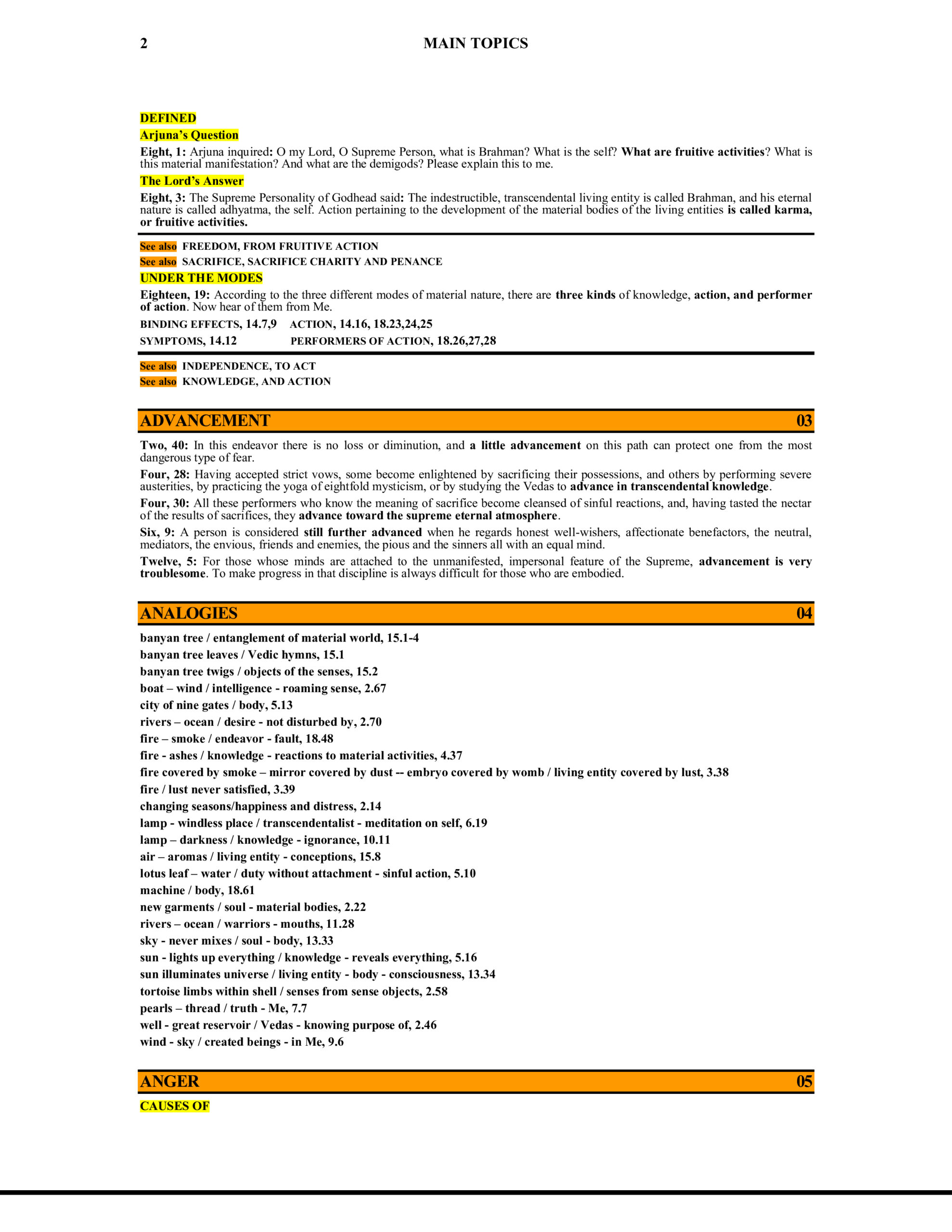
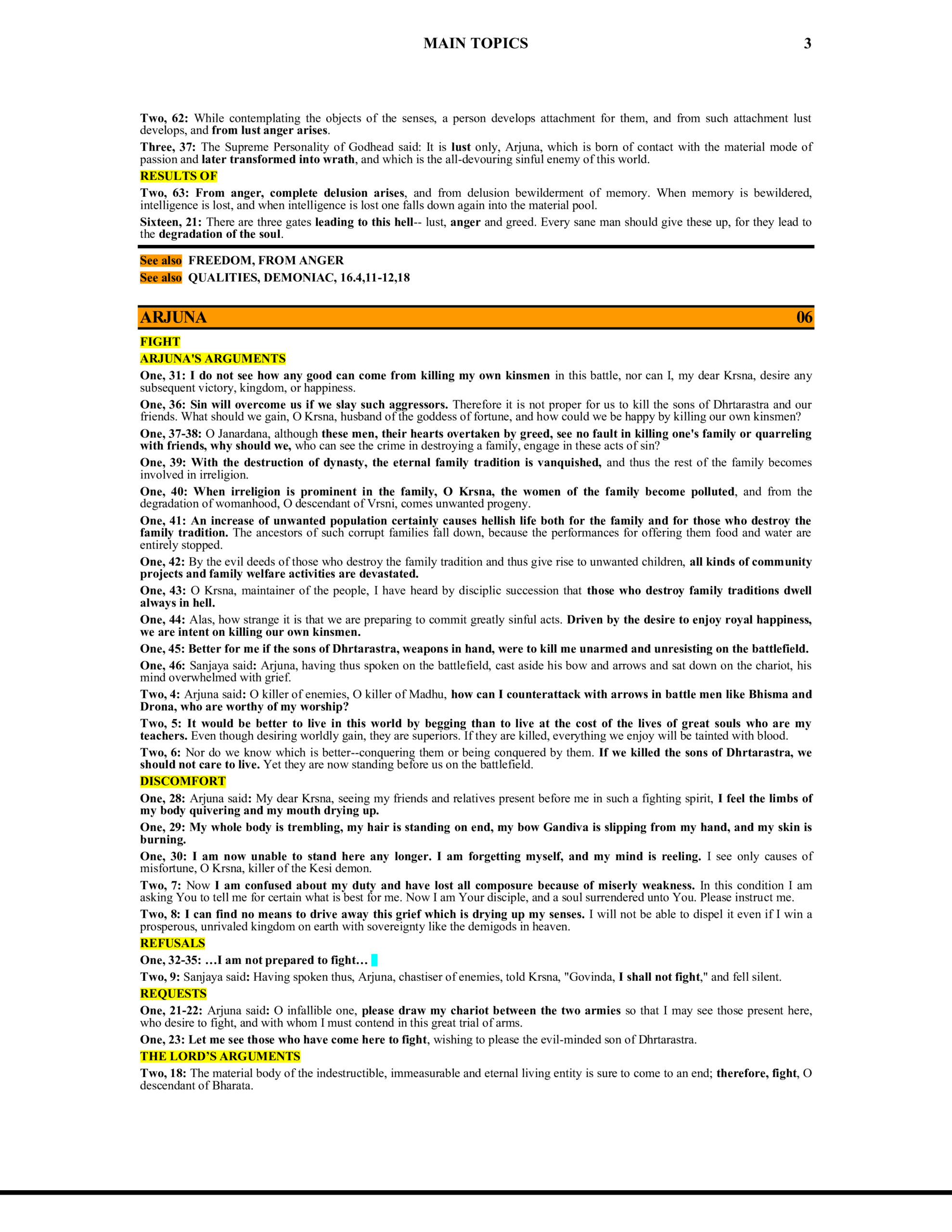
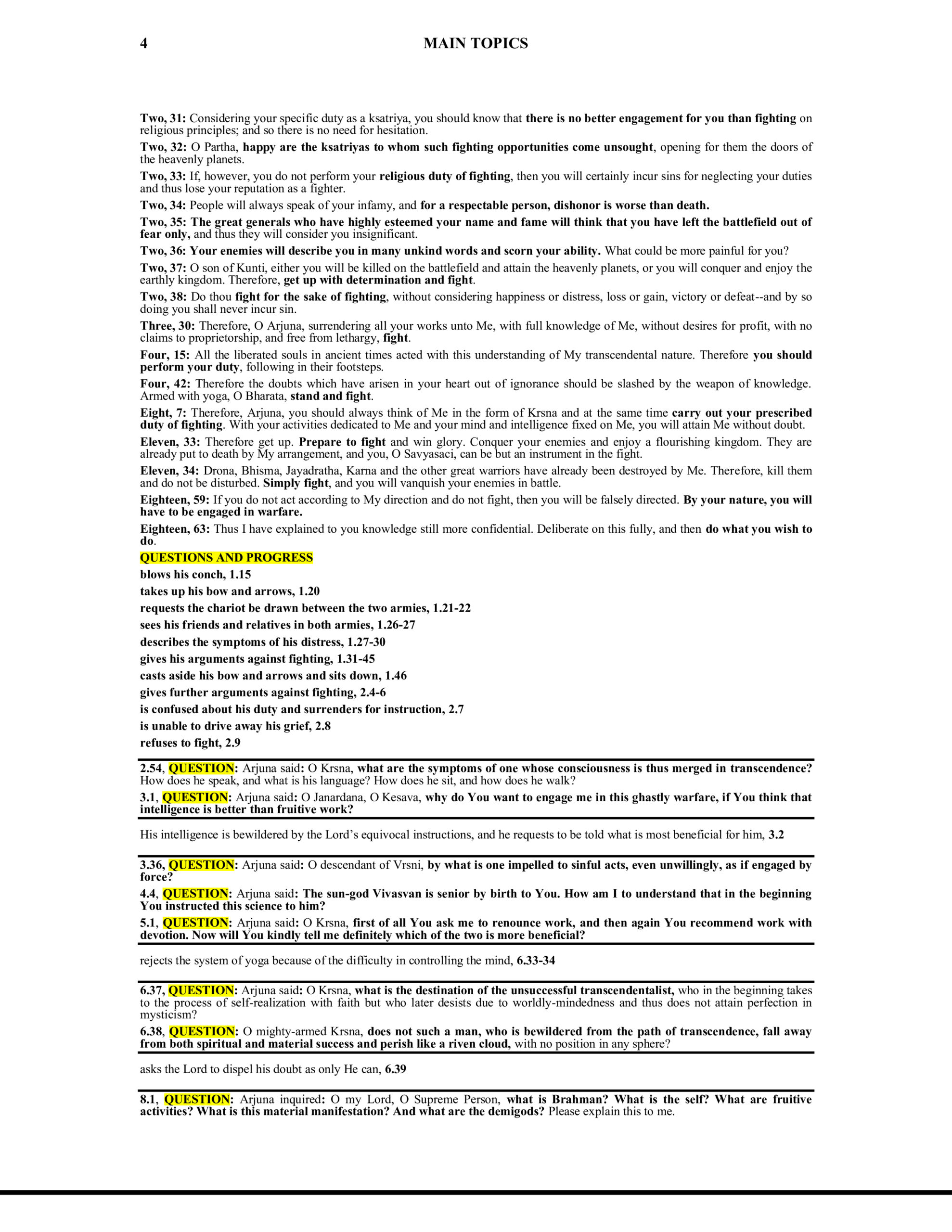
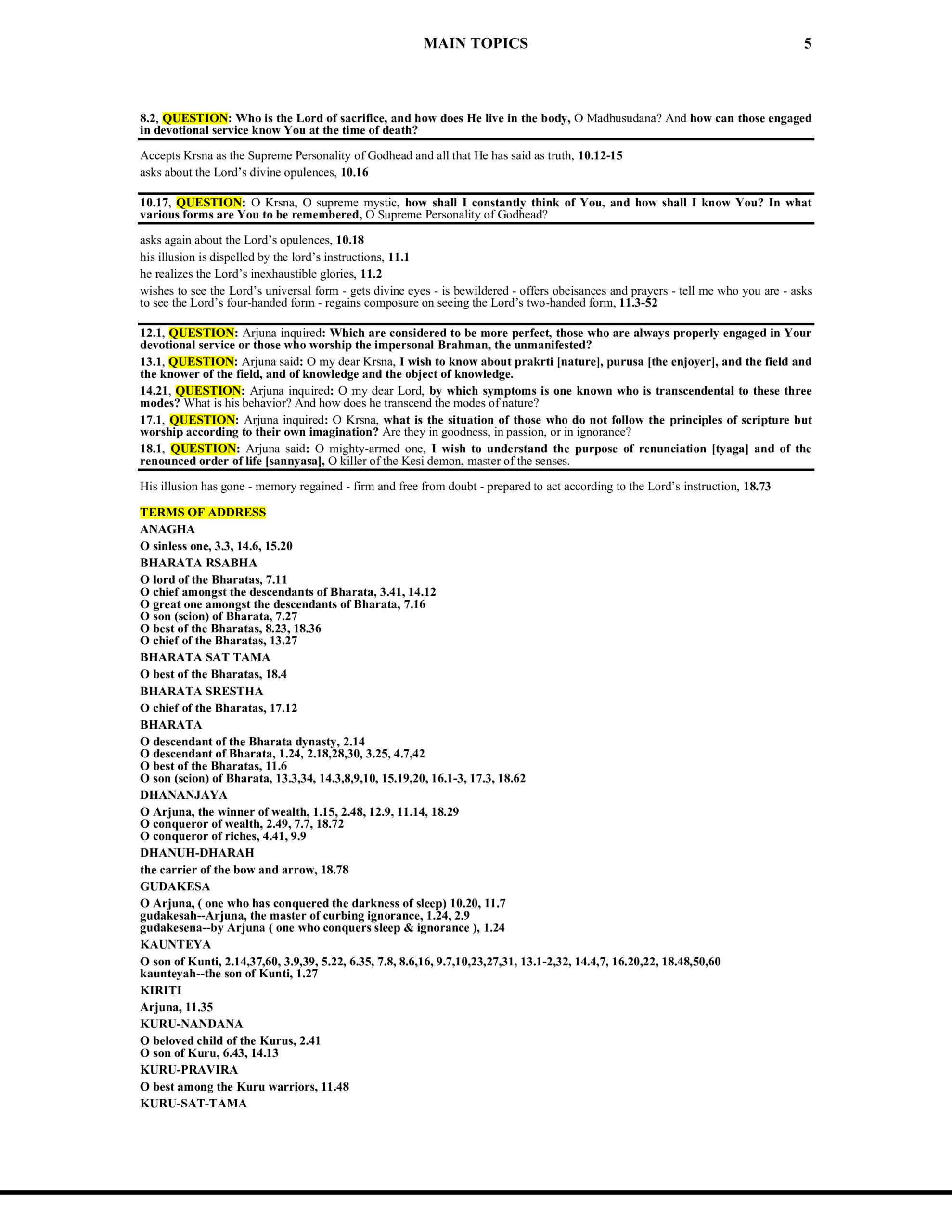
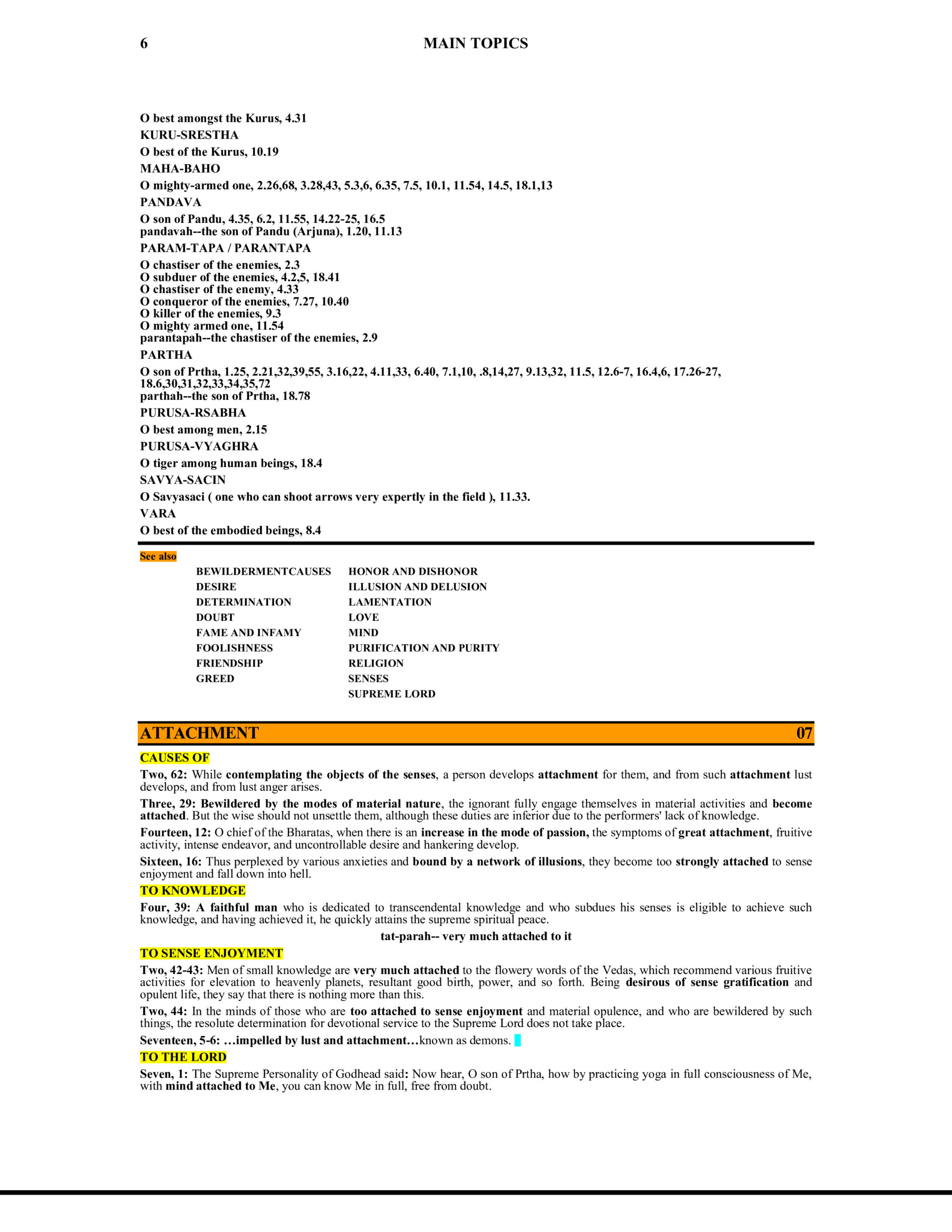
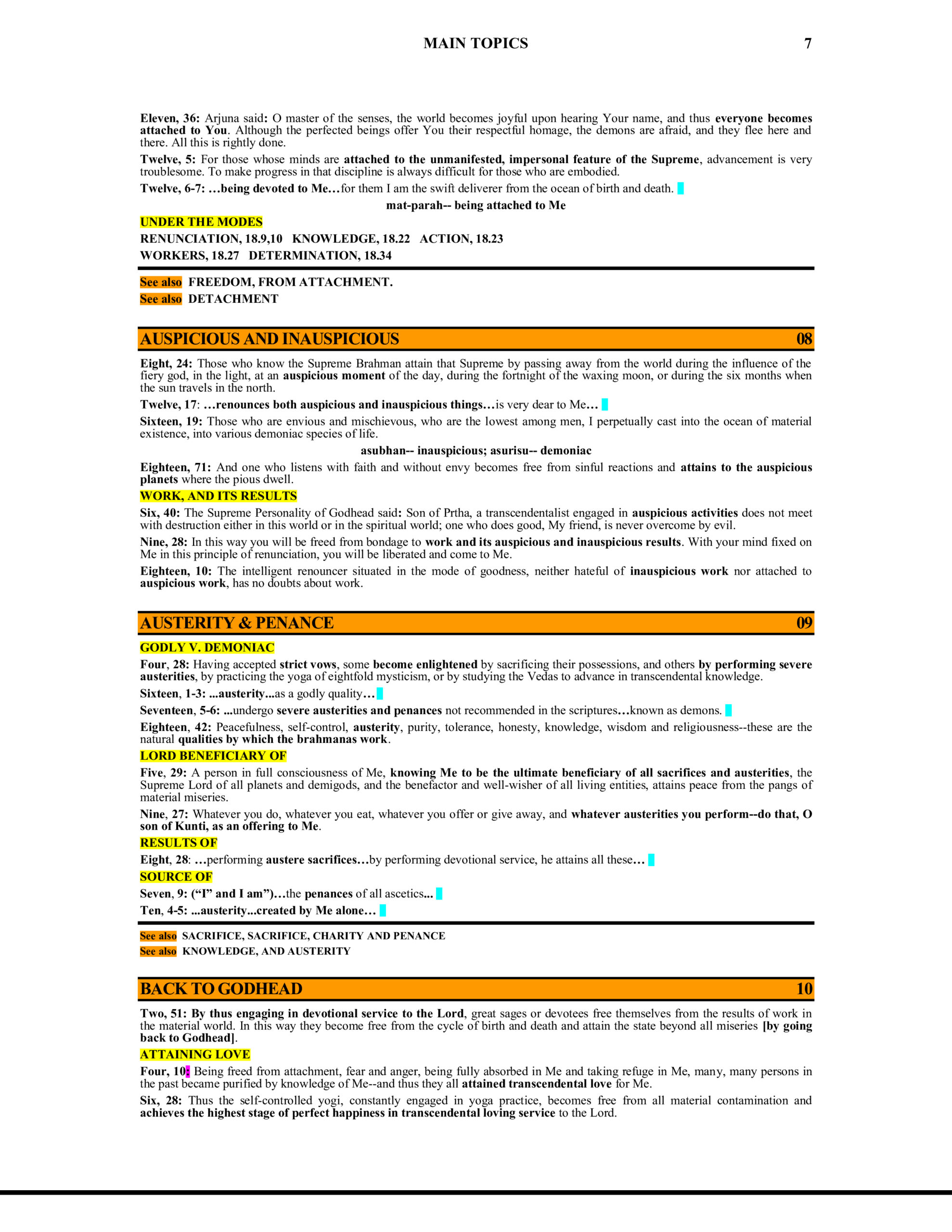
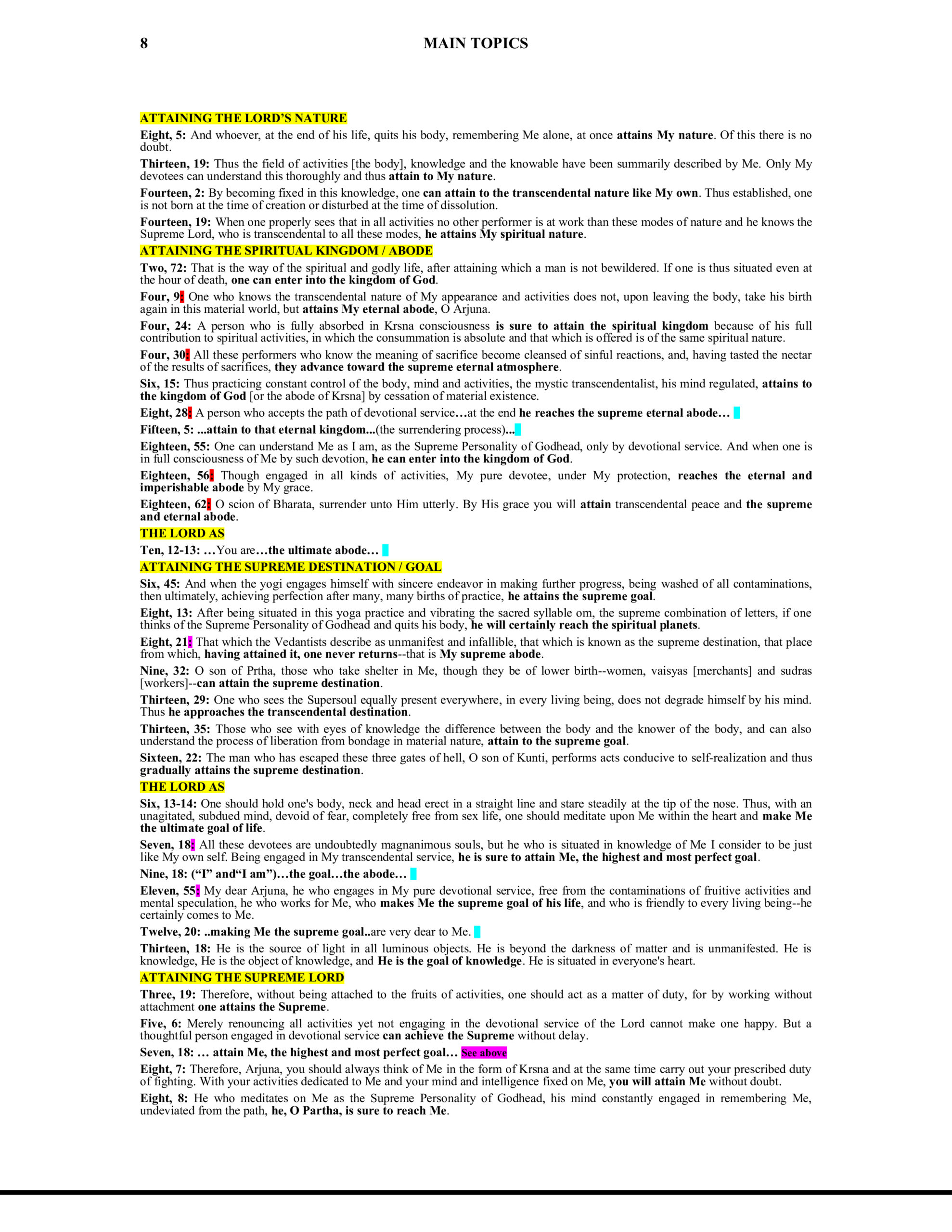

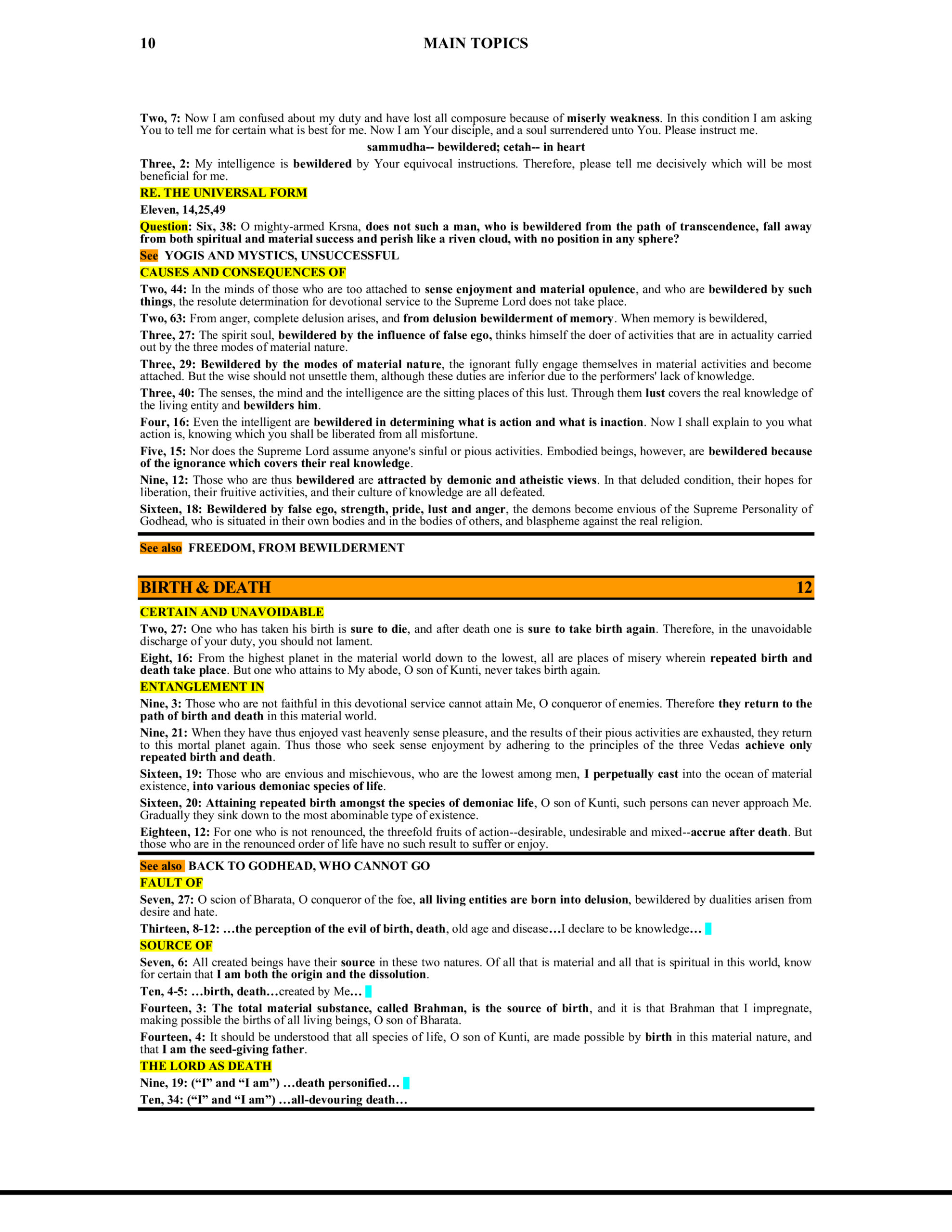

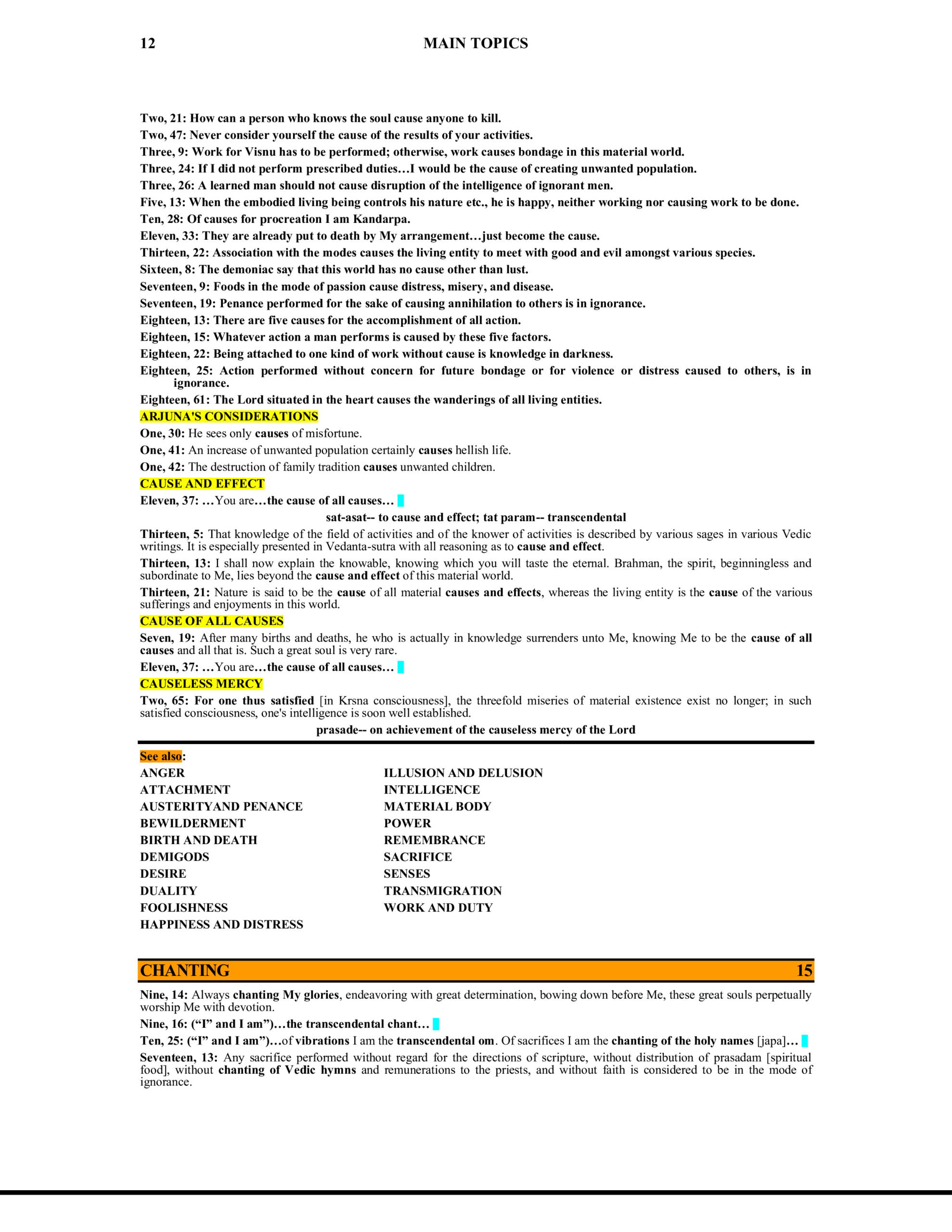
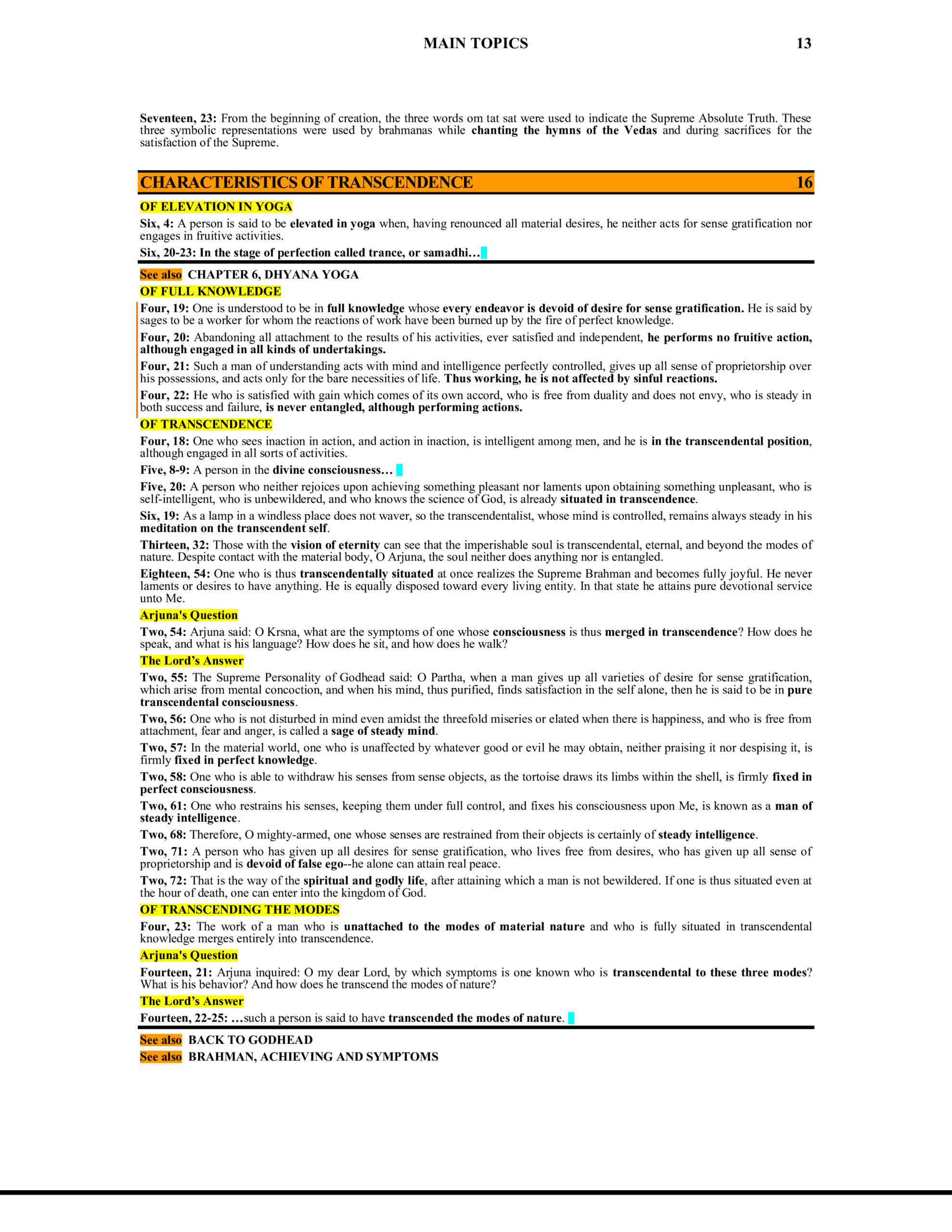
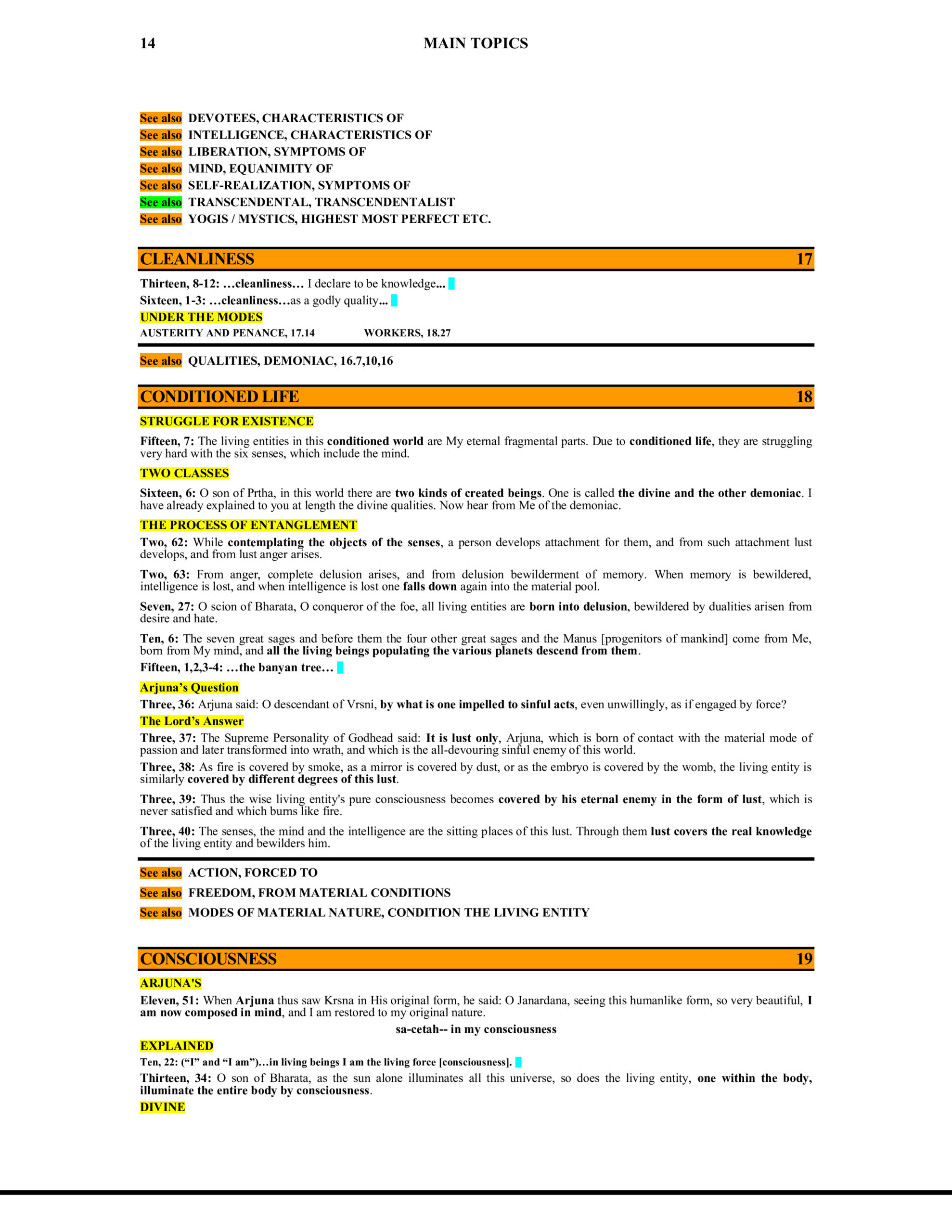
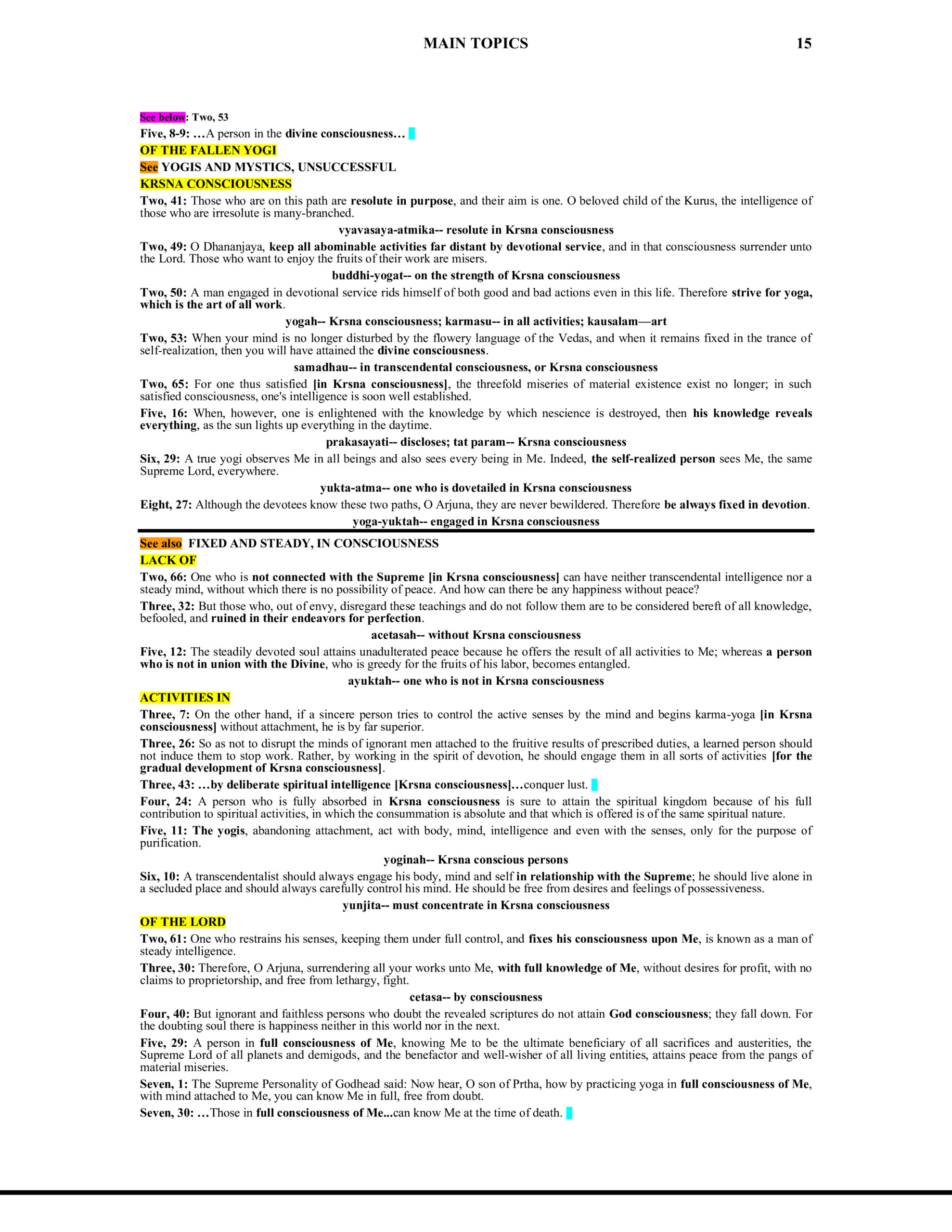
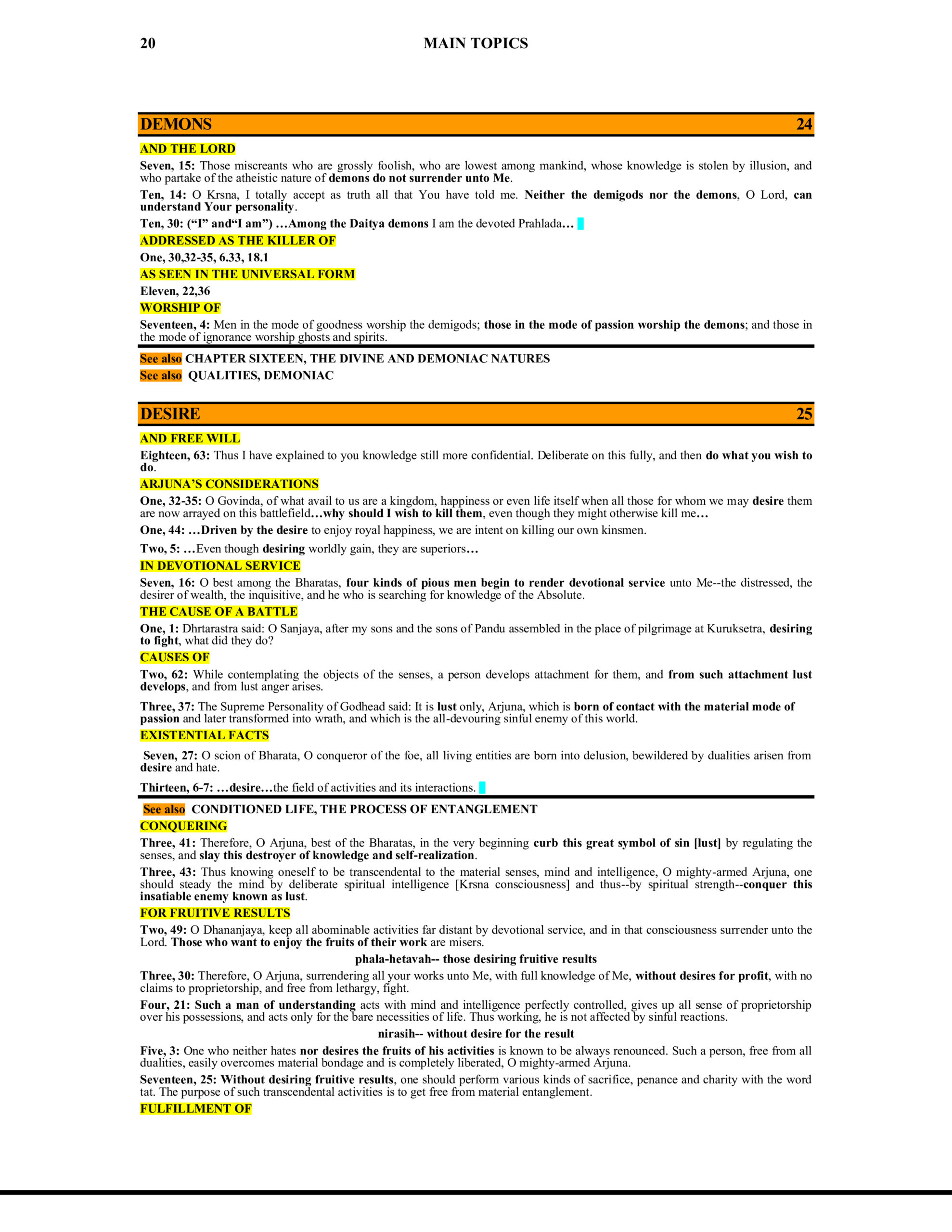
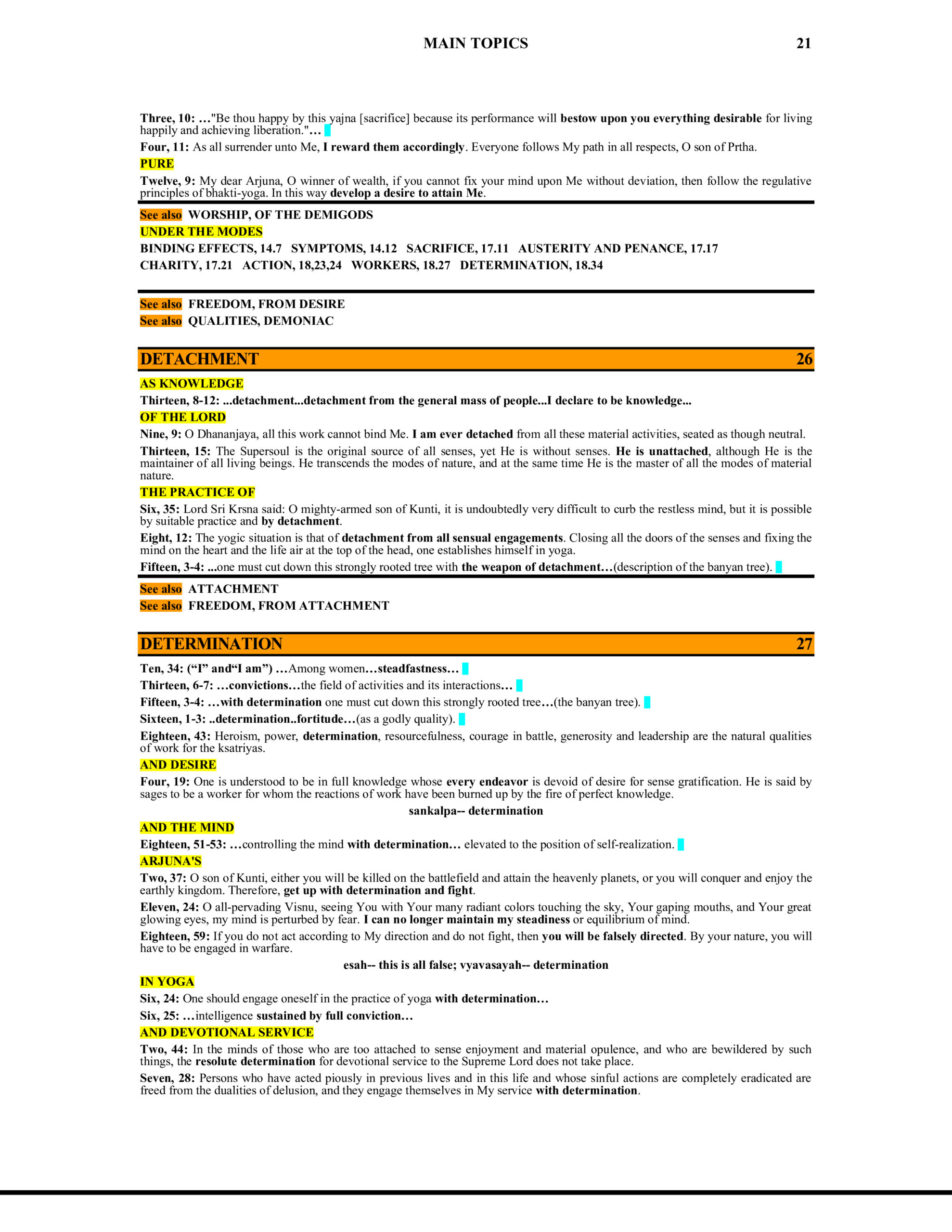
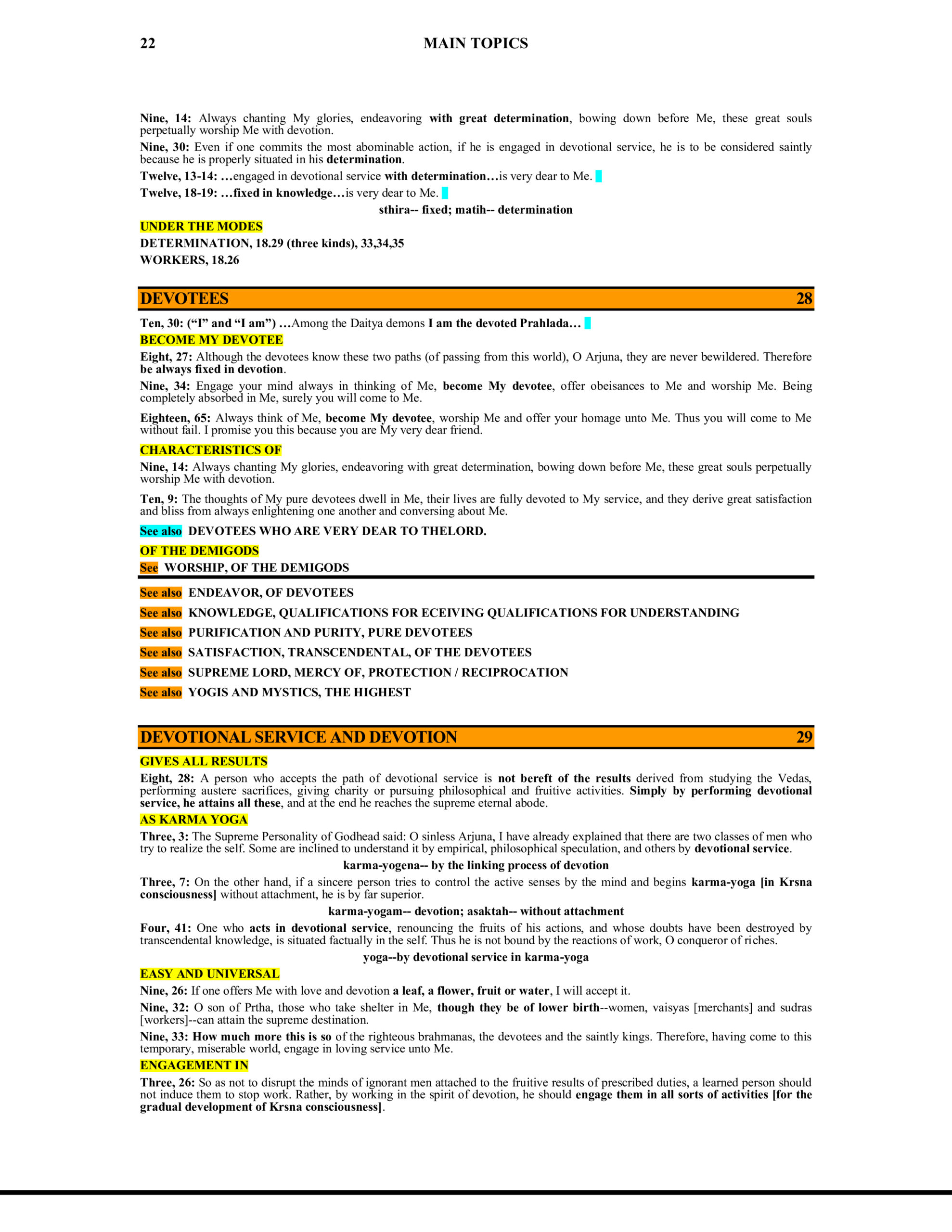
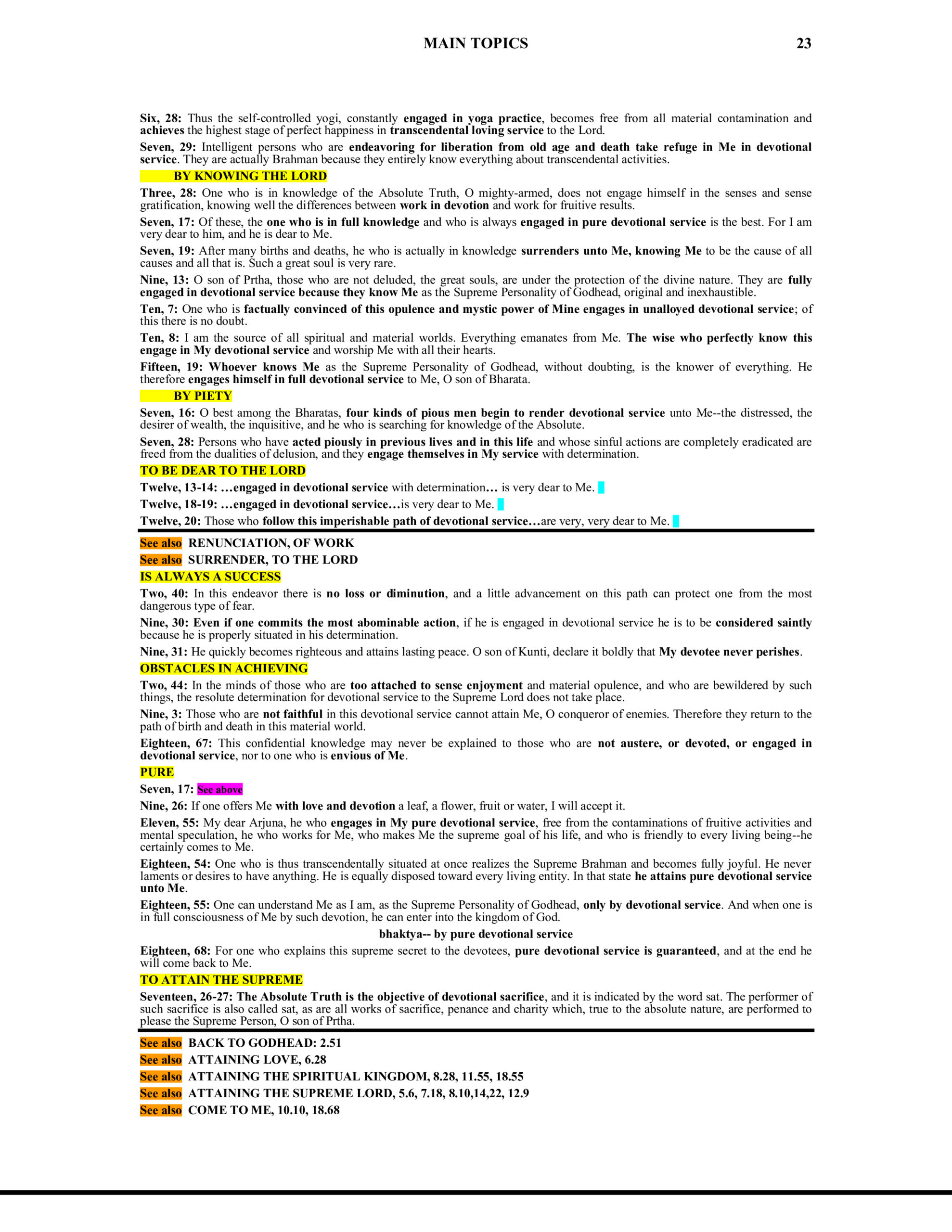
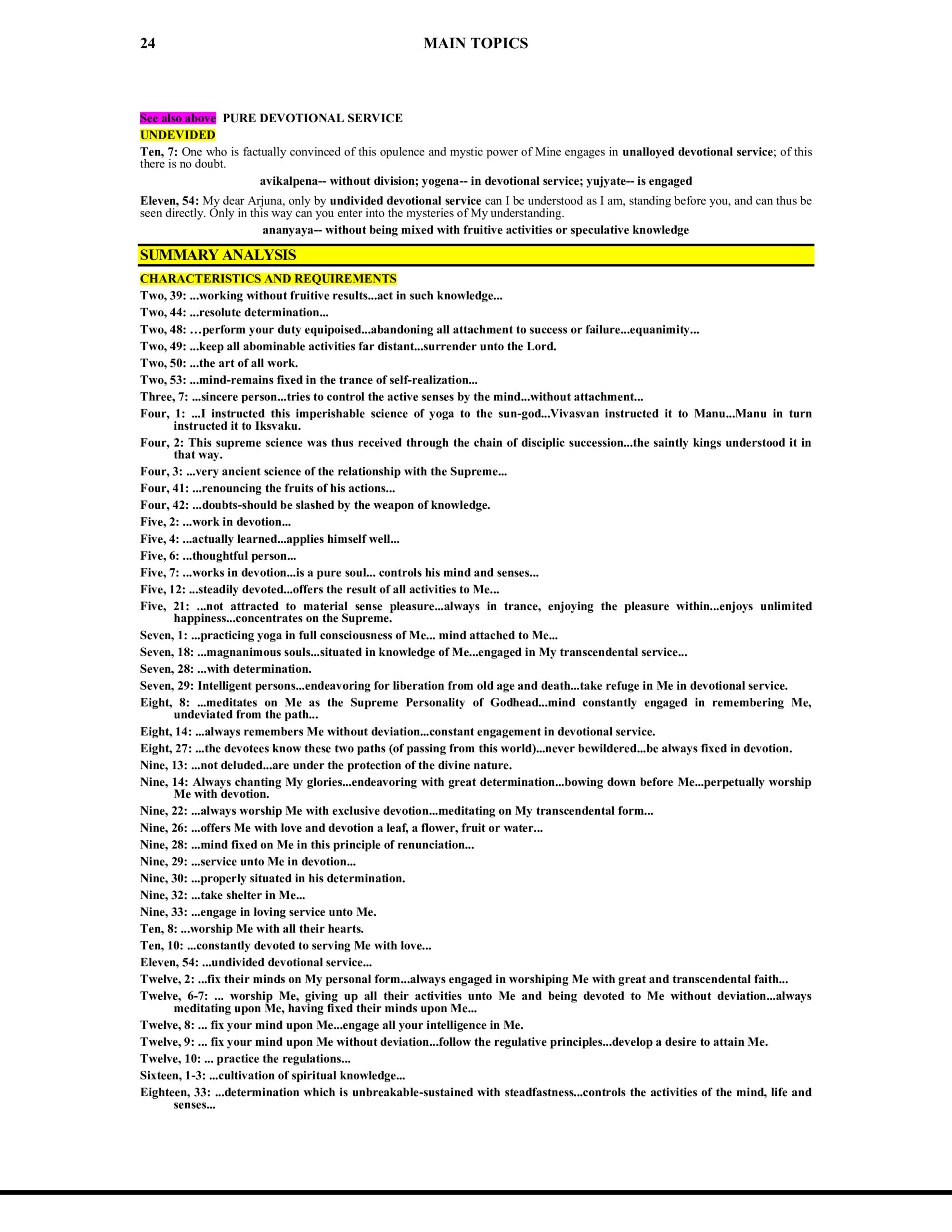
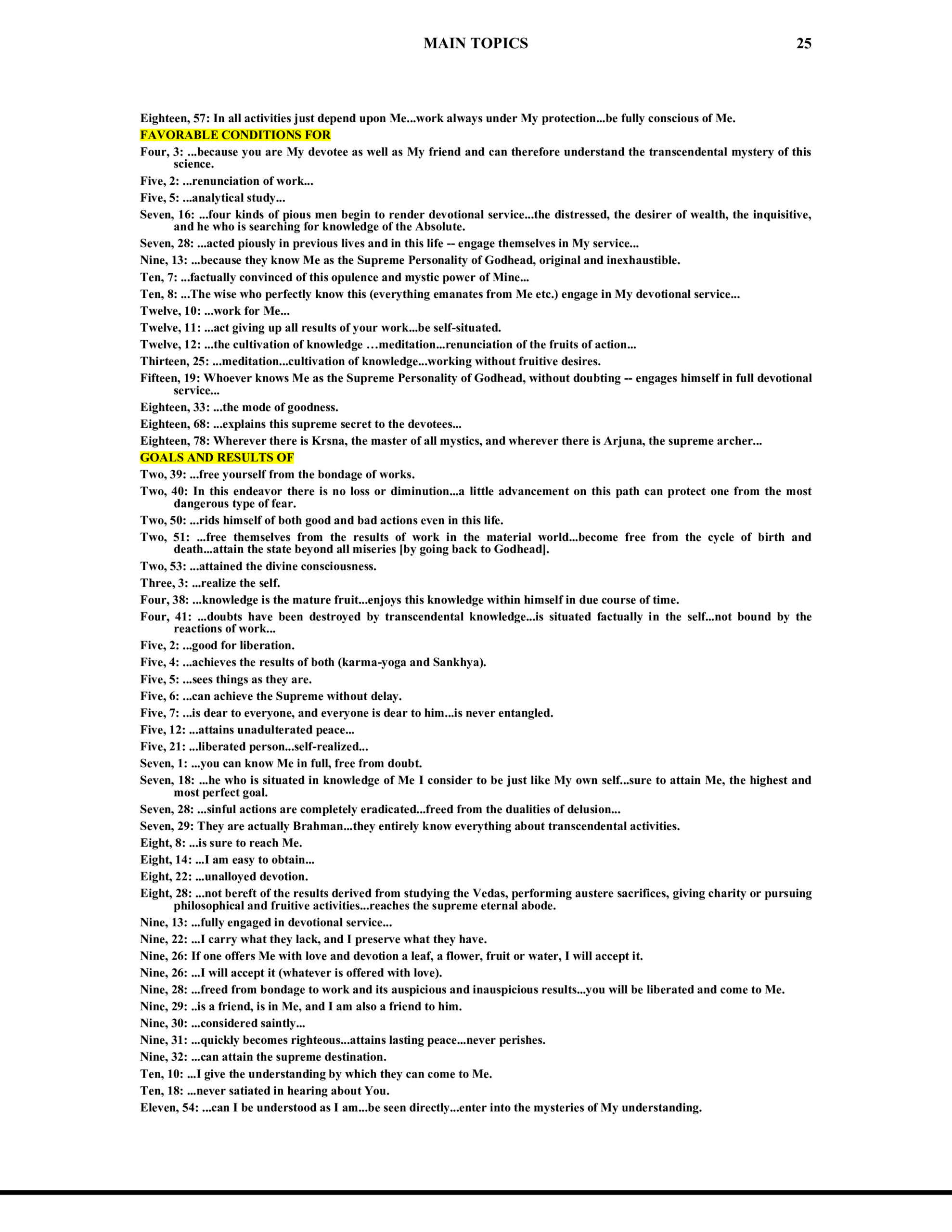
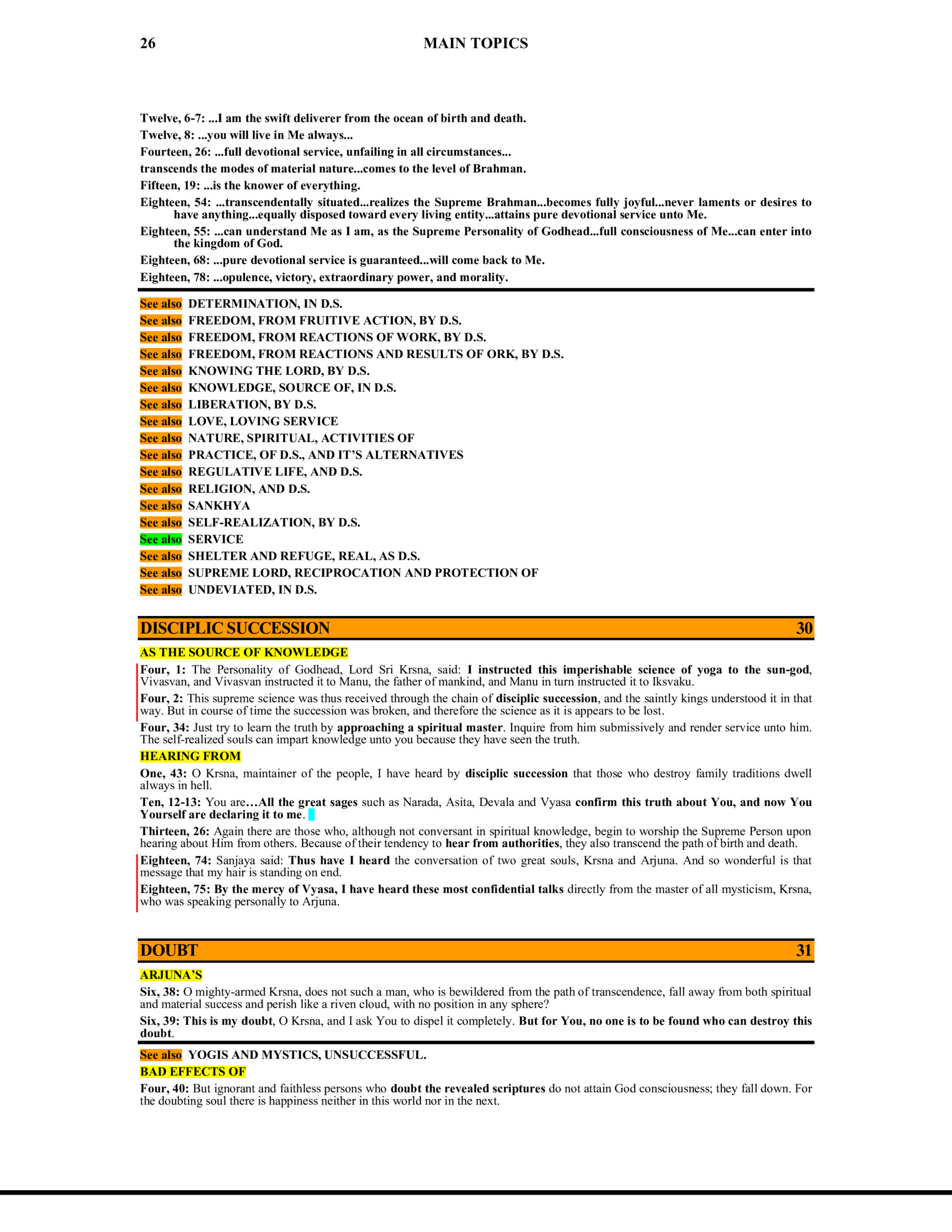
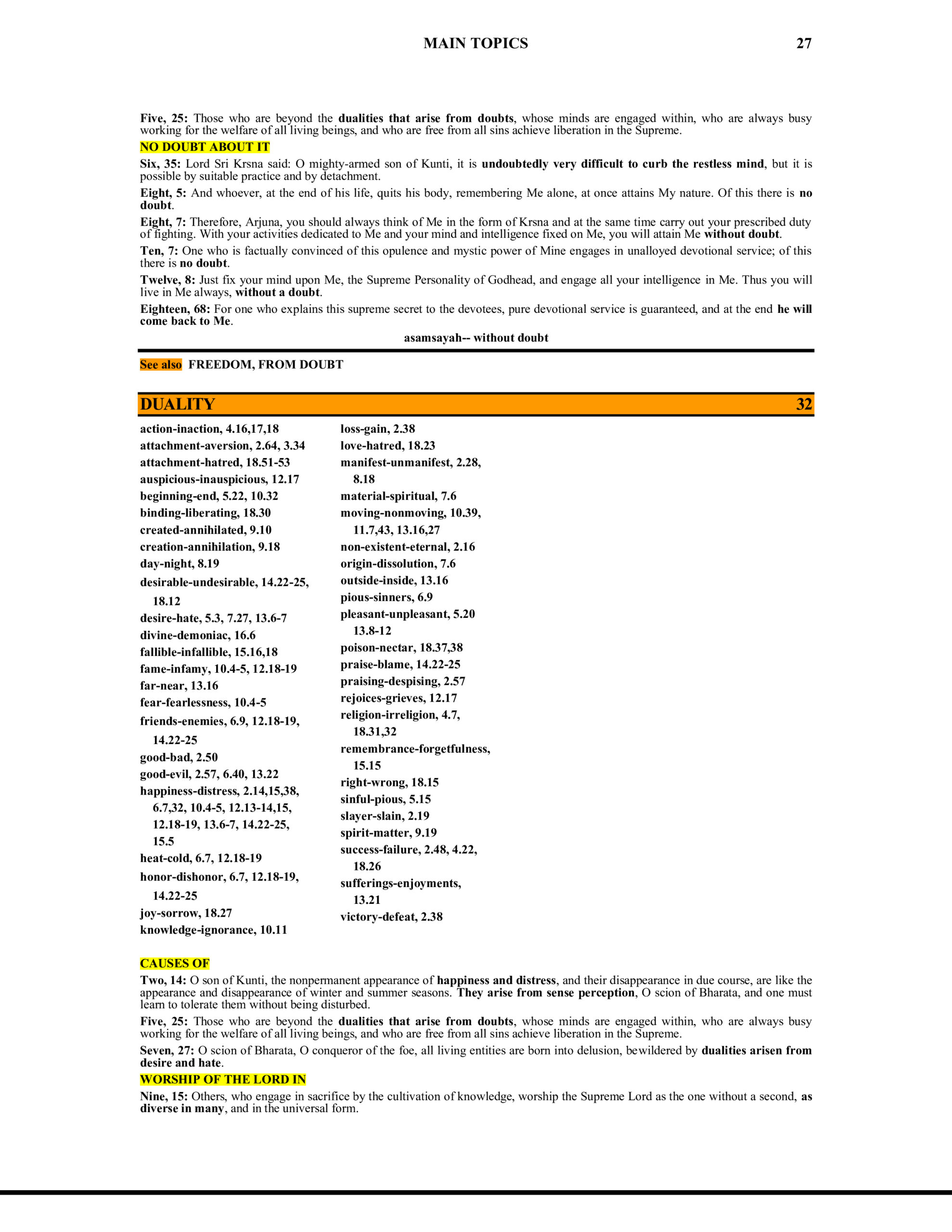





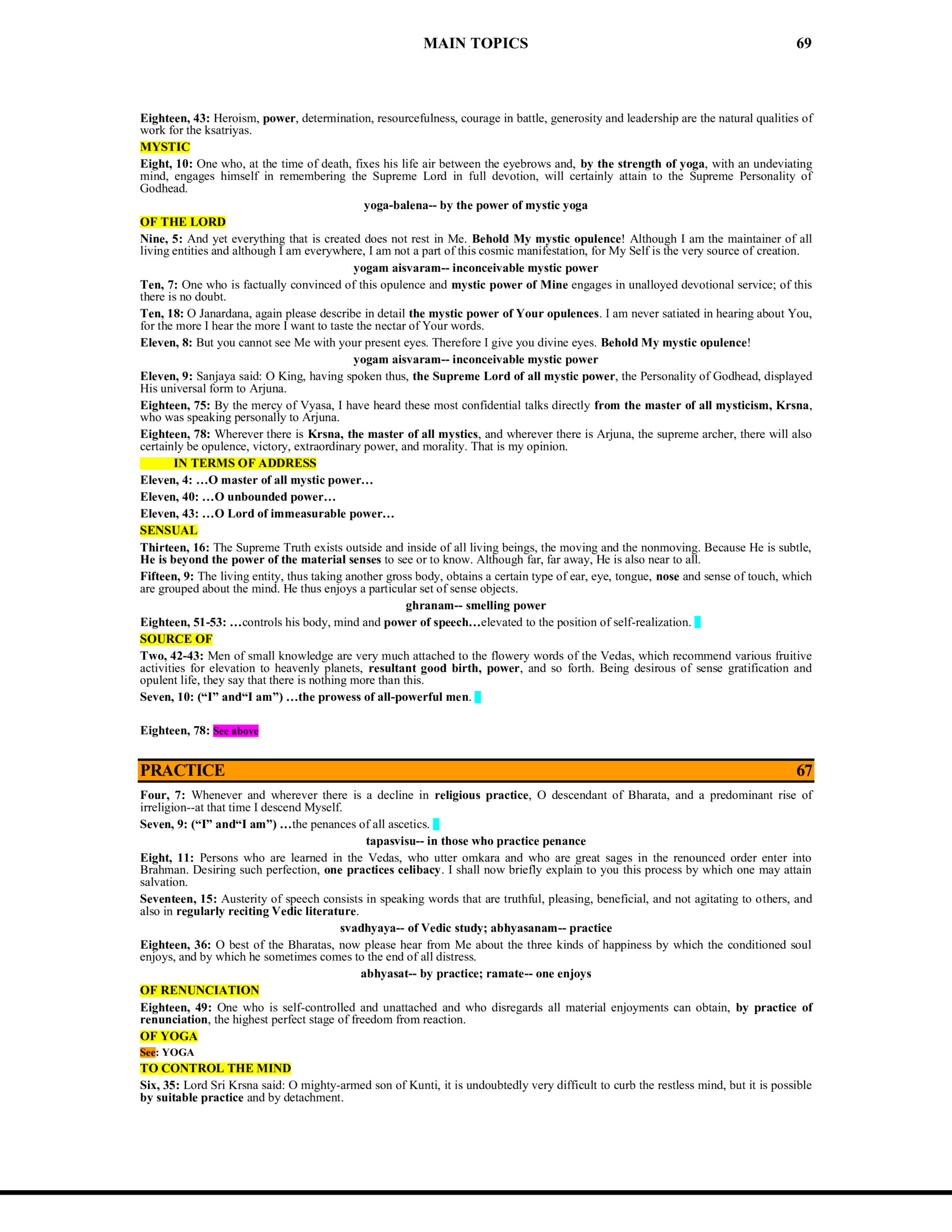
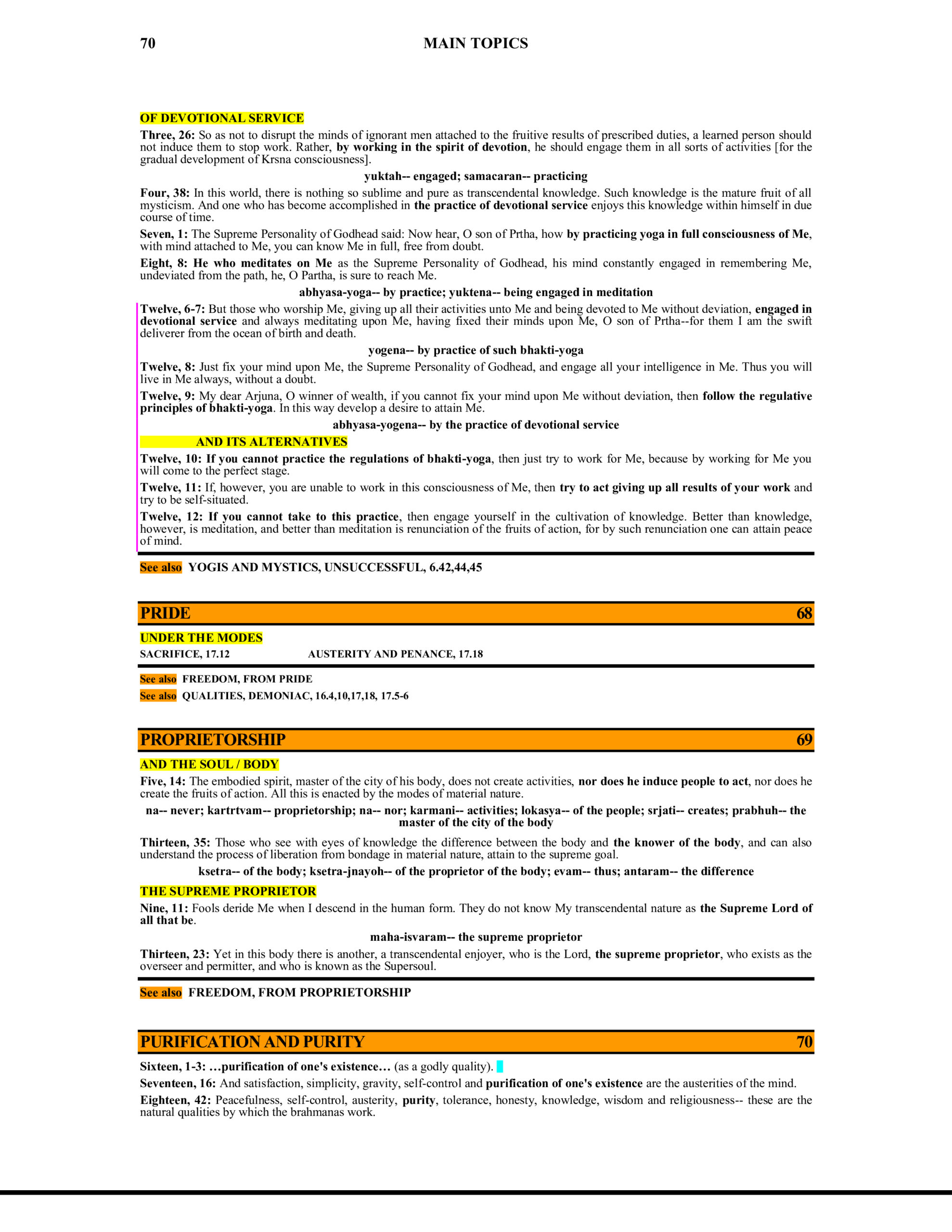
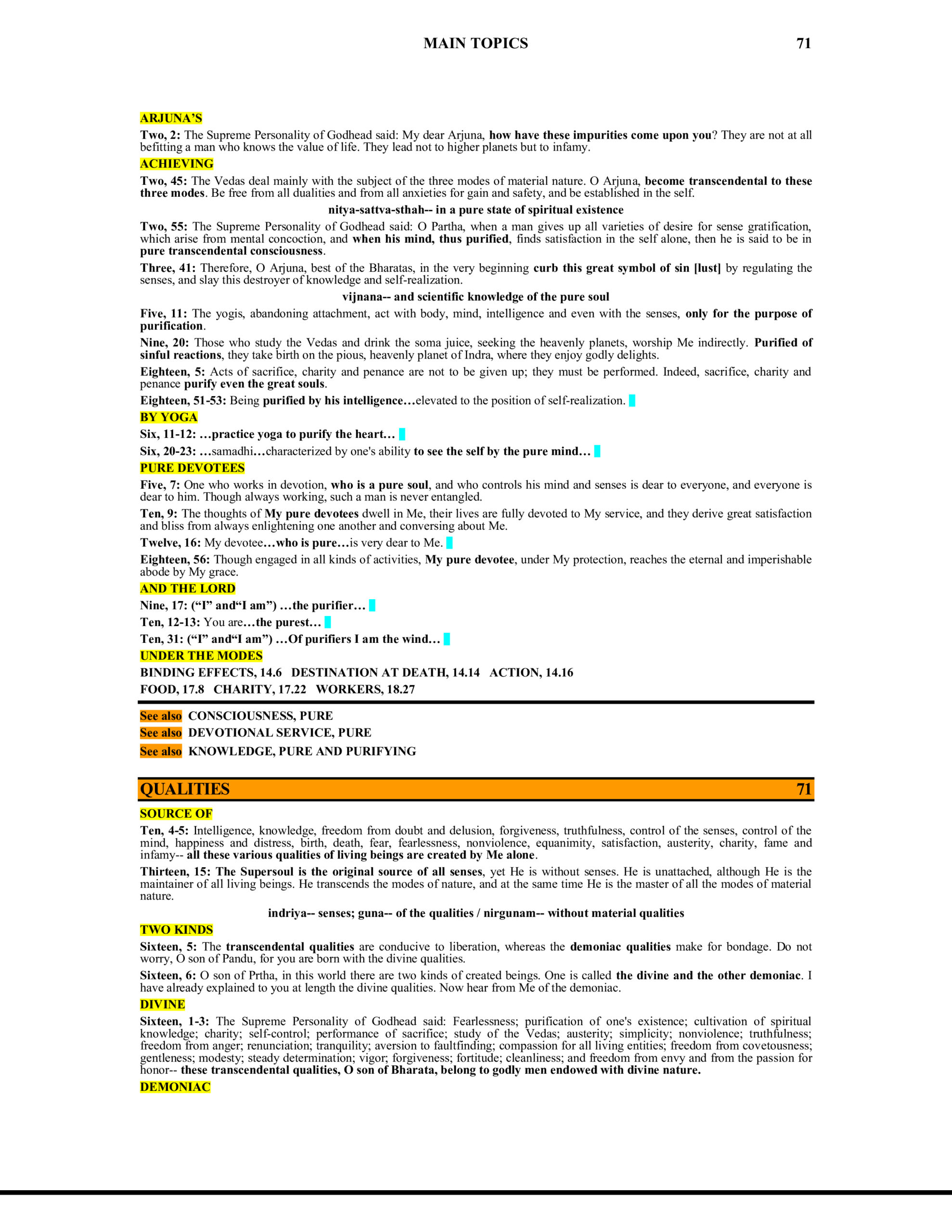
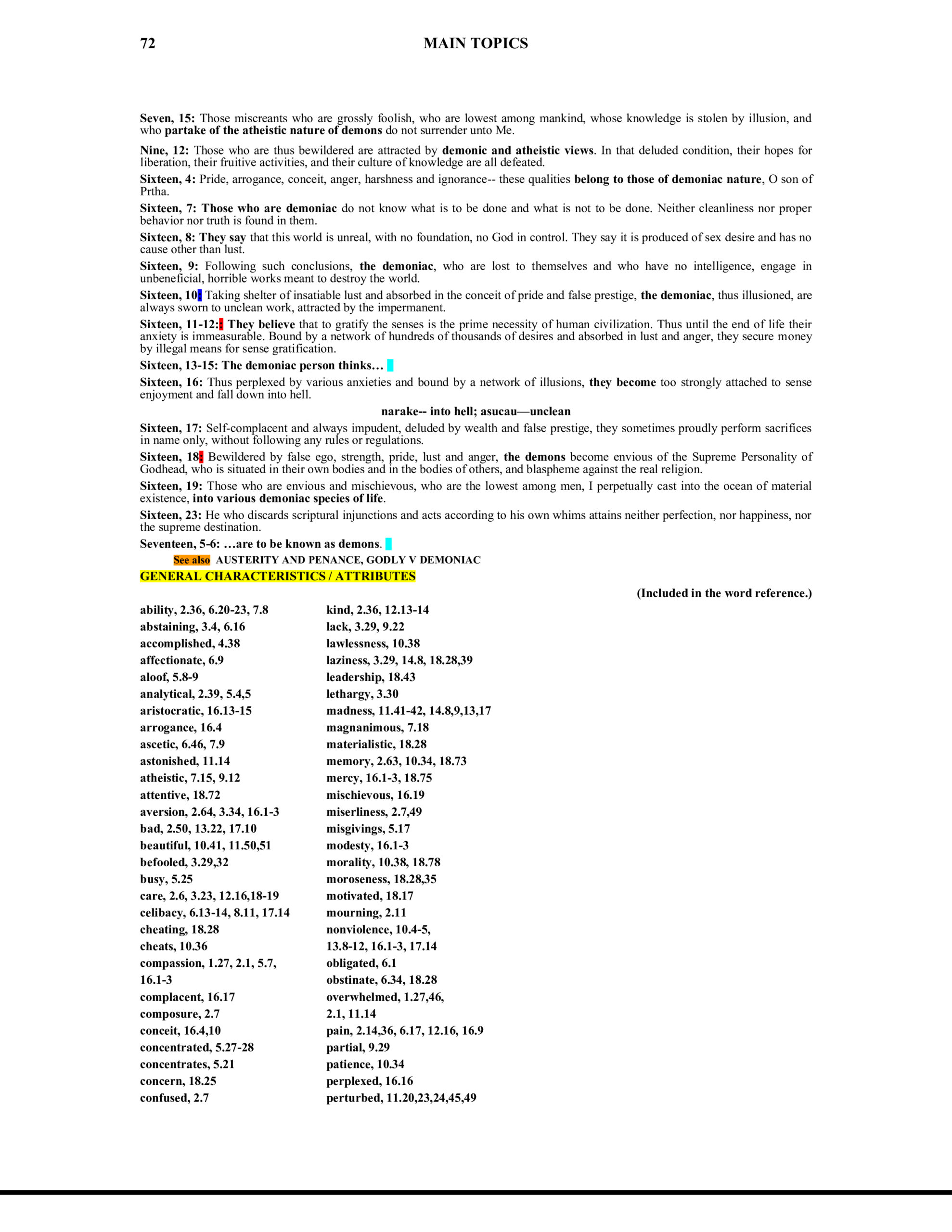






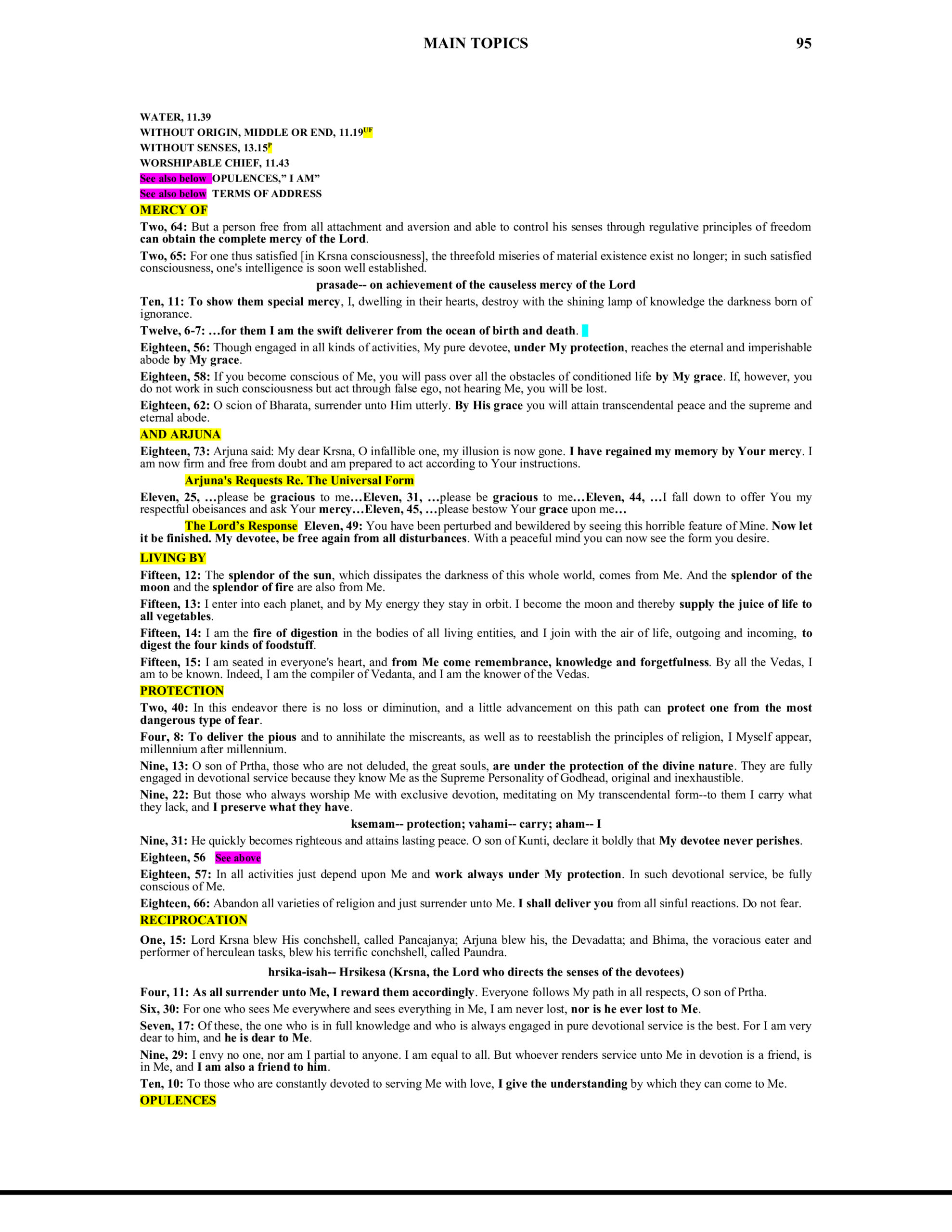
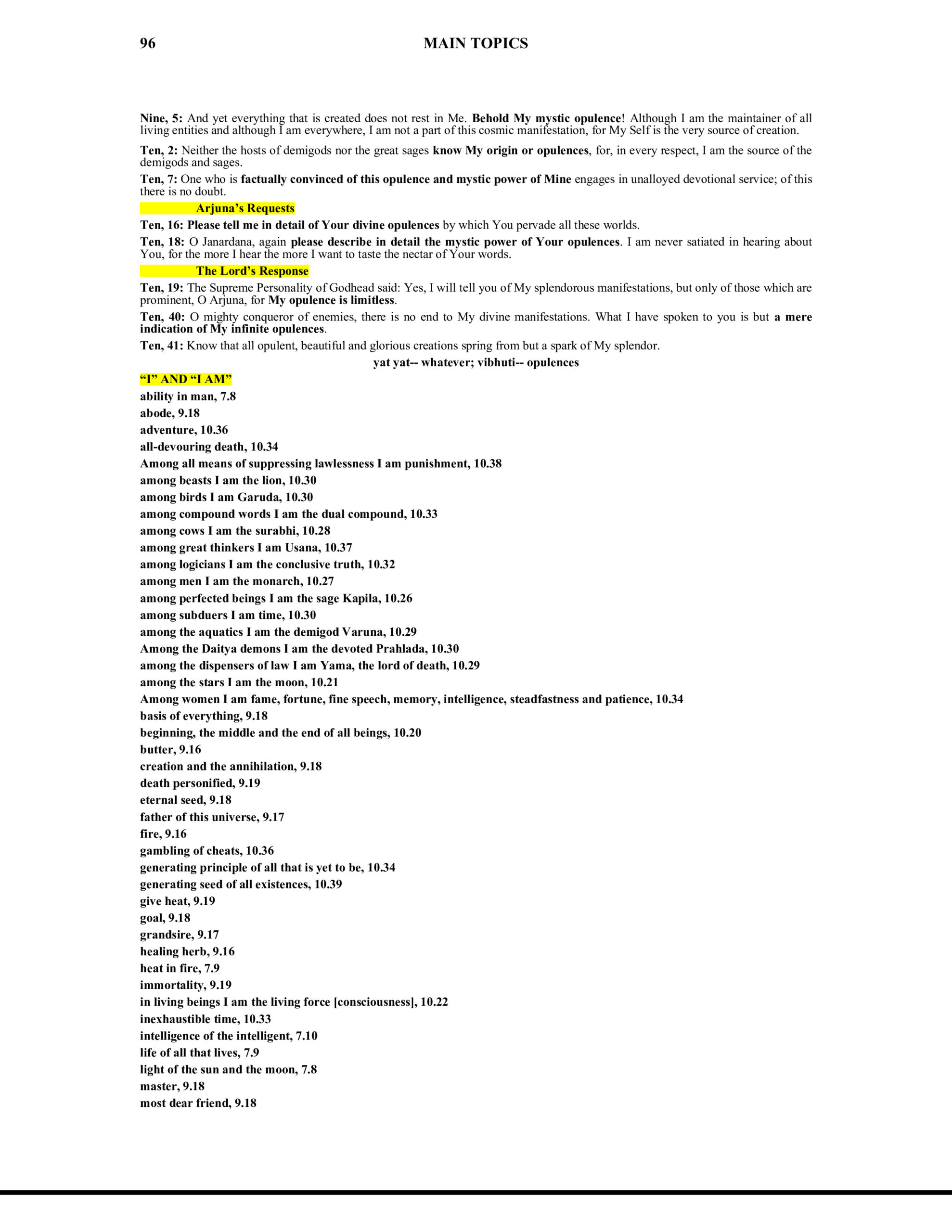

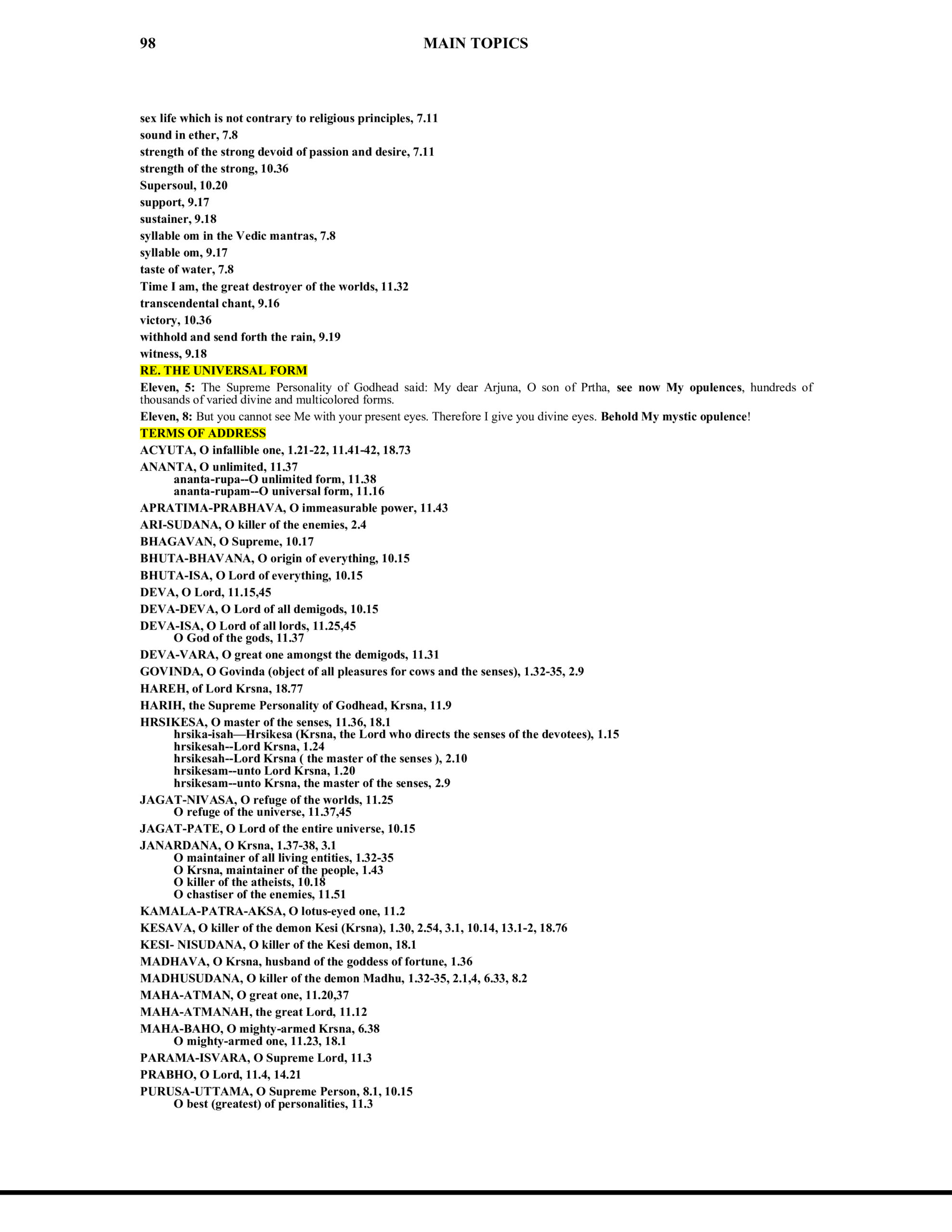
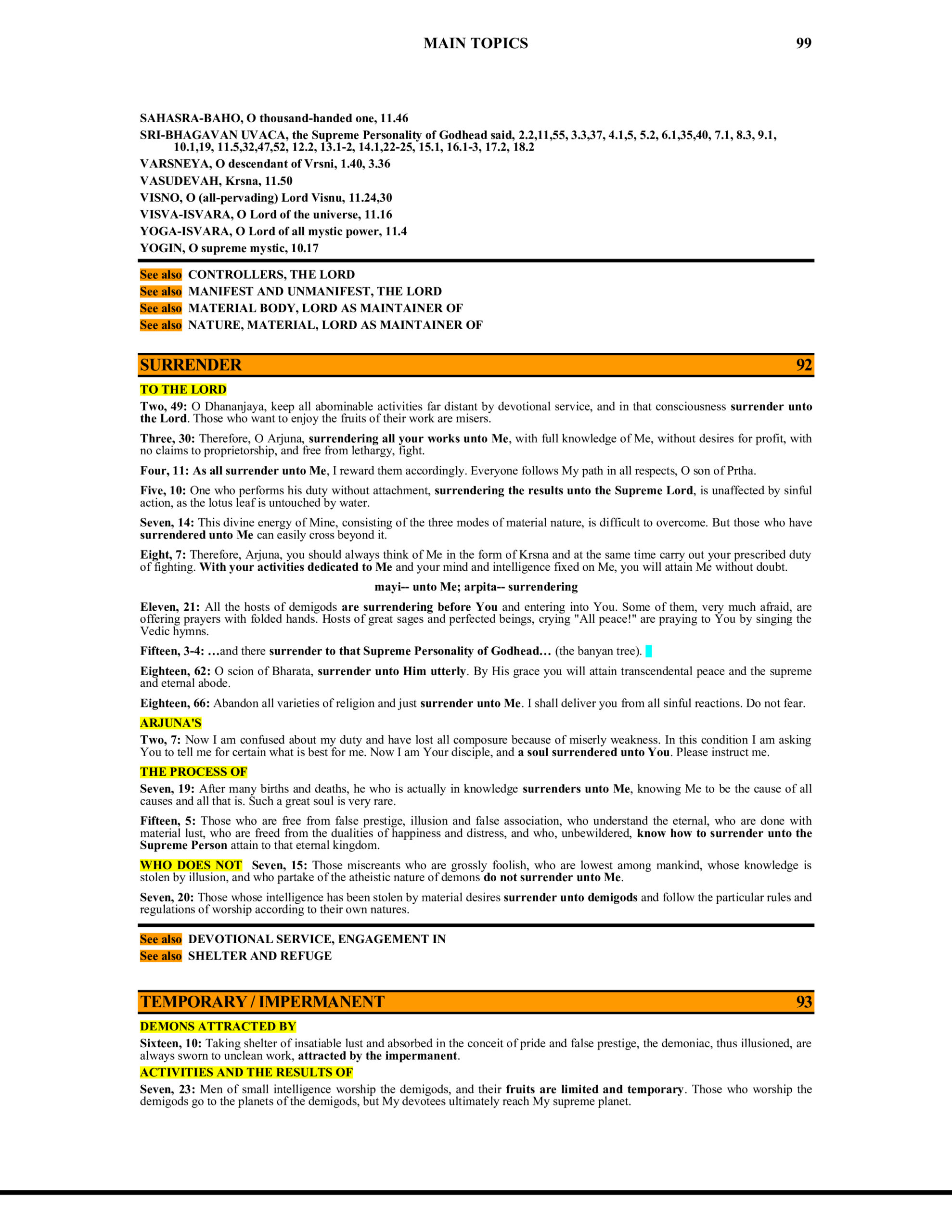


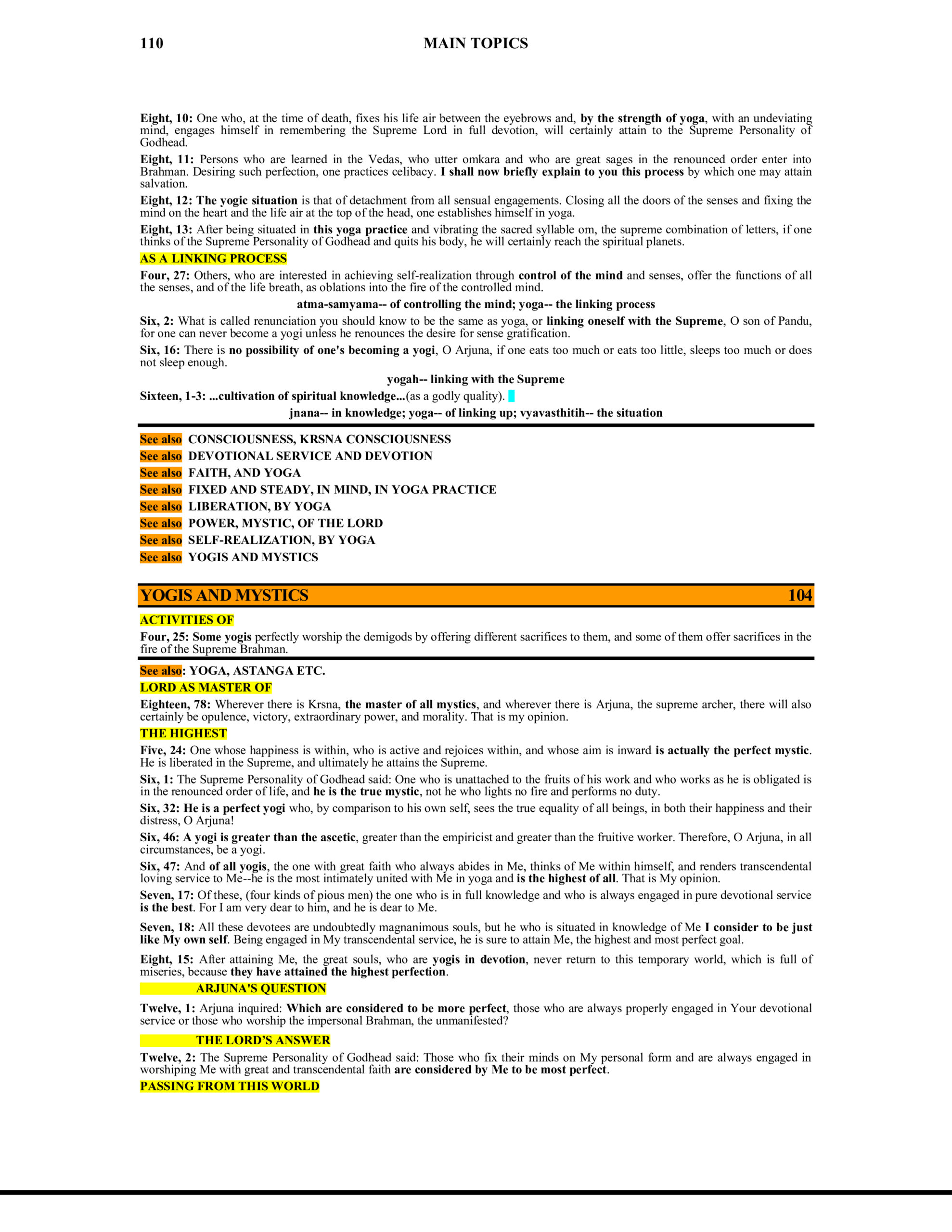
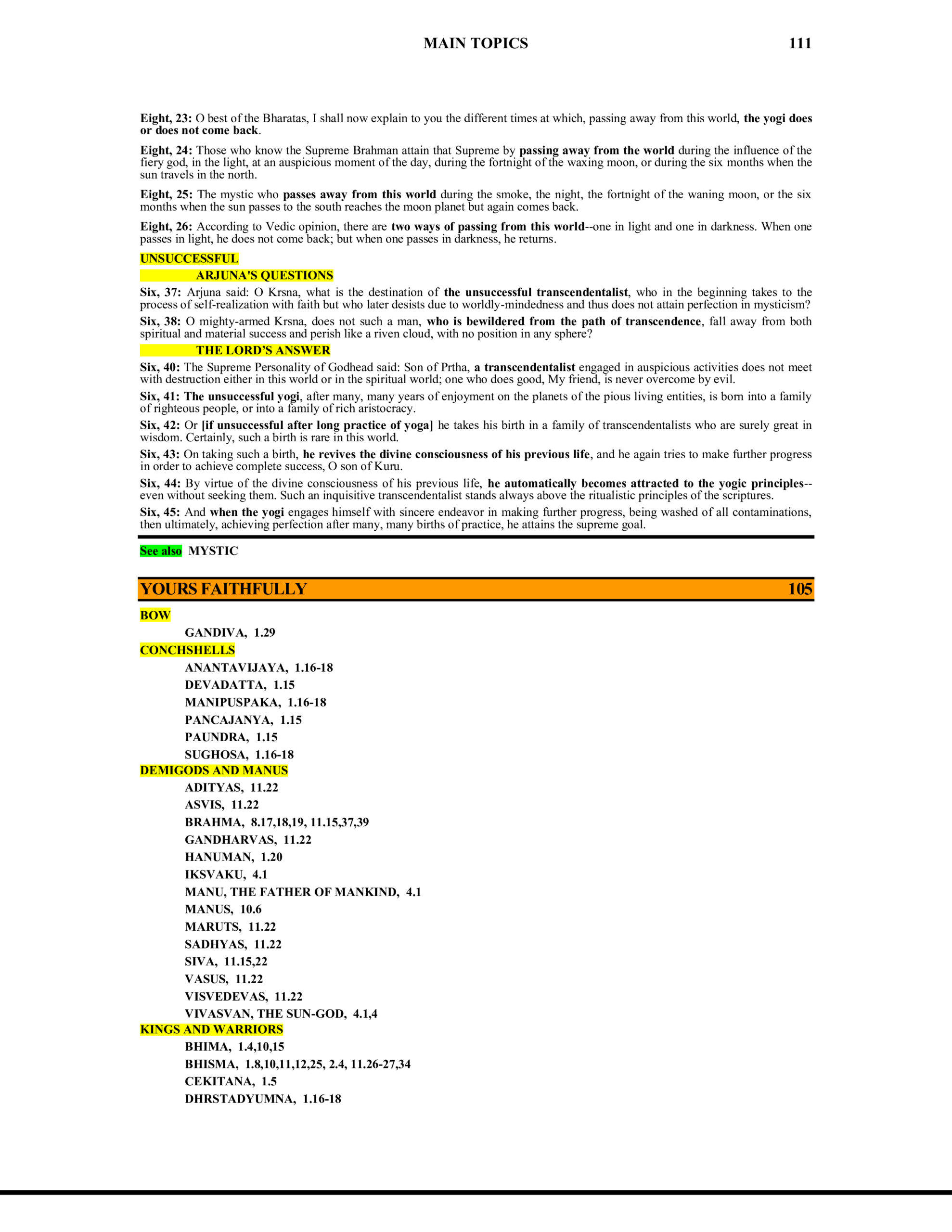

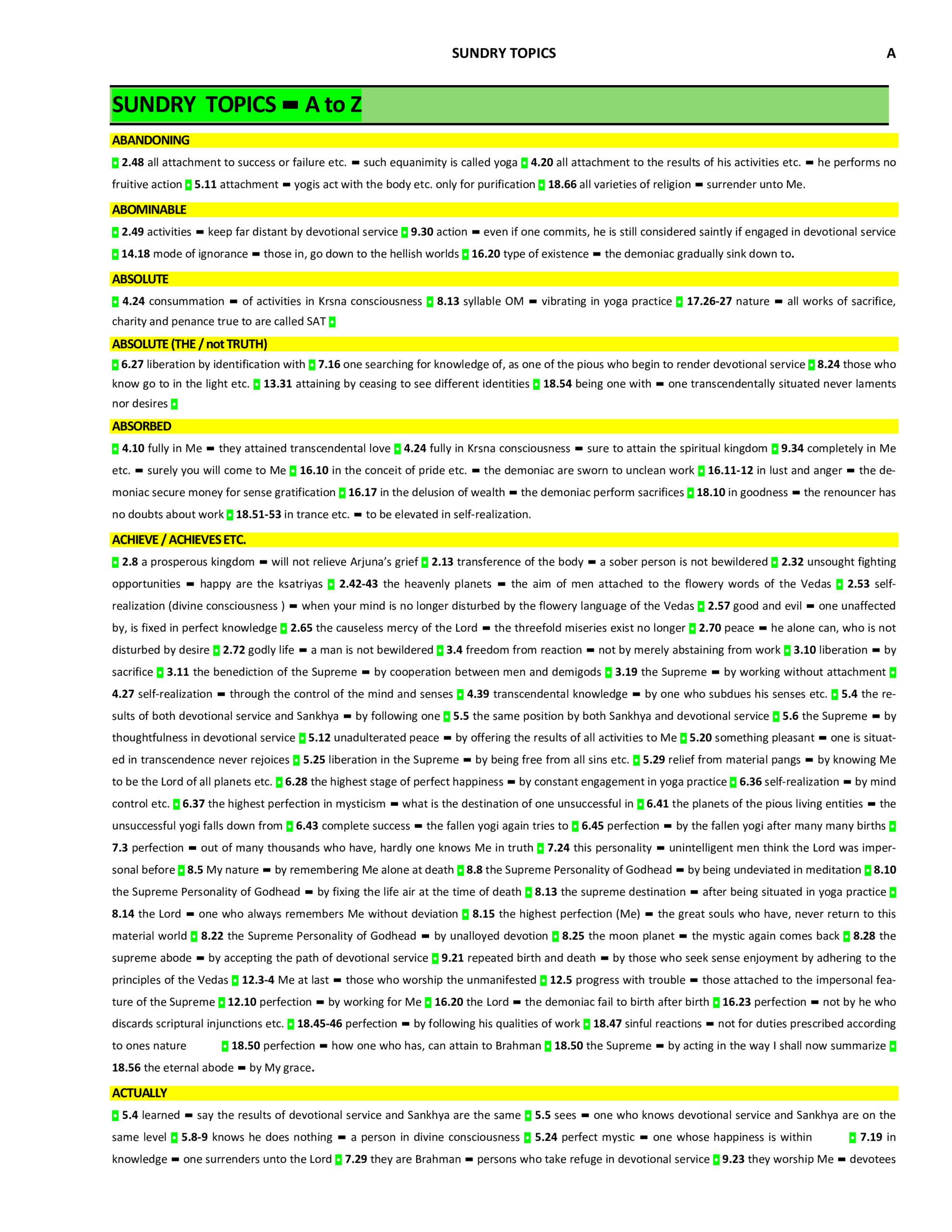
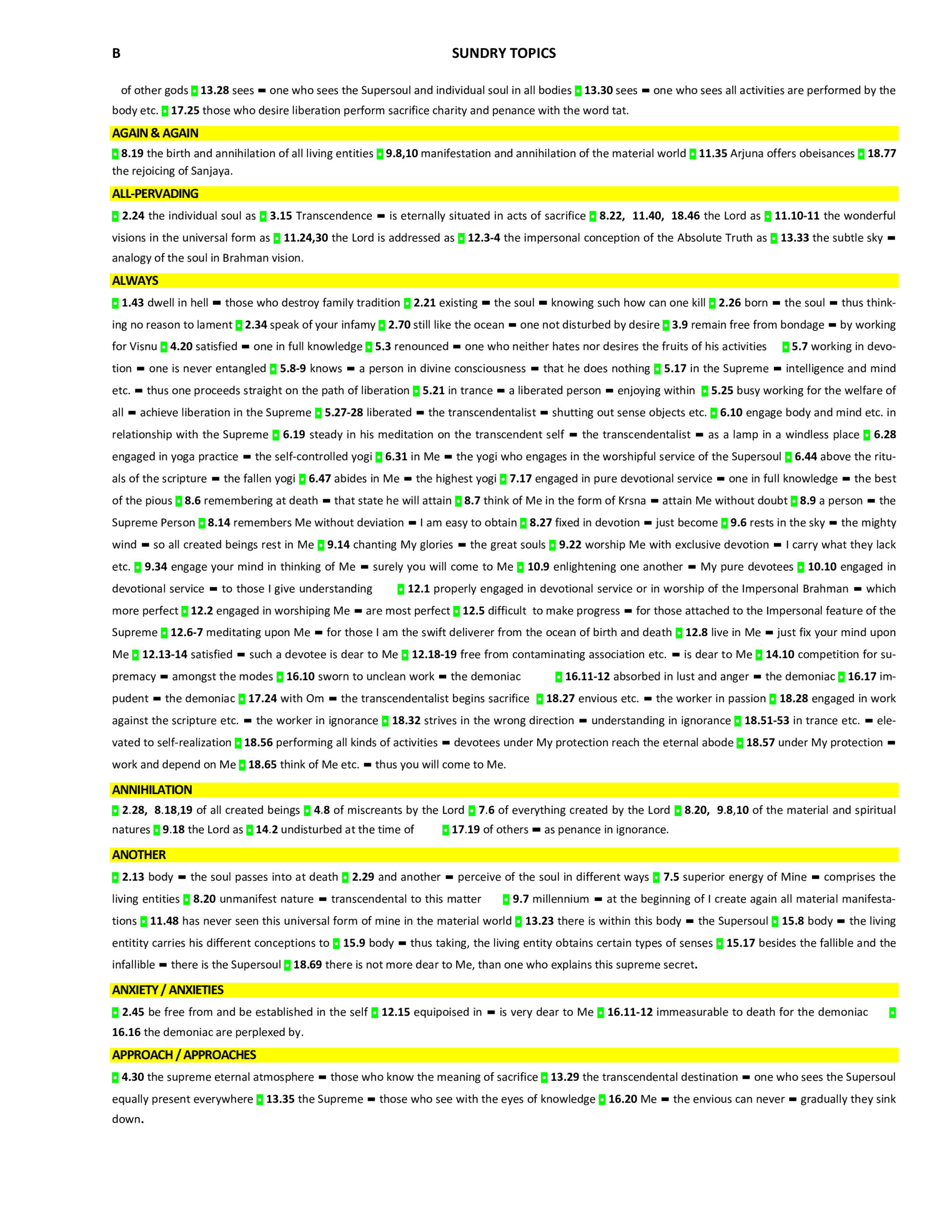
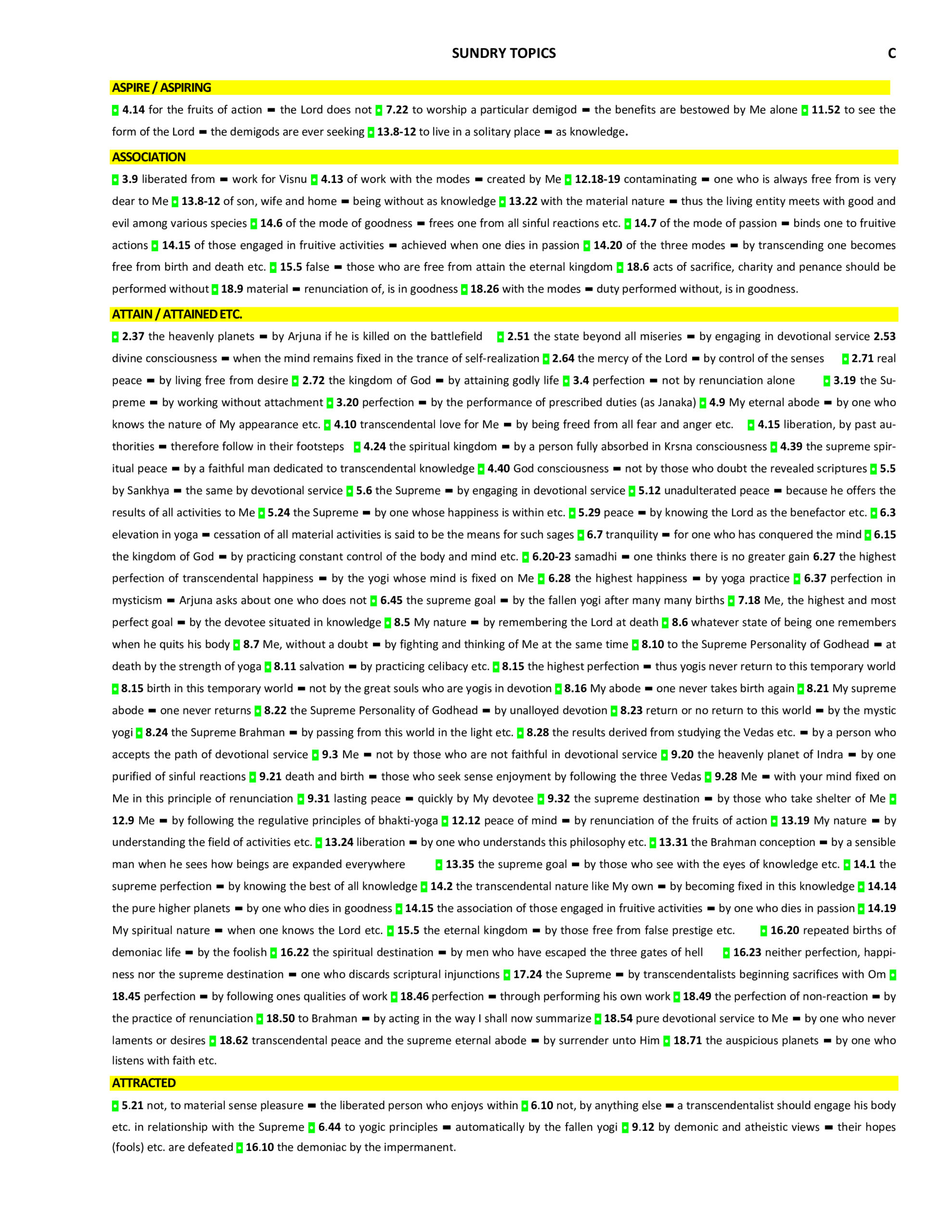
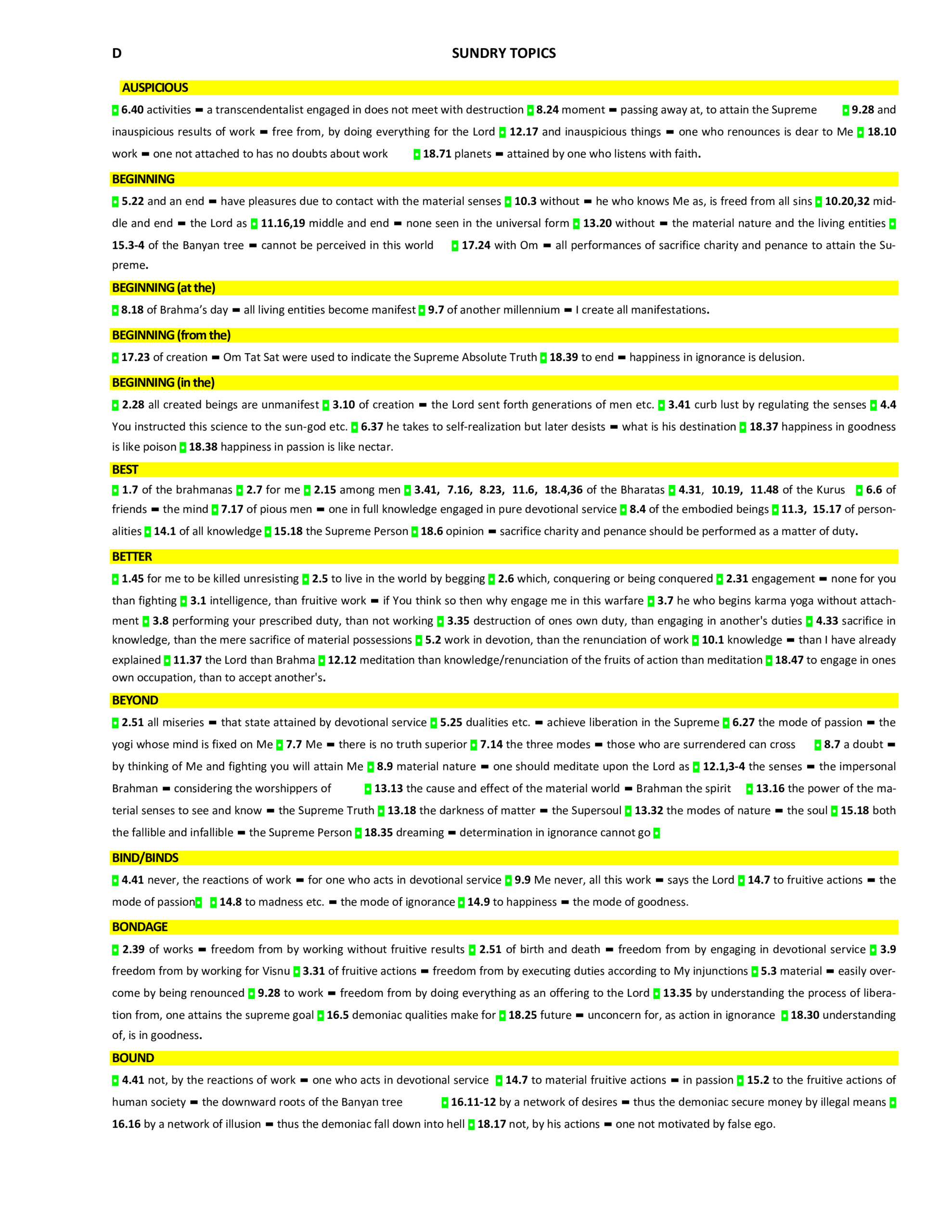
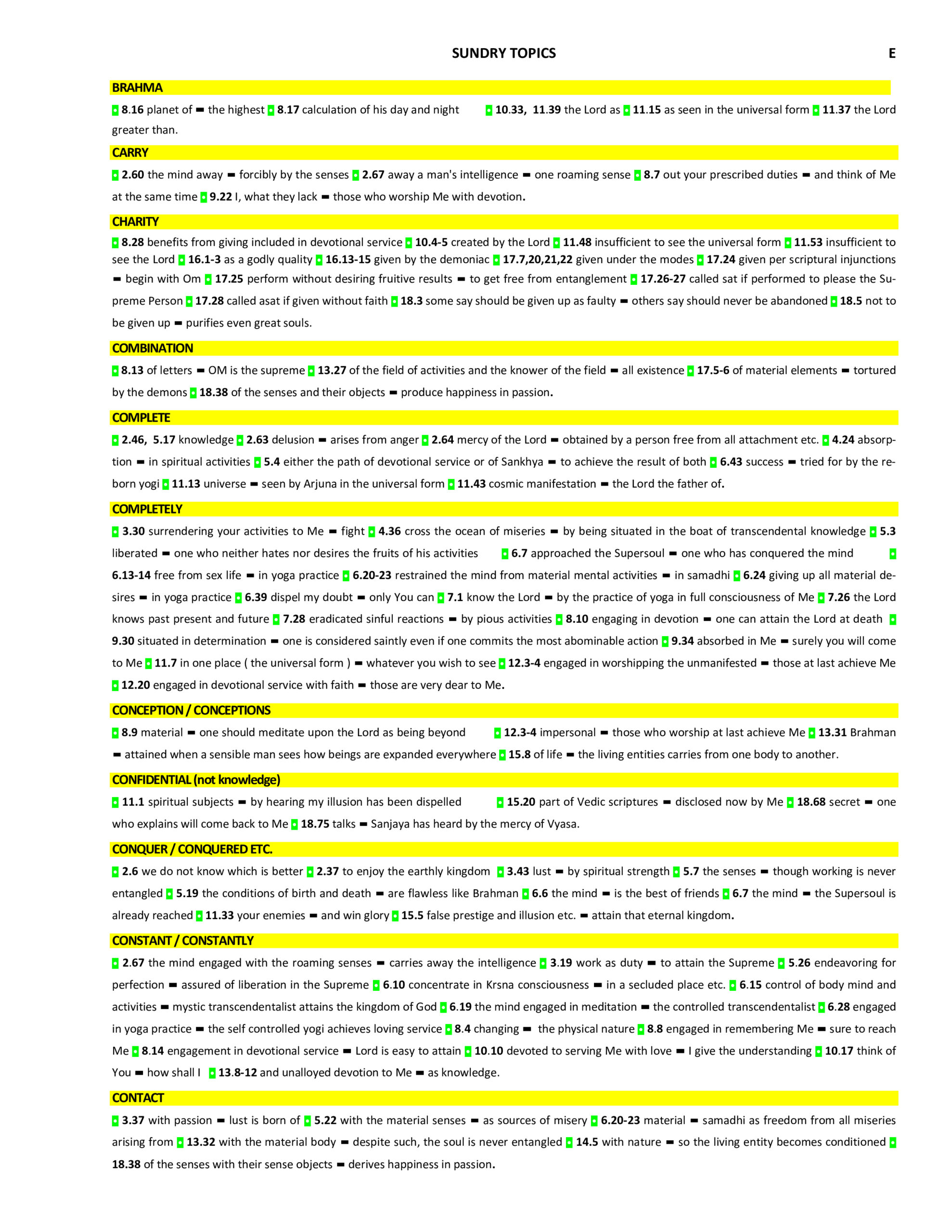
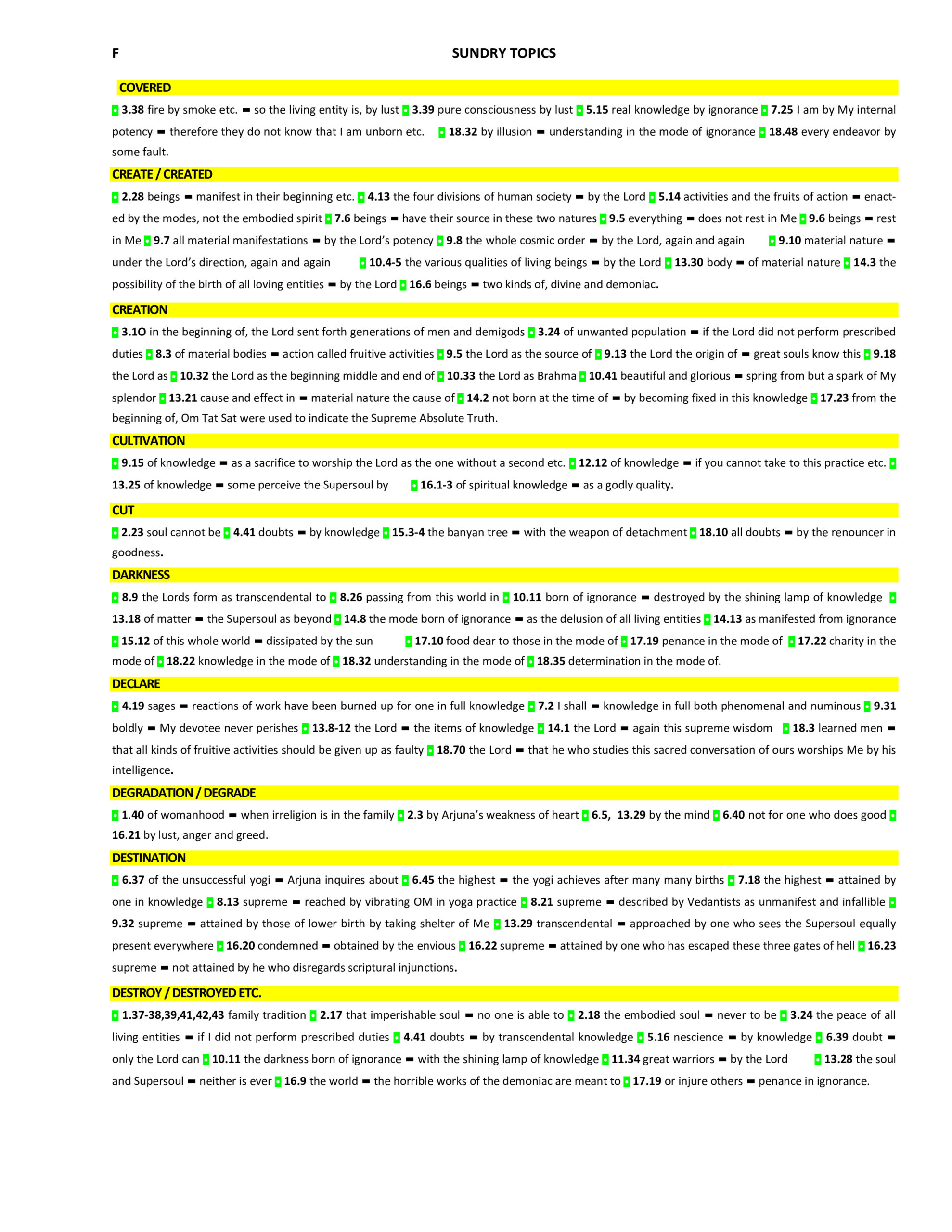

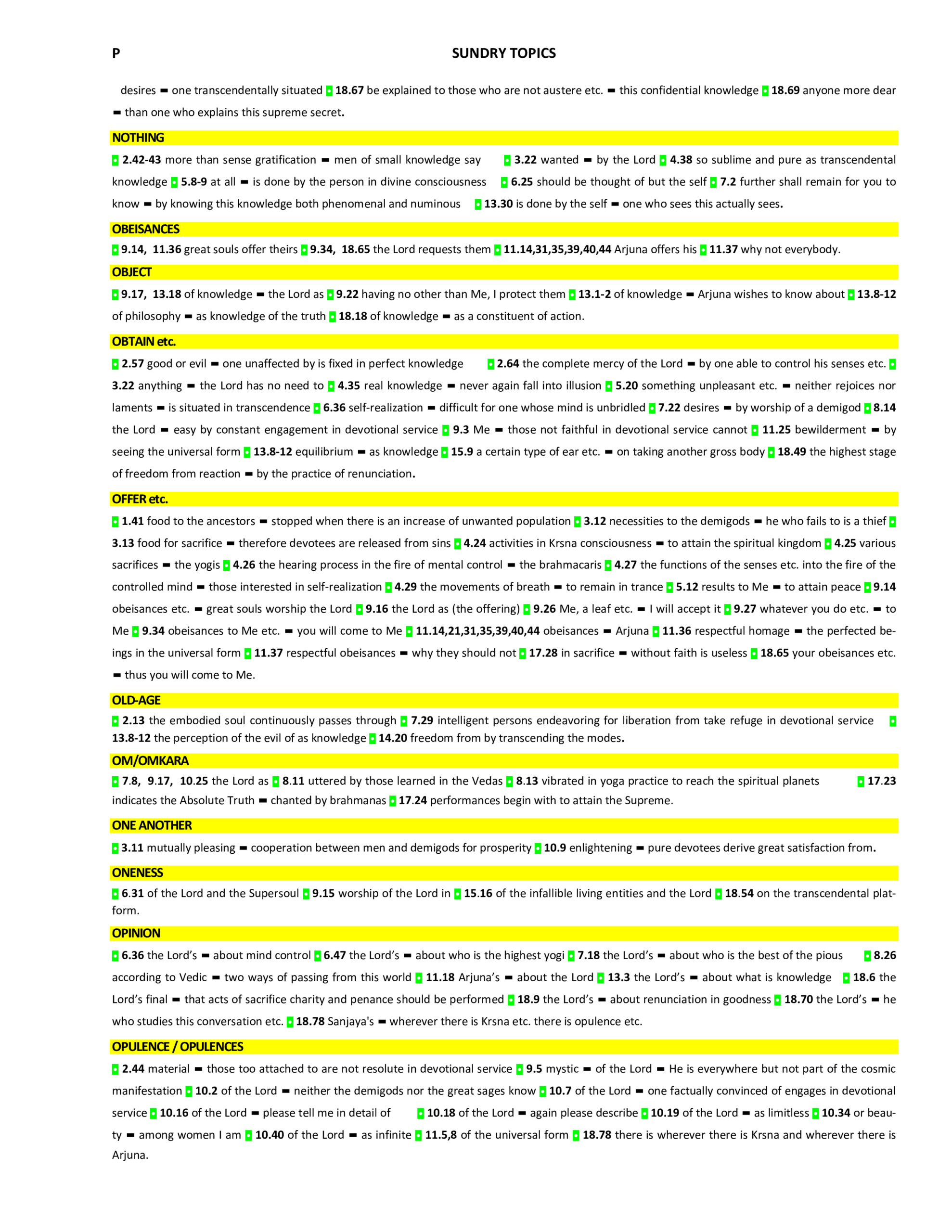
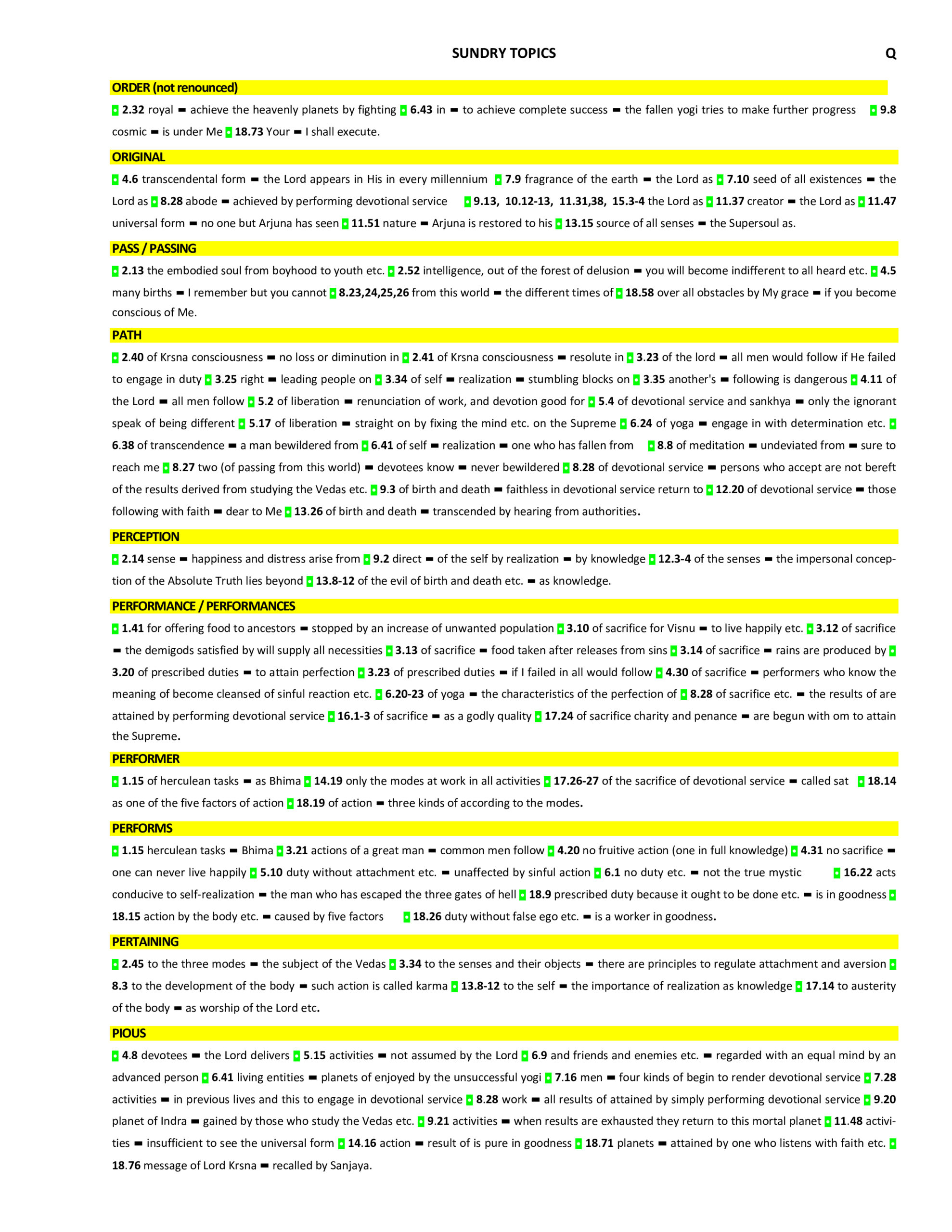
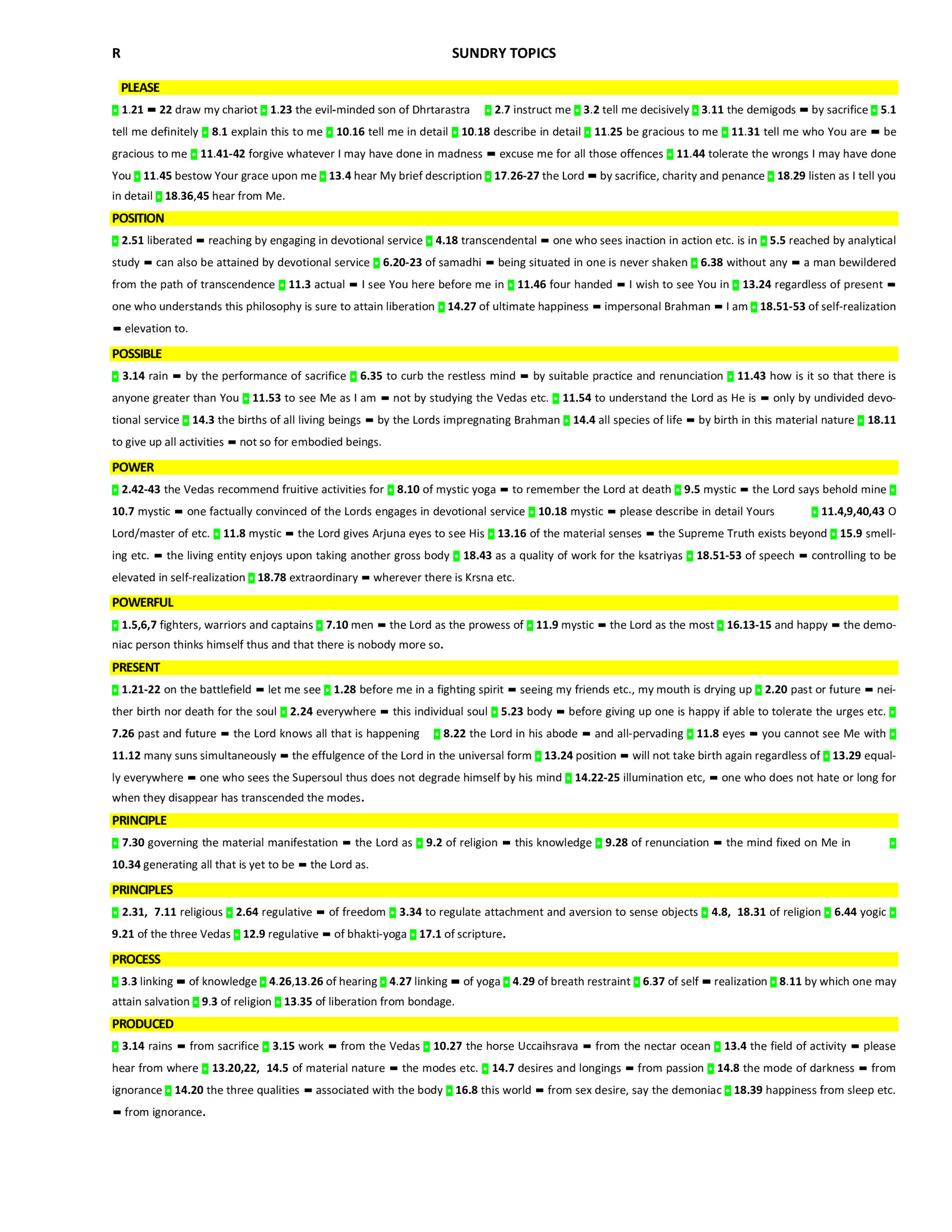
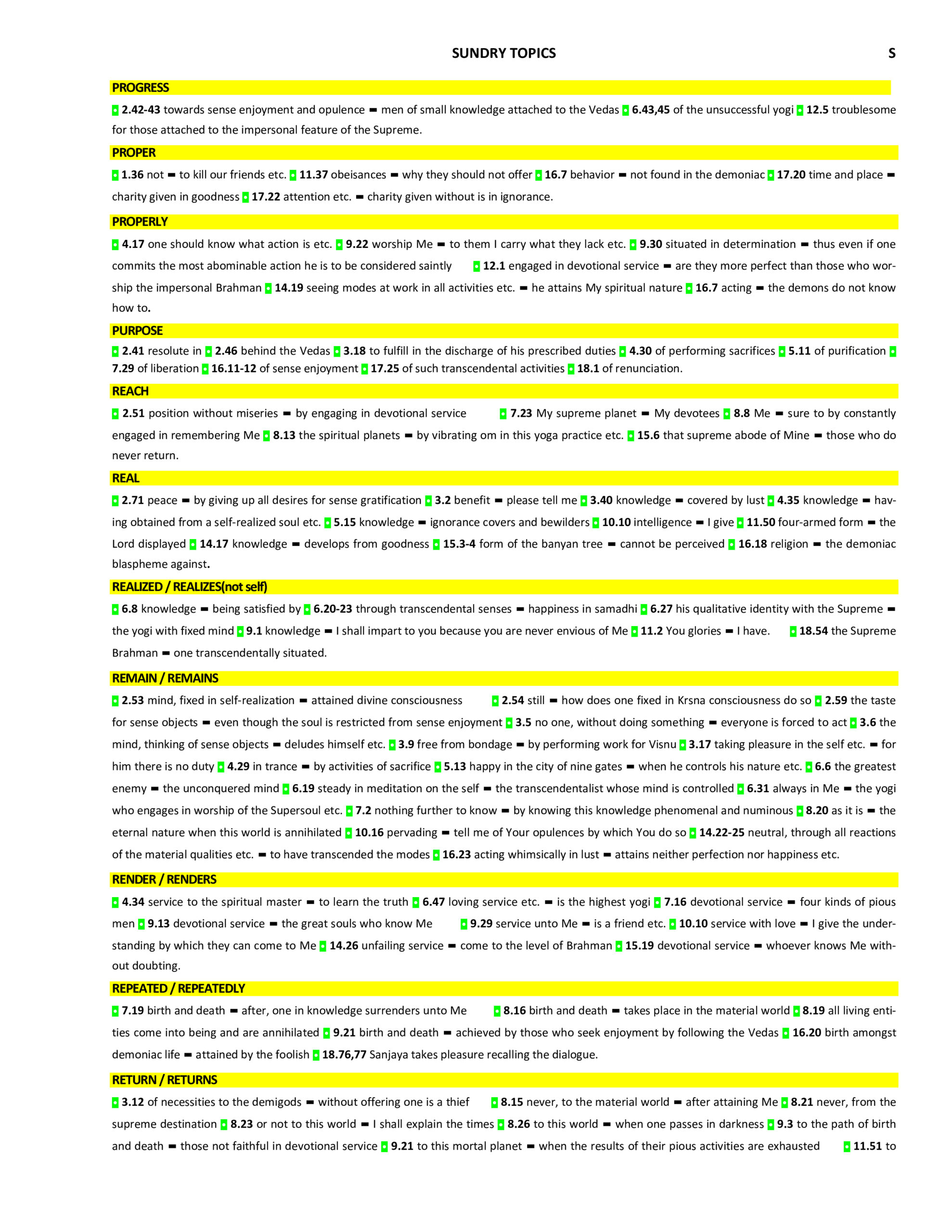

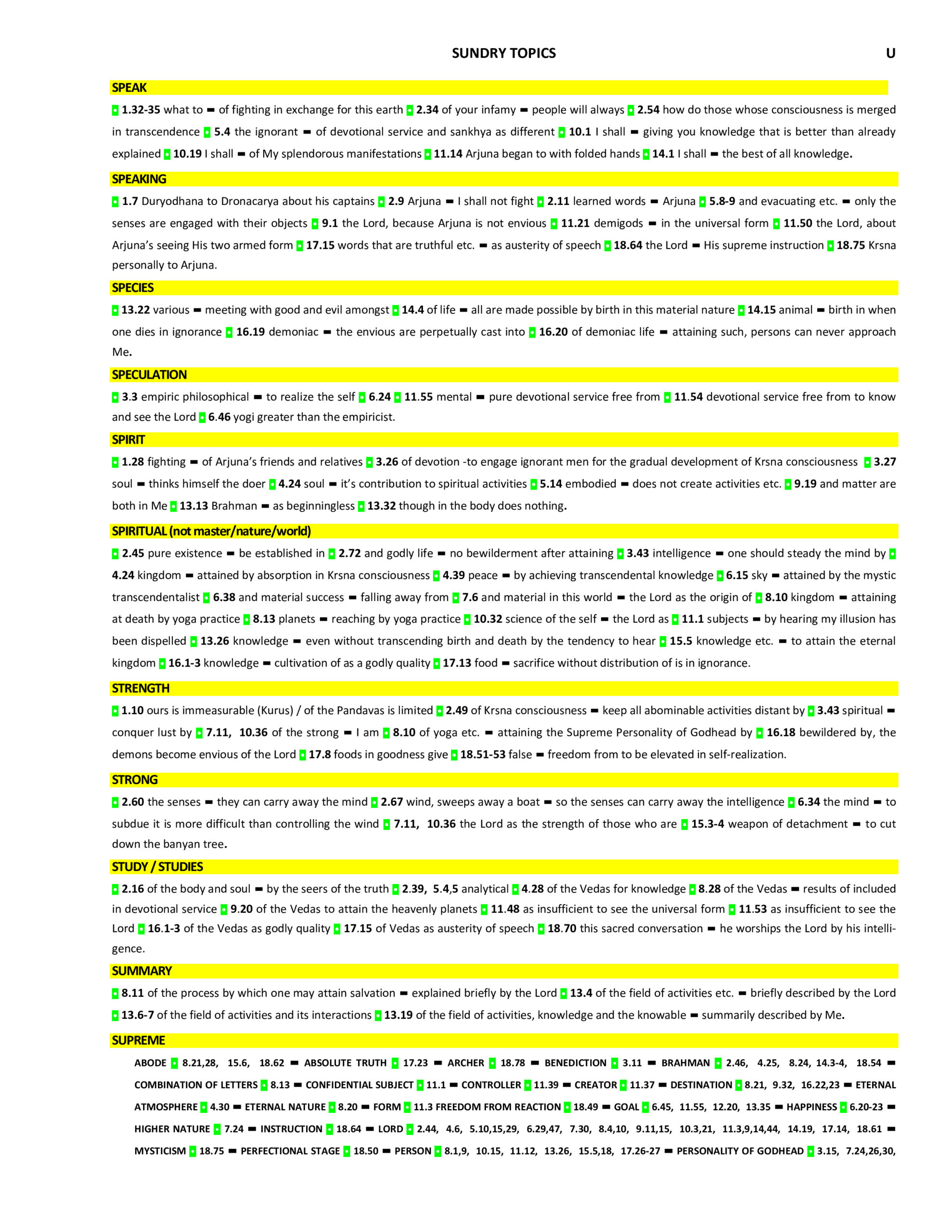
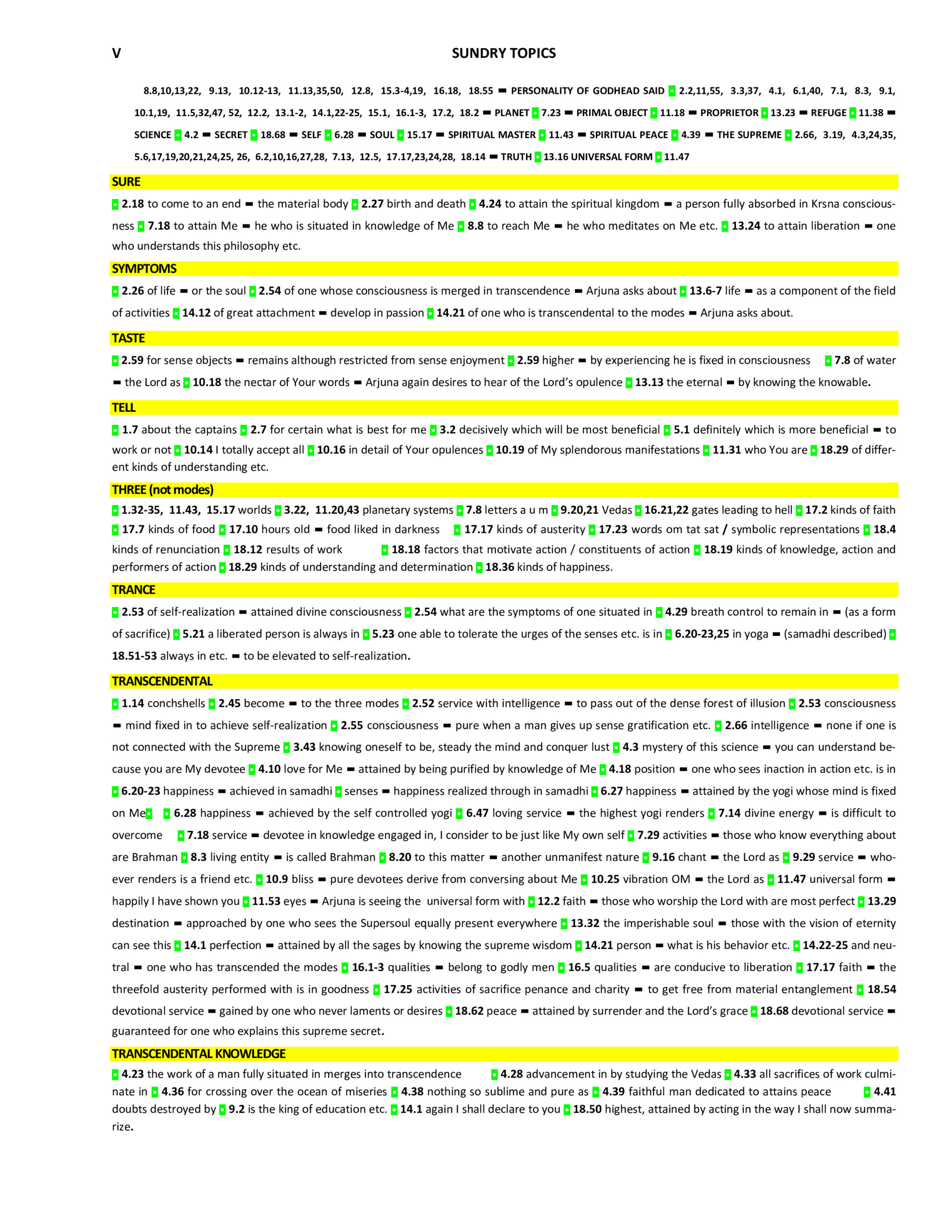
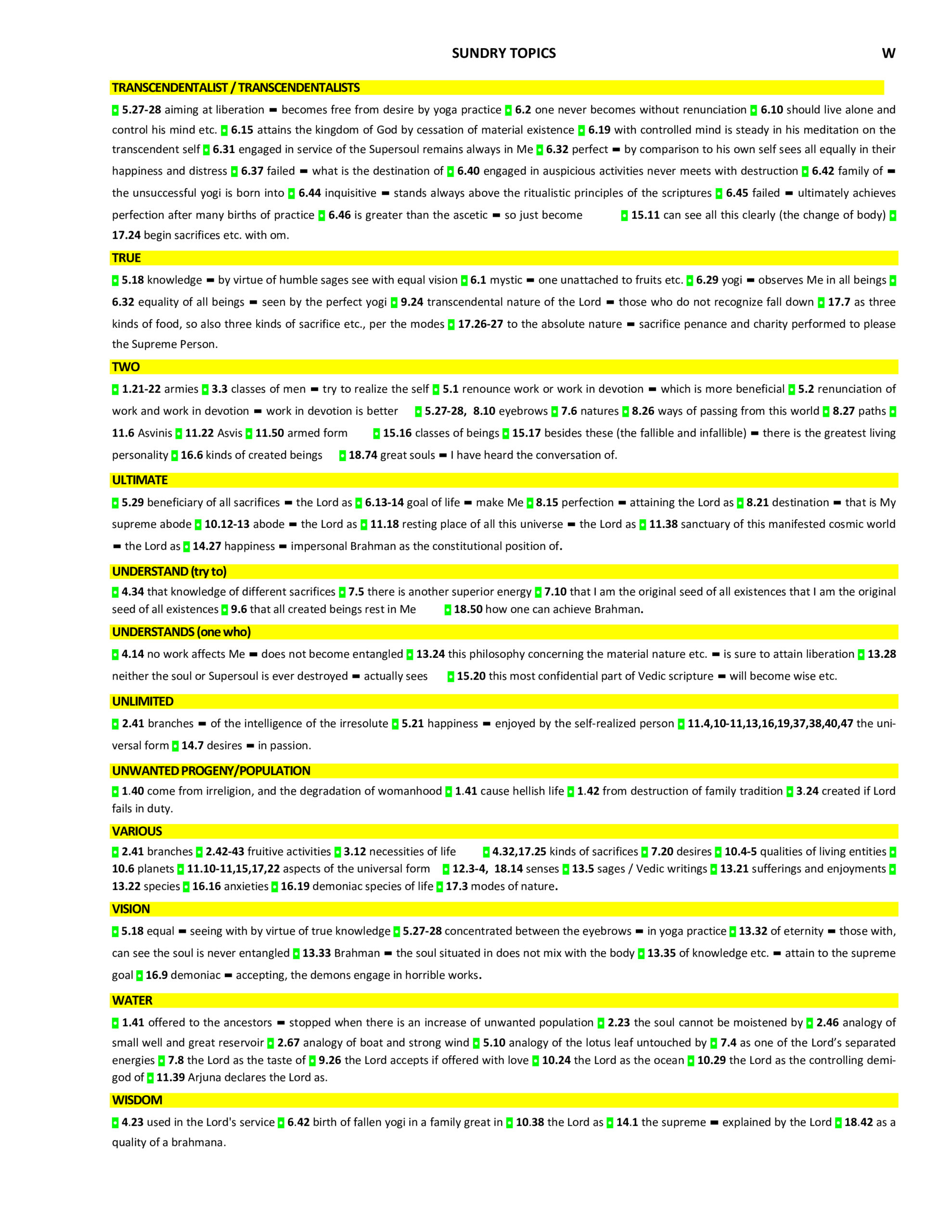
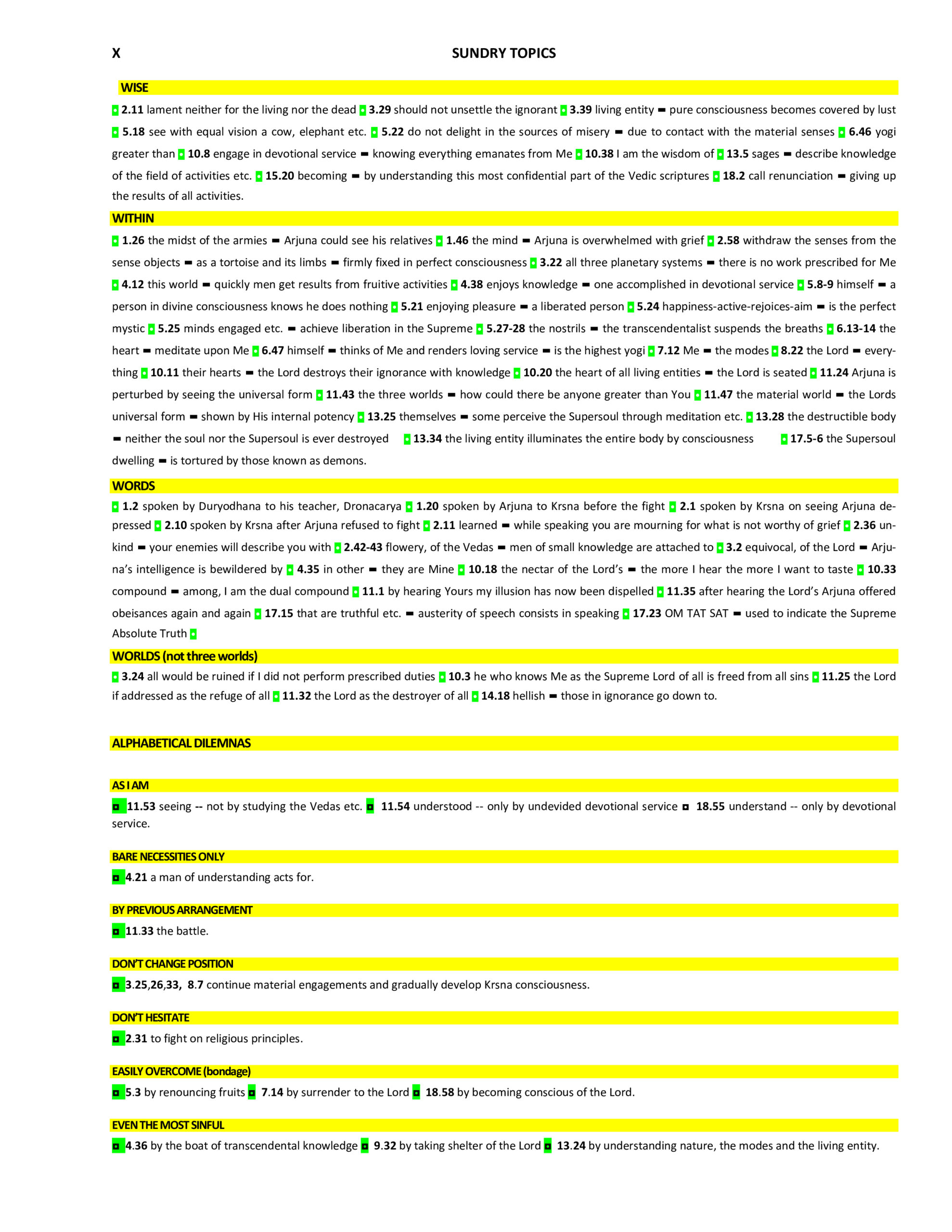

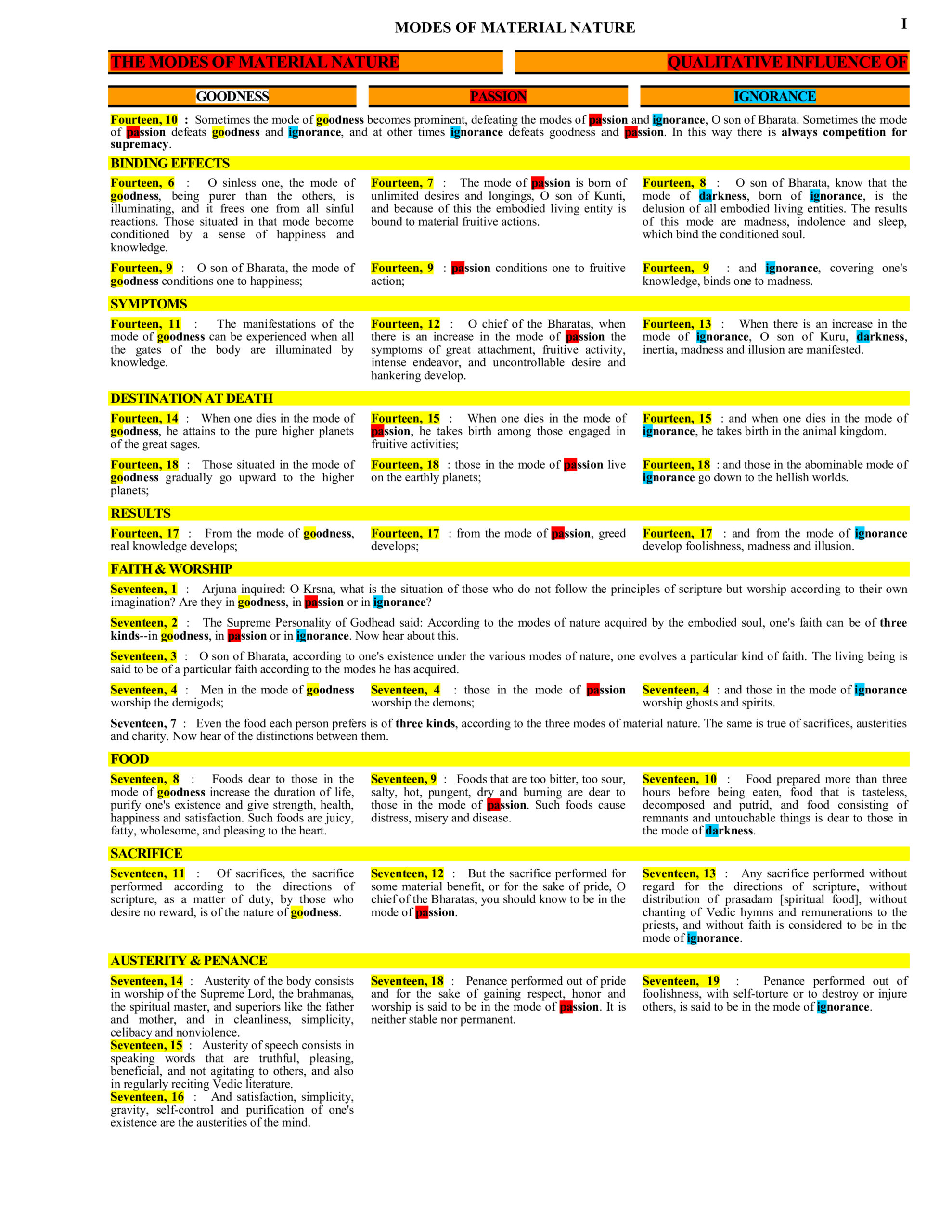
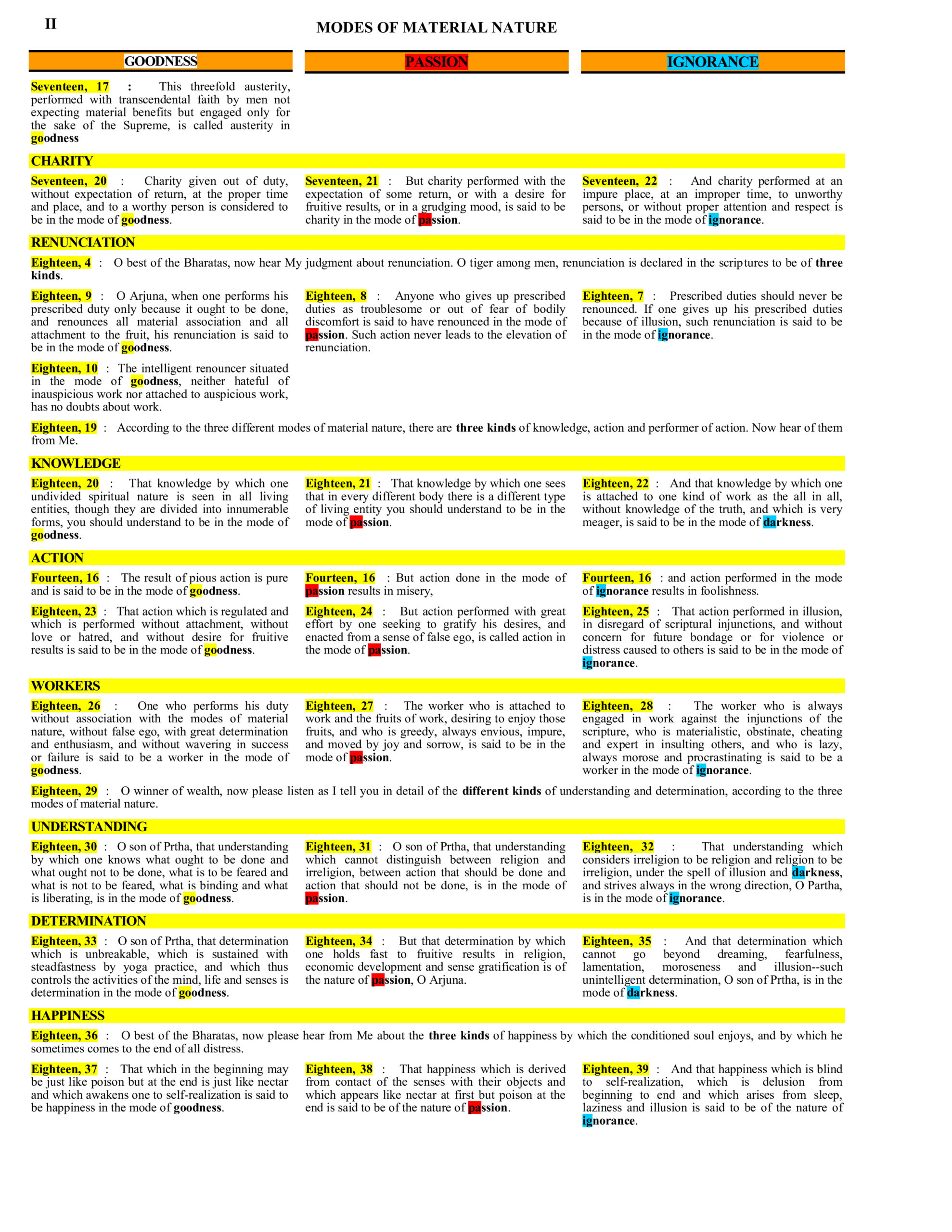
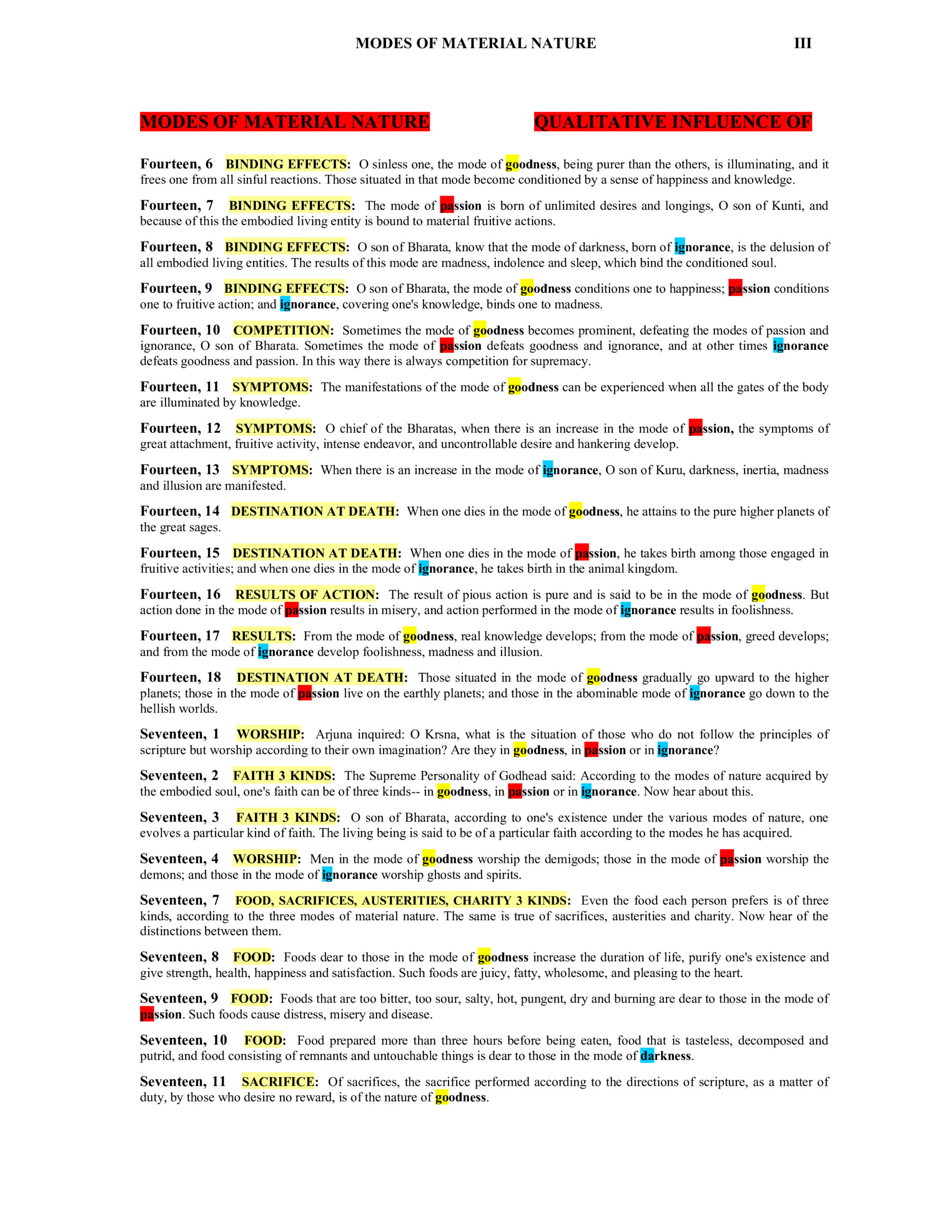
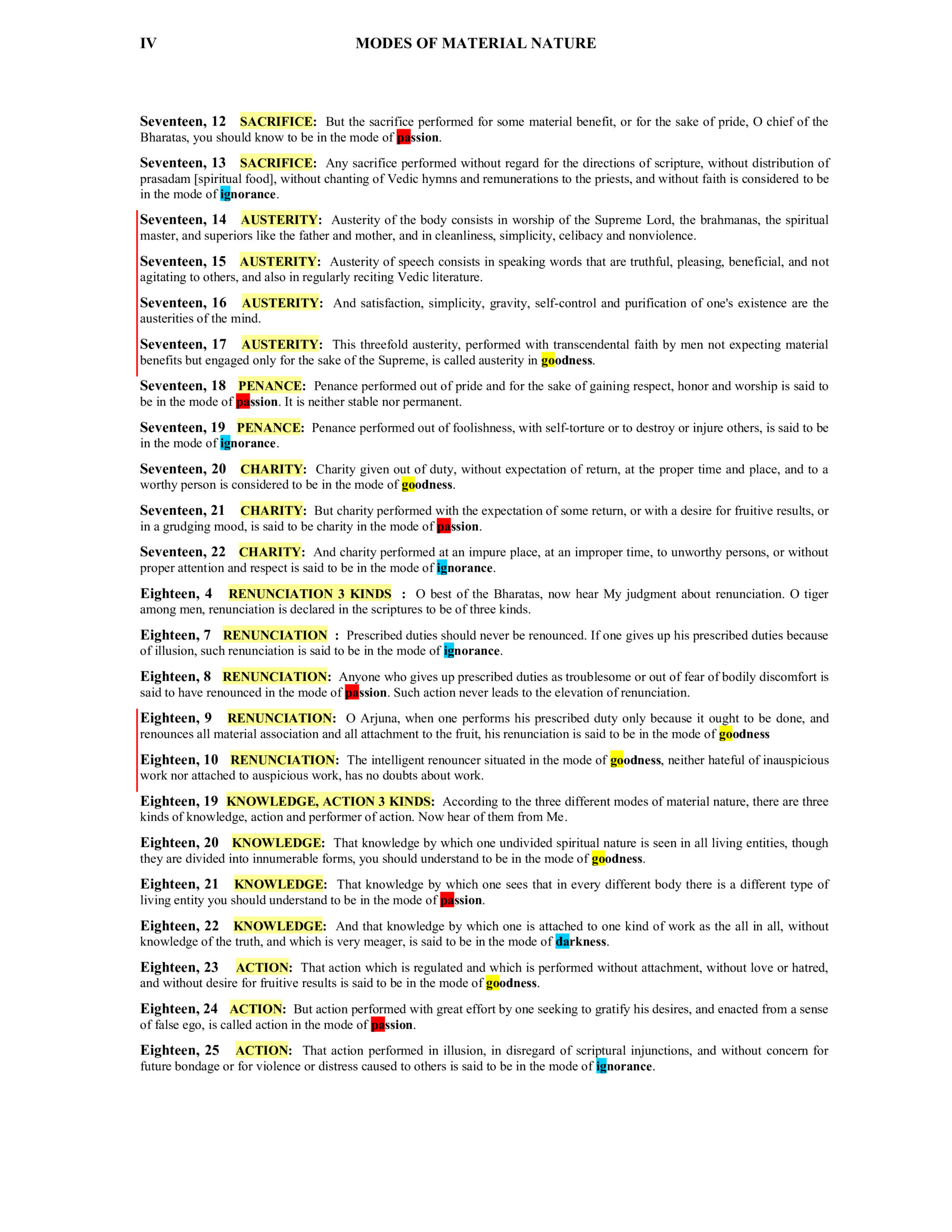
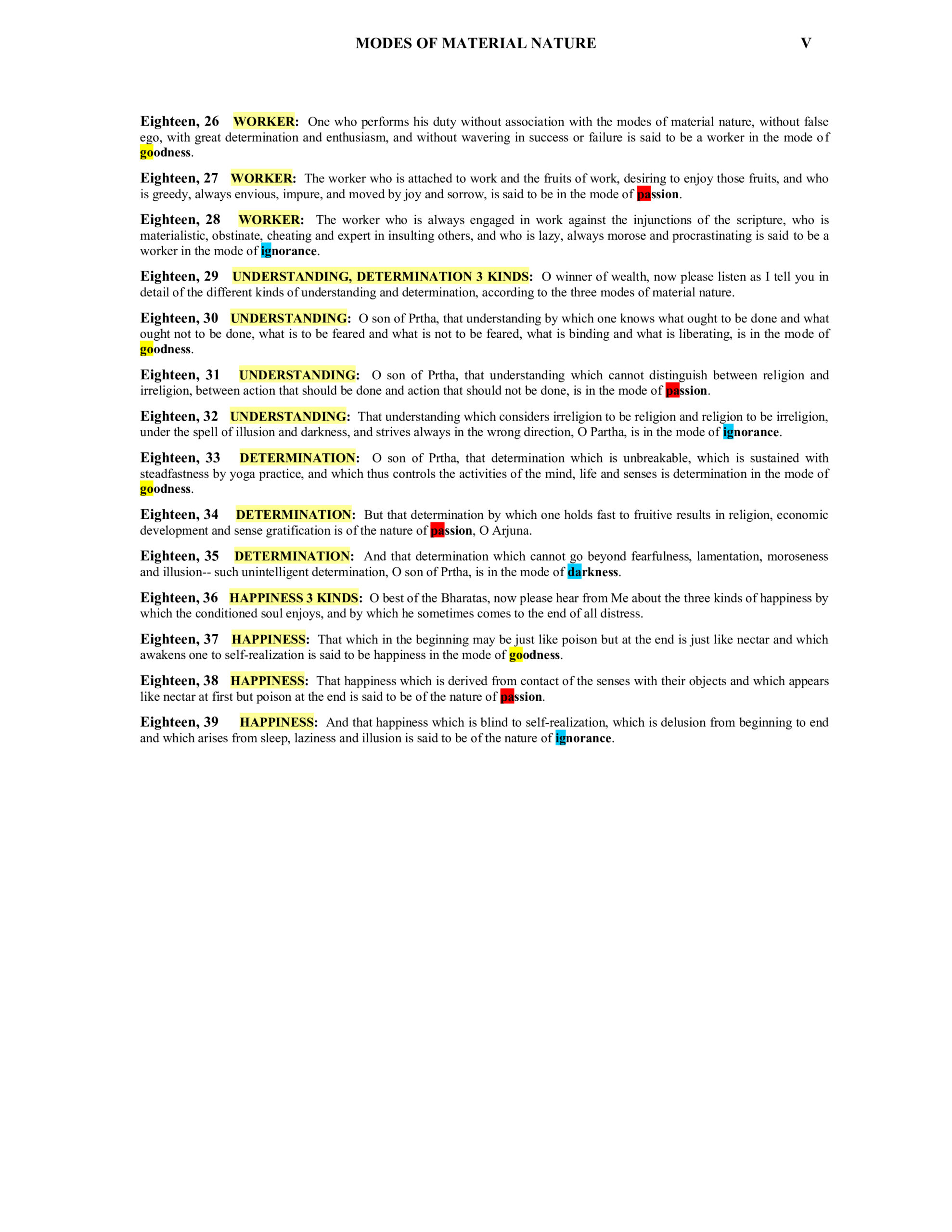
ability, 2.36, 6.20-23, 7.8
abstaining, 3.4, 6.16
accomplished, 4.38
affectionate, 6.9
aloof, 5.8-9
analytical, 2.39, 5.4,5
aristocratic, 16.13-15
arrogance, 16.4
ascetic, 6.46, 7.9
astonished, 11.14
atheistic, 7.15, 9.12
attentive, 18.72
aversion, 2.64, 3.34, 16.1-3
bad, 2.50, 13.22, 17.10
beautiful, 10.41, 11.50,51
befooled, 3.29,32
busy, 5.25
care, 2.6, 3.23, 12.16,18-19
celibacy, 6.13-14, 8.11, 17.14
cheating, 18.28
cheats, 10.36
compassion, 1.27, 2.1, 5.7, 16.1-3
complacent, 16.17
composure, 2.7
conceit, 16.4,10
concentrated, 5.27-28
concentrates, 5.21
concern, 18.25
confused, 2.7
contemplating, 2.62
conviction, 6.25, 13.6-7
convinced, 10.7
corrupt, 1.41
courage, 18.43
covetousness, 16.1-3
decisively, 3.2
dedicated, 4.39, 8.7
deliberate, 3.43, 18.63
depend, 3.18, 12.16, 18.57
depressed, 2.1
deride, 9.11
despising, 2.57
discipline, 5.26, 6.18, 12.5
discomfort, 18.8
discrimination, 2.60, 18.30,63
elated, 2.56
eligible, 2.15, 4.39
endurance, 2.16
enlightened, 4.28, 5.16, 10.9
enthusiasm, 18.26
equivocal, 3.2
exemplary, 3.21
experienced, 1.9, 14.11
expert, 1.3, 12.16, 18.28
false prestige, 15.5, 16.10,17
false strength, 18.51-53
familiarity, 11.44
faultfinding, 16.1-3
flawless, 5.19
flickering, 6.26
forgetfulness, 1.30, 15.15
forgiveness, 10.4-5, 11.41-42, 12.13-14, 16.1-3
fortitude, 16.1-3
generosity, 18.43
gentle, 5.18, 16.1-3
gladdened, 11.45
godly, 2.72, 9.20, 16.1-3,6
grace, 11.25,45, 18.56,58,62
gracious, 11.25,31,45
gravity, 17.16
grief, 1.46, 2.8,10,11,25,30, 12.17
grudging, 17.21
harshness, 16.4
helplessly, 3.5, 8.19
heroic, 1.4,5, 18.43
hesitation, 2.31
honesty, 6.9, 18.42
hope, 9.12, 16.11-12
humility, 5.18, 13.8-12
illumination, 14.6,11,22-25
imagination, 17.1
impertinence, 11.44
impetuous, 2.60
impotence, 2.3
impudence, 11.44, 16.17
impure, 17.22, 18.27
impurities, 2.2
indifferent, 2.52
indolence, 14.8
inertia, 14.13
inquisitive, 6.44, 7.16
insignificant, 2.35
insulting, 18.28
introspective, 2.69
irresolute, 2.41
kind, 2.36, 12.13-14
lack, 3.29, 9.22
lawlessness, 10.38
laziness, 3.29, 14.8, 18.28,39
leadership, 18.43
lethargy, 3.30
madness, 11.41-42, 14.8,9,13,17
magnanimous, 7.18
materialistic, 18.28
memory, 2.63, 10.34, 18.73
mercy, 16.1-3, 18.75
mischievous, 16.19
miserliness, 2.7,49
misgivings, 5.17
modesty, 16.1-3
morality, 10.38, 18.78
moroseness, 18.28,35
motivated, 18.17
mourning, 2.11
nonviolence, 10.4-5, 13.8-12, 16.1-3, 17.14
obligated, 6.1
obstinate, 6.34, 18.28
overwhelmed, 1.27,46, 2.1, 11.14
pain, 2.14,36, 6.17, 12.16, 16.9
partial, 9.29
patience, 10.34
perplexed, 16.16
perturbed, 11.20,23,24,45,49
petty, 2.3
pleased, 3.11, 10.9, 11.25,49
pleasing, 3.11, 17.8,15
polluted, 1.40
possessiveness, 6.10
pretender, 3.6
procrastinating, 18.28
proper, 1.36
prosperous, 2.8, 3.10,11, 6.41
prowess, 7.10
quarreling, 1.37-38
reasoning, 13.5
reeling, 1.30
relaxed, 11.41-42
repression, 3.33
resolute, 2.41,44
resourcefulness, 18.43
restless, 6.33,34,35
rich, 6.41
richest, 16.13-15
righteous, 6.41, 9.31,33
saintly, 9.30
sameness, 5.19
sane, 16.21
satiated, 3.17, 10.18
scorn, 2.36
sensible, 13.31
serious, 11.48,53
severe, 4.28, 11.48, 17.5-6
shaken, 6.20-23
silent, 2.9, 10.38, 12.18-19
simplicity, 13.8-12, 16.1-3, 17.14,16
sincere, 3.7, 6.45
sober, 2.13
steadfastness, 10.34, 18.33
striving, 12.16
submissively, 4.34
thoughtful, 5.6
trained, 15.10
tranquility, 6.7, 11.24, 16.1-3
trembling, 1.29, 11.35
truthfulness, 10.4-5, 16.1-3, 17.15
turbulent, 6.34
unable, 1.30, 12.11
unaffected, 2.57, 5.10
unagitated, 6.13-14
unclean, 16.10,16, 18.27
unconquerable, 1.16-18
uncontrollable, 14.12
undisturbed, 14.22-25
unfailing, 14.26
unkind, 2.36
unresisting, 1.45
unwavering, 14.22-25
unwillingly, 3.36
unworthy, 17.22
vigor, 16.1-3
violence, 18.25
voracious, 1.15
waver, 6.19
wavering, 18.26
weakness, 2.3,7
worldly, 2.5, 6.37
worry, 16.5
worthy, 2.4,11, 17.20
WORD REFERENCE






A |
abandon, 6.24, 18.66
abandoned, 18.3
abides, 6.47
ability, 2.36, 6. 20-23, 7.8
abominable, 2.49, 9.30, 14.18
above, 6.44, 7.13
absence, 13.8-12
abstaining, 3.4, 6.16
accompanying, 13.28
accomplish, 3.33
accomplished, 4.38
accomplishment, 18.13
accord, 4.22
accordance, 17.24, 18.41
accordingly, 4.11
accrue, 18.12
acquired, 3.5,33, 6.8, 17.2,3
acted, 4.15, 7.28
active, 3.7, 5.24,25, 14.22-25
actual, 6.13-14,20-23, 11.3
actuality, 3.27, 7.22
actually, 5.4,8-9,24, 7.19,29
addressed, 1.24, 11.41-42
adhering, 9.21
adhibhuta, 8.4
adhidaiva, 8.4
adhiyajna, 8.4
adhyatma, 8.3
adorned, 11.17
adventure, 10.36
affected, 4.21, 18.47
affectionate, 6.9
affects, 4.14
ages, 8.17
aggregate, 13.6-7
aggressors, 1.36
agitating, 17.15
aim, 2.41, 5.24
aiming, 5.27-28
alas, 1.44
alike, 14.22-25
all-devouring, 3.37, 10.34
all-expanding, 11.10- 11
allied, 11.26-27
all-inclusive, 7.6
along, 1.36,46, 3.10, 11.26-27
aloof, 5.8-9
amazing, 2.29
amid, 13.8-12
amidst, 2.56
analytical, 2.39, 5.4,5
ancestors, 1.41, 9.16,25, 10.29
ancient, 4.3,15
animal, 14.15
annihilate, 4.8
annihilated, 2.28, 8.19,20, 9.8,10
another’s, 3.35, 18.47
anyone’s, 5.15
appear, 4.6,8
appearance, 2.14, 4.9, 11.2
appears, 4.2, 6.33, 13.17, 18.38
applies, 5.4
approaching, 4.34, 13.8-12
appropriate, 6.36
approved, 4.32
aquatics, 10.29
archer, 1.16-18, 18.78
arise, 2.3,14,55, 5.25
arisen, 4.42, 7.27
arises, 2.62,63, 18.39
arising, 6.20-23
aristocracy, 6.41
aristocratic, 16.13-15
armies, 1.21- 22,24,26, 2.10
arms, 1.21-22, 11.16,19,23
army, 1.2,3,4,11
aromas, 15.8
arranged, 1.2,3
arrangement, 11.33
array, 1.20
arrival, 8.19
arrives, 8.19
arrogance, 16.4
arrows, 1.20,46, 2.4
art, 2.50
asat, 17.28
ascetic, 6.46
ascetics, 7.9
ashes, 4.37
aside, 1.46, 4.9, 18.51-53
ask, 5.1, 6.39
asking, 2.7
aspire, 4.14
assembled, 1.1,23,25, 11.15
associated, 4.13, 14.20
assume, 5.15
assumed, 7.24
assured, 5.26, 6.36
astonished, 11.14
ate, 11.41-42
atheistic, 7.15, 9.12
atmosphere, 4.30
attention, 6.11-12, 10.8, 17.22, 18.72
attentive, 18.72
authorities, 4.15, 13.26
automatically, 6.44, 8.19, 9.8
avail, 1.32-35
aversion, 2.64, 3.34, 16.1-3
awakening, 2.69
awakens, 18.37
awful, 11.25
b |
back, 2.51, 6.26, 8.23,25,26, 18.68
bad, 2.50, 13.22, 17.10
balance, 11.25, 15.14
banyan, 10.26, 15.1,3-4
bare, 4.21
based, 4.19, 18.2
basis, 9.18, 11.18, 14.27
battle, 1.8,31, 2.4, 11.34, 18.43
battlefield, 1.32- 35,45,46, 2.6,35,37
bearing, 1.20, 10.35
beasts, 10.30
beautiful, 10.41, 11.50,51
bed, 11.41-42
befitting, 2.2
befooled, 3.29,32
began, 11.14, 15.3-4
begging, 2.5
begin, 7.16, 13.26, 17.24
beginningless, 10.3, 13.13,20
begins, 3.7, 15.3-4, 18.15
behavior, 14.21, 16.7
behind, 2.46, 11.40
behold, 1.3,25, 9.5, 11.4,6,7,8,52
beholding, 11.22
believe, 16.11-12
bellies, 11.16,23
benefactor, 5.29
benefactors, 6.9
beneficial, 3.2, 5.1, 17.15
beneficiary, 5.29
benefit, 3.2, 10.1, 17.12, 18.64
benefits, 7.22, 17.17
bereft, 3.32, 8.28
besides, 7.5, 11.47, 13.8-12, 15.17
bestow, 3.10, 11.45
bestowed, 7.22
binding, 18.30
birds, 10.30
bitter, 17.9
blame, 14.22-25
blaspheme, 16.18
blazing, 4.37, 11.17,19,25,28,29, 30
blessed, 3.10
blew, 1.12,15,16-18
blind, 18.39
bliss, 10.9
blocks, 3.34
blood, 2.5
blowing, 1.19, 5.27- 28, 9.6
boat, 2.67, 4.36
boldly, 9.31
bona fide, 13.8-12, 17.26-27
bore, 11.10-11
boundless, 6.20-23
bow, 1.20,29,46
bowed, 11.14
bowing, 9.14
bowmen 1.4
boyhood, 2.13
brahmacaris, 4.26
brahmana, 5.18
brahmanas, 9.33, 17.14,23, 18.41,42
branched, 2.41
branches, 2.41, 15.1,2
breath, 4.27,29
breathing, 4.29, 5.8-9
breaths, 5.27-28
brief, 13.4
briefly, 8.11
brilliant, 11.10-11
bring, 6.26
broken, 4.2
brothers, 1.26,32-35
bugles, 1.13
burn, 4.37
burned, 2.23,24, 4.19
burning, 1.29, 11.19, 17.9
burns, 3.39
business, 18.44
busy, 5.25
butter, 4.24, 9.16
c |
calculation, 8.17
captains, 1.7
care, 2.6, 3.23, 12.18-19
carefully, 1.10, 3.23, 6.10
cares, 12.16
carried, 3.27, 6.25
carries, 15.8
carry, 8.7, 9.22
cast, 1.46, 16.19
cease, 1.37-38, 2.12, 6.20-23
ceases, 2.59, 13.31
ceasing, 2.59
celebrated, 15.18
celestial, 9.20, 11.10- 11
celibacy, 6.13-14, 8.11, 17.14
certain, 2.7, 7.6, 13.5, 15.9, 18.78
cessation, 6.3,15
chain, 4.2
change, 2.13,16, 18.26
changes, 13.4
changing, 8.4
chant, 9.16
characterized, 6.20-23
charge, 3.12
chariot, 1.6,14,20,21- 22,24,46
cheating, 18.28
cheats, 10.36
check, 5.23
chief (not as Arjuna address), 10.24, 11.26-27,43
chieftains, 1.25
children, 1.41,42, 10.28, 13.8-12
churning, 10.27
circumstances, 6.31,46, 14.26
city, 5.13,14
civilization, 16.11-12
claims, 3.30
classes, 3.3, 15.16
cleansed, 4.30, 5.17
clearly, 15.11
closing, 5.8-9, 8.12
cloth, 6.11-12
cloud, 6.38
club, 11.46
clubs, 11.17
cold, 6.7, 12.18-19
colors, 11.5,24
combination, 8.13, 13.27, 17.5-6, 18.13
combined, 1.13
come back, 8.23,26
coming, 2.20, 11.19
commit, 1.44
commits, 9.30
common, 3.21
community, 1.42
comparison, 6.32
compassion, 1.27, 2.1, 16.1-3
compelled, 18.60
competition, 14.10
compiler, 10.37, 15.15
complacent, 16.17
composed, 11.51
composure, 2.7
compound, 10.33
comprises, 7.5
conceit, 16.4,10
concentrated, 5.27-28
concentrates, 5.21
conception, 8.9
concern, 18.25
concerning, 13.24
conch, 1.15,16-18, 11.46
conchshells, 1.12,13,14,15,16- 18,19
concluded, 2.16
conclusions, 16.9
conclusive, 10.32
concoction, 2.55
condition, 2.7, 9.12, 14.5
conducive, 16.5,22
confirm, 10.12-13
confused, 2.7
connected, 2.66, 5.21
conquer, 2.6,37, 3.43, 11.33,34
consequently, 3.15
consider, 2.35,47, 7.18
considering, 2.31,38, 3.20, 5.8-9, 11.55, 18.16,25
considers, 6.20-23, 18.32
consisting, 7.14, 17.10
consists, 14.5, 17.14,15
constituents, 18.18
constitute, 7.4
constituted, 13.4
constitutional, 14.27
consummation, 4.24
contaminating, 12.18-19
contamination, 6.28
contaminations, 6.45, 11.55
SUMMARY VERSES
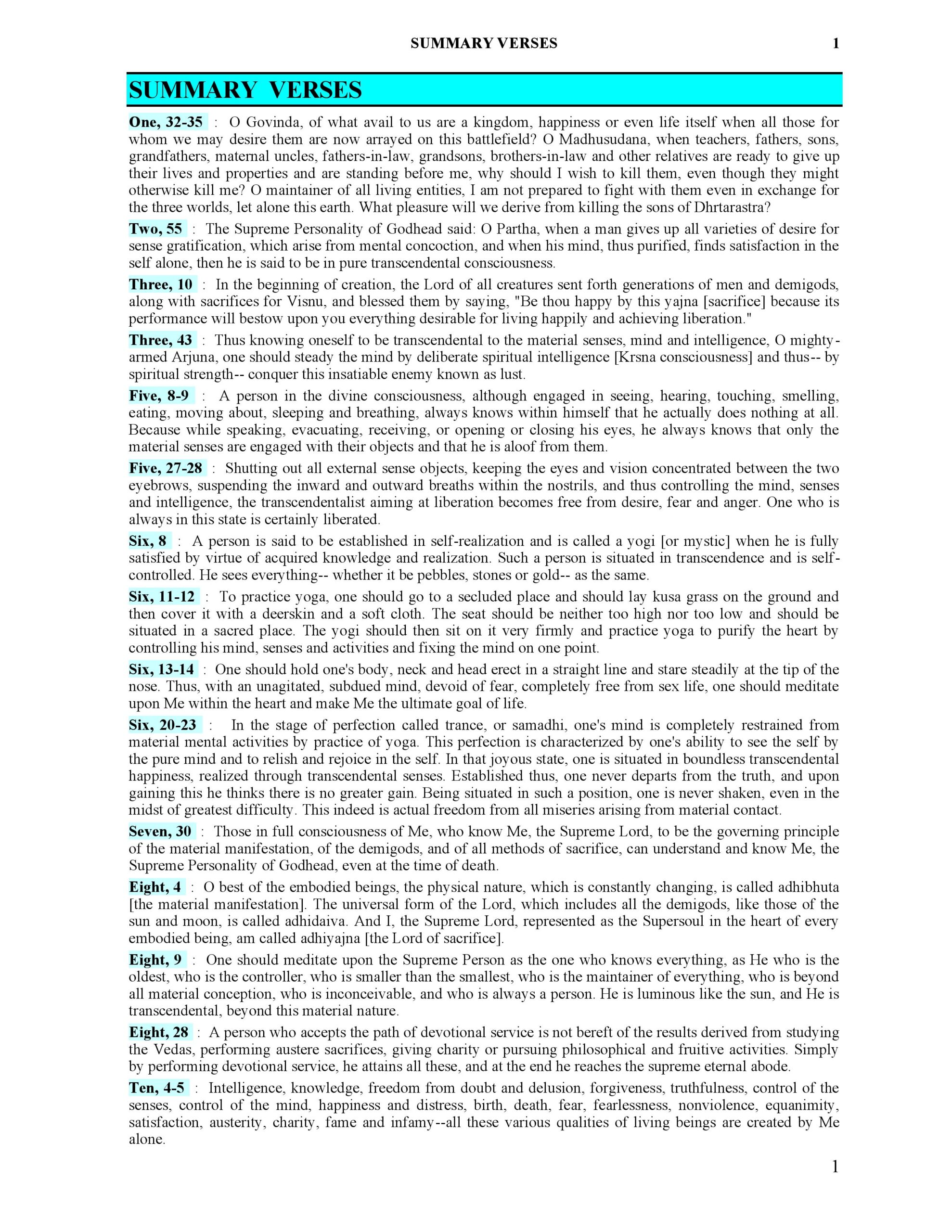
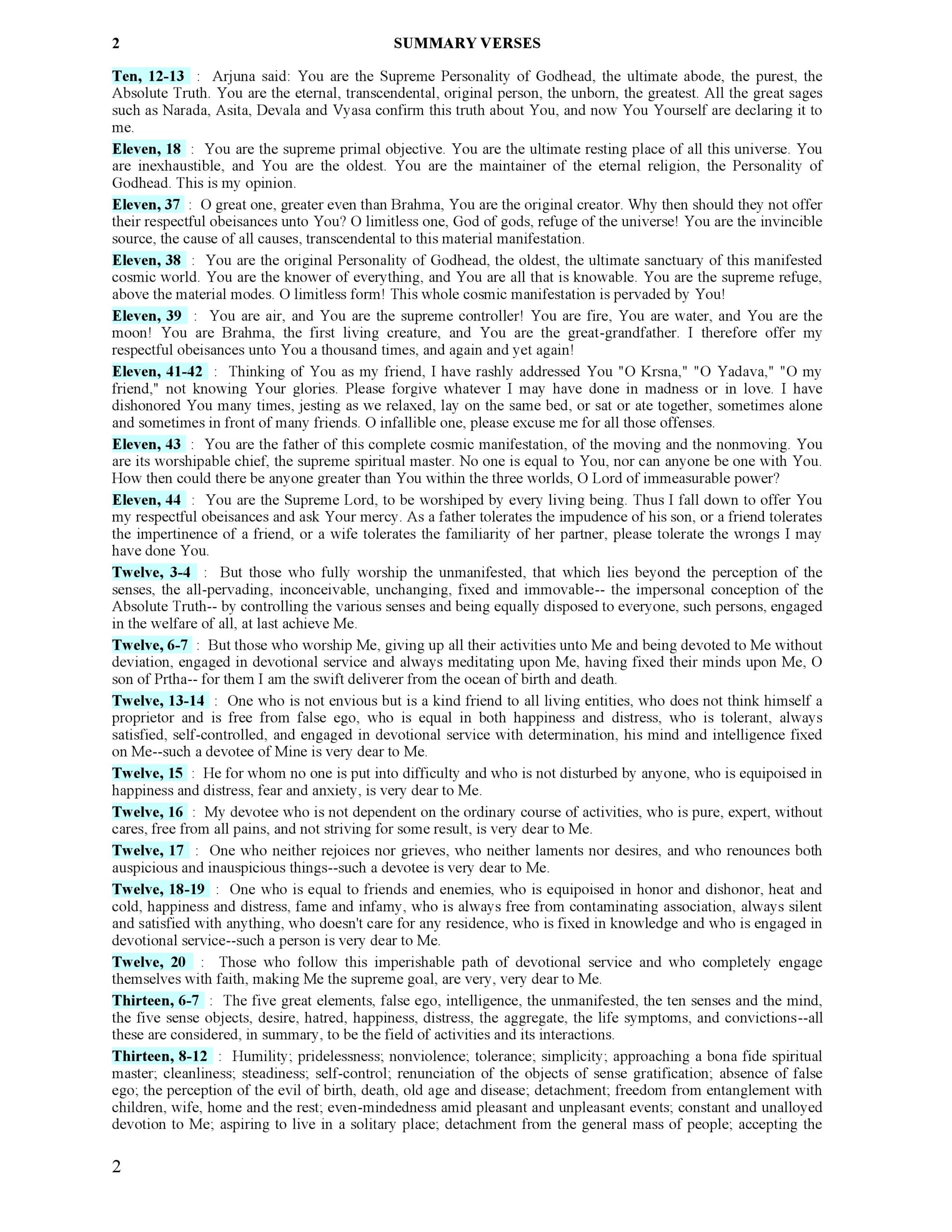
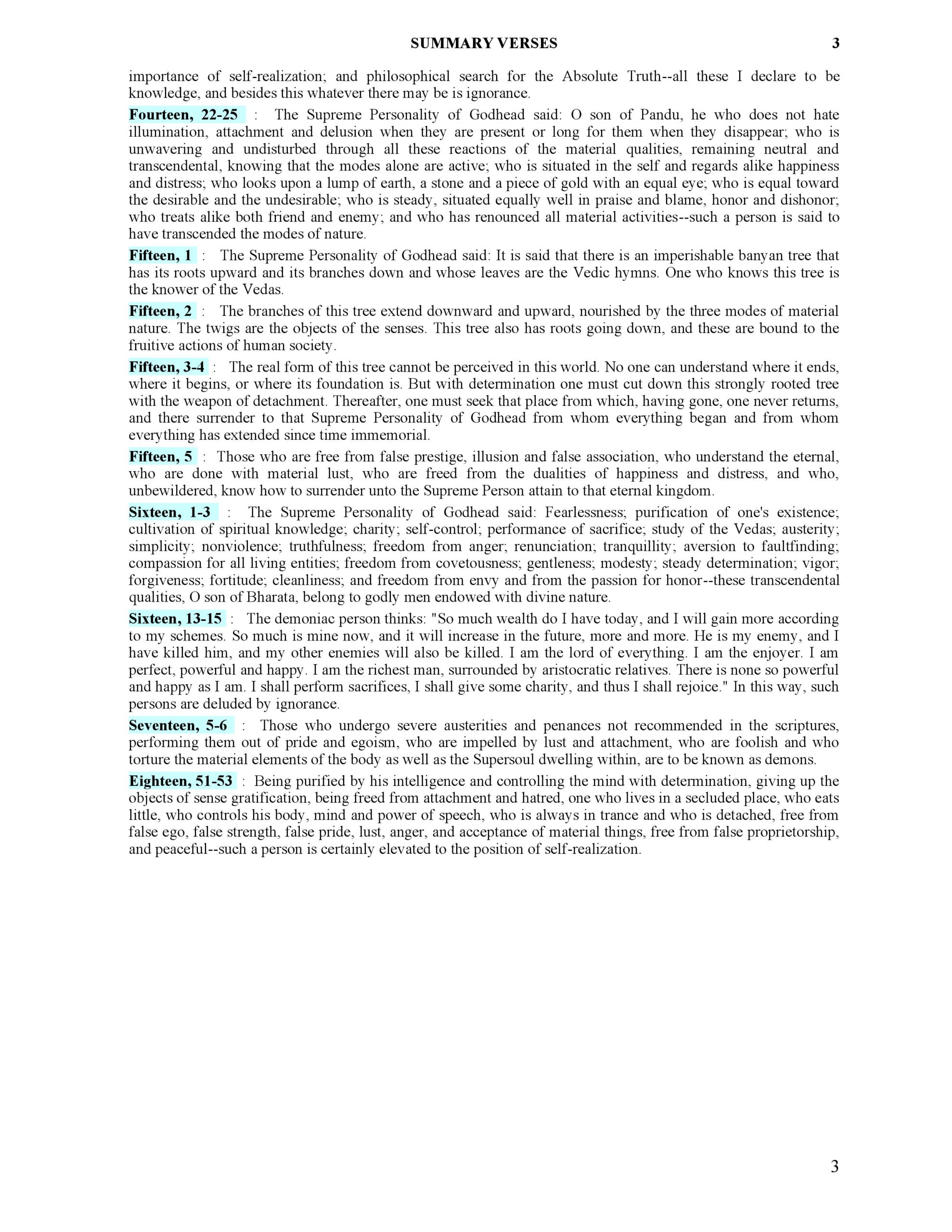
Audios
Srimad Bhagavatam 10.41.07-23
Srimad Bhagavatam 10.70.38-39
Srimad Bhagavatam 10.75.34-40
Srimad Bhagavatam 10.83.27-39